Haiku Review: Business Model Generation
Love it, loads of useful tools
Hipster mba
Good case studies not whole pic
Aggregated enterprise architecture wisdom
Love it, loads of useful tools
Hipster mba
Good case studies not whole pic
It still surprises me to see various discussions of business architecture where there is a poor understanding of the relationship between business models and business capabilities. The vast majority of discussions of business architecture, including books, articles, and blogs, make very little mention of business models, and nearly never discuss their relationship with business capabilities, organizations, stakeholders or resources.
To me, the concept of a business model is fundamental to using business capabilities. I cannot imagine attempting to understand a commercial organization without understanding the business models of that organization as a first step.
In this post, I will discuss the reasons why business architects must consider business models. I’ll start with some definitions to minimize confusion, given the fact that everyone has different definitions of these concepts. I’ll then discuss the concerns that I have about the lack of integration of core concepts. In a future post, I will discuss the various information models for including business models into business architecture as well as needed changes to business architecture methods (including capability analysis) in order to correctly place this role.
Caveat Emptor: The following discussion of business models will focus on commercial systems. If you are examining this space from the standpoint of a non-profit organization or government agency, your needs may not be well represented. My apologies. The reason for this will be immediately apparent when you read the definition of “business model” below.
The Business Architecture Society and the Business Architecture Guild have joined forces and created a common definition of a “business capability.” From the Business Architecture Body of Knowledge Handbook: “A business capability is a particular ability or capacity that a business may possess or exchange to achieve a specific purpose or outcome.” Note that the BIZBOK cites Ulrich Homann as the originator of the definition. For the sake of this discussion, let’s take this definition as a given.
There are many definitions of a business model. Perhaps the most popular definition today comes from Alexander Osterwalder, author of the popular business book “Business Model Generation.” However, his book doesn’t have the same level of discussion of a definition as the Ph.D. thesis that he wrote in which he defines a business model as follows. “A business model is a conceptual tool that contains a set of elements and their relationships and allows expressing a company’s logic of earning money. It is a description of the value a company offers to one or several segments of customers and the architecture of the firm and its network of partners for creating, marketing and delivering this value and relationship capital, in order to generate profitable and sustainable revenue streams.” [Osterwalder, 2004]
Osterwalder carefully notes that a business model is not a representation of the business organization itself. He states, and I concur, that the business organization is the “material form that the conceptual business model takes in the real world”. [Osterwalder, 2004]
I will also take a moment to define business strategy. This time, from Kaplan and Norton: Business strategy is a description of how an organization intends to create value for its shareholders, customers and citizens. Note that this is not the same as a business model. Osterwalder addresses this distinction by illustrating that one can view strategy, business model, and process model as a three-tier hierarchy. The top level, business strategy, describes the conceptual approach to business change. The business model goes into more detail, describing the relationships between various components. The third level, process, illustrates the association of activities to the people and business functions that will perform them. All three are necessary, but all three are different in level of detail and analysis. The following picture is directly from his Ph.D. thesis (click to enlarge for readability).

One of the challenges in bringing together these concepts is the fact that most business architecture references make no mention of business models or describe business models as a “side concern”, and most of the business model literature makes no reference to business capabilities. I attempted to address this gap in the paper where I introduced the Enterprise Business Motivation Model, back in 2008. While the model has dramatically improved since then, the core motivation remains the same: to integrate these two concepts into a single coherent approach to understanding and modeling a business.
Business architecture cares about the organization of a company. It also cares about the resources or tools in a company. Business architecture cares about the processes, and the information. These elements are all brought together in the understanding of a business capability. Business architecture also cares about strategy. However, as Osterwalder notes, connecting strategy to organization or processes without an understanding of the business models is a partial understanding at best.
Let’s be clear about one thing. Business strategy is related to business models. In fact I will go further to say that all effective business strategy applies to one model at a time. Business strategy that applies to more than one model is not strategy. It is either a goal, a principle, or a vision of some kind. A strategy, by definition, has to express “how” the goal will be achieved, and that requires the context of a business in which to achieve it. I know that this may be controversial, but it is CORE to my understanding and the experience I want to share.
So let’s look at the viewpoints of business model proponents and business architects.
There are a number of problems within large organizations that cannot be solved by business architects without a consistent and careful understanding of business models. These problems are tenacious and challenging.
I would like to suggest that three of the key value propositions for business and enterprise architecture lies in addressing these specific challenges. In other words, Business architecture is only effective if it copes with conflicting strategies, inconsistent understanding, and indecisiveness caused by poor prioritization.
Conclusion: Including business models directly into the business architecture practice is critical to quality. Failure to include them is a recipe for disaster.
How can we use Business Model Canvas beyond its initial intended context of commercial startups? In particular, how best can we use it to explore the ‘front-end’ of the business-models – the customer-facing parts – for non-profit organisations and government, and existing commercial businesses…
In the webinar Business Model Innovation for Architects and their Stakeholders we presented the Business Model Canvas as a relevant tool for Architects in many roles. Changing systems and processes alone is no longer enough in the rapidly changing env…
Is Business Model Canvas at risk of becoming another TOGAF – a useful tool for a specific context, yet often more of a hindrance than a help wherever people try to use it beyond its original purpose? And if so,…
How many times have I heard that the real problem with Agile is getting to the start line? There has to be some definition up front, but Agile methods don’t really help. Perhaps it’s a little secret for many organizations that they feel they must do more specification work up front because it makes it easier to control the Sprints. Oh dear!
To get to this starting gate we need to model the agile business in an Agile manner (YES!). Further we do not want to undertake complete or detailed business architecture (NO!!). We don’t have time, and anyway the core of the innovation and architecture should be done in the Agile Delivery project. But before we can fire up Agile projects we need to determine the scope and charter. If we use conventional scoping methods we may well deliver great functionality very quickly, but we probably won’t, unless we are very lucky, have delivered agile business capabilities that map to the business dynamics and can evolve along with the business.
Here’s a technique that may help.
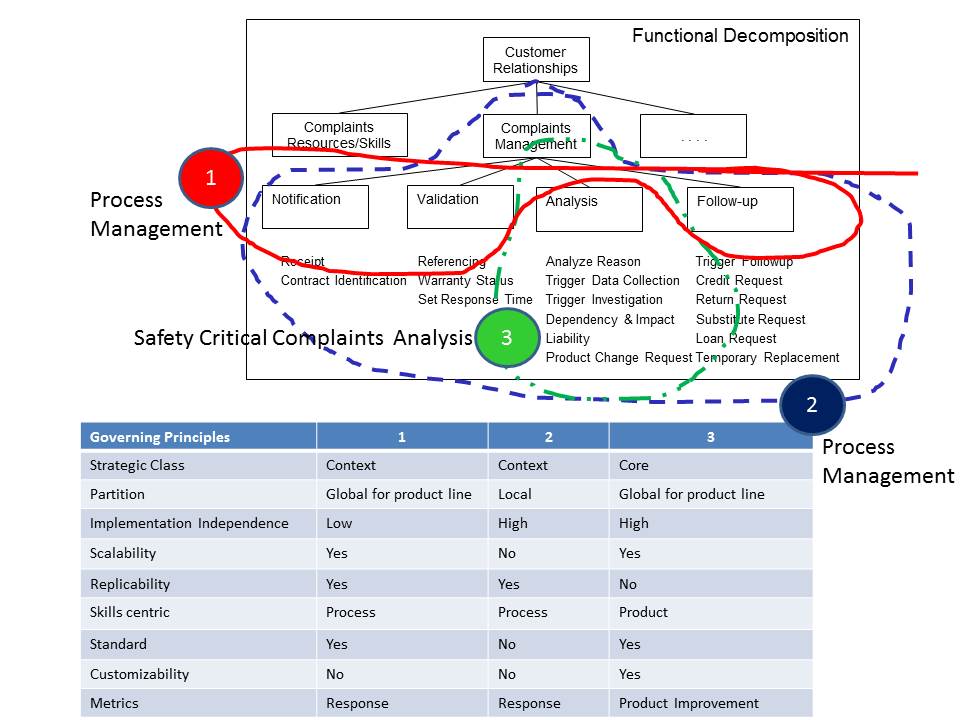
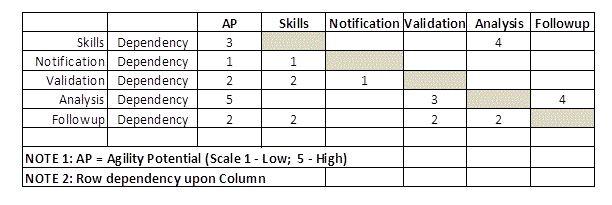
In the first image below I show a functional decomposition for complaints management which I have clustered into “candidate capabilities” labelled 1, 2 and 3, process management, customer relationships and analysis respectively. This usefully shows that capabilities can be varying levels of abstraction; there’s absolutely no necessity to have elegant models! The table below the decomposition shows various criteria I used to help me decide on the possible clusters. As you will see there’s variation in strategic classification; the partitioning – which may be key for deployment, some could be centralized others local; and the need for implementation independence and so on.
How many times have I heard that the real problem with Agile is getting to the start line? There has to be some definition up front, but Agile methods don’t really help. Perhaps it’s a little secret for many organizations that they feel they must do more specification work up front because it makes it easier to control the Sprints. Oh dear!
To get to this starting gate we need to model the agile business in an Agile manner (YES!). Further we do not want to undertake complete or detailed business architecture (NO!!). We don’t have time, and anyway the core of the innovation and architecture should be done in the Agile Delivery project. But before we can fire up Agile projects we need to determine the scope and charter. If we use conventional scoping methods we may well deliver great functionality very quickly, but we probably won’t, unless we are very lucky, have delivered agile business capabilities that map to the business dynamics and can evolve along with the business.
Here’s a technique that may help.
In the first image below I show a functional decomposition for complaints management which I have clustered into “candidate capabilities” labelled 1, 2 and 3, process management, customer relationships and analysis respectively. This usefully shows that capabilities can be varying levels of abstraction; there’s absolutely no necessity to have elegant models! The table below the decomposition shows various criteria I used to help me decide on the possible clusters. As you will see there’s variation in strategic classification; the partitioning – which may be key for deployment, some could be centralized others local; and the need for implementation independence and so on.
This post is number ten in a series of ten about real life experiences of using business model thinking as a foundation for planning and delivering change. Writing this post I’ve had the help of a true friend and admirable colleague (Eva Kammerfors), whom I’ve shared many of the referred to business model experiences with. […]
This post is number nine in a series of ten about real life experiences of using business model thinking as a foundation for planning and delivering change. Writing this post I’ve had the help of a true friend and admirable colleague (Eva Kammerfors) whom I’ve shared many of the referred to business model experiences with. […]
This post is number eight in a series of ten about real life experiences of using business model thinking as a foundation for planning and delivering change. Writing this post I’ve had the help of a true friend and admirable colleague (Eva Kammerfors) whom I’ve shared many of the referred to business model experiences with. […]
This post is the seventh in a series of ten about real life experiences of using business model thinking as a foundation for planning and delivering change. Writing this post I’ve had the help of a true friend and admirable colleague (Eva Kammerfors) whom I’ve shared many of the referred to business model experiences with. […]
As Enterprise Architects we drive to maximize value in our companies. With most EA teams residing within an IT area under a CIO we can find ourselves bogged down by the technology weighing down on decisions. The challenge with that…