OpenText Smart Process Applications: In The Age of the Customer BPMS is not enough

We live in “In the Age of the Customer” a time when he world’s leading companies look outward to emphasize a deep understanding of their customers, and what it takes to make their customers successful. They have come to realize that only when their customers are successful, will they be successful. As Sam Walton once […]

Related posts:

  1. OpenText Smart Process Applications: At the Intersection of Social Street and Core Systems Ave Last week, I helped kick off OpenText’s EIM Days in…
  2. Metastorm Positioned in Leaders Quadrant in 2009 BPMS Magic Quadrant Earlier this week, Metastorm announced that it has been positioned…
  3. Forrester Ranks Top Business Process Management Suites Yesterday Metastorm announced that it has been recognized as a…

Related posts brought to you by Yet Another Related Posts Plugin.

OpenText Smart Process Applications: At the Intersection of Social Street and Core Systems Ave

Last week, I helped kick off OpenText’s EIM Days in Washington DC (the first of 22 cities we will visit) with a conversation around OpenText’s Smart Process Applications. Smart Process Applications are near and dear to our heart at OpenText as they encompass not just BPM and DCM technologies, but bring our integrated EIM portfolio (e.g., […]

Related posts:

  1. Countdown: 31 Days Until the OpenText BPM User Summit! Let the countdown begin! There are only thirty-one more days…
  2. Social Enterprise Platforms – Meet Dynamic Case Management Social platforms, like Facebook, Twitter, and others are gaining traction…
  3. From Social Stigma to Social Synergy It is remarkable how quickly social technologies have become the…

Related posts brought to you by Yet Another Related Posts Plugin.

Shared Vocabulary for Business Innovation and Modernization

Do you remember when computers were hard to use? In fact it’s just nine years since a GM press release asserted that if they developed technology like Microsoft, we would all be driving cars that for no reason at all, would crash twice a day, shut down and refuse to restart. Since then Apple has showed Microsoft the way, and we all use smart phones, tablets and PCs that are genuinely easy to use and remarkably resilient.

Because of this great leap forward in personal device usability the smart phone user on the proverbial Clapham Omnibus might reasonably expect that enterprise systems should be similarly easy to use and resilient. Unless of course she was a customer of the Royal Bank of Scotland (RBS), in which case she will have painful memories of last year’s high profile failure caused by the core banking system crash which corrupted tens of millions of accounts.

Once upon a time banks in general were regarded as leaders in the use of information technology. Yet last year several high profile systems failures signalled that banking systems, far from being leading edge, are in rapid decline. Banks aren’t the only culprits. Along with the banks, insurance companies, retailers and others are starting to offer their customers smart phone apps, notwithstanding that behind the scenes their enterprise systems are frequently held together with sticky tape and sealing wax.

The reason many enterprise systems are in such a poor state is commonly because there are three parties involved in managing the enterprise systems that have widely divergent goals and objectives. The line-of-business manager typically views the systems as support to the business process and a cost to be managed. The IT Architect views the enterprise systems as a set of capabilities that must be progressively modernized to support business innovation. The IT Project Manager is focused on delivering projects to time and cost.

These views are of course diametrically opposed. And under cost and time pressure the Architect is frequently the lower ranking player. In consequence the immediate needs of the business overrule longer term objectives of modernization, reduced complexity, flexibility and even cost of ownership.

The real issue is that the three parties do not have a shared view of the business problem. The line-of-business manager’s business process view does not correlate at all to the delivery project. The Architect should be the evangelist for business innovation and modernization but he or she is too easily squeezed in the cost and time discussion. And the Project Manager typically does not share the detailed technical project view with the line of business manager, and argues for a solution specific architecture that reduces project risk. The result is the existing enterprise systems get more complex and slower to respond to change. And the IT industry has been doing exactly this for as long as anyone can remember!

It’s extraordinary, but with all our high tech knowledge and skills we don’t have a vocabulary to articulate the business problem in a way that allows effective communications between the participants. Many IT organizations have embraced services as a way to organize systems capabilities more effectively. These might be Web Services or APIs or referred to collectively as Service Oriented Architecture (SOA). But, even if these software services are architected to align with business perspective, they are always managed as a technical matter, defined and managed by the IT organization.

Yet line-of-business managers do understand services as a business concept; virtually every business product today has a service component to it. The global service provider industry has formed around this idea, and in the UK today service industries account for 77 per cent of the economy. So while IT and business share the common underlying concept, at the practical level there is no meeting of minds.

In order to create a better bridge between business and IT we need to work with both the “how” and the “what” the business is, and we can do this by complementing business processes with business services. Business services are a very natural way to talk about “what” the business does today and tomorrow, while business processes focus on the “how”. Because you don’t reinvent an industry by just analyzing business processes, you also need to evolve and innovate with improved and new business services.

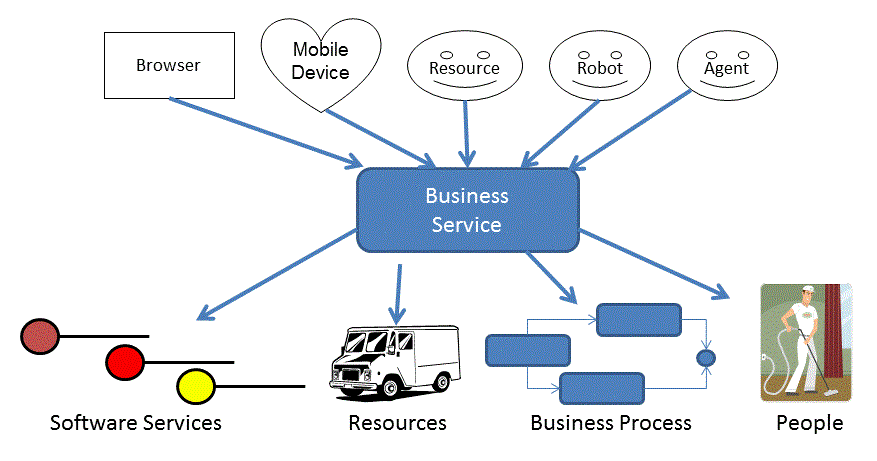
A good example of a service oriented business is Amazon.com Inc. They are well known as a service provider because they have constructed the Amazon enterprise as a set ofbusiness services which are offered to various external parties – enabling suppliers to sell second hand books or electronic goods on the Amazon platform; or providing data storage and Cloud computing services to other enterprises. The Amazon business services combine the compute and the business service integrating the commercial contracts, business processes, people, physical assets as well as the service interfaces that enable computer to computer or computer to device communications.
 

Using a common business and IT concept permits sensible analysis of whether a service is just a unit of cost, or what the strategic value is now and in the future, and what it adds to the business value chain. Given so many line-of-business managers are thoroughly familiar with the very high technology in their smart phones and other devices, it really is time for IT to treat the business as a mature partner and for the line-of-business manager to take real responsibility for the business service as a whole product.

Increasingly we see a convergence of IT and business organizations. The business service concept is an essential piece of vocabulary to focus on a business innovation and get everyone singing off the same hymn sheet to potentially huge advantage of the business. Just look at the Amazon example!

———————–
We will be running a workshop that explores these ideas in London in April in conjunction with the IASA UK Summit. If you can’t make the London event, (for geographic of schedule reasons) talk to me about how we can accommodate.

CfP TEAR 2013

TEAR 2013 – 8th Trends in Enterprise Architecture Research Workshop The TEAR workshop is organized in conjunction with the 17th IEEE International EDOC Conference (EDOC 2013) 9-13 September 2013, Vancouver, BC, Canada *** Deadline for submissions: April 15, 2013 *** Motivation The international TEAR workshop series brings together Enterprise Architecture (EA) researchers from different research […]

Delivering Business Value with Enterprise Architecture Using TOGAF® and ArchiMate®

<p><span style=”color: #505050; font-size: 11px; line-height: 19px;”>The last few years have been tough for many organizations, especially in (the aftermath of) the global economic turmoil. Getting to grips with the complexity of doing business is increasingly important. Many of the problems that organizations struggle with have similar characteristics. Consider for example:</span></p><ul><li>Business transformation has major impact on the organization, from work floor up to (top) management, ranging from process, organization structure, data, and IT infrastructure</li><li>Various solution alternatives for business- and IT problems are available and viable. Which alternatives will we pursue?</li><li>Business Units have concerns that do not always align. Both for change projects and for business as usual we see BU’s competing to meet their own targets rather than keeping an eye on common goals</li><li>Etc.</li></ul><p>In these cases it pays off to use Enterprise Architecture methods! On<strong> 21-February-2013</strong> I will present a <a title=”Register if you would like to attent” href=”https://opengroupevents.webex.com/ec0606l/eventcenter/enroll/join.do?confViewID=1003476223&amp;theAction=detail&amp;confId=1003476223&amp;path=program_detail&amp;siteurl=opengroupevents”><strong>webinar </strong></a>in which I will show how <a title=”Specification TOGAF” href=”https://opengroupevents.webex.com/ec0606l/eventcenter/enroll/join.do?confViewID=1003476223&amp;theAction=detail&amp;confId=1003476223&amp;path=program_detail&amp;siteurl=opengroupevents”>TOGAF </a>and <a title=”Specification ArchiMate” href=”https://opengroupevents.webex.com/ec0606l/eventcenter/enroll/join.do?confViewID=1003476223&amp;theAction=detail&amp;confId=1003476223&amp;path=program_detail&amp;siteurl=opengroupevents”>ArchiMate </a>add business value. The combination of these open standards provides organizations with a balanced approach to EA with extensive tool support. <a title=”Register if you would like to attent the webinar” href=”https://opengroupevents.webex.com/cmp0307l/webcomponents/widget/detect.do?siteurl=opengroupevents&amp;LID=1&amp;RID=2&amp;TID=11&amp;rnd=3433236763&amp;DT=60&amp;DL=nl&amp;isDetected=true&amp;backUrl=%2Fec0606l%2Feventcenter%2Fenroll%2Fjoin.do%3FconfViewID%3D1003476223%26theAction%3Ddetail%26confId%3D1003476223%26path%3Dprogram_detail%26siteurl%3Dopengroupevents”>Registration details for this webinar</a> can be found in the Open Group website. If you are interested in the slides, you can download them on the right of this page.</p><p> </p><div class=”captionImage left” style=”width: 600px;”><div class=”captionImage left” style=”width: 600px;”><img class=”left” src=”http://www.bizzdesign.com/assets/BlogDocuments-2/_resampled/resizedimage600437-Agenda-Webinar-TOGAF-ArchiMate-Delivering-Business-Value.png” alt=”Webinar delivering business value with TOGAF and ArchiMate” title=”During this webinar we’ll teach you how to add value to your business” width=”600″ height=”437″/><p class=”caption”>Webinar Delivering Business Value with Enterprise Architecture Using TOGAF® and ArchiMate®</p></div></div>

Categories Uncategorized

Changing the Nature of the Conversation

bg outline

By: Bill Cason, CTO, Troux

A key ingredient to achieving Business and IT alignment is the development of a common lexicon that all parties can use to describe and manage change.  This sounds like a fairly simple requirement, but in practice it can often prove to be difficult.  Your enterprise has this problem if you hear comments like these:describe the image

  • “We aren’t all on the same page in describing the business and its needs.”
  • “We have difficultly having fact based conversations about priorities.”

I’m reminded of the quote from “Cool Hand Luke” in which the Captain says to Luke “What we’ve got here is … failure to communicate.”  We do have a failure and if we can’t overcome it then all our efforts are going to be for naught.

Why do we have this problem?   Many times those of us in IT exhibit too much “inside out thinking”.  We speak of services we deliver to the business.  We speak about applications or technologies or architectural domains.  This terminology is ours and it is effective when we speak amongst ourselves, but it is ineffective when we need to communicate to business leaders.  Our customers are not going to change so in this case we are going to have to “go to the mountain” because the mountain is not going to come to us.

So what language do business leaders understand?  At Troux we have found that having a discussion with the business about “portfolios” is much more productive simply because it uses business language.  To that end we find that describing the enterprise as a set of interconnected portfolios greatly facilitates business conversations.  In fact, an “enterprise portfolio management” approach has direct analogies in to classical investment portfolio management.  Investment portfolio Management is defined as “The art and science of making decisions about investment mix and policy, matching investments to objectives, asset allocation for individuals and institutions, and balancing risk against performance.” 1 Likewise, at the end of the day, managing the enterprise is also about making investment decisions to manage risk and improve performance. 

Simply put business stakeholders understand what the business does and what the business does can be described in Business Capabilities.   Don’t confuse business capabilities with business processes, which are a description of “how” things are done.   And don’t think that you are speaking the language of the business when you only speak of organization structure.   Organization structure is important but as we all know it is subject to change fairly often whereas business capabilities remain a fairly stable, albeit abstract, description that establishes a commonly understood business context.  It’s worth noting that Forrester Research speaks of them as “The Rosetta Stone.” 2

Let’s consider an example — in this case we know for a fact that a set of applications need to modernized as they are implemented on obsolete, unsupported technology and have security risks.  One approach would be to propose a project to improve our technology architecture domain that will result in improved business services.  Depending on whether or not our customer understands what we said, that project may or may not easily get approved.  Now consider a different proposal: “Our business capability for customer provisioning is at risk because we have under invested in our technology portfolio.   We propose adding this project to our investment portfolio to reduce risk and improve performance of this key capability.”   This is the same proposal but will very likely yield different results, because we changed the nature of the conversation.

In practice, business capabilities can make the complex simple and enable what we at Troux call “fact based conversations.”  For a discussion of practical applications of business capabilities, attend our upcoming webinar “Speaking the Language Of The Business”.  You can register here.

[1] http://www.investopedia.com/terms/p/portfoliomanagement.asp#axzz2Jacaoaej

[1] “Business Capabilities Provide The Rosetta Stone For Business-IT Alignment”,  July 06, 2009, By Jeff Scott with Alex Cullen, Mimi An

Categories Uncategorized

drEAmtime – Frameworks

It looks like as if I am getting closer in finishing my exploration of the great post from Ivo Velitchkov. So far I have created following posts:

  1. drEAmtime – Communication
  2. drEAmtime – Bridging the Silo
  3. drEAmtime – Capability Cemetery
  4. drEAmtime – EPIC SCAN
  5. drEAmtime – Archetypes
  6. drEAmtime – WISE SCAN
  7. drEAmtime – PACE SCAN

To quote Ivo once more:

If you are an Enterprise Architect, a popular way to deal with complexity is to arm yourself with a framework. With a good framework, it is believed, you can do two things. First, reduce the variety of the enterprise to just a few things that share the same properties, according to some classification theory and where things doesn’t fit, add more layers of abstraction. And second, reduce the things you can possibly do to just a few but well defined and in a specific order, with well prescribed inputs and outputs, because that was common for so many organisations that did well so that it became a best practice, and the chances are, if you follow this way, it will do you well as well. Now, because of the shared understanding of the beneficial role of the abstract layers, and the boundaryless imagination unconstrained by the reality, there is a serious number of frame-works and on top of them other-works on how to adapt and adopt them.

And once more a lot of truth in it. One of the first things I learned while dealing with complexity actually was that it created panic. Even though it seemed to me quite obvious what the answer is and how to explain it by using an enormous amount of framework knowledge (of course shameless stolen from many) in my explanation I kind of did not really deliver the message. So my current working approach is to remind the audience of one simple short statement of wisdom: “Don’t Panic“.
I like to use frameworks, but the amount of frameworks is indeed enormous and heavily increasing (and I add one by bringing my GLUE thinking into the game). Pragmatic EA has an overview about frameworks which I personally find very interesting (GLUE is not in that list, because I did not register it so far and obviously no one else did).

So I do exactly what Ivo says: “Reduce the variety of the enterprise to just a few things that share the same properties” and it actually helps me to understand the complexity and trace broken information flows. So I personally find it very useful, but GLUE is of course at this very moment nothing else than an attempt to materialize my very own thinking where there was absolutely no need for any agreements with others. So it is strong for me, but most likely useless for everyone else. If you are interested in applying my thinking please let me know, I will see if I can somehow help you in understanding and applying my thoughts.

With respect to Ivos other statement: “And second, reduce the things you can possibly do to just a few but well defined and in a specific order, with well prescribed inputs and outputs, because that was common for so many organisations that did well so that it became a best practice, and the chances are, if you follow this way, it will do you well as well.” I have a different approach. I personally believe that GLUE always happens and is inevitable. So I personally don’t focus as a primary task on implementing one (or many if you look at the amount) framework, but instead I primarily look at broken information flows or GLUE diseases.


And those diseases I then try to fix, sometimes by proposing (and implementing) a framework, sometimes by inventing something new, sometimes by just talking to the people. It all depends on the context, but I try to guide the energy in the system in a way that it allows to emerge an solution.. It is of course very interesting (but not always relevant) to get hung up in discussion about frameworks or become really religious in applying some technique in one or the other way, but try to avoid that discussion, even though it is sometimes needed to cultivate collisions and by that look for something new (if lucky innovative).

Categories Uncategorized

drEAmtime – Frameworks

It looks like as if I am getting closer in finishing my exploration of the great post from Ivo Velitchkov. So far I have created following posts:

  1. drEAmtime – Communication
  2. drEAmtime – Bridging the Silo
  3. drEAmtime – Capability Cemetery
  4. drEAmtime – EPIC SCAN
  5. drEAmtime – Archetypes
  6. drEAmtime – WISE SCAN
  7. drEAmtime – PACE SCAN

To quote Ivo once more:

If you are an Enterprise Architect, a popular way to deal with complexity is to arm yourself with a framework. With a good framework, it is believed, you can do two things. First, reduce the variety of the enterprise to just a few things that share the same properties, according to some classification theory and where things doesn’t fit, add more layers of abstraction. And second, reduce the things you can possibly do to just a few but well defined and in a specific order, with well prescribed inputs and outputs, because that was common for so many organisations that did well so that it became a best practice, and the chances are, if you follow this way, it will do you well as well. Now, because of the shared understanding of the beneficial role of the abstract layers, and the boundaryless imagination unconstrained by the reality, there is a serious number of frame-works and on top of them other-works on how to adapt and adopt them.

And once more a lot of truth in it. One of the first things I learned while dealing with complexity actually was that it created panic. Even though it seemed to me quite obvious what the answer is and how to explain it by using an enormous amount of framework knowledge (of course shameless stolen from many) in my explanation I kind of did not really deliver the message. So my current working approach is to remind the audience of one simple short statement of wisdom: “Don’t Panic“.
I like to use frameworks, but the amount of frameworks is indeed enormous and heavily increasing (and I add one by bringing my GLUE thinking into the game). Pragmatic EA has an overview about frameworks which I personally find very interesting (GLUE is not in that list, because I did not register it so far and obviously no one else did).

So I do exactly what Ivo says: “Reduce the variety of the enterprise to just a few things that share the same properties” and it actually helps me to understand the complexity and trace broken information flows. So I personally find it very useful, but GLUE is of course at this very moment nothing else than an attempt to materialize my very own thinking where there was absolutely no need for any agreements with others. So it is strong for me, but most likely useless for everyone else. If you are interested in applying my thinking please let me know, I will see if I can somehow help you in understanding and applying my thoughts.

With respect to Ivos other statement: “And second, reduce the things you can possibly do to just a few but well defined and in a specific order, with well prescribed inputs and outputs, because that was common for so many organisations that did well so that it became a best practice, and the chances are, if you follow this way, it will do you well as well.” I have a different approach. I personally believe that GLUE always happens and is inevitable. So I personally don’t focus as a primary task on implementing one (or many if you look at the amount) framework, but instead I primarily look at broken information flows or GLUE diseases.


And those diseases I then try to fix, sometimes by proposing (and implementing) a framework, sometimes by inventing something new, sometimes by just talking to the people. It all depends on the context, but I try to guide the energy in the system in a way that it allows to emerge an solution.. It is of course very interesting (but not always relevant) to get hung up in discussion about frameworks or become really religious in applying some technique in one or the other way, but try to avoid that discussion, even though it is sometimes needed to cultivate collisions and by that look for something new (if lucky innovative).

Webcast: Enterprise Architect Soft Skills Series

Sharon Evans shared a new webcast series called, "Enterprise Architecture soft skills". I thought I would share with all of you as it looks like it could be a good resource for EA’s looking to strengthen their soft skills. Below…

Categories Uncategorized

★ D2a5839c8e4de, Bob left a message for you

Bob left a message for you See this email in English, Deutsch, Français, Italiano, Español, Português or 35 other languages. Bob left a message for you Only you can see the sender and content of your message, and you can…

Categories Uncategorized