
How to use the Gartner® Magic Quadrant™ for Enterprise Architecture Tools
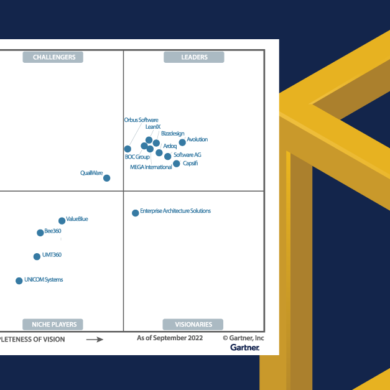 We’re honored to be positioned as a Leader in the 2022 Gartner® Magic Quadrant™ for Enterprise Architecture Tools for the 7th consecutive time. We’re positioned in the Leaders Quadrant based on our completeness of vision and ability to execute. What it means to be positioned in the Gartner® Magic Quadrant™ A Magic Quadrant is a tool that…
 Summary of our blog series on Capability-based Planning Our ongoing blog series on capability-based planning has covered a lot of ground. We started by explaining the basic concepts and the value of capabilities, addressed the design of capability maps, how to relate capabilities with your strategy and operating model, explored capability assessment and roadmapping, discussed…
 Enterprise Architecture Management is a term that’s widely thrown around in our industry. Some vendors even classify their software as an ‘enterprise architecture management tool’. An agile enterprise architecture management capability in an organization isn’t just based on using a limited tool to execute as-is architecture and do Technology Risk Management and Application Portfolio Management…
 In our blog series on Capability-based Planning, we’ve aimed to empower you with enough knowledge to implement Capabilities and Capability-based Planning in your organization. We’ve looked at the concept ‘capability’ and its use in decision-making and planning, how to design Capability Maps and how Capability-based Planning relates to other disciplines. Although you may now be…
 The previous article in this blog series covered how a Capability-Based Planning approach informs the Strategic Roadmap. We covered the Plan and Assess phases of Capability-Based Planning. In this blog, we’ll link the Plan and Assess phases to the Control phase of this process. To measure the effectiveness of change investments, you need a way…
 To implement change in large and complex organizations, you need to know how the organization functions. “Are you sure that if you remove a service on one side of the organization, you won’t stop a customer process elsewhere?” asks Peter Matthijssen of Bizzdesign. You need a roadmap called enterprise architecture. “This is an essential tool…
 Organizations need to have the ability to adapt to change continuously. The office of the CIO is typically tasked to execute transformational change initiatives, which is often complex because today’s large organizations have thousands of employees, processes and IT systems. An essential driver for the CIO to execute change is for the enterprise to move…
 Bizzdesign’s approach to Capability Governance is similar to BIZBOK’s but more pragmatic. Most importantly, it takes into account that many business architecture initiatives start from the IT organization as well as from a lower level of maturity. We often see that the core of a capability mapping team comes from some architecture department or team…
 Our blog series on Capability-based Planning focused on the why, what, and how of this subject matter. We’ve discussed the meaning and value of the concept ‘capability’, its use in decision-making and planning, the design of Capability Maps, and how to model capabilities and other business architecture concepts in coherence, among other subjects. This blog…
 Business processes are at work in our everyday lives when we order products from the Internet, buy goods from a store, or check into a hotel. The list goes on. There are many definitions of Business Process Management (BPM) on the Internet, and this discipline essentially focuses on delivering the organization’s products and services to…
 Machine Learning (ML) is a subfield of artificial intelligence aiming to teach computers to think the same way humans do. Data is used to train an algorithm that identifies and discovers patterns and makes predictions for new cases. Using ML is not uncommon. Examples include financial institutions using ML to detect potential cases of fraud….
 A topic attracting increasing attention from architects and executives alike is: How to use Capabilities to inform strategic planning. The previous blog articles in our series on Business Capability Design and Management focused on “How to assess Business Capabilities” and “How to Measure Business Capability Aspects”. These articles describe the overall four-stage Capability-based planning process…