Top Technology Trends and CIO Priorities for 2013

I have been regularly writing about emerging Information Technology trends on this blog. The CIO priorities for future are often linked to these trends but they also do influence the Information Technology trends in return. Gartner who is at the forefront of research in this space has recently released their research report outlining their top 10 strategic technology trends for 2013. The complete report can be accessed here but a brief summary of this research along with my own summary comments are as follows:
  1. Mobile Devices Battles – Windows 8 is here. Is your organisation going to deploy it? If yes, what will be the impact on your BYOD policy. Windows 8 tablets and smartphones will gain in prominence. What does this mean for your iOS and Android support model?
  2. Mobile Apps and HTML 5 –  Mobile app and web technologies are fast maturing and are influencing native application development too. How will you manage the hybrid web / native development frameworks?
  3. Personal Cloud – Online applications and services are transforming consumer technology. How will this effect your organisation? Windows 8 with Skydrive is an example of this trend.
  4. The Internet of Things – Becoming more mainstream now. What innovative business models will you create in next three years to benefit from IoT?
  5. Hybrid IT and Cloud Computing – As Cloud Computing evolves and matures new business and operating models are emerging. IT departments of large oranisations will be expected to act as service brokers in such hybrid models.
  6. Strategic Bid Data – Big Data has become a major driver of IT spending recently but going forward the trend will be to integrate this better with Data warehouses and Data Integration Infrastructure
  7. Actionable Analytics – Business needs real-time decision making and forward looking analytics. How can you embed this in real time applications?  
  8. Mainstream In-Memory Computing – How will In-Memory Computing disrupt the application architectures and how will your manage the operating and data governance requirements?  
  9. Integrated Platforms and Ecosystems – How do you balance vendor lock-in with benefits of integrated platforms?
  10. Enterprise APP Stores – The success of consumer App stores will drive organisation’s own enterprise App stores but this needs to balanced with security and support concerns.
Deloitte has been a recent welcome entrant in the Technology Trend publishing business with it releasing its fourth annual technology trend report recently. The folks at Deloitte have taken an interesting approach to this as they have grouped trends in two classifications or categories:  “Disruptors” are opportunities that can create sustainable positive disruption in IT capabilities, business operations, and sometimes even business models. “Enablers” are technologies in which many CIOs have already invested time and effort, but which warrant another look because of new developments or opportunities. Deloitte lists trends such as Influence of Mobility, Social, Analytics, Cloud as Disruptors while listing as Gamification, Refocussing on ERP and Security focus as Enablers. 

In one of my previous blog posts I had written about five forces shaping the CIO agenda. Very briefly, they were listed as, Business Services, Application Services, Cloud Computing, Consumerisation of Technology and Business Analytics. If above published 2013 trend research is taken into account then I would like to redefine them as follows:

  1. Evolution of Cloud Computing – Private, Public, Hybrid, Community, Personal
  2. Consumerisation of Technology – Windows 8, Tablet, Smart phone adaption
  3. Mainstream nature of Data Analytics – Big Data coming to Data Warehousing 
  4. Proliferation of Web APPs – Enterprise APP stores on the line of Mobile APP Stores
  5. Increasing Integration of Platforms – e.g. Rise of Appliances such as EXADATA
I think that the business and application services are slowly merging into the APP Store philosophy while the business analytics has gone mainstream since 2011. Cloud and increasing integration of platforms is a trend which has matured since past few years and is probably going to get through further rounds of evolution in coming years. It is interesting that no one is yet talking about explicit influence of Social as much as any of above trends. 
A Comparison of the Top Four Enterprise-Architecture Methodologies

I recently came across a very good article with above title written by Roger Sessions on the Microsoft Network. It is
one of the few articles which is backed up by good amount of industry research,
rich usage of references and very precise analysis of Enterprise Architecture
literature.


In this article Roger compares following four leading
Enterprise Architecture Frameworks;

  1. The Zachman Framework for Enterprise
    Architecture
  2. The Open Group Architecture Framework
  3. Federal Enterprise Architecture
  4. Gartner Enterprise Architecture Framework
He does so within the context of a fictional company that is facing
some very nonfictional operations problems. These problems include:
  1. IT
    systems that have become unmanageably complex and increasingly costly to
    maintain.
  2. IT
    systems that are hindering the organization’s ability to respond to
    current, and future, market conditions in a timely and cost-effective
    manner.
  3. Mission-critical
    information that is consistently out-of-date and/or just plain wrong.
  4. A
    culture of distrust between the business and technology sides of the
    organization.
Roger concludes that, “these methodologies are quite different
from each other, both in goals and in approach. This is good news and bad. It
is bad news, in that it increases the difficulty for many organizations in
choosing one single enterprise-architectural methodology. How do you choose
between methodologies that have so little in common? Choosing between Zachman
and TOGAF, for example, is like choosing between spinach and hammers. But the
good news is that these methodologies can be seen as complementing each other.
For many organizations, the best choice is all of these methodologies, blended
together in a way that works well within that organization’s constraints.”

Though the whitepaper is probably
getting a bit dated (Mar 2007) especially given the new releases from TOGAF 9.1
and Zachman have advanced the EA field in leaps and bounds, it is nonetheless a
very good piece of academic comparison grounded in some real life business
situation.

I have personally done similar compare
and contrast analysis between various EA frameworks on this blog through posts
such as, EA
Frameworks in Complete Harmony
, Zachman
Complexity and Change
, EA
– Different Perspectives
. These can be referenced as further reading on
this topic.  

Categories Uncategorized

Enterprise Architecture – A Perfect Tool for Operating Model Management

On this blog I have covered the discipline of Enterprise Architecture from a number of perspectives. Enterprise Architecture (EA) can be effectively leveraged as a foundation for Industry Reference Architectures e.g. The Retail Reference Architecture. Equally effectively EA can also be leveraged as the mechanism for Business and Technology Governance as well as Technology Performance Monitoring. In this article I would like to propose that Enterprise Architecture is also an effective tool for the Operating Model management, both for the definition as well as the ongoing lifecycle management. 
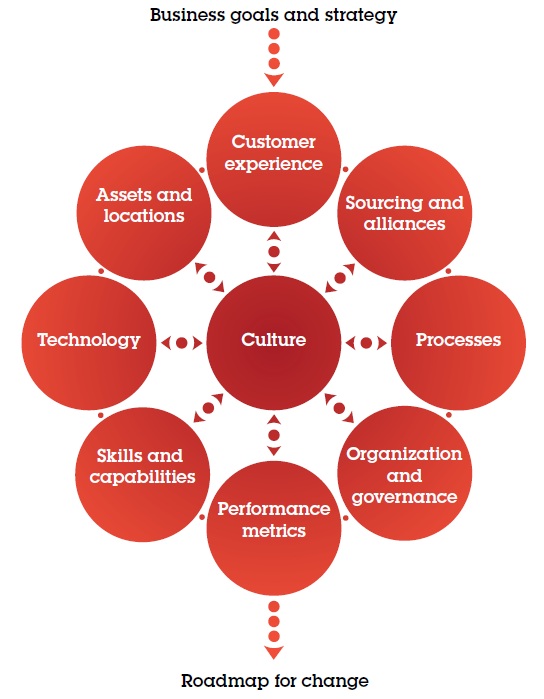
It may be worthwhile visiting some industry definitions for Operating Model before we explore how Enterprise Architecture can be effective here. The definition of Operating Model varies based on the Organisational and Operational context in which it is applied and hence probably one definition may not fit all Operating Model scenarios. However if I had to choose one definition, I would like to refer to the IBM’s definition of the Operating Model (see the picture below)
IBM Target Operating Model (TOM)

IBM proposes that a Target Operating Model (TOM) helps determine the best design and deployment of resources to achieve an organization’s business goals. It provides current operational maturity assessment and roadmap to defining and/or improving organisation’s Operations Strategy. Key deliverable include business review, current operating model assessment, desired future state and change management plan roadmap.
The TOM essentially is seen here as the mechanism to link the business goals and strategy of the organisation with the roadmap for change to achieve those goals. TOM then holds together various organisation concerns such as processes, technology, capabilities, customer view, governance and partners in a single cohesive fashion.
 
Now that we have briefly summarised an illustrative Operating Model definition, let us explore how Enterprise Architecture as a discipline or practice can be leveraged as a tool for its management. There are a number of good Enterprise Architecture Frameworks available for this purpose and recent revisions of certain frameworks have further established them as leading candidates for this purpose. I do not advocate or support a specific Enterprise Architecture Framework on this blog however for illustration purposes I am going to be using the TOGAF 9 as the tool for Operating Model Management. I would like to also mention the Zachman EA framework as the other leading framework which may be equally effective or in some application scenarios it may be a better fit. 
The purpose of this article is not to explain or define the TOGAF 9 and I would highly recommend visiting the OpenGroup website for relevant documentation. However for the ease of reference, I am going to share the TOGAF ADM which is the process for Enterprise Architecture Management in TOGAF. 
The process links the Vision and Strategy of the Organisation and its business / functions with a portfolio of change programs which realises this Strategy. TOGAF uses various architecture disciplines such as Business Architecture, Information Architecture (Data and Application) and Technology Architecture as mechanism for linking the Strategy with Implementation and Governance of Change programs to deliver on the Strategy. 
The central argument which I am now going to make is that such a process of Enterprise Architecture can be seamlessly deployed and leveraged to manage the Organisation Operating Model. A number of Enterprise Architecture Frameworks and especially Zachman categorically state that the application of Enterprise Architecture should not be restricted or limited to the Information Technology systems. It is a true framework for organisation and business management. For instance applying the TOGAF to manage the IBM TOM will result in following steps / mapping. The key here is to use tools, processes, approach, templates and constructs from each of the TOGAF ADM stage to define and develop the TOM stages as seen in figure – 1. 
  1. The business goals and strategy can be defined by the Preliminary phase while the vision underpinning this is defined in Phase A. Architecture Vision
  2. The Assets and the Locations of the TOM along with key processes can be captured and defined during the Phase B. Business Architecture
  3. Certain aspects of skills, capabilities, culture and processes too can be captured in Phase B
  4. The Technology, Processes, Performance Metrics can be captured through phases C and D while defining the Information and the Technology Architecture.
  5. The sourcing options and alliances can be identified and shortlisted in phase E. Opportunities and Solutions
  6. The phase F of migration planning can be used to identify the roadmap for change through what TOGAF calls as transition architectures
  7. Finally culture which is central to TOM needs to be constantly be a driving force as well as the recipient for the requirements for change
I would like to again highlight that this is simply an illustration of managing a view of Operating Model with a particular EA approach. However a number of other variations can be equally effectively managed by similar approach. It will probably make sense to present an illustration and mapping using other EA framework such as Zachman…may be a topic for next post on this blog!

References:

Strategy and transformation for a complex world, IBM Global Services, Mar 2011

The TOGAF Architecture Development Method (ADM)

The Zachman Framework

Enterprise Architecture – A Perfect Tool for Operating Model Management

On this blog I have covered the discipline of Enterprise Architecture from a number of perspectives. Enterprise Architecture (EA) can be effectively leveraged as a foundation for Industry Reference Architectures e.g. The Retail Reference Architecture. Equally effectively EA can also be leveraged as the mechanism for Business and Technology Governance as well as Technology Performance Monitoring. In this article I would like to propose that Enterprise Architecture is also an effective tool for the Operating Model management, both for the definition as well as the ongoing lifecycle management. 

It may be worthwhile visiting some industry definitions for Operating Model before we explore how Enterprise Architecture can be effective here. The definition of Operating Model varies based on the Organisational and Operational context in which it is applied and hence probably one definition may not fit all Operating Model scenarios. However if I had to choose one definition, I would like to refer to the IBM’s definition of the Operating Model (see the picture below)
IBM Target Operating Model (TOM)

IBM proposes that a Target Operating Model (TOM) helps determine the best design and deployment of resources to achieve an organization’s business goals. It provides current operational maturity assessment and roadmap to defining and/or improving organisation’s Operations Strategy. Key deliverable include business review, current operating model assessment, desired future state and change management plan roadmap.
The TOM essentially is seen here as the mechanism to link the business goals and strategy of the organisation with the roadmap for change to achieve those goals. TOM then holds together various organisation concerns such as processes, technology, capabilities, customer view, governance and partners in a single cohesive fashion.
 
Now that we have briefly summarised an illustrative Operating Model definition, let us explore how Enterprise Architecture as a discipline or practice can be leveraged as a tool for its management. There are a number of good Enterprise Architecture Frameworks available for this purpose and recent revisions of certain frameworks have further established them as leading candidates for this purpose. I do not advocate or support a specific Enterprise Architecture Framework on this blog however for illustration purposes I am going to be using the TOGAF 9 as the tool for Operating Model Management. I would like to also mention the Zachman EA framework as the other leading framework which may be equally effective or in some application scenarios it may be a better fit. 


The purpose of this article is not to explain or define the TOGAF 9 and I would highly recommend visiting the OpenGroup website for relevant documentation. However for the ease of reference, I am going to share the TOGAF ADM which is the process for Enterprise Architecture Management in TOGAF. 
The process links the Vision and Strategy of the Organisation and its business / functions with a portfolio of change programs which realises this Strategy. TOGAF uses various architecture disciplines such as Business Architecture, Information Architecture (Data and Application) and Technology Architecture as mechanism for linking the Strategy with Implementation and Governance of Change programs to deliver on the Strategy. 
The central argument which I am now going to make is that such a process of Enterprise Architecture can be seamlessly deployed and leveraged to manage the Organisation Operating Model. A number of Enterprise Architecture Frameworks and especially Zachman categorically state that the application of Enterprise Architecture should not be restricted or limited to the Information Technology systems. It is a true framework for organisation and business management. For instance applying the TOGAF to manage the IBM TOM will result in following steps / mapping. The key here is to use tools, processes, approach, templates and constructs from each of the TOGAF ADM stage to define and develop the TOM stages as seen in figure – 1. 
  1. The business goals and strategy can be defined by the Preliminary phase while the vision underpinning this is defined in Phase A. Architecture Vision
  2. The Assets and the Locations of the TOM along with key processes can be captured and defined during the Phase B. Business Architecture
  3. Certain aspects of skills, capabilities, culture and processes too can be captured in Phase B
  4. The Technology, Processes, Performance Metrics can be captured through phases C and D while defining the Information and the Technology Architecture.
  5. The sourcing options and alliances can be identified and shortlisted in phase E. Opportunities and Solutions
  6. The phase F of migration planning can be used to identify the roadmap for change through what TOGAF calls as transition architectures
  7. Finally culture which is central to TOM needs to be constantly be a driving force as well as the recipient for the requirements for change
I would like to again highlight that this is simply an illustration of managing a view of Operating Model with a particular EA approach. However a number of other variations can be equally effectively managed by similar approach. It will probably make sense to present an illustration and mapping using other EA framework such as Zachman…may be a topic for next post on this blog!

References:

Strategy and transformation for a complex world, IBM Global Services, Mar 2011

The TOGAF Architecture Development Method (ADM)

The Zachman Framework

Telefónica squares up to Amazon

Telefónica squares up to Amazon with Instant Servers global IaaS offering http://gigaom.com/europe/telefonica-squares-up-to-amazon-with-instant-servers-global-iaas-offering/

Categories Uncategorized