The Zachman Framework – The Perfect Tool for Operating Model Management

I have written previously on this blog about leveraging Enterprise Architecture as a methodology for the Operating Model creation and management. In this blog post I will briefly outline mechanism and benefits of using industry leading Zachma…

The Zachman Framework – The Perfect Tool for Operating Model Management

I have written previously on this blog about leveraging Enterprise Architecture as a methodology for the Operating Model creation and management. In this blog post I will briefly outline mechanism and benefits of using industry leading Zachma…

Transformation Business Model in Minutes?

For the past few months I have been busy helping Retail, Financial Services and Public Sector on their Digital, Multi-Channel and E-Commerce Transformation programs. Very early on in such transformation challenge, defining the business case for change …

Business Architecture & Enterprise Architecture – Match Made in Heaven

I recently spoke at the European BPM and EA Conference in London on this topic. This blog post is a summary version of my session.

Often Business Process Management and associated discipline such as Business Architecture is seen or managed in isolation of the overarching Enterprise Architecture construct. However the Business Architecture and Enterprise Architecture complement each other well to get the best value from each other. I think that the Business Architecture is one of the key enablers of the Enterprise Architecture and makes it real. While the Enterprise Architecture offers much needed context for the Business Architecture.

It might be useful to briefly review the definitions of both Business Architecture and Enterprise Architecture before understanding issues in their relationship. 

As I have been writing on this blog, Enterprise Architecture should not be limited to the IT or Technology concerns of an organisation. Rather it should be focused on addressing much broader scope covering the business, functional, operational, financial and people aspects of the enterprise. 

There are a number of Enterprise Architecture definitions out there. A couple of my favorite ones are as follows:


Enterprise Architecture provides a strategic planning framework that relates and aligns information technology with the business functions that it supports.


Or


Practice of enterprise architecture involves developing a framework to describe a series of “current”, “intermediate” and “target” reference architectures and applying them to align change within the enterprise. Another set of terms for these are “as-is”, “to-be” and the “migration plan”.


The Business Architecture Special Interest Group of Object Management Group (OMG) defines Business Architecture as follows:

“A Blueprint of the Enterprise That Provides A Common Understanding Of The Organization And Is Used To Align Strategic Objectives And Tactical Demands.”


“Business Architecture describes the product and/or service strategy, and the organizational, functional, process, information, and geographic aspects of the business environment”

I think that though the practice of both Business Architecture and Enterprise Architecture has matured over the past few years, there certainly are some issues when it comes to these two working well together. I have summarised them in four broad arguments;

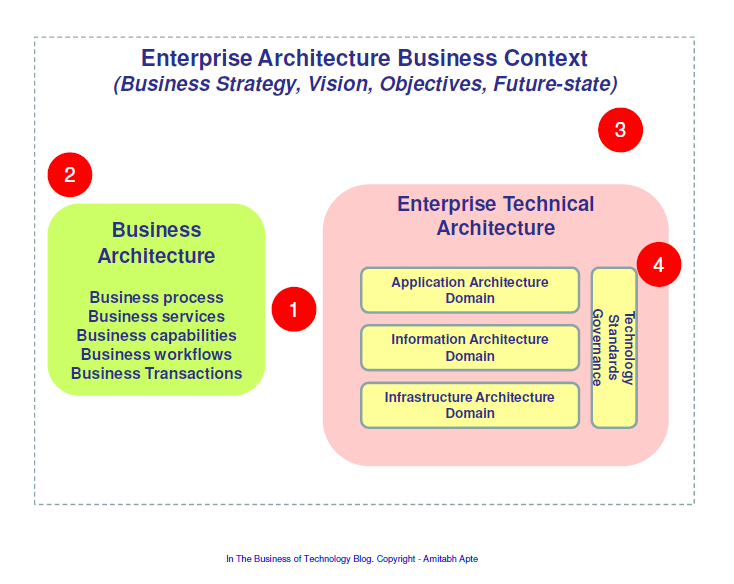
  1. Business Architecture not done at all. Enterprise Architecture teams only perform Enterprise Technical Architecture only.
  2. Business Architecture done in isolation of Enterprise Technical Architecture and then (if lucky) artificially superimposed
  3. Business Architecture and Business Context Confusion: confusion between why, what and how
  4. Technology focused governance: only conversations about technical standards, business governance disconnected from IT investment and decisions leading to critical gaps
I have tried to capture this pictorially below:
BA & EA in Isolation

This issue is getting wider acknowledgment given its strategic importance. I particularly like Randy Heffner’s work in this space. He states in one of his blogs;

“Simply positioning business architecture as a layer on top of existing EA domains is a mistake. Traditionally many organisations have pursued EA as Enterprise Technical Architecture (ETA). ETA is technology-centred.  Business architecture is business-centred. Simply layering it on top of ETA will result in tech-centred silo implementation.”


As Business Architecture Special Interest Group of Object Management Group(OMG) states, the Business Architecture defines the structure of the enterprise in terms of its governance structure, business processes, and business information. In defining the structure of the enterprise, business architecture considers customers, finances, and the market to align strategic goals and objectives with decisions regarding products and services; partners and suppliers; organization; capabilities; and key initiatives. Business Architecture primarily should focus on the business motivations, business operations and business analysis frameworks and related networks that link these aspects of the enterprise together and it should be seamlessly integrated with Enterprise Architecture efforts within the organisation. 

In my experience to tackle above listed issues, following measures can be taken by the Architecture team;

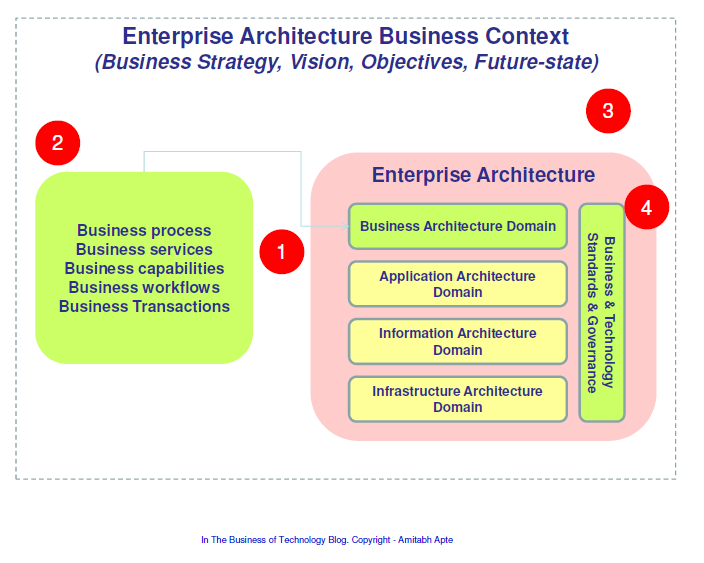
  1. Business Architecture as part of Enterprise Architecture
  2. Business Architecture drives Enterprise Architecture domains
  3. Business Architecture and Business Context clarified and integrate
  4. Business aligned Technology governance


My pictorial representation from earlier changes as below now:
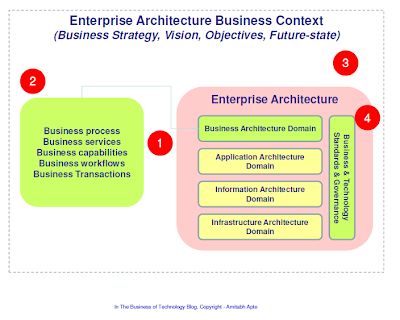

BA & EA in Collaboration

Modern Enterprise Architecture teams and Enterprise Architects can not longer afford to ignore the implications of Business Architecture. Likewise, modern business architects can no longer afford to work in isolation of organisation’s enterprise architecture. 

In conclusion of this article I would like to summarize my thoughts as follows:

  1. Enterprise Architecture in isolation of Business Architecture is simply Enterprise Technical Architecture
  2. Business Architecture should guide the development of Enterprise Architecture domains
  3. Business Architecture combined with Enterprise Architecture is a powerful tool for business-IT alignment
  4. Strategic Frameworks and Models help in achieving this alignment

And as Chris Potts would argue, the Chief Executive of an Organisation should be ultimately accountable for ensuring the two come together as we would expect him or her to be the Chief Enterprise Architect of the Enterprise!

For related articles:

Business Architecture & Enterprise Architecture – Match Made in Heaven

I recently spoke at the European BPM and EA Conference in London on this topic. This blog post is a summary version of my session.

Often Business Process Management and associated discipline such as Business Architecture is seen or managed in isolation of the overarching Enterprise Architecture construct. However the Business Architecture and Enterprise Architecture complement each other well to get the best value from each other. I think that the Business Architecture is one of the key enablers of the Enterprise Architecture and makes it real. While the Enterprise Architecture offers much needed context for the Business Architecture.

It might be useful to briefly review the definitions of both Business Architecture and Enterprise Architecture before understanding issues in their relationship. 

As I have been writing on this blog, Enterprise Architecture should not be limited to the IT or Technology concerns of an organisation. Rather it should be focused on addressing much broader scope covering the business, functional, operational, financial and people aspects of the enterprise. 

There are a number of Enterprise Architecture definitions out there. A couple of my favorite ones are as follows:


Enterprise Architecture provides a strategic planning framework that relates and aligns information technology with the business functions that it supports.


Or


Practice of enterprise architecture involves developing a framework to describe a series of “current”, “intermediate” and “target” reference architectures and applying them to align change within the enterprise. Another set of terms for these are “as-is”, “to-be” and the “migration plan”.


The Business Architecture Special Interest Group of Object Management Group (OMG) defines Business Architecture as follows:

“A Blueprint of the Enterprise That Provides A Common Understanding Of The Organization And Is Used To Align Strategic Objectives And Tactical Demands.”


“Business Architecture describes the product and/or service strategy, and the organizational, functional, process, information, and geographic aspects of the business environment”

I think that though the practice of both Business Architecture and Enterprise Architecture has matured over the past few years, there certainly are some issues when it comes to these two working well together. I have summarised them in four broad arguments;

  1. Business Architecture not done at all. Enterprise Architecture teams only perform Enterprise Technical Architecture only.
  2. Business Architecture done in isolation of Enterprise Technical Architecture and then (if lucky) artificially superimposed
  3. Business Architecture and Business Context Confusion: confusion between why, what and how
  4. Technology focused governance: only conversations about technical standards, business governance disconnected from IT investment and decisions leading to critical gaps
I have tried to capture this pictorially below:

BA & EA in Isolation

This issue is getting wider acknowledgment given its strategic importance. I particularly like Randy Heffner’s work in this space. He states in one of his blogs;

“Simply positioning business architecture as a layer on top of existing EA domains is a mistake. Traditionally many organisations have pursued EA as Enterprise Technical Architecture (ETA). ETA is technology-centred.  Business architecture is business-centred. Simply layering it on top of ETA will result in tech-centred silo implementation.”


As Business Architecture Special Interest Group of Object Management Group(OMG) states, the Business Architecture defines the structure of the enterprise in terms of its governance structure, business processes, and business information. In defining the structure of the enterprise, business architecture considers customers, finances, and the market to align strategic goals and objectives with decisions regarding products and services; partners and suppliers; organization; capabilities; and key initiatives. Business Architecture primarily should focus on the business motivations, business operations and business analysis frameworks and related networks that link these aspects of the enterprise together and it should be seamlessly integrated with Enterprise Architecture efforts within the organisation. 

In my experience to tackle above listed issues, following measures can be taken by the Architecture team;

  1. Business Architecture as part of Enterprise Architecture
  2. Business Architecture drives Enterprise Architecture domains
  3. Business Architecture and Business Context clarified and integrate
  4. Business aligned Technology governance


My pictorial representation from earlier changes as below now:


BA & EA in Collaboration

Modern Enterprise Architecture teams and Enterprise Architects can not longer afford to ignore the implications of Business Architecture. Likewise, modern business architects can no longer afford to work in isolation of organisation’s enterprise architecture. 

In conclusion of this article I would like to summarize my thoughts as follows:

  1. Enterprise Architecture in isolation of Business Architecture is simply Enterprise Technical Architecture
  2. Business Architecture should guide the development of Enterprise Architecture domains
  3. Business Architecture combined with Enterprise Architecture is a powerful tool for business-IT alignment
  4. Strategic Frameworks and Models help in achieving this alignment

And as Chris Potts would argue, the Chief Executive of an Organisation should be ultimately accountable for ensuring the two come together as we would expect him or her to be the Chief Enterprise Architect of the Enterprise!

For related articles:

Building Blocks of Your Enterprise Mobile Strategy

Given my current focus on Multi-Channel architecture & technology programs for Retail and Logistics customer in UK&I, I am often on a look out for new ideas, trends and business case studies. This interest took me to the IBM Enterprise Mobile Summit earlier this week in London Southbank. It was a compact but impressive gathering of Mobile industry experts, suppliers and consumers. It did help me crystallize my thoughts around Enterprise Mobile Strategy which I am trying to summarize in this blog post.   
When an Enterprise (commercial organisation) makes an investment decision to develop a Mobile Strategy (e.g. Mobile Applications or Apps) and related products or services, it should do so based on strategic enterprise intent (or in certain instances tactical response). This investment should take into account a number of stakeholder perspectives such as Functional, Development, Delivery, Operations, End-User Consumer and the Market.


IBM MobileFirst

The Strategic Intent and drivers behind Enterprise Mobile Investment – 
Before committing funds on Mobile strategy a valid question to ask is, what is your Enterprise attempting to achieve by mobile investment? For instance do you see mobile evolving as one of your primary channel to market? Are you attempting to gather insights from mobile data which may provide new opportunities for product and services expansion? 

Or are you simply trying to increase your business transactions though Mobile media. In some instances it may be seen as a media for extending the brand experience for more personal shopping or browsing experience.


The Enterprise Functional Perspective – If the purpose of Mobile strategy is to address internal organisation efficiency then the functional objectives need to focus on employee and organisation productivity enhancement. For instance how can a Mobile App transform, optimise internal work flow and may be also enhance the customer interactions. KPIs here could be reduction of complexity, reduction in wastage, improving quality, faster time to market etc. As I observed in IBM session, some of IBM customers are using the Mobile strategy to extend Enterprise business network in new ways. For instance an Italian organisation leveraged Mobile Apps to find promotions in their network and connected people to these promotions. Michael Gilfix of IBM in this session also cited IBM’s own example of how Mobile strategy is driving next level of productivity by acknowledging its global workforce segmentation.

The Development Lifecycle Perspective – During the session both Michael Gilfix of IBM and Jessica Figueras, a Mobile Industry Analysthighlighted a point that there is a difference between creating conventional Apps and Mobile Apps. Mobile development and developers need to understand the Mobile App consumption patterns, workflows and user interaction in different ways. IBM briefly shared their Mobile Development Lifecycle process which comprises of iterative phases such as; Design & Develop, Instrument, Integrate, Test, Scale & Certify, Deploy, Manage, Obtain Insight and back to Design & Develop. Jessica made a good point that Mobile Apps are becoming more and more complex and they need Enterprise Architecture underpinning them to be successful.


The IT Delivery and Operations Perspective – The above point about Enterprise Architecture requirements extends into the Operational and Delivery aspects of IT too. Challenge of Fragmentation is particularly important; how best to serve different fragmented devices to serve multi-channel experience which is a different challenge that Web Apps where one size often fits all consumers. Michael was also keen to point our Security and Access control aspects such as Loss of control over distribution, impact of BYOD, Control of data and access as code often would run in environment outside of Enterprise control. From the customer satisfaction perspective, the end-user of Mobile Apps will look out for and increasingly expect consistent multi-channel experience. e.g. Airline – phone, kiosk, in-flight, travel experience.

The consumer perspective: Creating compelling mobile user experience – Ali Al-Shakarchi, the UX Architect and Strategist from IBM had some very interesting themes on this perspective which can be argued as the most important factor to make Mobile strategy successful. He highlighted the fact that, user expectations are high and user tolerance is low when it comes to Apps as the competition is fierce, an alternative App is a tap away. Some of the tips which Ali shared were; Stay Relevant, Keep it simple, Build richer experience, Think innovation, Optimise for mobile, Create end to end experience, Be more social and evolve on an ongoing basis in a smart way.

Some of the demos / case studies during the session further underlined some of above points. The Barclays Pingit case study and how it is driving the C2C is a prime example of how Apps can bring success and create new Operating Models for large Enterprises. While the Tealeaf demo effectively showcased the power of analytics behind smart Mobile strategy. 


One of the key takeaway for me was, Why limit Mobile conversations to IT? Focus must be on exploring business opportunities & enhancing business capabilities”. Iwould like to congratulate IBM for putting together a smart, effective and useful summit. I certainly hope to apply some of the above lessons learnt for my customers in Retail and Logistics in near future. 

For more on IBM Mobilefirst read here

Building Blocks of Your Enterprise Mobile Strategy

Given my current focus on Multi-Channel architecture & technology programs for Retail and Logistics customer in UK&I, I am often on a look out for new ideas, trends and business case studies. This interest took me to the IBM Enterprise Mobile Summit earlier this week in London Southbank. It was a compact but impressive gathering of Mobile industry experts, suppliers and consumers. It did help me crystallize my thoughts around Enterprise Mobile Strategy which I am trying to summarize in this blog post.   
When an Enterprise (commercial organisation) makes an investment decision to develop a Mobile Strategy (e.g. Mobile Applications or Apps) and related products or services, it should do so based on strategic enterprise intent (or in certain instances tactical response). This investment should take into account a number of stakeholder perspectives such as Functional, Development, Delivery, Operations, End-User Consumer and the Market.


IBM MobileFirst

The Strategic Intent and drivers behind Enterprise Mobile Investment – 
Before committing funds on Mobile strategy a valid question to ask is, what is your Enterprise attempting to achieve by mobile investment? For instance do you see mobile evolving as one of your primary channel to market? Are you attempting to gather insights from mobile data which may provide new opportunities for product and services expansion? 

Or are you simply trying to increase your business transactions though Mobile media. In some instances it may be seen as a media for extending the brand experience for more personal shopping or browsing experience.


The Enterprise Functional Perspective – If the purpose of Mobile strategy is to address internal organisation efficiency then the functional objectives need to focus on employee and organisation productivity enhancement. For instance how can a Mobile App transform, optimise internal work flow and may be also enhance the customer interactions. KPIs here could be reduction of complexity, reduction in wastage, improving quality, faster time to market etc. As I observed in IBM session, some of IBM customers are using the Mobile strategy to extend Enterprise business network in new ways. For instance an Italian organisation leveraged Mobile Apps to find promotions in their network and connected people to these promotions. Michael Gilfix of IBM in this session also cited IBM’s own example of how Mobile strategy is driving next level of productivity by acknowledging its global workforce segmentation.

The Development Lifecycle Perspective – During the session both Michael Gilfix of IBM and Jessica Figueras, a Mobile Industry Analysthighlighted a point that there is a difference between creating conventional Apps and Mobile Apps. Mobile development and developers need to understand the Mobile App consumption patterns, workflows and user interaction in different ways. IBM briefly shared their Mobile Development Lifecycle process which comprises of iterative phases such as; Design & Develop, Instrument, Integrate, Test, Scale & Certify, Deploy, Manage, Obtain Insight and back to Design & Develop. Jessica made a good point that Mobile Apps are becoming more and more complex and they need Enterprise Architecture underpinning them to be successful.


The IT Delivery and Operations Perspective – The above point about Enterprise Architecture requirements extends into the Operational and Delivery aspects of IT too. Challenge of Fragmentation is particularly important; how best to serve different fragmented devices to serve multi-channel experience which is a different challenge that Web Apps where one size often fits all consumers. Michael was also keen to point our Security and Access control aspects such as Loss of control over distribution, impact of BYOD, Control of data and access as code often would run in environment outside of Enterprise control. From the customer satisfaction perspective, the end-user of Mobile Apps will look out for and increasingly expect consistent multi-channel experience. e.g. Airline – phone, kiosk, in-flight, travel experience.

The consumer perspective: Creating compelling mobile user experience – Ali Al-Shakarchi, the UX Architect and Strategist from IBM had some very interesting themes on this perspective which can be argued as the most important factor to make Mobile strategy successful. He highlighted the fact that, user expectations are high and user tolerance is low when it comes to Apps as the competition is fierce, an alternative App is a tap away. Some of the tips which Ali shared were; Stay Relevant, Keep it simple, Build richer experience, Think innovation, Optimise for mobile, Create end to end experience, Be more social and evolve on an ongoing basis in a smart way.

Some of the demos / case studies during the session further underlined some of above points. The Barclays Pingit case study and how it is driving the C2C is a prime example of how Apps can bring success and create new Operating Models for large Enterprises. While the Tealeaf demo effectively showcased the power of analytics behind smart Mobile strategy. 


One of the key takeaway for me was, Why limit Mobile conversations to IT? Focus must be on exploring business opportunities & enhancing business capabilities”. Iwould like to congratulate IBM for putting together a smart, effective and useful summit. I certainly hope to apply some of the above lessons learnt for my customers in Retail and Logistics in near future. 

For more on IBM Mobilefirst read here

Top Technology Trends and CIO Priorities for 2013

I have been regularly writing about emerging Information Technology trends on this blog. The CIO priorities for future are often linked to these trends but they also do influence the Information Technology trends in return. Gartner who is at the forefront of research in this space has recently released their research report outlining their top 10 strategic technology trends for 2013. The complete report can be accessed here but a brief summary of this research along with my own summary comments are as follows:
  1. Mobile Devices Battles – Windows 8 is here. Is your organisation going to deploy it? If yes, what will be the impact on your BYOD policy. Windows 8 tablets and smartphones will gain in prominence. What does this mean for your iOS and Android support model?
  2. Mobile Apps and HTML 5 –  Mobile app and web technologies are fast maturing and are influencing native application development too. How will you manage the hybrid web / native development frameworks?
  3. Personal Cloud – Online applications and services are transforming consumer technology. How will this effect your organisation? Windows 8 with Skydrive is an example of this trend.
  4. The Internet of Things – Becoming more mainstream now. What innovative business models will you create in next three years to benefit from IoT?
  5. Hybrid IT and Cloud Computing – As Cloud Computing evolves and matures new business and operating models are emerging. IT departments of large oranisations will be expected to act as service brokers in such hybrid models.
  6. Strategic Bid Data – Big Data has become a major driver of IT spending recently but going forward the trend will be to integrate this better with Data warehouses and Data Integration Infrastructure
  7. Actionable Analytics – Business needs real-time decision making and forward looking analytics. How can you embed this in real time applications?  
  8. Mainstream In-Memory Computing – How will In-Memory Computing disrupt the application architectures and how will your manage the operating and data governance requirements?  
  9. Integrated Platforms and Ecosystems – How do you balance vendor lock-in with benefits of integrated platforms?
  10. Enterprise APP Stores – The success of consumer App stores will drive organisation’s own enterprise App stores but this needs to balanced with security and support concerns.
Deloitte has been a recent welcome entrant in the Technology Trend publishing business with it releasing its fourth annual technology trend report recently. The folks at Deloitte have taken an interesting approach to this as they have grouped trends in two classifications or categories:  “Disruptors” are opportunities that can create sustainable positive disruption in IT capabilities, business operations, and sometimes even business models. “Enablers” are technologies in which many CIOs have already invested time and effort, but which warrant another look because of new developments or opportunities. Deloitte lists trends such as Influence of Mobility, Social, Analytics, Cloud as Disruptors while listing as Gamification, Refocussing on ERP and Security focus as Enablers. 

In one of my previous blog posts I had written about five forces shaping the CIO agenda. Very briefly, they were listed as, Business Services, Application Services, Cloud Computing, Consumerisation of Technology and Business Analytics. If above published 2013 trend research is taken into account then I would like to redefine them as follows:

  1. Evolution of Cloud Computing – Private, Public, Hybrid, Community, Personal
  2. Consumerisation of Technology – Windows 8, Tablet, Smart phone adaption
  3. Mainstream nature of Data Analytics – Big Data coming to Data Warehousing 
  4. Proliferation of Web APPs – Enterprise APP stores on the line of Mobile APP Stores
  5. Increasing Integration of Platforms – e.g. Rise of Appliances such as EXADATA
I think that the business and application services are slowly merging into the APP Store philosophy while the business analytics has gone mainstream since 2011. Cloud and increasing integration of platforms is a trend which has matured since past few years and is probably going to get through further rounds of evolution in coming years. It is interesting that no one is yet talking about explicit influence of Social as much as any of above trends.