Shearing Layers – Part 1 physical buildings

In Stewart Brand’s terrific work, “How Buildings Learn”, there are some great analogies to what we do in Enterprise Architecture. He expanded on the concept of “shearing layers” introduced by Robert V. O’Neill in his “A hierarchical concept of ecosystems”. The primary notion being that we can hierarchically understand our ecosystems better by understanding the different rates of change possible at the different layers.


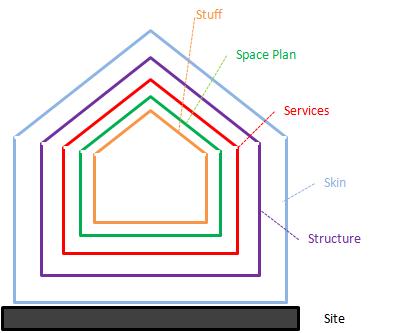
The diagram above is reproduced from How Buildings Learn, and represents the parts of a building which change at different rates. It is arranged from outside in with, in this representation, no absolute correlation between the parts and rate of change. 
Using Brand’s own explanation, the layers have the following descriptions:

Site

The site is the geographical setting, the urban location and the legally defined lot whose boundaries and context outlast generations of ephemeral buildings

Structure

The foundation and load bearing elements are perilous and expensive to change, so people don’t. These are the building.

Skin

External surfaces can change more frequently than the structure of the building. Changes in fashion, energy cost, safety, etc. cause changes to be made to the skin. However tradition and preservation orders often inhibit changes to the skin since the skin is very much the aesthetic.

Services

These are the working guts of the building, communications/wiring, plumbing, air handling, people moving. Ineffective services can cause buildings to be demolished early, even if the surrounding structure is still sound.

Space Plan

The space plan represents the interior layout – the placement of walls, ceilings, doors, etc. As buildings are re-purposed, as fashion changes so can the interior quickly be reconfigured.

Stuff

The appurtenances that make the space useful for its intended purpose. Placement of tables, chairs, walls cubicles, etc.
 
In further articles, I will develop this theme in 2 directions. First in thinking about how data can affect the way that retail organizations can think about their layout and organization (shearing at the Stuff/Space Plan layers of both brick and mortar and web stores. Second in looking at Enterprise Architecture through the lens of shearing layers – by analogy with Brand’s writing and thinking.
Shearing Layers – Part 1 physical buildings

In Stewart Brand’s terrific work, “How Buildings Learn”, there are some great analogies to what we do in Enterprise Architecture. He expanded on the concept of “shearing layers” introduced by Robert V. O’Neill in his “A hierarchical concept of ecosystems”. The primary notion being that we can hierarchically understand our ecosystems better by understanding the different rates of change possible at the different layers.


The diagram above is reproduced from How Buildings Learn, and represents the parts of a building which change at different rates. It is arranged from outside in with, in this representation, no absolute correlation between the parts and rate of change. 
Using Brand’s own explanation, the layers have the following descriptions:

Site

The site is the geographical setting, the urban location and the legally defined lot whose boundaries and context outlast generations of ephemeral buildings

Structure

The foundation and load bearing elements are perilous and expensive to change, so people don’t. These are the building.

Skin

External surfaces can change more frequently than the structure of the building. Changes in fashion, energy cost, safety, etc. cause changes to be made to the skin. However tradition and preservation orders often inhibit changes to the skin since the skin is very much the aesthetic.

Services

These are the working guts of the building, communications/wiring, plumbing, air handling, people moving. Ineffective services can cause buildings to be demolished early, even if the surrounding structure is still sound.

Space Plan

The space plan represents the interior layout – the placement of walls, ceilings, doors, etc. As buildings are re-purposed, as fashion changes so can the interior quickly be reconfigured.

Stuff

The appurtenances that make the space useful for its intended purpose. Placement of tables, chairs, walls cubicles, etc.
 
In further articles, I will develop this theme in 2 directions. First in thinking about how data can affect the way that retail organizations can think about their layout and organization (shearing at the Stuff/Space Plan layers of both brick and mortar and web stores. Second in looking at Enterprise Architecture through the lens of shearing layers – by analogy with Brand’s writing and thinking.

Business Architects: Do Not Start With Strategy

Frequently, when reading articles or books on business architecture, the following advice emerges:

Business architects start with the strategy of an organization.  They take that strategy and map it to the capabilities of the enterprise to clarif…

Categories Uncategorized

Fragility of Markets and Architecture Failure

As the NASDAQ exchange came to a grinding halt this past week, I, as well as many of you perhaps thought about system failure and what was the series of events and initial conditions that preceded the shutdown. Did a human did something strange that set a series of events in motion that jeopardized the…