Are Business Process Management and Business Architecture a perfect match?

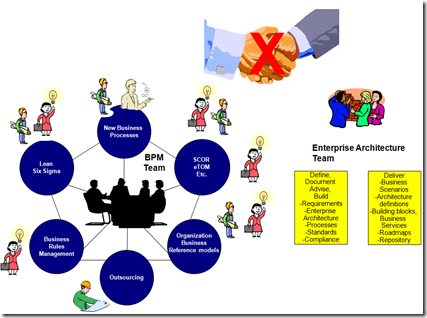
Whenever I suggest collaboration between these two worlds, I always observe some sort of astonishment from my interlocutors. Many Enterprise Architects or Business Architects do not realise there may be synergies. Business Process Management (BPM) team have not understood what Enterprise Architecture is all about and the other way around…. There is no a single definition of Business Process Management, often it means different things to different people. To keep it very generic, BPM relates to any activities an organization does to support its process efforts.
image
There are many activities which can be included in such efforts:
· The use of industry Business Reference Model (or Business Process Reference Model), a reference for the operational activities of an organization, a framework facilitating a functional Lines of Business, such as

o The Federal Enterprise Architecture Business Reference Model of the US Federal Government
o The DoD Business Reference Model
o The Open Group Exploration and Mining Business Reference Model (https://www.opengroup.org/emmmv/uploads/40/22706/Getting_started_with_the_EM_Business_Model_v_01.00.pdf)
o Frameworx (eTOM) for Telco companies
o The Supply Chain Operations Reference (SCOR®) model
o The SAP R/3 Reference Model
o The Oracle Business Models : Oracle Industry Reference Model for Banking, (IRM), Oracle Retail Reference Model
o And others…

· The use of organization specific Business Reference models
· The use of Business process improvement methodologies

o Lean, a quantitative data driven methodology based on statistics, process understanding and process control
o Six Sigma, a methodology that mainly focuses on eliminating bad products or services to clients by using statistical evaluation

· Business Process Reengineering, which in reality is a facet of BPM
· The understanding of Business Change Management, the process that empowers staff to accept changes that will improve performance and productivity
· The understanding of Business Transformation, the continuous process, essential to any organization in implementing its business strategy and achieving its vision
· The use of Business Rules Management which enables organizations to manage business rules for decision automation
· The understanding of Business Process Outsourcing (BPO) services to reduce costs and increase efficiency
· The support of Business Process modeling and design, which is illustrated description of business processes, usually created with flow diagrams. The model contains the relationship between activities, processes, sub-processes and information, as well as roles, the organization and resources. This can done with many notations such as flow chart, functional flow block diagram, control flow diagram, Gantt chart, PERT diagram, IDEF, and nowadays with the standard de facto notations such as UML and BPMN
· The support of BPM tools and suites implementation. With the right, process models can be simulated, to drive workflow or BPMS systems, and can be used as the basis for an automated process monitoring system (BAM)
· The support of Business Activity Monitoring (BAM), the ability to have end-to-end visibility and control over all parts of a process or transaction that spans multiple applications and people in one or even more companies.

To combine Business Process Management and Enterprise Architecture for better business outcomes is definitely the way forward, where BPM provides the business context, understanding, and- metrics, and Enterprise Architecture provides the discipline to translate business vision and strategy into architectural changes. Both are needed for sustainable continuous improvement. When referring to Enterprise Architecture, we would mainly refer to Business Architecture. Business Architecture involves more than just the structure of business processes. It also entails the organization of departments, roles, documents, assets, and all other process-related information.

Business Architects may be defining and implementing the Business Process framework and, in parallel, influencing the strategic direction for Business Process Management and improvement methodologies (e.g. Lean, Six Sigma). The business process owners and Business Analysts are working within their guidelines at multiple levels throughout the organizations’ business process. They have roles and responsibilities to manage, monitor and control their processes.
An important tool in developing Business Architecture is a Business Reference Model. These types of models are enormously beneficial. They can be developed in the organization to build and extend the information architecture. The shared vocabulary (verbal and visual) that emerges from these efforts promotes clear and effective communication.

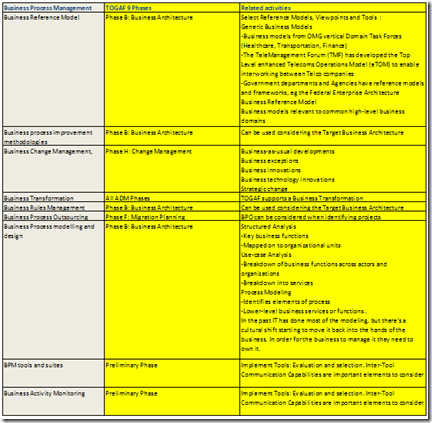
To illustrate the touch points between Enterprise Architecture and Business Process Management, I have illustrated in the table below the synergies between the two approaches using TOGAF® 9.
image

In this table, we observe that, there is a perfect match between Business Process Management and the use of an Enterprise Architecture framework such as TOGAF. BPM is often project based and the Business Architect (or Enterprise Architect) may be responsible for identifying cross-project and cross-process capabilities. It can be considered as being the backbone of an Enterprise Architecture program. We can also add to this, that Service Oriented Architecture is the core operational or transactional capability while BPM does the coordination and integration into business processes.

When using BPM tools and suites, you should also consider the following functionalities: workflow, enterprise application integration, content management and business activity monitoring. These four components are traditionally provided by vendors as separate applications which are merged through BPM into a single application with high levels of integration. The implementation of a BPM solution should theoretically eliminate the maintenance and support cost of these four applications resulting in reducing the total cost of ownership.

Business Architecture provides the governance, alignment and transformational context for BPM across business units and silos. Enterprise Architects, Business Architects, Business Analysts should work together with BPM teams, when approaching the topic of Business Process Management. BPM efforts need structures and appropriate methodologies. It needs a structure to guide efforts at different levels of abstraction (separating “the what“ (the hierarchical structure of business functions) from “the how” (how the desired results are achieved), a documented approach and structure to navigate among the business processes of the organization, i.e. a Business Architecture. They also need a methodology such as an Enterprise Architecture framework to retain and leverage what they have learned about managing and conducting BPM projects.

Are Business Process Management and Business Architecture a perfect match?

Whenever I suggest collaboration between these two worlds, I always observe some sort of astonishment from my interlocutors. Many Enterprise Architects or Business Architects do not realise there may be synergies. Business Process Management (BPM) team have not understood what Enterprise Architecture is all about and the other way around…. There is no a single definition of Business Process Management, often it means different things to different people. To keep it very generic, BPM relates to any activities an organization does to support its process efforts.

image
There are many activities which can be included in such efforts:
· The use of industry Business Reference Model (or Business Process Reference Model), a reference for the operational activities of an organization, a framework facilitating a functional Lines of Business, such as

o The Federal Enterprise Architecture Business Reference Model of the US Federal Government
o The DoD Business Reference Model
o The Open Group Exploration and Mining Business Reference Model (https://www.opengroup.org/emmmv/uploads/40/22706/Getting_started_with_the_EM_Business_Model_v_01.00.pdf)
o Frameworx (eTOM) for Telco companies
o The Supply Chain Operations Reference (SCOR®) model
o The SAP R/3 Reference Model
o The Oracle Business Models : Oracle Industry Reference Model for Banking, (IRM), Oracle Retail Reference Model
o And others…

· The use of organization specific Business Reference models
· The use of Business process improvement methodologies

o Lean, a quantitative data driven methodology based on statistics, process understanding and process control
o Six Sigma, a methodology that mainly focuses on eliminating bad products or services to clients by using statistical evaluation

· Business Process Reengineering, which in reality is a facet of BPM
· The understanding of Business Change Management, the process that empowers staff to accept changes that will improve performance and productivity
· The understanding of Business Transformation, the continuous process, essential to any organization in implementing its business strategy and achieving its vision
· The use of Business Rules Management which enables organizations to manage business rules for decision automation
· The understanding of Business Process Outsourcing (BPO) services to reduce costs and increase efficiency
· The support of Business Process modeling and design, which is illustrated description of business processes, usually created with flow diagrams. The model contains the relationship between activities, processes, sub-processes and information, as well as roles, the organization and resources. This can done with many notations such as flow chart, functional flow block diagram, control flow diagram, Gantt chart, PERT diagram, IDEF, and nowadays with the standard de facto notations such as UML and BPMN
· The support of BPM tools and suites implementation. With the right, process models can be simulated, to drive workflow or BPMS systems, and can be used as the basis for an automated process monitoring system (BAM)
· The support of Business Activity Monitoring (BAM), the ability to have end-to-end visibility and control over all parts of a process or transaction that spans multiple applications and people in one or even more companies.

To combine Business Process Management and Enterprise Architecture for better business outcomes is definitely the way forward, where BPM provides the business context, understanding, and- metrics, and Enterprise Architecture provides the discipline to translate business vision and strategy into architectural changes. Both are needed for sustainable continuous improvement. When referring to Enterprise Architecture, we would mainly refer to Business Architecture. Business Architecture involves more than just the structure of business processes. It also entails the organization of departments, roles, documents, assets, and all other process-related information.

Business Architects may be defining and implementing the Business Process framework and, in parallel, influencing the strategic direction for Business Process Management and improvement methodologies (e.g. Lean, Six Sigma). The business process owners and Business Analysts are working within their guidelines at multiple levels throughout the organizations’ business process. They have roles and responsibilities to manage, monitor and control their processes.
An important tool in developing Business Architecture is a Business Reference Model. These types of models are enormously beneficial. They can be developed in the organization to build and extend the information architecture. The shared vocabulary (verbal and visual) that emerges from these efforts promotes clear and effective communication.

To illustrate the touch points between Enterprise Architecture and Business Process Management, I have illustrated in the table below the synergies between the two approaches using TOGAF® 9.

image

In this table, we observe that, there is a perfect match between Business Process Management and the use of an Enterprise Architecture framework such as TOGAF. BPM is often project based and the Business Architect (or Enterprise Architect) may be responsible for identifying cross-project and cross-process capabilities. It can be considered as being the backbone of an Enterprise Architecture program. We can also add to this, that Service Oriented Architecture is the core operational or transactional capability while BPM does the coordination and integration into business processes.

When using BPM tools and suites, you should also consider the following functionalities: workflow, enterprise application integration, content management and business activity monitoring. These four components are traditionally provided by vendors as separate applications which are merged through BPM into a single application with high levels of integration. The implementation of a BPM solution should theoretically eliminate the maintenance and support cost of these four applications resulting in reducing the total cost of ownership.

Business Architecture provides the governance, alignment and transformational context for BPM across business units and silos. Enterprise Architects, Business Architects, Business Analysts should work together with BPM teams, when approaching the topic of Business Process Management. BPM efforts need structures and appropriate methodologies. It needs a structure to guide efforts at different levels of abstraction (separating “the what“ (the hierarchical structure of business functions) from “the how” (how the desired results are achieved), a documented approach and structure to navigate among the business processes of the organization, i.e. a Business Architecture. They also need a methodology such as an Enterprise Architecture framework to retain and leverage what they have learned about managing and conducting BPM projects.

How not to define business-architecture…

Oh no, not again… Having all but crippled enterprise-architecture for the past decade with a muddled mess of myopia and misdefinitions, it seems Open Group are hell-bent on making the same kind of mess in business-architecture… I need to be upfront about this: I don’t regard Open Group as ‘the bad guys’. Far from it: […]

Perspectives of Enterprising, Architecture & Systems

Enterprising This blog post deals with the summer school of week 31. The summer school dealt with the theme of “enterprising” which literally means anything from Enterprise Architecture, Viable Systems Models and technologies related to the systems development. Sally Bean … Continue reading

Monet revisited (or: non-traditional approaches to developing TOGAF® Next)

Enterprises are changing and we need to understand them in non-traditional ways. A lot of the best ideas come from unexpected directions, and in the next iteration of TOGAF®, doesn’t it make sense to incorporate them to make EA more adaptable and less…

PODCAST: Why data and information management remain elusive after decades of deployments; and how to fix it

Listen to our recorded podcast on the state of data and information management strategies, or read the transcript. This podcast was recorded by Dana Gardner of Interarbor Solutions in conjunction with The Open Group Conference, Austin 2011. Continue re…

Why business-model to enterprise-architecture?

Yes, I admit it: I’ve been kinda pouring out the posts lately. Sorry…
But why all this fuss about business-models and enterprise-architecture? What’s the point about the bottom-line not being the baseline to work from? If everyone’s selling something to someone, is there really any difference between a for-profit and a non-profit business-model? And who would […]

From business-model to enterprise-architecture

Okay, I think I’m finally getting somewhere, on looking for a way to connect a business-model to enterprise-architecture, to provide a full link between top-down intent and bottom-up real-world constraints.
This specific part goes from the business-model downwards, from Business Model Canvas to Archimate, and thence to BPMN, UML and other detail-layer models. (There’s another part […]

Rethinking the layers in enterprise-architecture

Still plodding away on ideas for a systematic process to translate a business-model in Business Model Canvas down into real-world architecture and implementation. (This links up with quite a few previous posts, such as ‘More on business-models‘, ‘Enterprise-architecture – let’s keep it simple‘ and ‘Is Archimate too IT-centric for enterprise-architecture?‘)
[Note: this is a work-in-progress post, […]

Is Archimate too IT-centric for enterprise-architecture?

Archimate aims to be the standard notation for enterprise-architectures. But has it become too IT-centric to be usable for that purpose? And is there any way we can get it to break out of the IT-centric box?
These questions came up for me whilst exploring the architectural processes we could use in expanding a business-model developed […]