Turning around the Team

Without doubt the biggest contributing factor to success on projects where I’ve been engaged as an Enterprise Architect is the human dimension. Bringing a method that people can buy into, in a language that they understand and then reinforcing this wit…

Turning around the Team

Without doubt the biggest contributing factor to success on projects where I’ve been engaged as an Enterprise Architect is the human dimension. Bringing a method that people can buy into, in a language that they understand and then reinforcing this wit…

Categories Uncategorized

Enterprise Architecture Roadmap for success: Tooling

<p><span style=”color: #505050; font-size: 11px; line-height: 19px;”>In this eighth posting we will cover the topic of <a title=”BiZZdesign Architect” href=”http://tools/bizzdesign-architect/”>Enterprise Architecture Tooling</a>. First we will explore the question what capabilities effective Enterprise Architecture teams need from tools, and list some characteristics that tools need to have in order to efficiently support Enterprise Architects. In the second portion of this blog we will address best practices that Enterprise Architecture teams can use to fully leverage the power of Enterprise Architecture tools.</span></p><p> </p><div class=”captionImage left” style=”width: 600px;”><div class=”captionImage left” style=”width: 600px;”><img class=”left” src=”http://www.bizzdesign.com/assets/BlogDocuments-2/_resampled/resizedimage600375-Enterprise-Architecture-Tooling.png” alt=”Enterprise Architecture Roadmap for Success Contents” title=”Enterprise Architecture Roadmap for Success:” width=”600″ height=”375″/><p class=”caption”>Enterprise Architecture Roadmap for Success: part eight; Tooling</p></div></div><h2>Many Enterprise Architecture aspects</h2><p>From <a title=”Blogs by Sven van Dijk and Bas van Gils” href=”http://www.bizzdesign.com/blog/posts/bas-van-gils-and-sven-van-dijk”>previous postings</a> in this series it has become clear that Enterprise Architecture has many aspects, and that the specific set of aspects to focus on greatly depends on the approach that an organization takes with respect to Enterprise Architecture. For example more strategic aspects in a top-down approach and more operational aspects in a bottom up approach.</p><p>But in general we could state that Enterprise Architecture is always about knowledge and communication. Enterprise Architecture brings together various perspectives, enabling integrated analysis on the current and future state of the architecture of the enterprise. This results in valuable knowledge that greatly enhances decision making, whether on a strategic or more operational level. This knowledge not only needs to be efficiently managed and maintained, it also needs to be communicated to the right stakeholder at the right time, and even more importantly: in the right format. An essential aspect in Enterprise Architecture is stakeholder communication. Enterprise Architecture has a diverse audience including business and technical backgrounds, and each of the stakeholders needs to be addressed in a language that is clearly understood.</p><p>This gives us directly a number of essential qualifications for Enterprise Architecture tools: rigidity when it comes to the management and maintenance of knowledge, and flexibility when it comes to the analysis (ad-hoc, what-if, etc.), presentation and communication of the knowledge to diverse audiences.</p><p>So what you are looking for is a tool with solid repository capabilities, and flexible modeling and analysis functionality:</p><ul><li>Options to create manageable partitions of Enterprise Architecture knowledge such as models. Definition of these partitions should be flexible and fully customizable, while the tool offers functionality to make sure that integrity of the data over the various partitions is not compromised;</li><li>Management of versions, including life cycle (draft, approved, etc.), but also versions in time (current state, future state, etc.);</li><li>A metamodel that possesses just enough formality to model all aspects of the enterprise  (business, people, processes, technology) in a coherent and meaningful way, but is on the other hand flexible enough to customize and tailor to cover capturing organization specific information;</li><li>Flexible and ad-hoc modeling and analysis functionality is essential to deal with the various questions and concerns that stakeholders have regarding the Enterprise Architecture;</li><li>Reporting and communication features capable of slicing and dicing the knowledge in any way, and little restrictions on the format in which the knowledge can be presented to various audiences;</li></ul><h2>A single Enterprise Architecture tool or a set of tools that supports Enterprise Architecture?</h2><p>In the tooling business there are many vendors, some of them claiming to offer one-stop-shop Enterprise Architecture solutions. Given the diverse functionality that Enterprise Architecture needs, and the myriad of approaches organizations take on Enterprise Architecture based on their priorities, a one-size-fits-all solution does not often seem the best choice.</p><p>Take for example document management capabilities to support Enterprise Architecture governance on the one hand side, and multi-faceted ad-hoc model querying to support complex design decision making on the other hand. When trying to cover both in one tool you don’t usually get the best of the both worlds.</p><p>Often it is better to select a small number of specialized tools that can be aligned so that together they support the full spectrum of capabilities that Enterprise Architecture needs. This can sometimes be found in a “tool suite” from one vendor. But if the organization wants more flexibility to choose the best tool, they usually end up with tools that support open standards so that they can be easily aligned with other components in the organization specific Enterprise Architecture tool set.</p><p> </p><div class=”captionImage left” style=”width: 600px;”><div class=”captionImage left” style=”width: 600px;”><img class=”left” src=”http://www.bizzdesign.com/assets/BlogDocuments-2/_resampled/resizedimage600498-Enterprise-Architecture-Repository.png” alt=”Enterprise Architecture Repository” title=”Enterprise Repository, Architecture Repository” width=”600″ height=”498″/><p class=”caption”>Enterprise Architecture Repository</p></div></div><p><a title=”TOGAF®, The Open Group Architecture Framework, is a proven, comprehensive and generic methodology and framework.” href=”http://consultancy/enterprise-architecture-management/togaf/”>TOGAF’s </a>description and depiction of the architecture repository gives a good overview of what the architecture content is that needs to be created, managed and maintained in an enterprise architecture environment. The architecture landscape often consists of descriptions using models to express the architecture on various levels: strategic, segment, and capability. Other model content includes solution architectures in terms of building blocks, and a library with reference models. The models are based on the organization specific meta model. Other types of data in the architecture repository include architecture requirements, a library of standards, governance data and data describing the architecture capability itself.</p><p>The architecture repository is often a conceptual thing rather than a physical implementation on a single database. Often, a set of tools are in use in an organization to support various processes and management of various types of data. The tools are aligned, e.g. based on the structure suggested by TOGAF, so that together they form a complete solution supporting the Enterprise Architecture capability.</p><h2>A fool with a tool…</h2><p>In this final part of this posting we want to address the actual use of Enterprise Architecture tools. In our practice we sometimes see organizations looking for off-the-shelve solutions that “do” Enterprise Architecture for them. It may sound as an open door, but in our opinion a tool should support enterprise architects so that they don’t have to bother about simple, straightforward, and activities with an administrative character. In that way, they can focus on the real design challenges that the organization faces: the activities with which Enterprise Architecture actually adds value to the organization. Talented and intelligent enterprise architects are those who ask the right questions, and who can reduce complexity with smart models. Tools should make the life of these architects easier by being flexible, supportive, and not imposing all kinds of cumbersome activities for simple tasks. Some Enterprise Architecture tools claim to automate the intelligent design work, and that Enterprise Architecture automatically “happens” once installed on the companies’ servers. In practice this is rarely the case. Effective architecture is all about the right architect using the right tool in the right way, or as we sometimes say: a fool with a tool is a still a fool making faster disaster.</p><p> </p><div class=”captionImage left” style=”width: 301px;”><img class=”left” src=”http://www.bizzdesign.com/assets/BlogDocuments-2/Fool-with-a-Enterprise-Architecture-Tool-.png” alt=”Enterprise Architecture Fool with a Tool” title=”Enterprise Architecture Tooling” width=”301″ height=”222″/><p class=”caption”>Enterprise Architecture Fool with a Tool</p></div><h2>Next posting</h2><p>If you’d like to know more, please contact the authors directly at <a title=”E-mail Bas van Gils” href=”mailto:b.vangils@bizzdesign.com”>b.vangils@bizzdesign.com</a> / <a title=”E-mail Sven van Dijk” href=”mailto:s.vandijk@bizzdesign.com”>s.vandijk@bizzdesign.com</a>, or leave a comment. The next post in this series is about using consultants for building Enterprise Architecture practices. It is scheduled to be posted between 11<sup>th</sup> and 15<sup>th</sup> of March.  </p>

Categories Uncategorized

Understanding the Strategy Diffusion Problem

“Everyone is trying to do their best but they don’t fully understand our strategy. As a consequence, we are getting better and better at things that don’t matter.” Senior Business Manager While most leaders have a good idea of what they want their organizations to do, they struggle to translate their vision into focused and […]

Next Generation – applying Enterprise Architecture to managing projects


Enterprise Architecture is evolving; the new generation of Enterprise Architecture methods finally achieving their goals to slash project times and reduce costs for organisations. This is critical as companies strive to increase their competitive advantage, optimise their operations, reduce costs and respond faster to market demands. To that end, Enterprise Architects have positioned themselves to provide advice on using IT as a strategic tool as part of the strategic decision making process with company directors.
Gartner heralds the impact of Enterprise Architecture (EA) on delivering business value through the strategic use of IT.
Overwhelmingly we find EA practitioners focused on delivering on business value and strategic transformation,” said Philip Allega, managing vice president at Gartner. “Gone are the days of just ‘doing EA’ with little value or impact. Sixty-eight percent of organizations surveyed stated that they are focusing their EA program on aligning business and IT strategies, delivering strategic business and IT value, or enabling major business transformation.” [1]
Enterprise Architecture is supporting the development of IT operations and infrastructure into the new “Agile” paradigm.  Enterprise Architecture needs to not only deliver value but accelerate projects, operations while speeding up delivery and time-to-value.  Nautilus-PM [2] has chosen the Agile EA method to accelerate project management and development as it offers the most pragmatic approach to delivering incremental project outcomes without having to undertake the long winded processes commonly found in the traditional software and enterprise architecture development methods. The future is “Agile” with thought-leaders, such as Gartner predicting that by the end of 2012, agile development methods will be used on 80% of all software development projects [3]..
Visual Enterprise Architecture shapes the project activities and approach. “Agile” demands a departure from the traditional waterfall approach to systems engineering that saw monolithic system development and implementation that took high level analysis through to detailed design. The complications arose as time elapsed and changes would require repeating analytical and design cycles, which proved to be cumbersome and difficult to manage.  The “Agile” incremental approach to developing systems focuses on delivering prioritised clusters of system functionality for faster utilisation while planning subsequent increments of reprioritised functionality as the capability need grows. This enables a company to make operational use of these systems earlier, while giving it the flexibility to respond and grow in response to market and customer demand.  A change in market demand can affect the prioritisation assigned to system functions, which can be brought into operation sooner if so required or can be postponed in favour of higher prioritised functionality. This approach has been used effectively in public sector organisations to streamline operations, reduce systems and infrastructure costs while enabling personnel to deliver greater value for money (VfM).  The systems procurement and acquisition processes in public sector organisations have been scrutinised and found to cost too much money. Frequently, by using the traditional systems engineering methods, functionality and systems are obsolete by the time that they are delivered. Evaluations has found that the systems have been too late, over budget and lacking in the functional richness needed to provide user satisfaction.
The US DOD insist on an “evolutionary acquisition” approach for all identified natural systems, i.e. they buy a few items or the initial elements of the product, use it, learn from its features or performance, then develop it further, rather than trying (and failing) to specify all details from the outset [4].
The birth of  the “Agile” approach to EA has not been without tears.  Similarly, when the Object Oriented paradigm was introduced the “old guard” custodians of IT standards regaled “It will never work”. Agile has also received the same cynicism until the weight and burden of demonstration has demanded a rethink. It is not surprising that with the weight of investment into the traditional methods of developing EA that there would be a resistance to the newer “disruptive” approaches. This has been a familiar pattern: companies who invested heavily in mainframe infrastructure resisted moving towards a flexible, open architecture due to their perceived investment in these old systems, it is a matter of time before the cost of maintaining older legacy systems outweigh the advantages realised by new methods, structures and systems.
Fortunately for organisations, the adoption of Enterprise Architecture to visualise Project timelines and roadmaps means that they do not lose their investment into their infrastructure but are able to redeploy resources and applications to leverage greater value and take control of their system portfolio.  
Enterprise Architecture builds on the creation of blueprints and enterprise maps that visualise Enterprise Views of concepts, issues, principles and key goals to build a common understanding across stakeholder groups. Having a unified view that supports discussions and decisions ensures the common ground for implementing evolving information systems and business processes.  The Nautilus project CPM (critical path method) plans plug into this living enterprise view of road-mapping and time-lines.
While this approach may seem to be common sense to Boards of Directors, Funders and other Stakeholders, it is a new direction and a new paradigm for EA: This is The Visual Age. We have departed from the strict demarcation of Business – IT – Technical and Implementation Architectural views that have been promoted by methods and frameworks such as TOGAF. It advocates a leaner, compact and multi dimensional approach more akin to the Checkland [5]soft systems methodology with its World-view (Weltaanschaung) and focus on stakeholders, client views and business value.  Engagement with business and IT communities and provision of a common natural language engenders strategic alignment and seamless threads from business vision and goals through to operations and infrastructure. The organisation begins to work and think like a total organism.
Through dialogue with key stakeholders and executing an “Agile”  approach organisations and project boards enjoy results not within the average 12 months [6] that was the usual time taken using previous methods, but within 3 months. Enterprise Architecture provides key actionable products and blueprints using language that management, developers and the wider community understand.   This accelerated approach to visualising the key concerns, issues, concepts and requirements speed up decision making. The concepts illustrated relate to multi dimensional aspects of the enterprise. They represent aspects that need to be addressed and are illustrated in an “AS-IS” current picture of problem areas, and “TO-BE” solution concepts and goal situation.  Each dimension is then worked down into their respective areas, such as information, business process, infrastructure and technology while maintaining correlation and interdependencies.
In summary, the new generation builds upon the natural world, is aligned with the demands and lessons learned from the traditional systems engineering while providing new agility to corporations and organisations.

Nautilus Project Management

Nautilus-PM is a niche innovation SME development consultancy, relying on 34 years experience in the delivery of multi disciplinary projects with EU or government funding, using CPM (critical path method) and CIM (continuous inspection monitoring) systems.  
Nautilus PM is a separate strategic business unit within EU-Reconnect LLP, a major contributor in transferring conventional proven engineering design & construction management techniques into IT enterprise architecture methods. In its profile Nautilus-PM relies heavily on tAgile EA method for accelerating the journey between SME product & services concept and commercialisation – Routes to Funding and Routes to Market.
Nautilus-PM can therefore be best identified as a technical and commercially focussed consultancy operation, dedicated to assist SMEs with boots-on-the-ground sustainable development. Its’ services include the following:
·         Levelling obstacles and potential entry and exit points in business development, assisting SMEs to compete with cognisant solutions; foundation research, collaboration and routes-to-market on the basis of cooperation, and exploring co-evolution of societal and technological change.
·         Connecting SMEs with the innovation landscape of the EU and Government, and assistance with creating collaboration with Large Enterprises and Universities, and through obtaining development funds through Eurostars, smart grants, innovation vouchers and R&D tax credits and Patent Box support
·         Using innovative Enterprise Architecture methods and tools, i-visualisations and lean project management of development programs, enabling effective routes to credits and routes-to-market.
·         Introducing initiatives aimed at increasing market growth and max ROI and access to EU funding (up to 75%)
·         Assisting SMEs as pathfinder toward practical industrial technologies supporting:
o   Advanced manufacturing and processing
o   Research and innovation (policy, rules, routes and ethics)
o   Sustainable development and international cooperation
o   ‘Access to funding/risk finance, inducement prizes (participation in equity financing)
o   Practical, easy-to-apply Information & Communication Technology, including securitisation
o   Innovation & change program/project monitoring and evaluation


1 STAMFORD, Conn., January 15, 2013, Gartner Says Enterprise Architecture Practitioners Significantly Influenced $1.1 Trillion http://www.gartner.com/newsroom/id/2303215
2 Nautilus-PM Project Management method incorporating CPM www.nautilus-pm.eu
3 PMI Agile Certified Practitioner (PMI-ACP)®, http://www.pmi.org/Certification/New-PMI-Agile-Certification.aspx
4 UK Parliament, Defence Acquisition, Chris Donnelly, Session 2012-2013 http://www.publications.parliament.uk/pa/cm201213/cmselect/cmdfence/writev/acquisition/m15.htm
5 Checkland, Peter B. Systems Thinking, Systems Practice, John Wiley & Sons Ltd. 1981, 1998. ISBN 0-471-98606-2
6 Example of roadmap for traditional Enterprise Architecture: http://www.ibm.com/developerworks/rational/library/jan07/temnenco/index.html

Next Generation – applying Enterprise Architecture to managing projects


Enterprise Architecture is evolving; the new generation of Enterprise Architecture methods finally achieving their goals to slash project times and reduce costs for organisations. This is critical as companies strive to increase their competitive advantage, optimise their operations, reduce costs and respond faster to market demands. To that end, Enterprise Architects have positioned themselves to provide advice on using IT as a strategic tool as part of the strategic decision making process with company directors.
Gartner heralds the impact of Enterprise Architecture (EA) on delivering business value through the strategic use of IT.
Overwhelmingly we find EA practitioners focused on delivering on business value and strategic transformation,” said Philip Allega, managing vice president at Gartner. “Gone are the days of just ‘doing EA’ with little value or impact. Sixty-eight percent of organizations surveyed stated that they are focusing their EA program on aligning business and IT strategies, delivering strategic business and IT value, or enabling major business transformation.” [1]
Enterprise Architecture is supporting the development of IT operations and infrastructure into the new “Agile” paradigm.  Enterprise Architecture needs to not only deliver value but accelerate projects, operations while speeding up delivery and time-to-value.  Nautilus-PM [2] has chosen the Agile EA method to accelerate project management and development as it offers the most pragmatic approach to delivering incremental project outcomes without having to undertake the long winded processes commonly found in the traditional software and enterprise architecture development methods. The future is “Agile” with thought-leaders, such as Gartner predicting that by the end of 2012, agile development methods will be used on 80% of all software development projects [3]..
Visual Enterprise Architecture shapes the project activities and approach. “Agile” demands a departure from the traditional waterfall approach to systems engineering that saw monolithic system development and implementation that took high level analysis through to detailed design. The complications arose as time elapsed and changes would require repeating analytical and design cycles, which proved to be cumbersome and difficult to manage.  The “Agile” incremental approach to developing systems focuses on delivering prioritised clusters of system functionality for faster utilisation while planning subsequent increments of reprioritised functionality as the capability need grows. This enables a company to make operational use of these systems earlier, while giving it the flexibility to respond and grow in response to market and customer demand.  A change in market demand can affect the prioritisation assigned to system functions, which can be brought into operation sooner if so required or can be postponed in favour of higher prioritised functionality. This approach has been used effectively in public sector organisations to streamline operations, reduce systems and infrastructure costs while enabling personnel to deliver greater value for money (VfM).  The systems procurement and acquisition processes in public sector organisations have been scrutinised and found to cost too much money. Frequently, by using the traditional systems engineering methods, functionality and systems are obsolete by the time that they are delivered. Evaluations has found that the systems have been too late, over budget and lacking in the functional richness needed to provide user satisfaction.
The US DOD insist on an “evolutionary acquisition” approach for all identified natural systems, i.e. they buy a few items or the initial elements of the product, use it, learn from its features or performance, then develop it further, rather than trying (and failing) to specify all details from the outset [4].
The birth of  the “Agile” approach to EA has not been without tears.  Similarly, when the Object Oriented paradigm was introduced the “old guard” custodians of IT standards regaled “It will never work”. Agile has also received the same cynicism until the weight and burden of demonstration has demanded a rethink. It is not surprising that with the weight of investment into the traditional methods of developing EA that there would be a resistance to the newer “disruptive” approaches. This has been a familiar pattern: companies who invested heavily in mainframe infrastructure resisted moving towards a flexible, open architecture due to their perceived investment in these old systems, it is a matter of time before the cost of maintaining older legacy systems outweigh the advantages realised by new methods, structures and systems.
Fortunately for organisations, the adoption of Enterprise Architecture to visualise Project timelines and roadmaps means that they do not lose their investment into their infrastructure but are able to redeploy resources and applications to leverage greater value and take control of their system portfolio.  
Enterprise Architecture builds on the creation of blueprints and enterprise maps that visualise Enterprise Views of concepts, issues, principles and key goals to build a common understanding across stakeholder groups. Having a unified view that supports discussions and decisions ensures the common ground for implementing evolving information systems and business processes.  The Nautilus project CPM (critical path method) plans plug into this living enterprise view of road-mapping and time-lines.
While this approach may seem to be common sense to Boards of Directors, Funders and other Stakeholders, it is a new direction and a new paradigm for EA: This is The Visual Age. We have departed from the strict demarcation of Business – IT – Technical and Implementation Architectural views that have been promoted by methods and frameworks such as TOGAF. It advocates a leaner, compact and multi dimensional approach more akin to the Checkland [5]soft systems methodology with its World-view (Weltaanschaung) and focus on stakeholders, client views and business value.  Engagement with business and IT communities and provision of a common natural language engenders strategic alignment and seamless threads from business vision and goals through to operations and infrastructure. The organisation begins to work and think like a total organism.
Through dialogue with key stakeholders and executing an “Agile”  approach organisations and project boards enjoy results not within the average 12 months [6] that was the usual time taken using previous methods, but within 3 months. Enterprise Architecture provides key actionable products and blueprints using language that management, developers and the wider community understand.   This accelerated approach to visualising the key concerns, issues, concepts and requirements speed up decision making. The concepts illustrated relate to multi dimensional aspects of the enterprise. They represent aspects that need to be addressed and are illustrated in an “AS-IS” current picture of problem areas, and “TO-BE” solution concepts and goal situation.  Each dimension is then worked down into their respective areas, such as information, business process, infrastructure and technology while maintaining correlation and interdependencies.
In summary, the new generation builds upon the natural world, is aligned with the demands and lessons learned from the traditional systems engineering while providing new agility to corporations and organisations.

Nautilus Project Management

Nautilus-PM is a niche innovation SME development consultancy, relying on 34 years experience in the delivery of multi disciplinary projects with EU or government funding, using CPM (critical path method) and CIM (continuous inspection monitoring) systems.  
Nautilus PM is a separate strategic business unit within EU-Reconnect LLP, a major contributor in transferring conventional proven engineering design & construction management techniques into IT enterprise architecture methods. In its profile Nautilus-PM relies heavily on tAgile EA method for accelerating the journey between SME product & services concept and commercialisation – Routes to Funding and Routes to Market.
Nautilus-PM can therefore be best identified as a technical and commercially focussed consultancy operation, dedicated to assist SMEs with boots-on-the-ground sustainable development. Its’ services include the following:
·         Levelling obstacles and potential entry and exit points in business development, assisting SMEs to compete with cognisant solutions; foundation research, collaboration and routes-to-market on the basis of cooperation, and exploring co-evolution of societal and technological change.
·         Connecting SMEs with the innovation landscape of the EU and Government, and assistance with creating collaboration with Large Enterprises and Universities, and through obtaining development funds through Eurostars, smart grants, innovation vouchers and R&D tax credits and Patent Box support
·         Using innovative Enterprise Architecture methods and tools, i-visualisations and lean project management of development programs, enabling effective routes to credits and routes-to-market.
·         Introducing initiatives aimed at increasing market growth and max ROI and access to EU funding (up to 75%)
·         Assisting SMEs as pathfinder toward practical industrial technologies supporting:
o   Advanced manufacturing and processing
o   Research and innovation (policy, rules, routes and ethics)
o   Sustainable development and international cooperation
o   ‘Access to funding/risk finance, inducement prizes (participation in equity financing)
o   Practical, easy-to-apply Information & Communication Technology, including securitisation
o   Innovation & change program/project monitoring and evaluation


1 STAMFORD, Conn., January 15, 2013, Gartner Says Enterprise Architecture Practitioners Significantly Influenced $1.1 Trillion http://www.gartner.com/newsroom/id/2303215
2 Nautilus-PM Project Management method incorporating CPM www.nautilus-pm.eu
3 PMI Agile Certified Practitioner (PMI-ACP)®, http://www.pmi.org/Certification/New-PMI-Agile-Certification.aspx
4 UK Parliament, Defence Acquisition, Chris Donnelly, Session 2012-2013 http://www.publications.parliament.uk/pa/cm201213/cmselect/cmdfence/writev/acquisition/m15.htm
5 Checkland, Peter B. Systems Thinking, Systems Practice, John Wiley & Sons Ltd. 1981, 1998. ISBN 0-471-98606-2
6 Example of roadmap for traditional Enterprise Architecture: http://www.ibm.com/developerworks/rational/library/jan07/temnenco/index.html
Categories Uncategorized

Agility Through New Technologies

Without the capability of linking application development with the infrastructure such as servers, middleware and network your organization will most likely be in more trouble than the decision-makers think. Information technologies have a profound impact on the organization’s ability to reinvent its business model(s) and the products it produces and since organizations in various industries […]

Shared Vocabulary for Business Innovation and Modernization

Do you remember when computers were hard to use? In fact it’s just nine years since a GM press release asserted that if they developed technology like Microsoft, we would all be driving cars that for no reason at all, would crash twice a day, shut down and refuse to restart. Since then Apple has showed Microsoft the way, and we all use smart phones, tablets and PCs that are genuinely easy to use and remarkably resilient.

Because of this great leap forward in personal device usability the smart phone user on the proverbial Clapham Omnibus might reasonably expect that enterprise systems should be similarly easy to use and resilient. Unless of course she was a customer of the Royal Bank of Scotland (RBS), in which case she will have painful memories of last year’s high profile failure caused by the core banking system crash which corrupted tens of millions of accounts.

Once upon a time banks in general were regarded as leaders in the use of information technology. Yet last year several high profile systems failures signalled that banking systems, far from being leading edge, are in rapid decline. Banks aren’t the only culprits. Along with the banks, insurance companies, retailers and others are starting to offer their customers smart phone apps, notwithstanding that behind the scenes their enterprise systems are frequently held together with sticky tape and sealing wax.

The reason many enterprise systems are in such a poor state is commonly because there are three parties involved in managing the enterprise systems that have widely divergent goals and objectives. The line-of-business manager typically views the systems as support to the business process and a cost to be managed. The IT Architect views the enterprise systems as a set of capabilities that must be progressively modernized to support business innovation. The IT Project Manager is focused on delivering projects to time and cost.

These views are of course diametrically opposed. And under cost and time pressure the Architect is frequently the lower ranking player. In consequence the immediate needs of the business overrule longer term objectives of modernization, reduced complexity, flexibility and even cost of ownership.

The real issue is that the three parties do not have a shared view of the business problem. The line-of-business manager’s business process view does not correlate at all to the delivery project. The Architect should be the evangelist for business innovation and modernization but he or she is too easily squeezed in the cost and time discussion. And the Project Manager typically does not share the detailed technical project view with the line of business manager, and argues for a solution specific architecture that reduces project risk. The result is the existing enterprise systems get more complex and slower to respond to change. And the IT industry has been doing exactly this for as long as anyone can remember!

It’s extraordinary, but with all our high tech knowledge and skills we don’t have a vocabulary to articulate the business problem in a way that allows effective communications between the participants. Many IT organizations have embraced services as a way to organize systems capabilities more effectively. These might be Web Services or APIs or referred to collectively as Service Oriented Architecture (SOA). But, even if these software services are architected to align with business perspective, they are always managed as a technical matter, defined and managed by the IT organization.

Yet line-of-business managers do understand services as a business concept; virtually every business product today has a service component to it. The global service provider industry has formed around this idea, and in the UK today service industries account for 77 per cent of the economy. So while IT and business share the common underlying concept, at the practical level there is no meeting of minds.

In order to create a better bridge between business and IT we need to work with both the “how” and the “what” the business is, and we can do this by complementing business processes with business services. Business services are a very natural way to talk about “what” the business does today and tomorrow, while business processes focus on the “how”. Because you don’t reinvent an industry by just analyzing business processes, you also need to evolve and innovate with improved and new business services.

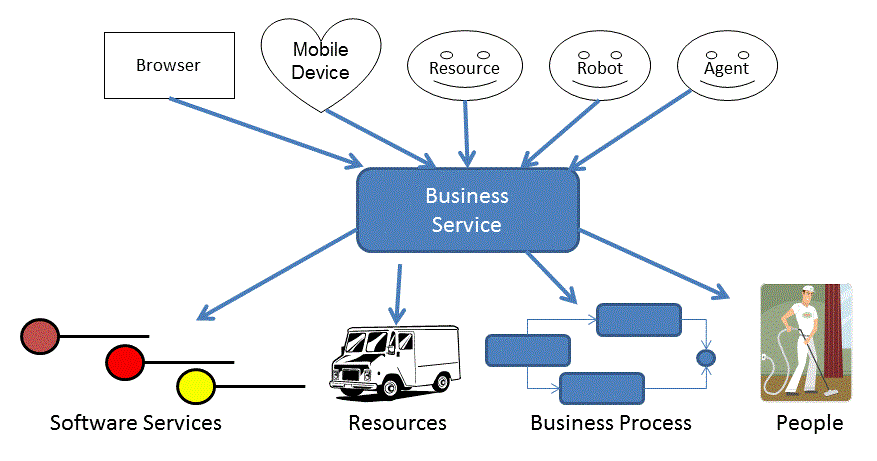
A good example of a service oriented business is Amazon.com Inc. They are well known as a service provider because they have constructed the Amazon enterprise as a set ofbusiness services which are offered to various external parties – enabling suppliers to sell second hand books or electronic goods on the Amazon platform; or providing data storage and Cloud computing services to other enterprises. The Amazon business services combine the compute and the business service integrating the commercial contracts, business processes, people, physical assets as well as the service interfaces that enable computer to computer or computer to device communications.
 

Using a common business and IT concept permits sensible analysis of whether a service is just a unit of cost, or what the strategic value is now and in the future, and what it adds to the business value chain. Given so many line-of-business managers are thoroughly familiar with the very high technology in their smart phones and other devices, it really is time for IT to treat the business as a mature partner and for the line-of-business manager to take real responsibility for the business service as a whole product.

Increasingly we see a convergence of IT and business organizations. The business service concept is an essential piece of vocabulary to focus on a business innovation and get everyone singing off the same hymn sheet to potentially huge advantage of the business. Just look at the Amazon example!

———————–
We will be running a workshop that explores these ideas in London in April in conjunction with the IASA UK Summit. If you can’t make the London event, (for geographic of schedule reasons) talk to me about how we can accommodate.