FEAC Certified
Coming Soon…
FEAC Certified
Aggregated enterprise architecture wisdom
Coming Soon…
FEAC Certified
{loadposition certsearch}
{loadposition 10295}
{loadposition certsearch}
{loadposition 10295}
“Last year the decision was finally made to mandate Agile across our enterprise. The decision was taken, even though there were many unanswered questions. The assumption was that forcing the migration, along with adoption of popular “enterprise Agile methods” would ensure resolution of the outstanding questions. In practice, Agile methods have been very effective in delivering specific digital business initiatives. But almost inevitably the distribution and delegation of architecture has resulted in duplication, inconsistency and increased complexity, across all project types including legacy and new projects. We are now concerned that we no longer have an effective governance capability. The question is how do we fix this without losing the undoubted benefits of Agile methods?“ Enterprise Architect, F2000 company.
Over the past few months I have heard this message over and over again. While Agile is being successful, it is increasingly in conflict with broader goals. And this is clearly becoming a major issue, manifest in increased complexity, horizon of change and coordination issues as well as inconsistent customer experience. I am now regularly advising a practical approach to resolution by addressing from the governance perspective.
In many organizations governance is still practiced by phase or stage gate peer review, and Agile projects are forced to accommodate, which leads to WaterScrumFall or worse. But governance criteria and policies are often very weak anyway, out of date or non-existent. Consequently governance is frequently a matter of opinion and experience, highly dependent upon the experience of individual reviewers. As we all know, a basic principle of Agile methods is delegation of responsibility, and ideally we need to delegate governance to the Agile practitioners and teams. So the question is how to implement self-governance and ensure quality and consistency of governance?
I think it was an old John Cleese training film in which Cleese himself plays the part of a manager telling a subordinate that he is now empowered, and he scatters magic dust over him and shouts some magic words saying, “You are now empowered!” Clearly this isn’t any more useful than telling an Agile team that they are now self-governing! Rather we need to go back to basics and define and communicate what governance is required and provide Agile teams with guidance on what is expected.
That sounds good in theory, except that in practice no one is going to be able to accurately define all the governance requirements; certainly not in a fast changing, Agile business and technology environment; nor will Agile development teams be able to keep up with a bureaucratic regime that continually issues edicts that everyone is expected to adopt.
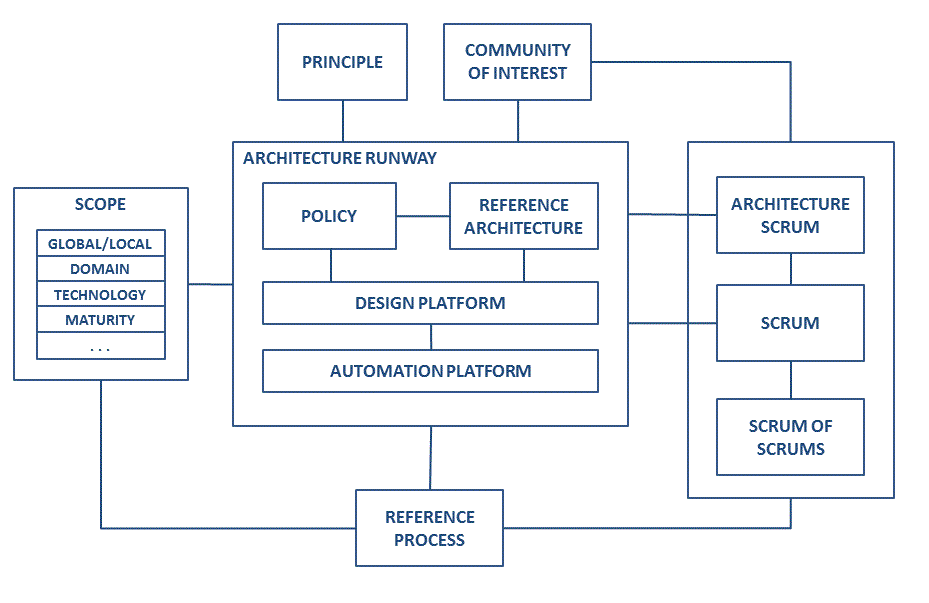
What’s required is a governance system that works in an Agile environment. The parameters of the Agile governance system comprise:
a) A defined Agile governance model
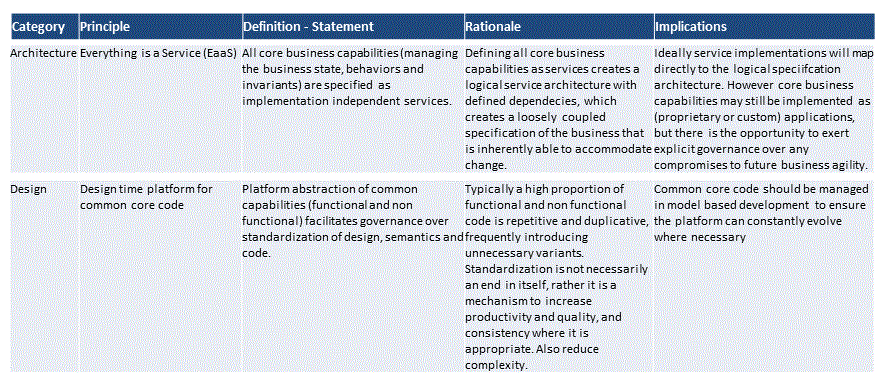
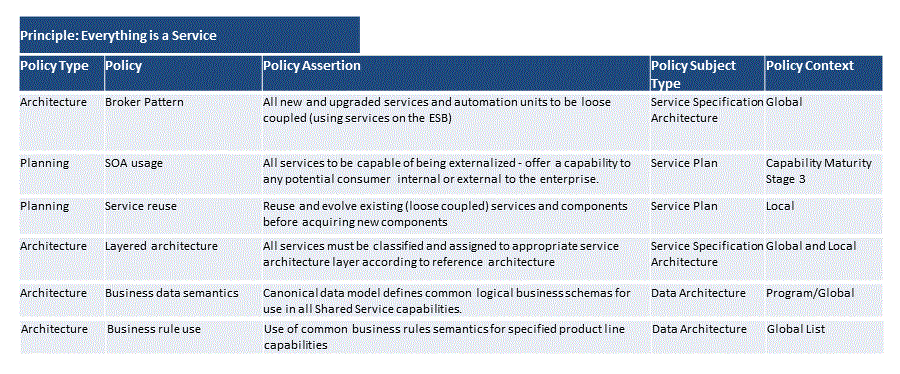
b) Defined principles and reference architecture that establish ways of working together with articulation of business value
c) Automation systems that progressively incorporate the principles and reference architecture into frameworks, tooling, design time platforms, deliverable profiles and knowledge management systems.
d) A Community of Interest (CoI) responsible for the governance system and communications
e) A communication system that ensures Agile projects are fully implementing the governance system, and providing at least retrospective feedback to the CoI that contributes to a common asset base as well as practice maturity.
The art of architecture is largely developed through experience. I’ve found that if you can put in place the right, structured approach you can overcome the challenge of lack of experience and help grow a high performing team. Continue reading →
Technology is playing a much bigger role in customer’s lives, and is changing the way senior management view the IT department. Historically the CIO’s role was to keep the lights running, now however, IT is considered to not only be the key to unlocking new revenue, but also a way of keeping up with the Read More
Organizations do not work, in real life, like they work on paper. On paper, there are departments (all shaped like a neat rectangle) and business processes with neat inflows and outflows of responsibility and information. On paper, you improve things by modeling things on paper, and then moving things around, on paper, then teaching people…
The reality of today’s highly competitive and customer demand-centric market conditions have pushed software (solution) delivery organizations beyond the traditionally accepted limits of software development and delivery capabilities. There is no argument that Lean methodologies such as Lean Six Sigma and DevOps can help improve operational solution delivery capacities through: Streamlining of solution delivery process Read more
The speed of innovation is accelerating at the edges. Actually, it has always been like that – some times in the form of shadow IT; some times in the form of one-trick mobile apps; some times in the form of technology diversity that an EA might not lik…
This week I released some more research on enterprise architecture. But this time it’s a bit different than what you usually see. For this research I wanted to focus on how EA helps enable impactful initiatives. So to kick that off I chose to publish best practices on Big Data. See the link below: Best […]
The post Get Your Enterprise Architects Plugged Into Your Big Data Initiatives appeared first on Mike J Walker.
This week I released some more research on enterprise architecture. But this time it’s a bit different than what you usually see. For this research I wanted to focus on how EA helps enable impactful initiatives. So to kick that off I chose to publish best practices on Big Data. See the link below: Best […]
The post Get Your Enterprise Architects Plugged Into Your Big Data Initiatives appeared first on Mike J Walker.