An Integrated Electronic Health Record Needs Enterprise Architecture for Communicating …

A lot of activity and progress is underway around the world right now, and has been for some time, regarding integrating and sharing health data for healthcare management and delivery purposes. Many standards, reference models and authorities have arisen to guide implementation and use of IT for these purposes, for example health information exchange standards driven by the Office of the National Coordinator for Health Information Technology (ONC – http://www.healthit.gov/).  Many very new and modern health IT capabilities and products are available now, alongside systems and data that may have been first created over 30 years ago (particularly in the Federal Government).

In the media and within procurement activity, the swirl of misused phrases and definitions isn’t clarifying many approaches.  Records vs. Data vs. Information. Interoperability vs. Integration. Standards vs. Policies. Systems vs. Software vs. Products or Solutions. COTS vs. Services vs. Modules vs. Applications. Open Source vs. Open Standards. Modern vs. Legacy vs. Current.

In Enterprise Architecture (EA) terms, the messages regarding Integrated Healthcare IT requirements aren’t commonly being presented at a consistent level of abstraction, according to a consistent architecture model and vocabulary. As well, the audience or consumers of this information aren’t being addressed in ways most impactful to their specific needs and concerns.

What are the audience concerns?  IT system owners need to maintain data security and system performance, within technology and investment constraints. Doctors need consistent, instant, reliable and comprehensive visualization of data and the point of care. Government oversight bodies need recurring validation that money is spent wisely and results meet both mission and legislative requirements. Veterans, soldiers and their families need absolutely private, accurate, real-time information about their healthcare status – wherever they are. The pharmaceutical and medical device industries need timely, useful data regarding outcomes and utilization – to drive product improvement and cost-effectiveness. Hospitals, clinics and transport services need utilization and clinical workflow measurements to manage personnel and equipment resources.

The highest separation of concerns can be segmented by standard Enterprise Architecture domains or “views”.  A very generic, traditional model is the “BAIT” model – i.e. Business, Application, Information and Technology. Note that this is very similar to the widely-known “ISO Reference Model for Open Distributed Processing” (RM-ODP) Viewpoints – which underpin evolving healthcare standards including the “HL7 Services Aware Interoperability Framework” (SAIF).

The “Business Domain” encompasses the discussion about business processes, financials, resources and logistics, organization and roles.  Who does what, under what circumstances or authority, and how outcomes are evaluated and purchased.  The business drivers and enablers of successful healthcare delivery, one might say.  

The “Application Domain” concerns automating the “practice of healthcare”. Automated systems (and their user interfaces) are very helpful in planning, monitoring and managing the workflow, resources and facility environments, and of course processing data for clinical care, surveillance and health data management and reporting purposes. This is where healthcare expertise is codified in software and device configurations, where medical intelligence and knowledge meets computer-enabled automation. This domain is the chief concern of clinical practitioners and patients – where they can most helpfully provide requirements and evaluate results.  Software that’s built to process healthcare data comes in many shapes and sizes, can be owned or rented, are proprietary or completely transparent.

The “Information Domain” is in essence the “fuel” for the Application Domain.  Healthcare practitioners and patients care that this fuel is reliable, protected and of the highest quality – but aren’t too invested in how this is achieved, beyond required or trained procedures.  It’s like filling the car with gas – there’s some choice and control, but fundamentally a lot of trust that the gas will do the job.  For those whose concern is actually delivering gas – from undersea oil deposits all the way to the pump – this domain is an industry unto itself. Likewise, collecting, repurposing, sharing, analyzing information about patient and provider healthcare status is a required platform on which successful healthcare user applications and interfaces are built. This is what “Chief Medical Information Officers” are concerned with, as are “Medical Informatics Professionals”. They are also concerned with the difference between healthcare “records”, “archives” and “information” – but that’s a discussion for another day.

It is critical to note that “Information” is composed of data; core or “raw” data is packaged, assembled, standardized, illustrated, modeled and summarized as information more easily consumed and understood by users. Pictures, sound bites and brief notes taken by an officer at an accident scene are data (as are “Big Data” signals from public social media and traffic sensors); the information packages include the accident report, the newspaper article, the insurance claim and the emergency room evaluation.  These days, with the proliferation of data-generating devices and sensors, along with the rapid data replication and distribution channels available over the Internet, the “Data Domain” itself can be a nearly independent concern of some – providing the raw fuel to the information fire, oil for refined gas.

The “Technology Domain” is essentially all of the electronic computing and data storage elements needed to manage data and resulting information, operate software and deliver the software results to user interfaces (like browsers, video screens, medical devices).  Things like servers, mobile phones, physical sensors, telecommunications networks, storage repositories – this includes the machine-specific software embedded into medical equipment.

Sidebar: Data Domain Standards

Quite a bit of work and investment is required to collect, filter, store, protect and make available raw data across the clinical care lifecycle, in order that the right kind of information is then available to be utilized by users or software. Most importantly, reusable, open standards and Reference Implementation Models (RIMs) concerned with the Data Management domain are foundation requirements for any effective healthcare information system that participates in the global healthcare ecosystem.

A RIM is basically working software or implementation patterns for testing and confirming compliance with standards, thereby promoting creation of software products that incorporate and maintain the standards.  It’s a reusable, implementable, working set of code with documentation – focused on a common concern, decoupled from implementation policies or constraints. RIMs are useful for facilitating standards adoption across collaborative software development communities at every layer of the Enterprise Architecture.

For example, a data-domain RIM developed several years ago by Oracle Health Sciences (in a clinical research setting) focused on maintaining role-based access security requirements when two existing sets of research and patient care data were merged for querying.  The design of the single RIM merged the HL7 Clinical Research Model (BRIDG) with an HL7 EHR Model (Care Record) to support a working proof-of-concept – that others could adopt as relevant.  The “concern” here was data security – separate from the information and application-level concerns of enabling multi-repository information visualization methods for researchers.

The point of this discussion on EA-driven separation of concerns is illustrated as follows. When a spokesman (or RFP author) says “the system will be interoperable” – it’s likely that by “system” the meaning is some segment of the “Application Domain” being able to exchange objects from the “Information Domain”.  Instead, a better phrase might be “the software application will be able to share standardized healthcare information with other applications”. This keeps the principle discussion at the application and information-sharing software level, and doesn’t make detailed assumptions or predictions regarding concerns in the Business, Data or Technology Domains.  Those are different, but related discussions, and may already be addressed by reusable, standard offerings, RIMs or acquisition strategies.   

Taking this approach to broadly interpret the recent announcement that the DoD will seek a competitive procurement for “Healthcare Management Software Modernization” – it appears the focus of this need is the Application Domain – i.e. software packages and/or services that generate and use healthcare information while managing healthcare processes and interactions.

To support these new software application features, separate but related activity is required to address “modernization” concerns among the other EA domains – concerns relating to datacenter infrastructure, data management and security services, end-user devices and interfaces, etc.  Some of this activity may not be dedicated to healthcare management, but be shared and supported for enterprise use, for other missions. That’s why use of a current, relevant EA frameworks (such as DODAF v2.02 and the OMB “Common Approach” ) is so important, managing shared capabilities and investments.   

Using standard EA viewpoints to separate concerns will also expose reuse opportunities (and possibly consolidate or reduce acquisition needs), i.e. leveraging existing  investments that are practical enablers. Some examples might include the developing iEHR health record structured message translation and sharing services, plus HHS/ONC initiatives including Health Information Exchange Networks and the “VA Blue Button” personal health record service.   

What Happened to the Fine Art of Business Analysis? – Revisited 2013

Link: http://taotwits-too-big-to-tweet.blogspot.com/2013/05/what-happened-to-fine-art-of-business.html

From Taotwit's Too-Big-To-Tweet

Back in 2008, I wrote a paper on Business Analysis. Recently, I’ve been revisiting this subject in my day-job and this made me realise how little things had changed and inspired me to write this post, which is, basically, the original article re-written, with additional thoughts (in italics).

The role of the Business Analyst has never been more important but needs refocus on Information Systems not the technical solution. Many of us can recall a time when a distinction was made between the hardware and software supporting the business and the information used by the business – there was a clear difference between IT, to describe the former, and IS to describe the latter. 
IS stood for Information Systems: 
IS: The landscape  of business  information used by people within an organisation 
and how they use information to deliver business outcomes. 

IT, in contrast, meant: 
IT:  The  hardware  and  software  technology  that  automates  or  otherwise  supports 
information processing. 

This distinction between these two concepts is all but lost, and the disciplines associated with Information Systems (such as Business Analysis and IS Architecture), are have become too obsessed with IT. 

Read more

SCRUM at the center of Enterprise Architecture

A couple of days ago a tweet from John Gøtze cought my attention

EA can be agile and scrummilicious, says @soerenstaun in guest lecture at the IT University of Copenhagen.
— John Gøtze (@gotze) 29. April 2013

And my reaction to it was it should:

“@gotze: EA can be agile and scrummilicious, says @soerenstaun in guest lecture at the IT University of Copenhagen.” I say it should!
— Kai Schlüter (@ChBrain) 29. April 2013


(c) Tom Graves

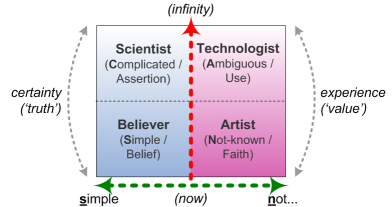
To explore this a bit further now finally this blog post. When I am tasked to implement Enterprise Architecture first time or to improve an existing capability then I put an agile approach in the core, preferable SCRUM. There is various reasons for this. To explain the concept I borrow the SCAN framework from Tom Graves, here in particular the post Sensemaking – modes and disciplines.


In my implementations of Enterprise Architecture activities I focus on the problem space Ambiguous and Not-Known. Ambiguous problems can be quite well solved with SCRUM, where “the whole is greater than the sum of it parts”, Aristotle. Agile approaches which do not put the team into the centre of their methodology do not seem to work as well in this problemspace. The identification to which quadrant a problem and the corresponding solution belongs is in my mind always an ambiguous problem, due to the scope of Enterprise Architecture, trying to cover the whole [which is more than the sum of its parts].

Problems which belong to Simple or Complicated I usually hand over as fast as possible to better suited teams or individuals, while the ambiguous problems I keep inside of Enterprise Architecture. The Not-Known space is total different and typically I focus on finding the Innovation which emerges here instead of trying to force it. I believe that Innovation can be easier found peripheral and not really by looking for it centrally.

By implementing SCRUM in the center some key elements needs to be in place to succeed. One of the most crucial elements is the Chief Architect, be it the official announced Chief Architect, or a manager (e.g. CIO) who is filling that role. The Chief Architect is the one who gets the SCRUM role Product Owner assigned. And here typically some effort and attention is needed to secure that the Chief Architect is focussing on delivering into his role as Product Owner instead of doing the actual work. The work should be done by the SCRUM team (or Pigs).

The most important element here is to create an environment in which the team utilizes the strenghts of each other. And here also lies one of the biggest challenges, because most Enterprise Architects have been grown from technical roles and have been survived quite some selection criterias till they have become an Enterprise Architect. Statistically I observe a high amount of heroes or divas, who are quite biased that an Enterprise Architect and especially they themselves are the crown of the evolution. Concepts like the Peter Principle support that thinking even more. 🙂

The only role which is fairly easy to fill is the SCRUM Master. Just take any good SCRUM Master who is NOT knowing much about Enterprise Architecture (preferred) or willingly not going into the content (sometimes hard, if the SCRUM Master is self biased believing to know better about Enterprise Architecture). So literally someone who only focusses on securing that the process runs.

This is of course not always easy to implement, but it is my main target to achieve. And I continue developing a team towards that target, till it is achieved. And when achieved the speed can be even increased, because then the environmental problems are solved and the focus can be on the delivery of good Enterprise Architecture Services, which is a post I also plan.  SCRUM helps me to deliver to my main objective. Enterprise Architecture and especially my approach GLUE is about People first:


Comments as always more than welcome.

EA Food Chain – Enterprise Architecture from Business Strategy to Operating Systems

Hard to add to the self explanatory picture above! Even though I am a technologist at heart, the discerning reader will surely appreciate the hogging of real estate by the word “Business”. After all, that is what it is all about.But please, please, ple…

What really matters

I planned for quite a while to write a post (or series of posts to be accurate) but there was always something distracting me. Well, that happens, so no worries. Yesterday and the day before I have been on the Gartner EA Summit which was truly great and enlightening in many different ways, despite my incapability to plan a bit ahead. When I left the hotel today 5:00 in the morning to catch the first flight home I truly planned to write about it, more than one post actually. But then something was brought to my intention, something what really matters. (I might though come back to the Gartner EA Summit and what I learned later).

The flight went fine and I got picked up as planned by the taxi. Perfect service by the way including Internet access and bottled water to drink. As always the travel went smooth and perfect, so I could work my way through a stockpile of email to put some things into context, sort one or the other topic. Basically normal travel type of work. But then, something was brought to my intention. Heavy impact actually.

  1. All of a sudden the driver had to go into the breaks, not really, but strong enough for me to recognize, so I looked up to see whats up and of course the classical motorway road works traffic jam.
  2. I heard some breaks, but nothing really worrying and then suddenly the driver was taking his hands away from the steering wheel and in that very same moment a large truck was blowing his horn and then the noise of metal, plastics and humans screaming.
  3. Something bumped also in the car I was sitting in (normally I was sitting always on the front seat, but this time I was sitting in the back to work) and a giant truck was sledging diagonal from the back into my sight field and into the farming field next to the roadway.
  4. [total silence]
  5. The driver of the truck left his truck within 10 seconds as far as I was able to recognize unharmed and the driver of the taxi I was sitting in just drove 20 meter forward to secure a way for potential emergency cars.
  6. Then we left the car, and it was a field of demolition. Apparently a second truck was standing on the emergency lane obviously heavily hit by something in the rear. A small bus for 8 persons was wrecked and standing on his wheels but into the wrong direction (later my driver told me that he has seen that bus doing a rollover), 2 cars have been hit heavily (airbags executed) and bumped into the cars in front of them, one of them obviously hitting us.

Our car and another car almost unharmed, just small scratches in the rear, but have a look at the red truck who litereally was flying in as my driver told me on the rest of the travel more than once.

  1. Almost at the very moment 4 people from Johanniter Unfallhilfe came running. I was truly impressed, but in reality it was just luck that they have been driving a couple of cars behind us. So the professionals could take over and did that really great. It was very fast clear that noone was harmed heavily. Everyone involved could walk, talk and was cleary able to response reasonable (despite some really shaking knees and white faces).
  2. Shortly afterwards police officers came to secure the area and a helicopter flew in. Impressive speed by the way, I haven’t clocked it, but it for sure was well below 10 minutes till the helicopter with the doctor was there.
  3. The volunteer fireworkers from that area also arrived with quite some vessels and people.
  4. What was obvious in that realm of chaos was high professionalism, but also quite some communication and handovers. From Johanniter to police to doctors to fireworkers. The cars were triple checked (Johanniter, Policemen, Fireworkers) All of the involved professionals spoke to the people involved in the accident, quite some confusion about many things for example insurance (how irrelevant at THAT moment, yet important for some. As far as I recognized it, that insurance concept was at least one thing people understood in that moment).
  5. They collected all of us and explained the steps and there was a fairly good atmosphere, because everyone was well aware that things could have been way worse. Personal data was recorded by the police people, the doctors did a short examination and send those from the more heavily impacted cars into hospital, the fireworkers cleaned the street to allow the emergency cars to drive through, lots of pictures were made.
  6. Not that I want to make that experience again or wish that anyone, but it was brilliant to see them in action, coming from knowing nothing to full control of the situation in less then 15 minutes.
 
Given all what I learned at the Gartner EA Summit (and other events), why can that story not be told different?
 
  1. Preventive
    1. A Traffic Jam is signalled back to the following cars (and to traffic control) and warns the drivers (like red alarm in Star Trek if you want) or even better forces the car to slow down, no matter what the driver believes.
    2. A car in trouble signals to the other cars (and traffic control) that it is in trouble.
    3. Cars are forced to have a relevant safety distance.
    4. Cars are forced to not overspeed (yes, there will be people who believe this should not be done, but in that case it would have helped a lot and under worse circumstances it would have saved life).
  2. Impact
    1. On an impact the car or environment is signalling to other cars as well as to traffic control.
    2. Traffic control sends a drone to examine the area and create a 3D model.
    3. That 3D model gets send to all potentially involved parties which can use it to plan the operation while already driving to location.
    4. Each unit supported by augmented reality updates new information real time into that model, so that everyone involved has the full picture and can therefore act acordingly, e.g. more people, specialized vessels, specialized skills, but also retreat if the impact was less harmful than thought. There could be way more parties involved than in this particular case.
  3. Afterwards
    1. All the information can be directly fed into the system including the 3D model for reports, insurance, news, whatsoever.
So thank you consumer market for bringing us all these great new potential, but it is only interesting. Relevant is something else, nevertheless, please explore more, because it might be useful somewhere else. Truly relevant. Over to you.
 
P.S.: This was just a quick writing, the accident is less than 8 hours ago and I was doing quite some other things in between, but I believe there could be many stories created out of this and potentially there are already units in the world building this system so that it is usable, easy to use and as cheap as possible. I can only hope for that.

June 2013 Events

One seminar (free) and several workshops (pay).Perspectives on Enterprise Architecture and Systems Thinking (EAST)14 June 2013, Central LondonThe meeting is intended for experienced practitioners of Enterprise Architecture (EA) and/or Systems Thinkin…

Enterprise Architecture Fatigue

Enterprise Architecture FatigueInteresting discourse with a new client. They have been through numerous attempts to establish Governance using Enterprise Architecture and every time they find themselves swamped with extremely clever people who produce …

Marketecture – a technique every architect should learn

One of the drivers for me to develop the content in my book “Stories that Move Mountains” was the development of many different ‘marketectures’ to help market the ideas in a new architecture. This idea resurfaced in a recent posting from Cutter.


http://blog.cutter.com/2013/04/09/marketects-delivering-good-enterprise-architecture/?utm_source=rss&utm_medium=rss&utm_campaign=marketects-delivering-good-enterprise-architecture