Luck, Serendipity, and the Contextual Strategist

Recently, @davegray @tetradian @nickmalik and I (@mikerollings) had a brief twitter exchange about the role of luck in strategy. What is luck anyway? Isn’t it just a happy accident, an unexpected happening, a simple explanation for the unexpected, a serendipitous association that leaves us in awe of the randomness of life? In that context, strategy […]

i-i-i is about Focusing on the Individual and Not Yourself

The “i” generation – not quite the selfish focused gang that was recently called out in the UK by its Chief Rabbi and noted by c|net’s Chris Matyszczyk. Like prior generational movements, this one too is misunderstood. The “i” generation is about the importance of the individual which is profoundly different than focusing selfishly on […]

Multi-Channel Retailing Takes a new Meaning with Retail Apps

Retail Reference Architecture, it’s evolution and real-life pragmatic implementations happens to be one of my key interest area. So far on this blog I have discussed the concept of Retail Reference Architecture, proposed a concise yet complete Simplified Retail Reference Architecture and also shared some of the innovations from real-life implementations of Retailers such as ASOS. As a matter of fact I do follow fortunes of ASOS with great interest. To me this is a bold, new take on the science of retailing (…some might call is an Art of Retailing) which combines best practices from innovator’s such as Amazon.com and presents a unique and deceptively simple business model. This post shares some of my further observations about ASOS and more importantly how they continue to lead the innovative use of Information Technology in the retail space.

Since summer ASOS  has launched its App for the Apple range of mobile devices. The new service has been designed for iPhone, iPad and iPod Touch users, and along with the function to ‘save for later’ any item of interest sold by the trader, the app also includes a locator for local drop-off points for customers looking to return unwanted purchases.
Free to download, the new app lets you browse and shop directly from fashion editorials, very similar to Net-à-Porter’s. The app comes with trend reports and also contains content originally produced for the online version of the Asos magazine as well as exclusive footage and features such as video and 360-degree views of clothing items. The iPad app is available for free from the App Store since August this year with both Android and iPhone versions scheduled to launch by the close of 2011. 

As the App design James Davie says, “this App design provided a series of new challenges. Most importantly striking the perfect balance between giving the user the familiar ASOS shopping experience, and the equally familiar iPad navigation experience. The final result is a balance of both which should give the user a quick, painless and enjoyable shopping experience.”  Having personally used this App now I can confirm that this is one of the best fashion retailing App available out there with intuitive navigation, fresh content, catalogue, bold designs and just tons of “coolness”! Above the cosmetics, what stands out for me is the fact that, customer accounts are totally synchronised across all of the retailer’s platforms so whether they are using the new apps, the standard website or the mobile site all of their details will remain consistent.
This App and iPad appear to be made for each other and not just a lift-off from ecommerce site made to fit with iPad format. Just to clarify I am not a regular ASOS shopper but as a keen Retail Technology practitioner and follower…this company and it’s innovation are worth watching!

Multi-Channel Retailing Takes a new Meaning with Retail Apps

Retail Reference Architecture, it’s evolution and real-life pragmatic implementations happens to be one of my key interest area. So far on this blog I have discussed the concept of Retail Reference Architecture, proposed a concise yet complete Simplified Retail Reference Architecture and also shared some of the innovations from real-life implementations of Retailers such as ASOS. As a matter of fact I do follow fortunes of ASOS with great interest. To me this is a bold, new take on the science of retailing (…some might call is an Art of Retailing) which combines best practices from innovator’s such as Amazon.com and presents a unique and deceptively simple business model. This post shares some of my further observations about ASOS and more importantly how they continue to lead the innovative use of Information Technology in the retail space.

Since summer ASOS  has launched its App for the Apple range of mobile devices. The new service has been designed for iPhone, iPad and iPod Touch users, and along with the function to ‘save for later’ any item of interest sold by the trader, the app also includes a locator for local drop-off points for customers looking to return unwanted purchases.
Free to download, the new app lets you browse and shop directly from fashion editorials, very similar to Net-à-Porter’s. The app comes with trend reports and also contains content originally produced for the online version of the Asos magazine as well as exclusive footage and features such as video and 360-degree views of clothing items. The iPad app is available for free from the App Store since August this year with both Android and iPhone versions scheduled to launch by the close of 2011. 

As the App design James Davie says, “this App design provided a series of new challenges. Most importantly striking the perfect balance between giving the user the familiar ASOS shopping experience, and the equally familiar iPad navigation experience. The final result is a balance of both which should give the user a quick, painless and enjoyable shopping experience.”  Having personally used this App now I can confirm that this is one of the best fashion retailing App available out there with intuitive navigation, fresh content, catalogue, bold designs and just tons of “coolness”! Above the cosmetics, what stands out for me is the fact that, customer accounts are totally synchronised across all of the retailer’s platforms so whether they are using the new apps, the standard website or the mobile site all of their details will remain consistent.
This App and iPad appear to be made for each other and not just a lift-off from ecommerce site made to fit with iPad format. Just to clarify I am not a regular ASOS shopper but as a keen Retail Technology practitioner and follower…this company and it’s innovation are worth watching!

Will Your Organisation Need a CIO by 2020?

The title of my new blog post is provocative. Why would I ask such a question, especially after covering number of CIO surveys, trends, leading CIO thought leaders and underlining the strategic importance of IT in this very blog? I am asking this question because the IT Landscape as you and I know it, is changing and very fast.  Even by IT industry standards the pace of recent developments is remarkable. The business technology is undergoing rapid evolution. And the central argument which I am presenting here is that the conventional role of CIO or CIO function as it stands today will either be ineffective, redundant or out-dated and hence not required by end of this decade. Let me explain…

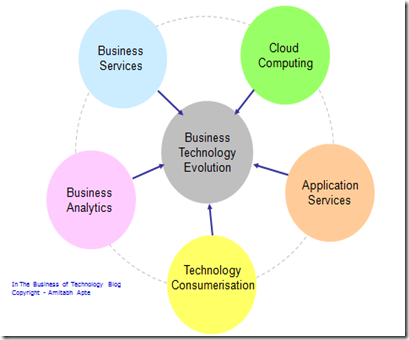
There are a number of reasons and drivers for the rapid evolution of business technology. However according to me there are five major forces which are influencing this evolution. They are Business Services, Application Services, Business Analytics, Consumerisation of IT and Cloud Computing. I will try to explain them briefly  
image

Rise of Business Services – Awareness of the fact that, “Organisations purchase technology to fulfil business needs” is growing like never before. Given economic challenges very few organisations can now justify technology investment for pure technology advantages. Your CEO, COO, CXO and CFO will be demanding “Return on Investment” (ROI) and “Value for Money” (VFM) from each technology $ invested and they will be demanding that most likely in year one. Days of five or even three year technology pay-back are certainly behind us. And this is where purchasing business services independent of large technology investment is becoming so attractive. There are a number of examples of this trend ranging from payment processing to HR processing. Google is taking business services to new dimensions.
 

A test question for you – If you are CEO of a mid-size organisation would you invest $5 Million in back office processing software, hardware, network, back-up, security etc.? Or would you sign up for business outcome based contract with niche business services supplier? I know your answer and mine is the same!
 
Maturing Cloud Computing IndustryEnough is written about benefits of Cloud Computing (including this blog) so I won’t repeat it. However it is safe to conclude that Cloud is more than hype. It is real and there is an entire industry being built around Cloud propositions by all major IT vendors as well as rising number of niche players. Cloud computing if adopted in right manner frees your organisation from capital intensive infrastructure and operations investments. The business justification will not be far different than arguments which I have listed above. Cloud computing however gives organisations added flexibility of building solutions to suit their requirements yet allows them to offload its capital and resource intensive aspects to infrastructure specialists. It can be easily argued that business services are a variant of cloud computing. 
Another test question for you – You are a CFO of retail chain and you have a legacy retail management application. Your peak business transactions are expected only in the months of March, September and December but for all other months you operate at half the transactions of peak. Would you like to scale up and down the capacity and hence the cost of your retail application operations? I know your answer and mine is the same!
 
Business Analytics Coming of Age – A large number of small niche companies and even large companies like IBM and Oracle are investing millions of $ in developing and enhancing business analytics products and services and they are doing this for a very good reason. People like you and me (and multiply that number by millions of Indians and Chinese) are adapting to self-service shopping lifestyle. When was the last time you went into your bank branch? Or when was the last time you bought a book in a book shop? When was the last time you called your airline or visited its city booking office to purchase your airline tickets? I know your answer….we are more and more relying on smart, intuitive ecommerce sites, price comparison sites, shopping portals, kiosks, ATMs, etc. to buy everyday and occasional things of need and desire. The merchants are looking for smarter ways to know you, your preferences, your wish lists and keep your loyalty. This is true for brick and mortar businesses too by the way. And smart merchants are turning to business analytics to make more sense of their business transactions, shopping patterns, supplier dependencies, seasonality and thousands of other trends which affect their business. 

Another test question for you – if you are a mid-size or small company COO running a brick and mortar plus an ecommerce portal for your business would you rely on your in-house MI experts to keep up with 1000s of changing patterns, equations, behaviours and trends? Or would you secure an external niche business analytics company to analyse tons of your business transactions, do the number crunching and present predictions for next quarter along with benchmarks? I know your answer and mine is not too different! 
 
Popularity of Application Services – This may be very specific development but worth making a note of. You may recollect my earlier blog on ASOS and how smartly they are leveraging open access to their applications of catalogues. Apple App Store is another example of this model. These smart technology and business models are making middleware software, hardware and tools almost redundant by giving core access to application tier of your business systems. You suppliers and partners deliver direct to your application and data tier, why bother with message brokering? See my proposed revised retail reference architecture and you will know what I mean. 

Let me not ask you a question but pass you my verdict on this one – No I don’t need an internal IT department to develop interface to launch my catalogue on Apple App Store. I will go to a niche small firm who will do it for me at fraction of cost to much better response times than internal development and test department. 
 
Spread of Technology ConsumerisationAgain enough is said about Apple ipad, Amazon Kindle, and Android smart-phones. The fact is if you are reading this you have either all of minimum one of them. And I know that you will prefer to carry your own ipad to work and do your office email, documents as well look for best place for Thurs after-work drinks on Google map on one of those boring conference calls. And if you organisation is not funding your smart-phone then you do not mind getting on an attractive tariff to join swelling ranks of smart mobile workers of next generation. I am not even mentioning Google Docs, Microsoft Office 365 and other similar offerings which liberate corporate IT. 

You know where I am going next – If your data privacy and security concerns were addressed would you mind if your employees brought their own IT equipment to work? I would not if I am a CFO of a business which made loss of double digit last year and who do not understand why I pay three times for a desk top compared to retail cost of ipad!
 
To summarise my argument – given these very influential forces which are shaping the world of business technology and the fact that they are here and will be growing in their influence….and their strong commercial as well as functional advantages; how long before your conventional CIO function turns into out-dated, ineffective and irrelevant cost centre? If the trajectory of this evolution continues like this, will your organisation need a CIO by 2020? I know your answer and mine is very similar!

A Model for Literature on Enterprise Architecture

I have been working with several different perspectives on governance, strategy, it architecture and enterprise architecture. I have read several books on the three topics and as such I have been able to build a model for categorizing the literature. … Continue reading

How Innovative Retail Architecture is Boosting Profits at ASOS

Outstanding and outperforming businesses often challenge conventional industry architectures. Such organisations innovate and develop new business models on their way to above-average profits. The online fashion giant ASOS (as seen on screen) has exact…

How Innovative Retail Architecture is Boosting Profits at ASOS

Outstanding and outperforming businesses often challenge conventional industry architectures. Such organisations innovate and develop new business models on their way to above-average profits. The online fashion giant ASOS (as seen on screen) has exactly done this. In one of firsts of the industry, ASOS intends to make free global shipping a “permanent” part of its business model after international sales growth fuelled a 63 per cent jump in sales in the first quarter to £107m. International sales grew 160 per cent to £59.6m in the three months to June 30, and now make up 57 per cent of overall sales. Singapore, Russia and Australia are among the fastest-growing markets. This is impressive compared to UK high street bellwether Marks & Spencer which narrowly beat City expectations recently by declaring a 13% increase in profits in its last financial year. But ASOS business performance looks blockbuster when it is compared to other retail results. For instance the gravity of the high street downturn is spelled out in new research which shows UK retail chains have been closing stores this year at a rate of about 20 a day. The latest figures from accountancy firm PricewaterhouseCoopers show 375 retailers went bust in the second quarter of 2011, a 9% increase on the same period last year. 

So what makes ASOS special? ASOS targets internet-savvy 16 to 34-year-old women looking to emulate the designer looks of celebrities such as Kate Moss, Sienna Miller and Alexa Chung, but at a fraction of the price. While many retailers have struggled against tough macro headwinds, ASOS has prospered, benefiting from a young core customer base and the migration of spending from the high street to the Internet. The firm has a Facebook store and mobile applications. “This is about the shopping experience coming to you. That could be via apps, on your mobile, on Facebook,” said the CEO. “This is the next shift in terms of how we perceive shopping online. Rather than websites that you go to I think it becomes much more part of your personalised web experience.” Compare and contrast this with the fact that, despite huge outlays in the past, the new Marks & Spencer boss is to spend an extra £600m on its UK chain. 

But the unsung hero behind ASOS flight according to me is the innovation which ASOS IT department is bringing to the business. ASOS has crashed the conventional retail reference architecture and brought innovation leveraging the technology advances such as Cloud Computing, Social Media and Consumer Devices. For instance ASOS is assessing how Microsoft’s Azure cloud service could be used to expose mobile data application programming interfaces, which would enable it to extend its reach through mash-ups. Daniel West, IT director, ASOS, has established an IT strategy to build for the cloud first, rather than on-premise. “We look at the cloud first and build if nothing is available.” Daniel West said: “My technology design is to support our international growth. So we need to look at delivery through the cloud.”

image
Innovative Retail Reference Architecture (Revised V2)

See my revised Retail Reference Architecture above which reflects ASOS innovation. (Ref: The original Retail Reference Architecture). The ASOS APIs which power the mash-ups empowers young ASOS customers to bypass traditional Retail Touch Points and Work-flows and access the ASOS catalogue directly. It has merged social networking and shopping by launching the first European fully integrated Facebook Store. ASOS customers are able to buy, save, share and comment on items without needing to leave the social networking site to obtain full e-commerce functionality.

ASOS successfully demonstrate that Industry Reference Architectures are a sound and solid foundation but they are not sacred and should be chopped, changed and innovated to bring dynamic benefits to the business. I am not claiming that innovative Retail Architecture is the only reason behind ASOS success. Smart branding, clear customer segmentation, effective supply-chain and visionary leadership have clearly contributed to ASOS success. However, the contributions from ASOS IT team can not be underestimated in the analysis of ASOS success.