EA Worst Practice Alert – This shiny EA tool is the solution for all my problems!

Enterprise Architecture’s fundamental purpose is to enable business outcomes by materializing business strategies into real solutions. As we have discussed in previous posts, there are some important aspects to maturing your Enterprise Architectur…

Cloud and Consumerisation Have Changed the Desktop Forever

This blog post is sponsored by T-Systems and the Zero Distance community. Cloud and the consumerisation of IT have changed the face of end user computing, and the desktop in particular irrevocably. When I look at the shape of end user computing, how much it has changed over the last couple of years, and what the future […]

How to Ensure Enterprise Architecture Success

Last week I asked everyone to get creative with Enterprise Architecture and bring sexy back. This week I would like to know how you arrived at the decision of implementing Enterprise Architecture and would like to guide you through the next steps.
Ensu…

Categories Uncategorized

The Art of Banking: How Financial Services Approach Great Customer Experiences

During a recent conversation with colleagues from the Financial Services sector, one person challenged: “Is there really anything new and innovative for banking technology, or have we already seen it all?” The lively discussion led to a far more interesting and important question: “Where are banks finding the inspiration and tools to drive customer-focused innovation?” […]

Related posts:

  1. Three Big Topics in Financial Services In the wake of this historic, global economic downturn there…
  2. Customer-Driven Conversation Understanding how to handle customer needs and expectations is critical…
  3. OpenText Smart Process Applications: In The Age of the Customer BPMS is not enough We live in “In the Age of the Customer” a…

Related posts brought to you by Yet Another Related Posts Plugin.

Survey: Information Security Attacks Up 25%

Guest post by Mark Lobel If you want to protect your information assets in today’s interconnected business environment, you need to know your enemy. What are they after, how do they aim to get it and how are you going to stop them? New hacker strategies, the Bring Your Own Device trend, and Cloud Computing are all combining to expose companies to unprecedented information security risks. Yet, companies are acting as if nothing has changed. […]

Building an Effective Enterprise Architecture Capability

Enterprise Architecture supports implementation of change in a coordinated way. Building an Enterprise Architecture Capability is a process of change in itself, and thus can be supported by Enterprise Architecture methods and tools. In this White Pape…

Categories Uncategorized

Holiday: time to do some in-depth reading

I’m just back from a great, relax holiday. Apart from having good quality time with my family, holiday is also a great time to immerse myself in some books. Instead of the quick information gathering I normally do by scanning my twitter timeline, quick-reading blog posts, and some more in-depth articles from time to time, I really focused on a single book for a couple of hours. Reading books really.

The post Holiday: time to do some in-depth reading appeared first on The Enterprise Architect.

Using CMU/SEI Quality Attribute Workshop (QAW) while developing an Architecture Vision

Business Scenarios are a proven technique to link business requirements to architectural models. According to TOGAF a Business Scenario is a description of:

  • A business process, application, or set of applications that can be enabled by the architecture
  • The business and technology environment
  • The people and computing components (called “actors”) who execute the scenario
  • The desired outcome of proper execution”

Recently I have been working with another technique which is commonly used by Software Engineering People but mainly for Software Architecture: Quality Attribute Workshops (QAWs) from CMU SEI (Carnegie Mellon Software Engineering Institute. This technique make use of interactive workshops with the main stakeholders of a project. Where you the solution is to be developed either internally or externally (not a COTS), then this technique could be combined with the Business Scenario.
A Quality Attribute Workshop (QAW) is a systematic approach to elicit the needed requirements. This will ensure that all quality attributes are included in the final design. To This end it:

  • is a facilitated method that engages system stakeholders early in the life cycle to discover the driving quality attributes of a software-intensive system
  • provides a way to identify important quality attributes and clarify system requirements before the software architecture has been created (Implementation Governance)
  • is based on the qualities and the non-functional requirements that may be captured in the Architecture Vision document, the team will identify and elaborate specific quality attribute scenarios and document them
  • produces a documentation that includes most of the quality attributes specified by the stakeholders

QAW defines two kinds of architectures:

  • System Architecture: the fundamental and unifying system structure defined in terms of system elements, interfaces, processes, constraints, and behaviours
  • Software Architecture: the structure or structures of the system, which comprise software elements, the externally visible properties of those elements and the relationships among them

The TOGAF specification considers the Enterprise as a System, however the term System in QAW is more related to IT Systems. QAW provides an opportunity to gather stakeholders together to provide input about their needs and expectations with respect to key quality attributes that are of particular concern to them. A similar concept to what we try to achieve with the TOGAF Business Scenario but with a focus on IT systems quality attributes.

It is also a purpose of identifying scenarios from the point of view of a diverse group of stakeholders which can then be used by the system engineers to analyse the system’s architecture and identify concerns. QAW is mainly addressing non-functional requirements and there is still needs to understand the problems we try to solve, gather functional requirements like in Business Scenarios.
clip_image002
Quality Attribute Workshops ensure that quality attribute scenarios are identified, prioritized, and refined before the software architecture is completed. Individual requirements are viewed in a forum in relation to one another in the context of the overall problem. Architecture is based on complete set of requirements that add up to a whole problem description.

Technique requires involvement – at an early stage in architecture project

  • Business stakeholders (end users)
  • Systems stakeholders (installers, administrators, DBAs; network, training, acquirers, system and software engineers, etc.)
  • Other stakeholders (such as Operations amongst others)

The QAW provides:

  • Increased stakeholder communication, an informed basis for architectural decisions
  • Improved architectural documentation, and support for analysis and testing throughout the life of the system

And the results include:

  • A list of architectural drivers
  • Raw scenarios
  • A prioritized list of raw scenarios
  • Refined scenarios

During the workshops the Stakeholders receive a “participant’s handbook” providing example quality attribute taxonomies, questions, and scenarios.

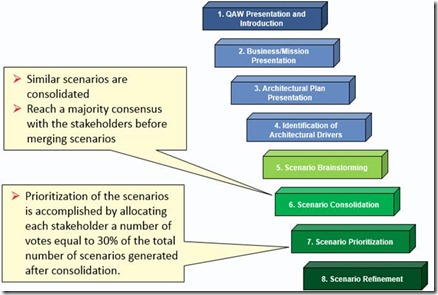
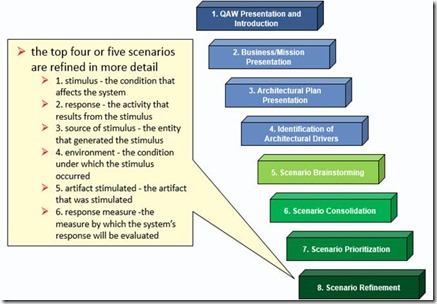
Below are the steps of the QAW.
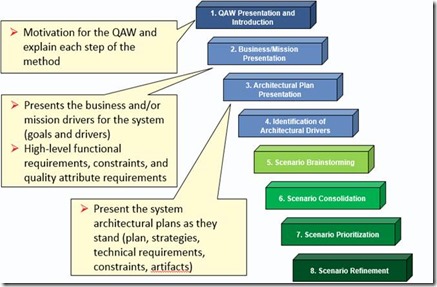
clip_image004
clip_image006
clip_image008
clip_image010
Business and/or mission drivers for the system (goals and drivers), plan, strategies, high-level functional requirements, constraints, artifacts and quality attribute requirements should be presented to the stakeholders. Using Business Scenario in conjunction with QAWs can be an appropriate approach.

A QAW lends itself to the capture of many architecturally relevant materials:

  • Software architectural documentation is a collection of view packets plus any documentation that applies to more than one view
  • Each view packet contains a primary presentation, a catalogue of the view’s elements (including element behaviour), use case diagrams, sequence diagram, context diagrams, collaboration diagram, a variability guide, architecture background (rationale, analysis results, and assumptions about the environment), and other information including mapping to requirements

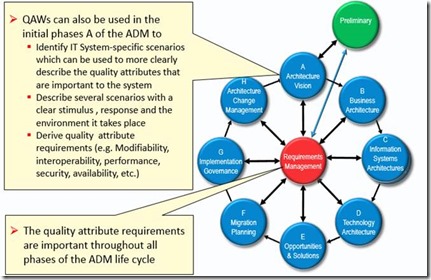
These elements may also be produced in a Business Scenario or produced later in the ADM phases A : Architecture Vision, C: Information Systems Architectures (stakeholders management and taxonomy of artifacts).

clip_image012
The outputs from the QAW can be summarised as:

  • A list of architectural drivers
  • Raw scenarios
  • A prioritized list of raw scenarios
  • Refined scenarios
  • Questionnaire

Quality attribute requirements are the means by which a system is intended to meet its business goals and QAW helps to document them.

Software architectures must be designed so that their quality attributes are met.

The QAWs technique can be utilised as a complementary approach to gather all sort of requirements including those from Software Architectures when appropriate.

Using CMU/SEI Quality Attribute Workshop (QAW) while developing an Architecture Vision

Business Scenarios are a proven technique to link business requirements to architectural models. According to TOGAF a Business Scenario is a description of:

  • A business process, application, or set of applications that can be enabled by the architecture
  • The business and technology environment
  • The people and computing components (called “actors”) who execute the scenario
  • The desired outcome of proper execution”

Recently I have been working with another technique which is commonly used by Software Engineering People but mainly for Software Architecture: Quality Attribute Workshops (QAWs) from CMU SEI (Carnegie Mellon Software Engineering Institute. This technique make use of interactive workshops with the main stakeholders of a project. Where you the solution is to be developed either internally or externally (not a COTS), then this technique could be combined with the Business Scenario.
A Quality Attribute Workshop (QAW) is a systematic approach to elicit the needed requirements. This will ensure that all quality attributes are included in the final design. To This end it:

  • is a facilitated method that engages system stakeholders early in the life cycle to discover the driving quality attributes of a software-intensive system
  • provides a way to identify important quality attributes and clarify system requirements before the software architecture has been created (Implementation Governance)
  • is based on the qualities and the non-functional requirements that may be captured in the Architecture Vision document, the team will identify and elaborate specific quality attribute scenarios and document them
  • produces a documentation that includes most of the quality attributes specified by the stakeholders

QAW defines two kinds of architectures:

  • System Architecture: the fundamental and unifying system structure defined in terms of system elements, interfaces, processes, constraints, and behaviours
  • Software Architecture: the structure or structures of the system, which comprise software elements, the externally visible properties of those elements and the relationships among them

The TOGAF specification considers the Enterprise as a System, however the term System in QAW is more related to IT Systems. QAW provides an opportunity to gather stakeholders together to provide input about their needs and expectations with respect to key quality attributes that are of particular concern to them. A similar concept to what we try to achieve with the TOGAF Business Scenario but with a focus on IT systems quality attributes.

It is also a purpose of identifying scenarios from the point of view of a diverse group of stakeholders which can then be used by the system engineers to analyse the system’s architecture and identify concerns. QAW is mainly addressing non-functional requirements and there is still needs to understand the problems we try to solve, gather functional requirements like in Business Scenarios.

clip_image002
Quality Attribute Workshops ensure that quality attribute scenarios are identified, prioritized, and refined before the software architecture is completed. Individual requirements are viewed in a forum in relation to one another in the context of the overall problem. Architecture is based on complete set of requirements that add up to a whole problem description.

Technique requires involvement – at an early stage in architecture project

  • Business stakeholders (end users)
  • Systems stakeholders (installers, administrators, DBAs; network, training, acquirers, system and software engineers, etc.)
  • Other stakeholders (such as Operations amongst others)

The QAW provides:

  • Increased stakeholder communication, an informed basis for architectural decisions
  • Improved architectural documentation, and support for analysis and testing throughout the life of the system

And the results include:

  • A list of architectural drivers
  • Raw scenarios
  • A prioritized list of raw scenarios
  • Refined scenarios

During the workshops the Stakeholders receive a “participant’s handbook” providing example quality attribute taxonomies, questions, and scenarios.

Below are the steps of the QAW.
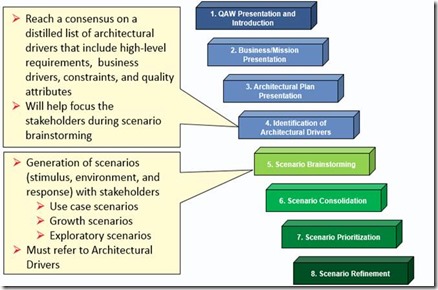
clip_image004
clip_image006
clip_image008
clip_image010
Business and/or mission drivers for the system (goals and drivers), plan, strategies, high-level functional requirements, constraints, artifacts and quality attribute requirements should be presented to the stakeholders. Using Business Scenario in conjunction with QAWs can be an appropriate approach.

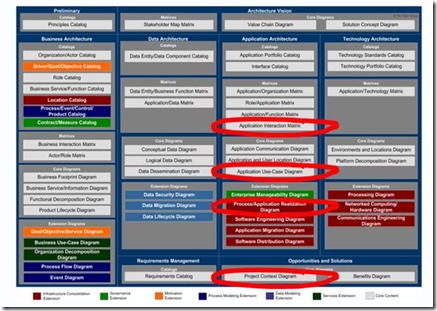
A QAW lends itself to the capture of many architecturally relevant materials:

  • Software architectural documentation is a collection of view packets plus any documentation that applies to more than one view
  • Each view packet contains a primary presentation, a catalogue of the view’s elements (including element behaviour), use case diagrams, sequence diagram, context diagrams, collaboration diagram, a variability guide, architecture background (rationale, analysis results, and assumptions about the environment), and other information including mapping to requirements

These elements may also be produced in a Business Scenario or produced later in the ADM phases A : Architecture Vision, C: Information Systems Architectures (stakeholders management and taxonomy of artifacts).
clip_image012
The outputs from the QAW can be summarised as:

  • A list of architectural drivers
  • Raw scenarios
  • A prioritized list of raw scenarios
  • Refined scenarios
  • Questionnaire

Quality attribute requirements are the means by which a system is intended to meet its business goals and QAW helps to document them.

Software architectures must be designed so that their quality attributes are met.

The QAWs technique can be utilised as a complementary approach to gather all sort of requirements including those from Software Architectures when appropriate.

Context is Everything!

“Context eats strategy for lunch.” This quote is typically attributed to Peter Drucker, one of the most revered management consultants and business authors of all time, whose writings made significant contributions to the foundations of today’s business corporation. Most of us know this to be true . . . yet, we often ignore it in […]

Ten Ways to Kill An Enterprise Architecture Practice

Have you seen practices that you know could kill an Enterprise Architecture practice?  I have.  A recent LinkedIn thread asked for examples, and I came up with my top ten.  I’d love to hear your additions to the list.

How to screw up an EA practice

  1. Get a senior leader to ask for EA without any idea of what he is going to get for it. If necessary, lie. Tell leaders that EA will improve their agility or reduce complexity without telling them that THEY and THEIR BUSINESS will have to change.
  2. Set no goals. Allow individual architects to find their own architecture opportunities and to do them any way they want.   Encourage cowboy architecture.
  3. Buy a tool first. Tell everyone that they need to wait for results until the tool is implemented and all the integration is complete.
  4. Get everyone trained on a “shell framework” like Zachman. Then tell your stakeholders that using the framework will provide immediate benefits.
  5. Work with stakeholders to make sure that your EA’s are involved in their processes without any clear idea of what the EA is supposed to do there. Just toss ’em in and let them float.
  6. Delete all the data from your tool. Give no one any reason why. You were just having a bad hair day.
  7. Get in front of the most senior people you can, and when you get there, tell them how badly they do strategic planning.
  8. Change your offerings every four months. Each time, only share the new set of architectural services with about 20% of your stakeholders.
  9. Create a conceptual model of the enterprise that uses terms that no one in the enterprise uses. Refer to well known business thinkers as sources. When people complain, tell them that they are wrong. Never allow aliases.
  10. Every time you touch an IT project, slow it down. Occasionally throw a fit and stop an IT project just for fun. Escalate as high as you can every time. Win your battles at all costs.

Your career will be short. 🙂