Why do you need an architecture repository?
A Labnaf White Paperby Alain De Preter Why do you…
Aggregated enterprise architecture wisdom
A Labnaf White Paperby Alain De Preter Why do you…
 Today, we are honored and excited to announce a new external investor in Bizzdesign: Main Capital Partners (“Main”). With a keen focus on investing in B2B SaaS companies, we’re confident that Main is a natural fit to help us accelerate our strategic growth strategy. With Main by our side, we can further sharpen our focus…
By Satya Misra, Associate Director, HCL Technologies
Can you envisage a business that has no clear idea of what it has to work with and how it will achieve crucial goals? Sounds bizarre right! But this is very likely to happen due to the lack of skilled people who can understand and align business goals with a technical strategy and architecture that’s capable of supporting the current needs. This introduces us to an imperative discipline, Enterprise Architecture, which is considered a silver bullet by most organizations.
By Vishal Kumar, Consultant, Deloitte Consulting
A master’s in business administration helps students understand business dynamics better. I believe having the ability to see business as a wholesome thing is paramount in today’s era. There is a dire need for students to apply the lens of Enterprise Architect and break the silos approach to enable students to see the business as a single unit. It is pivotal to understand that enterprise doesn’t run in silos the way the subjects during our MBA might make us think. For an enterprise to run efficiently and effectively, it needs to run collaboratively, i.e., all the fundamental constituents of an enterprise need to make progress in tandem.
“An enterprise is only as strong as the weakest link.”
Let’s take an analogy of the human body. For a human body to run efficiently, it needs an intention and goal, and it requires food as fuel, sleep as refreshment and a family as a support system.
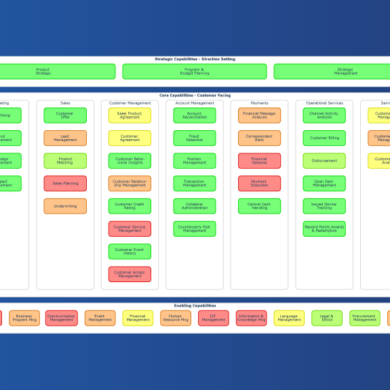 As we explained in our previous blog on capability assessment, to effectively assess Capabilities and execute Capability-Based Planning, we need to define three dimensions: Strategic Importance, Capability Maturity, and Adaptability, and measure them. Simply put, the first dimension lets you prioritize those capabilities that are most important to your enterprise; the second focuses on where…
By Kees van den Brink, Senior Manager Platform Architect, ServiceNow.
This blog title is derived from the famous quote by George E.P. Box from his paper “Science and Statistics”:
Box made this statement in relation to the use of statistical models by scientists, but I’ve found that it applies equally well to the use of open standards by enterprise architects and other digital practitioners.
Key take away from this blog:
o Standards can be useful when you:
o Learn and adopt from what makes sense
o Reject what does not fit
o Want to know more: Read “The Turning Point: A Novel about Agile Architects Building a Digital Foundation”
Frankly, standards can be very helpful and are necessary, like the TCP/IP standard, or even old standards such as the Baudot Code (https://en.wikipedia.org/wiki/Baudot_code), which helped early instances of what would later be called telecommunications companies grow fast, or the ISO Standards, which help with interoperability.
However, there are a lot of lesser-known standards that are not getting such broad adoption. Examples that come to mind are the IT4IT™ Standard, TOGAF® Standard, BIZBOK®, etc.
What technical and financial analytics should CIOs and decision makers expect from Enterprise Architects in 2022?
Enterprises are in the middle of an application explosion and a transformation acceleration.
Looking just at the application landscape: industry surveys tell us that the average enterprise is using 1,295 cloud services , and also runs around 500 custom applications . The worldwide enterprise applications market reached $241 billion last year, growing 4.1% year-over-year in 2020, according to IDC .
The underpinning architectures of enterprises– made up of interactions between people, processes and technology, and often also physical assets (IoT) – are also growing and changing at pace.
Enterprise Architects keep CIOs and business units informed using IT cost calculations and technical and lifecycle metrics.
They will often present costs and technical metrics for the current IT landscape, plus forecasts to inform planning for new business scenarios and digital transformation projects.
 Architects are typically professional at creating designs, analyses and plans that set their audiences in motion. However, to captivate your audiences, it’s important to create appealing visuals to convey a key message successfully. Yet, if your visuals are not presented with adequate context and structure, the impact of your message is limited at best. How…
By Paul Sheldon In 2006, Jeanne Ross, Peter Weill and…
By Iver Band, EA Principals Senior Instructor and ArchiMate Expert…
This is the last, 5th instalment on Roam. Here I’ll share how I use it. This part will be easier to write than some of the previous ones. What won’t be easy is to keep it short. Here are the links to the previous post in the series: Part 1: what is it, Part 2: […]
Many organizations have started to break up a portion of their monolith applications and systems, transitioning to sets of smaller, interconnected microservices.
A recent survey by TechRepublic, found that organizations who used microservices were reaping clear benefits: 69% were experiencing faster deployment of services, 61% had greater flexibility to respond to changing conditions, and 56% benefited more from rapidly scaling up new features into large applications.