“Making Pianos” or “Being an Artist”

I saw a story on CBS about Wally Boot who has worked at the Steinway factory for 50 years. He was born on Steinway Street and has learned how to make every part in a Steinway, but what he makes is so much more. At the end of the story, Charlie Rose says “there is […]

The post “Making Pianos” or “Being an Artist” appeared first on Mike Rollings.

Enterprise Architecture – A Perfect Tool for Operating Model Management

On this blog I have covered the discipline of Enterprise Architecture from a number of perspectives. Enterprise Architecture (EA) can be effectively leveraged as a foundation for Industry Reference Architectures e.g. The Retail Reference Architecture. Equally effectively EA can also be leveraged as the mechanism for Business and Technology Governance as well as Technology Performance Monitoring. In this article I would like to propose that Enterprise Architecture is also an effective tool for the Operating Model management, both for the definition as well as the ongoing lifecycle management. 
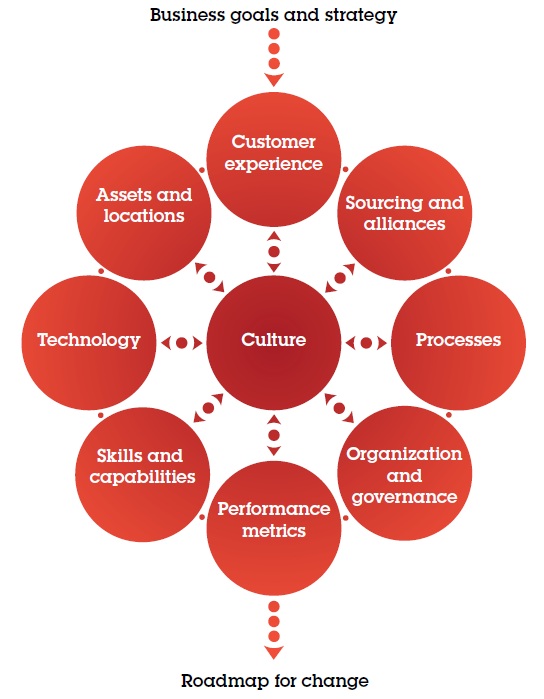
It may be worthwhile visiting some industry definitions for Operating Model before we explore how Enterprise Architecture can be effective here. The definition of Operating Model varies based on the Organisational and Operational context in which it is applied and hence probably one definition may not fit all Operating Model scenarios. However if I had to choose one definition, I would like to refer to the IBM’s definition of the Operating Model (see the picture below)
IBM Target Operating Model (TOM)

IBM proposes that a Target Operating Model (TOM) helps determine the best design and deployment of resources to achieve an organization’s business goals. It provides current operational maturity assessment and roadmap to defining and/or improving organisation’s Operations Strategy. Key deliverable include business review, current operating model assessment, desired future state and change management plan roadmap.
The TOM essentially is seen here as the mechanism to link the business goals and strategy of the organisation with the roadmap for change to achieve those goals. TOM then holds together various organisation concerns such as processes, technology, capabilities, customer view, governance and partners in a single cohesive fashion.
 
Now that we have briefly summarised an illustrative Operating Model definition, let us explore how Enterprise Architecture as a discipline or practice can be leveraged as a tool for its management. There are a number of good Enterprise Architecture Frameworks available for this purpose and recent revisions of certain frameworks have further established them as leading candidates for this purpose. I do not advocate or support a specific Enterprise Architecture Framework on this blog however for illustration purposes I am going to be using the TOGAF 9 as the tool for Operating Model Management. I would like to also mention the Zachman EA framework as the other leading framework which may be equally effective or in some application scenarios it may be a better fit. 
The purpose of this article is not to explain or define the TOGAF 9 and I would highly recommend visiting the OpenGroup website for relevant documentation. However for the ease of reference, I am going to share the TOGAF ADM which is the process for Enterprise Architecture Management in TOGAF. 
The process links the Vision and Strategy of the Organisation and its business / functions with a portfolio of change programs which realises this Strategy. TOGAF uses various architecture disciplines such as Business Architecture, Information Architecture (Data and Application) and Technology Architecture as mechanism for linking the Strategy with Implementation and Governance of Change programs to deliver on the Strategy. 
The central argument which I am now going to make is that such a process of Enterprise Architecture can be seamlessly deployed and leveraged to manage the Organisation Operating Model. A number of Enterprise Architecture Frameworks and especially Zachman categorically state that the application of Enterprise Architecture should not be restricted or limited to the Information Technology systems. It is a true framework for organisation and business management. For instance applying the TOGAF to manage the IBM TOM will result in following steps / mapping. The key here is to use tools, processes, approach, templates and constructs from each of the TOGAF ADM stage to define and develop the TOM stages as seen in figure – 1. 
  1. The business goals and strategy can be defined by the Preliminary phase while the vision underpinning this is defined in Phase A. Architecture Vision
  2. The Assets and the Locations of the TOM along with key processes can be captured and defined during the Phase B. Business Architecture
  3. Certain aspects of skills, capabilities, culture and processes too can be captured in Phase B
  4. The Technology, Processes, Performance Metrics can be captured through phases C and D while defining the Information and the Technology Architecture.
  5. The sourcing options and alliances can be identified and shortlisted in phase E. Opportunities and Solutions
  6. The phase F of migration planning can be used to identify the roadmap for change through what TOGAF calls as transition architectures
  7. Finally culture which is central to TOM needs to be constantly be a driving force as well as the recipient for the requirements for change
I would like to again highlight that this is simply an illustration of managing a view of Operating Model with a particular EA approach. However a number of other variations can be equally effectively managed by similar approach. It will probably make sense to present an illustration and mapping using other EA framework such as Zachman…may be a topic for next post on this blog!

References:

Strategy and transformation for a complex world, IBM Global Services, Mar 2011

The TOGAF Architecture Development Method (ADM)

The Zachman Framework

Business Performance Management, the next big thing…again

We all possess the gene to want to solve problems when faced with them. It’s human nature. People form organizations and this gene sometimes manifests itself in organizational titles and roles invented to address organizational challenges. This is natural too. For example, when support organizations face the challenge of aligning to business organizations, we see…

New Publication: A Systemic-Discursive Framework for Enterprise Architecture

John Gotze and I have published a new peer-reviewed paper in the Journal of Enterprise Architecture with the title: A Systemic-Discursive Framework for Enterprise Architecture. You can download the paper from here (note: this requires AEA membership). If you are not a member of AEA let me know and I will send you a PDF copy of the paper.

This article examines, through a case study of an Australian government agency, the systemic and discursive properties of Enterprise Architecture adoption in a government enterprise. Through the lens of Luhmann’s generalised systems theory of communication, the authors argue that the manner in which organisational communication is organised throughout the Enterprise Architecture adoption process has a noticeable impact on successful implementation. Two important conclusions are made: Firstly, successful Enterprise Architecture adoption demands sustainable resonance of Enterprise Architecture as a discourse communicated in the enterprise. Secondly, misunderstanding and reshaping Enterprise Architecture as a management discourse is an inherent premise for high quality adoption. The authors propose a new theoretical model, the Enterprise Communication Ecology, as a metaphor for the communicative processes that precede, constrain, and shape Enterprise Architecture implementations. As a result, Enterprise Architecture as a discipline must adopt a systemic-discursive framework in order to fully understand and improve the quality of Enterprise Architecture management programs.

Enjoy!

Business Architecture enables Tactical “doers” to implement Strategy – Part 2

Upon reading the article titled As Chocolate Is To Peanut Butter, Strategy Is To Tactics, by Nacie Carson, author of The Finch Effect, two questions came to mind. How does the team leader/manager identify which of their organization’s strategic outcomes they can impact, either directly or indirectly and how much  impact can they actually have?

The post Business Architecture enables Tactical “doers” to implement Strategy – Part 2 appeared first on Louise A Harris on Enterprise Business Architecture.

The Planning Paradox

One of my uncle’s favorite jokes goes like this: Greg: “Hey Gabriel, say to me ‘what’s the most important thing about humor?’” Gabriel: “Okay Greg, what’s the mo-“ Greg: “Timing.” [At this point, you’re supposed to laugh] “Timing” is the most important thing to business strategy planning As it turns out, timing is also the…

Business Architect Skills Assessment

Six years ago I posted a blog article called Solution Architect Skills Idea. At the time, I was a practicing Solution Architect pushing the boundaries to mature the Solution Architect discipline. I built the Solution Architect Skills Assessment to help organize the skills I felt were necessary to be a world class Solution Architect and…

Stories that Move Mountains – is out !

The last year has been a very busy one, and for everyone who subscribed to this feed a rather poor one in terms of entries. The reason for the lack of postings is very simply down to the effort required to write a book!.

This was released in the UK a few weeks ago and will be released in the US later in November. We have a website for the book with its own blog that provides background to the ideas of storytelling and visual design:

http://storiesthatmovemountains.com/

We also have a Facebook page where we hope to build more of a community around the CAST model and gather feedback.

http://www.facebook.com/StoriesThatMoveMountains


In the last few days a good selection of pages from the book have been uploaded to Amazon to allow you to click inside and see the very visual style we used.

You can also go to ComputerWeekly.com research library and read chapter 2 in full (although a registration is required).

If you download the chapter and scroll right to the end you will find out how to buy the book with a 30% discount.

I’ll get back to blogging about IT, Enterprise Architecture and IT Strategy on this blog, so if you’re interested in the content for storytelling, visual design and improving your presentations please take a look at the facebook page and my other blog.