It’s Time IT Is Part of the Business

For years, we’ve been talking about achieving business value from IT. Now it’s time for a change in language and attitude. Instead of referring to “IT and the business,” let’s talk about “IT and other parts of the business.” Why? It boils down to three reasons: The digital economy is already here We are in […]

Winning Over Choosey Multichannel Customers

Guest post by Ian Kahn When you think about a multichannel consumer, you probably envision a customer who is running from store to store and bouncing from web site to web site in search of the best deal. In reality, multichannel consumers have a limited list of retailers among their favorites, according to PwC’s 2014 Global Total Retail Survey of nearly 15,000 consumers. PwC defines multichannel customers as those who purchase from at least two […]

Events, messages and state

I have recently had the need to think about messages, events, and state. I may have finally caught up to where Nigel Green was three years ago!These three ideas are often bundled together, but really they represent different things. And when we try to …

The Wrong Answer

I am frequently appalled by the lack of rigor in this craft and this has been recently highlighted to me by a linguistic habit that I suspect comes from a younger generation. ( Sorry guys feel free to have a hack at the old bastard!) That is the use of the answer Yes/No to a […]

Mapping Agile Architecture

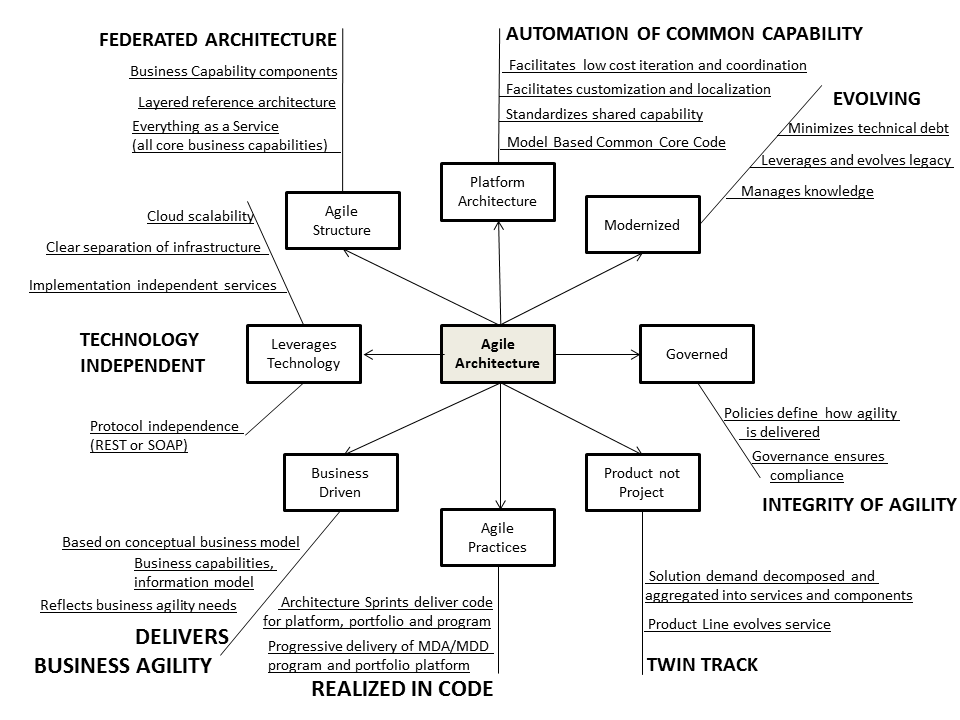
Jason Bloomberg recently published a mind map for Agile Architecture. It’s a nice map that sketches top level thinking and I welcome that. It prompted me to do a drill down.

Mind maps are useful in that they are, by definition free form and intended to support brain storming. The downside is obvious – they are generally inconsistent and cause modelers’ intense frustration! Caveat emptor over, I fully agree with Jason that we need a dual interpretation of Agile  – that is Agile practices and Agile Architecture, and I have written about this on many occasions. Also that the entire motivation is about business agility. On this last point my mind map is clearly a little more technical than Jason’s, and on reflection I think that is because it’s essential to converge the business and technology concerns.

For example, the map suggests a strong capability centric approach to interpret the business morphology. However this is insufficient; the technology must also establish appropriate levels of implementation independence that will facilitate the pluggability of business capabilities. Similarly you might think that considerations regarding the platform and delivery technology (such as MDA/MDD) are irrelevant to business concerns. However the platform and platform delivery technology are potentially massive drivers of rapid iteration and ongoing change, because they encapsulate common application level infrastructure and common services, so understanding the “business” standardization and localization model is crucial to delivering agility through this structure.

References:
Related posts: 

Mapping Agile Architecture

Jason Bloomberg recently published a mind map for Agile Architecture. It’s a nice map that sketches top level thinking and I welcome that. It prompted me to do a drill down.

Mind maps are useful in that they are, by definition free form and intended to support brain storming. The downside is obvious – they are generally inconsistent and cause modelers’ intense frustration! Caveat emptor over, I fully agree with Jason that we need a dual interpretation of Agile  – that is Agile practices and Agile Architecture, and I have written about this on many occasions. Also that the entire motivation is about business agility. On this last point my mind map is clearly a little more technical than Jason’s, and on reflection I think that is because it’s essential to converge the business and technology concerns.

For example, the map suggests a strong capability centric approach to interpret the business morphology. However this is insufficient; the technology must also establish appropriate levels of implementation independence that will facilitate the pluggability of business capabilities. Similarly you might think that considerations regarding the platform and delivery technology (such as MDA/MDD) are irrelevant to business concerns. However the platform and platform delivery technology are potentially massive drivers of rapid iteration and ongoing change, because they encapsulate common application level infrastructure and common services, so understanding the “business” standardization and localization model is crucial to delivering agility through this structure.

References:
Related posts: 

The Next Chapter of Enterprise Architecture: Self-Service

bg outline

By: Ben Geller, VP Marketing, Troux

serving everyone v2Enterprise Architecture (EA) has changed exponentially over the years with transforming from an IT-driven initiative to a business strategy necessity.  EA as a field formally took shape in 1987 with the publication of John Zachman’s article “A Framework For Information Systems Architecture”. The paper described both the need for and the challenges of managing increasingly scattered systems:

“The cost involved and the success of the business depending increasingly on its information systems require a disciplined approach to the management of those systems.”

In today’s world we are seeing dramatic changes in how reaching this information system nirvana plays out. Why? Because we live in a world where digital access and apps are available for everything and anything. With digital and technological disruptors firmly rooted in our world there is a massive mind shift at play in how we interact with technology as well as how we expect to get things done.

Naturally, that has significant impact on EA, an IT-rooted discipline that both drives and manages change across the technology landscape.

Consumers are now accustomed to doing things themselves, and those expectations carry over into the business environment. Thanks to our “there’s-an-app-for-that” world, the IT department isn’t the only one who interacts with technology. We live in a world where everyone wants to be hands-on to leverage IT solutions and information.

What does this mean for EA?

These shifts open up a world of opportunity, or better yet a major necessity, for a function that can connect the enterprise dots to achieve a greater business outcome. EA is in the best position to step into that role. Critical business decisions require seeing the big picture in any situation. The big picture is gained through insights that answer the businesses most important questions. Successful EA should empower and inform stakeholders to answer these questions and make sound decisions using combined enterprise knowledge.

Today’s Version of EA: Beyond the IT Function

In December 2013 Gartner published Predicts 2014: Enterprise Architect Role Headed for Dramatic Change, highlighting the future version of EA which crosses business functions and often lives outside of IT altogether.

  • Over 78% of EA practitioners are focused on leveraging EA to integrate business and IT, as well as to grow and transform their businesses.
  • Today, 55% of organizations are supporting EA with either the collaboration or participation of business leaders.

At Troux, we call this new era of EA enterprise intelligence. Enterprise intelligence gives the C-suite and their decision-making counterparts a heightened level of transparency by establishing a line-of-site that spans the enterprise as a whole without weighing down IT resources to make it happen.

The Way Forward

If you are reading this thinking, we are so behind the curve, go easy on yourself. The new era is in the early stages. Gartner estimates that market penetration of business architecture is at 20 percent. There is a lot of ground to be covered. Just be sure your business and IT worlds are interacting and integrating – that is what the people want, after all.  

Make Strategic Business and IT Decisions: Download the Troux Answers Guide to gauge your ability to make strategic business and IT decisions. The guide takes you through questions like:

  • Where do we have disconnects between IT and the business?
  • What are our current IT costs for supporting the business?
  • What is the consolidated view of our application landscape?
  • What are our enterprise interdependencies?
  • How should the future landscape need to look to support our business?



New Call-to-Action

Categories Uncategorized