Fine-tuning IT decision making
Filed under: Business Technology, CIO Tagged: Business, Business value, Chief information officer, CIO, Enterprise Architecture, Global Management, IT Governance, Optimization, Outsourcing
Aggregated enterprise architecture wisdom
Filed under: Business Technology, CIO Tagged: Business, Business value, Chief information officer, CIO, Enterprise Architecture, Global Management, IT Governance, Optimization, Outsourcing
SCENE 3, MIDMORNING, FADE IN:
IT sits down on the couch. Shaking its head from side to side.
IT: I really thought we had already solved this problem.
Doctor: Is it something that I am familiar with?
IT: We spoke about it before. I’m back in the do…
By Patty Donovan, The Open Group On Wednesday, October 2nd, The Open Group and Enterprise Architects will host a tweet jam which discusses how organisations can lead business disruption with Enterprise Architecture (EA). Today, businesses are being forced to come … Continue reading →
SCENE 4, MIDMORNING, BACK FROM A QUICK BREAK, FADE IN:
IT is sitting on the couch, calm and a little tired. The session continues.
Doctor: When you called last night you seemed very concerned.
IT: Sure, last night I walked into the room and I could …

%20-%20blog.jpg) If you are like the majority of Americans, you probably started your day with a cup of Joe. This Sunday, September 29th, is National Coffee Day; a day to celebrate the drink that clears the fog, charges us up in the morning, and at times keeps us going throughout the day.
If you are like the majority of Americans, you probably started your day with a cup of Joe. This Sunday, September 29th, is National Coffee Day; a day to celebrate the drink that clears the fog, charges us up in the morning, and at times keeps us going throughout the day.
According to the National Coffee Association’s 2013 online survey, 83 percent of U.S. adults drink coffee and 63 percent of Americans drink it every day. No wonder there is a Starbucks on every street corner. We need our morning boost.
As my colleagues gathered around the coffee pot , it got me thinking: what business solutions do professionals rely on for their necessary kick? In this day and age, where would we be without companies like Google and Bing for things as simple as research and as complex as web analytics? And, what about our smart phones, which allow us to stay connected and get work done anywhere at any time? We’re in a fast-paced world where our daily jolts have suddenly become imperative to success.
Like a dose of caffeine, Troux also provides added clarity and a boost in productivity with our Enterprise Portfolio Management software. Our solutions lift the fog to help customers gain new levels of visibility into how IT resources are spread across the business, allowing them to make better business decisions. Better decisions lead to higher efficiencies which lead to a much sought after jump in productivity.
A serving of Troux helps our CIO customers assess what they have, what is actually needed to support business strategy and what can simply go away. If something isn’t needed, we provide a plan to get rid of it quickly and safely. And we can figure all of these things out real fast. That should get any business person buzzing!
Troux is a powerful engine to make quick, valuable decisions, just like your morning cup of Joe. Mugs up!
In honor of National Coffee Day, we’re getting a round at Starbucks for 20 of our coffee drinking friends. Tell us on Twitter (@trouxsoftware) what would happen if we took your coffee away, hashtag #WithoutCoffee. The first 20 responses will get e-certificates for Starbucks.


This blog post is sponsored by T-Systems and the Zero Distance community. Cloud and the consumerisation of IT have changed the face of end user computing, and the desktop in particular irrevocably. When I look at the shape of end user computing, how much it has changed over the last couple of years, and what the future […]
Last week I asked everyone to get creative with Enterprise Architecture and bring sexy back. This week I would like to know how you arrived at the decision of implementing Enterprise Architecture and would like to guide you through the next steps.
Ensu…
Are you and your enterprise a prisoner of the past? I don’t mean legacy applications and technologies, I mean today’s business processes and applications. I work with many different enterprises and what’s common to the great majority is the centrality of business processes and applications, and the difficulty in evolving these existing solutions.
Actually I am frequently amazed at the understanding of many business managers. I marvel at how they use the lingua franca of their applications to describe their business. I will readily admit that when I first meet someone like this it’s a bit scary, because their vocabulary is like a foreign language. But frequently I find that it’s also a foreign language to their colleagues and it represents a rather primitive form of power play! Believe me. And that vocabulary of course often pervades the business process also. But the even scarier thing is that these organizations don’t realize they are locked into yesterday; or looking in the rear view mirror is you prefer. And just like Fred Brooks mythical beasts, struggling against the grip of the tar pits [1], they will eventually be overwhelmed by the complexity and their inability to change. Yes they may be delivering Cloud based Web and mobile applications to their customers, but are they just adding to the inherent business complexity?
I observe smart, successful companies making major mistakes as they enter the digital economy. First they set up an eServices project or division. This is treated as an innovation center and separated from the core business, in order to get to market quickly. But of course when they get to market the new products don’t integrate with the core business. Sure there’s application and service integration, anyone can patch old and new together at that level; but what about the way the business works; the business model and the vocabulary used, the opportunities for channel switching, and the development of distinctive sales and customer support systems and internal and external company culture that transcends the technology channels. And the ability to evolve the old and new in a way that they complement each other?
This problem is visible in the decreasing agility of organizations. Many have adopted Agile development but, and I say this as a certified Scrum Master, how many Agile projects think about the vocabulary and integrated business model issue? Yes Agile projects generally deliver faster, better and cheaper, but are they basically adding to the size and eventual grip of the tar pit? Just getting there faster!
In the digital economy enterprises must turn themselves inside-out! Expose their core business capabilities as services through multiple, interconnected channels for internal and external use. Today’s SOA best practice is primarily inwards looking. What’s required is a new form of business model that details the new world from the customers’ perspective. And this needs to be reflected in the way the business operates internally also.
The new business model needs to be a radical departure from de facto practices in business architecture, enterprise architecture or business requirements. And it needs to be developed to govern Agile development projects. Key characteristics include:
– A service oriented business model that transcends business and IT.
– Understandable by all stakeholders
– Owned by the business.
– All enterprise capabilities are (eventually) published as externalized business services and supported by common software services
– Implementation independent models
– Developed as part of an Agile process – initial scoping sprint, followed by drill down modeling sprints by domain and or capability; delivering just sufficient detail to charter Agile delivery projects.
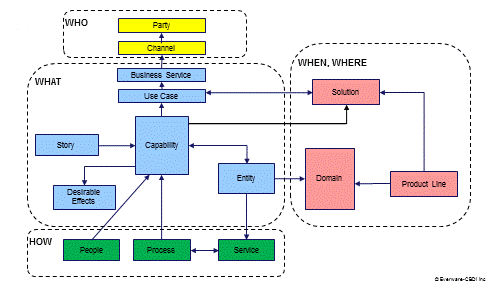
Are you and your enterprise a prisoner of the past? I don’t mean legacy applications and technologies, I mean today’s business processes and applications. I work with many different enterprises and what’s common to the great majority is the centrality of business processes and applications, and the difficulty in evolving these existing solutions.
Actually I am frequently amazed at the understanding of many business managers. I marvel at how they use the lingua franca of their applications to describe their business. I will readily admit that when I first meet someone like this it’s a bit scary, because their vocabulary is like a foreign language. But frequently I find that it’s also a foreign language to their colleagues and it represents a rather primitive form of power play! Believe me. And that vocabulary of course often pervades the business process also. But the even scarier thing is that these organizations don’t realize they are locked into yesterday; or looking in the rear view mirror is you prefer. And just like Fred Brooks mythical beasts, struggling against the grip of the tar pits [1], they will eventually be overwhelmed by the complexity and their inability to change. Yes they may be delivering Cloud based Web and mobile applications to their customers, but are they just adding to the inherent business complexity?
I observe smart, successful companies making major mistakes as they enter the digital economy. First they set up an eServices project or division. This is treated as an innovation center and separated from the core business, in order to get to market quickly. But of course when they get to market the new products don’t integrate with the core business. Sure there’s application and service integration, anyone can patch old and new together at that level; but what about the way the business works; the business model and the vocabulary used, the opportunities for channel switching, and the development of distinctive sales and customer support systems and internal and external company culture that transcends the technology channels. And the ability to evolve the old and new in a way that they complement each other?
This problem is visible in the decreasing agility of organizations. Many have adopted Agile development but, and I say this as a certified Scrum Master, how many Agile projects think about the vocabulary and integrated business model issue? Yes Agile projects generally deliver faster, better and cheaper, but are they basically adding to the size and eventual grip of the tar pit? Just getting there faster!
In the digital economy enterprises must turn themselves inside-out! Expose their core business capabilities as services through multiple, interconnected channels for internal and external use. Today’s SOA best practice is primarily inwards looking. What’s required is a new form of business model that details the new world from the customers’ perspective. And this needs to be reflected in the way the business operates internally also.
The new business model needs to be a radical departure from de facto practices in business architecture, enterprise architecture or business requirements. And it needs to be developed to govern Agile development projects. Key characteristics include:
– A service oriented business model that transcends business and IT.
– Understandable by all stakeholders
– Owned by the business.
– All enterprise capabilities are (eventually) published as externalized business services and supported by common software services
– Implementation independent models
– Developed as part of an Agile process – initial scoping sprint, followed by drill down modeling sprints by domain and or capability; delivering just sufficient detail to charter Agile delivery projects.
Over the last few years, a lot has been said and written about Enterprise Architecture. While more and more people have heard of it, it appears that it is still only known and understood by a relatively small group of professionals. In this short reco…
The first edition of the EA Perspective Paper has been […]
. First I have to declare that while I’ve never worked with Phil I have worked in the same organization and I do know him. So with any conflict of interest covered off we can now get down to business. There are lots of books that will offer either directly or discursively a reference architecture. […]