The Rise of the Connected Advisor

Guest post by C. Steven Crosby Due to their central role in client relationships, advisors are at the heart of traditional wealth management models. However, the need for advisors to guide clients through options in an opaque market is increasingly being called into question. As information proliferates and technology expands, potentially disruptive new competitors are coming online and forcing wealth managers to reconsider the role of the advisor. New channels for obtaining investment advice and […]

Webinar: Transform Vision into Value: Managing the Strategy to Execution Process

Join me for this follow-up to last month’s sold-out webinar. In this presentation, I will talk about the business architecture process of managing strategy execution. This free webinar is sponsored by Accelare and is open for anyone to attend. Please forward to others you think might be interested. You can register here: Tuesday, July 29th, […]

Open Group goes into mining

The Open Group Publishes First Global Reference Model for Natural Resources Industry.  The EM Model establishes an operational blueprint for organizations that impacts the definition of business activities across the indus…

Mapping Agile Architecture

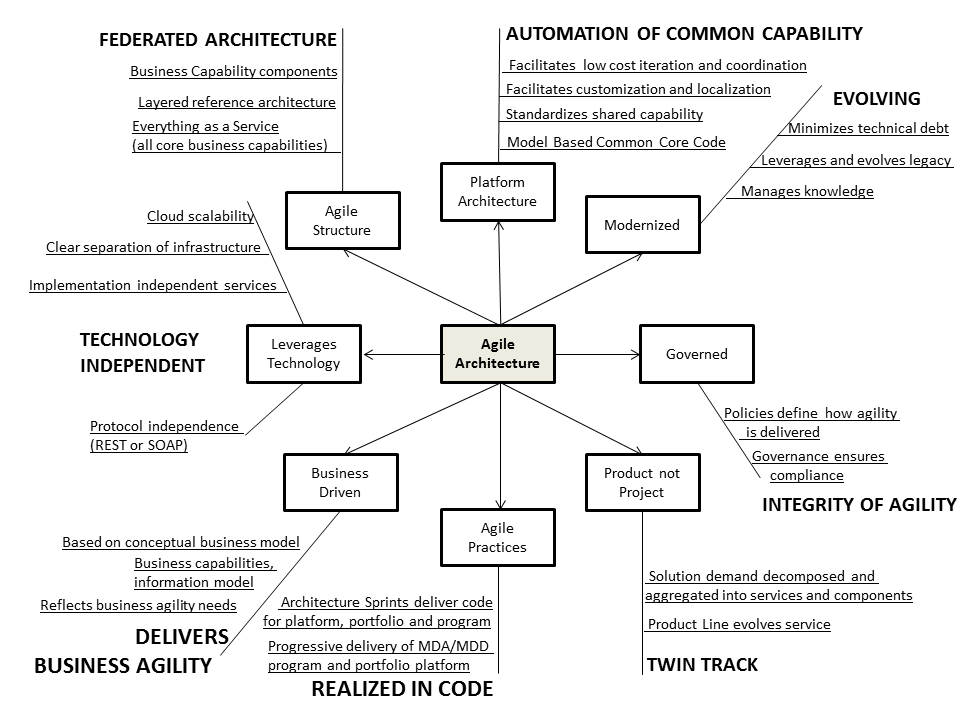
Jason Bloomberg recently published a mind map for Agile Architecture. It’s a nice map that sketches top level thinking and I welcome that. It prompted me to do a drill down.

Mind maps are useful in that they are, by definition free form and intended to support brain storming. The downside is obvious – they are generally inconsistent and cause modelers’ intense frustration! Caveat emptor over, I fully agree with Jason that we need a dual interpretation of Agile  – that is Agile practices and Agile Architecture, and I have written about this on many occasions. Also that the entire motivation is about business agility. On this last point my mind map is clearly a little more technical than Jason’s, and on reflection I think that is because it’s essential to converge the business and technology concerns.

For example, the map suggests a strong capability centric approach to interpret the business morphology. However this is insufficient; the technology must also establish appropriate levels of implementation independence that will facilitate the pluggability of business capabilities. Similarly you might think that considerations regarding the platform and delivery technology (such as MDA/MDD) are irrelevant to business concerns. However the platform and platform delivery technology are potentially massive drivers of rapid iteration and ongoing change, because they encapsulate common application level infrastructure and common services, so understanding the “business” standardization and localization model is crucial to delivering agility through this structure.

References:
Related posts: 

Mapping Agile Architecture

Jason Bloomberg recently published a mind map for Agile Architecture. It’s a nice map that sketches top level thinking and I welcome that. It prompted me to do a drill down.

Mind maps are useful in that they are, by definition free form and intended to support brain storming. The downside is obvious – they are generally inconsistent and cause modelers’ intense frustration! Caveat emptor over, I fully agree with Jason that we need a dual interpretation of Agile  – that is Agile practices and Agile Architecture, and I have written about this on many occasions. Also that the entire motivation is about business agility. On this last point my mind map is clearly a little more technical than Jason’s, and on reflection I think that is because it’s essential to converge the business and technology concerns.

For example, the map suggests a strong capability centric approach to interpret the business morphology. However this is insufficient; the technology must also establish appropriate levels of implementation independence that will facilitate the pluggability of business capabilities. Similarly you might think that considerations regarding the platform and delivery technology (such as MDA/MDD) are irrelevant to business concerns. However the platform and platform delivery technology are potentially massive drivers of rapid iteration and ongoing change, because they encapsulate common application level infrastructure and common services, so understanding the “business” standardization and localization model is crucial to delivering agility through this structure.

References:
Related posts: