Business Capabilities vs. Technical Capabilities: What’s The Difference?
Organizations are usually organized by how they function or around business areas. However, this traditional way of organizing leads to a lot of interdepartmental overlaps and inefficiencies, the enemies of agile business execution and organiz…
 Capability-Based Planning activities are structured in a cycle: Map, assess, plan, and control. It shows us where to begin and the next steps to gradually increase the impact on the organization. Read more in our whitepaper: “How Business Architecture contributes to successful strategy execution”. In the “Map” phase, we define and create the Capability Map,…
 Machine Learning (ML) is a subfield of artificial intelligence aiming to teach computers to think the same way humans do. Data is used to train an algorithm that identifies and discovers patterns and makes predictions for new cases. Using ML is not uncommon. Examples include financial institutions using ML to detect potential cases of fraud….
 So far in our blog series, the capability models we’ve used are relatively simple in terms of their structure. In our previous blog post on capability measurement, we already promised to provide more detail on how you can model capabilities over time and how to describe different instances. In larger organizations, the same business capability…
 ArchiMate is the modeling language of choice for most enterprise architects. When ArchiMate is communicated to a business audience, however, the default visualization is often perceived as too technical. To solve this, Bizzdesign is creating alternative ways of visualizing ArchiMate models, such as the Metro Map. The new Metro Map view visualizes dataflow or processes…
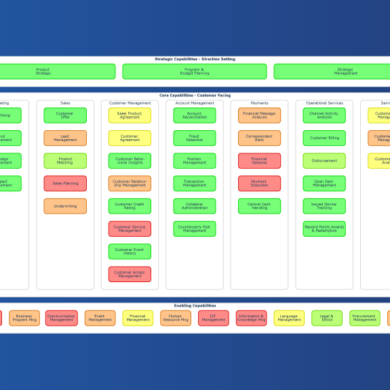 As we explained in our previous blog on capability assessment, to effectively assess Capabilities and execute Capability-Based Planning, we need to define three dimensions: Strategic Importance, Capability Maturity, and Adaptability, and measure them. Simply put, the first dimension lets you prioritize those capabilities that are most important to your enterprise; the second focuses on where…
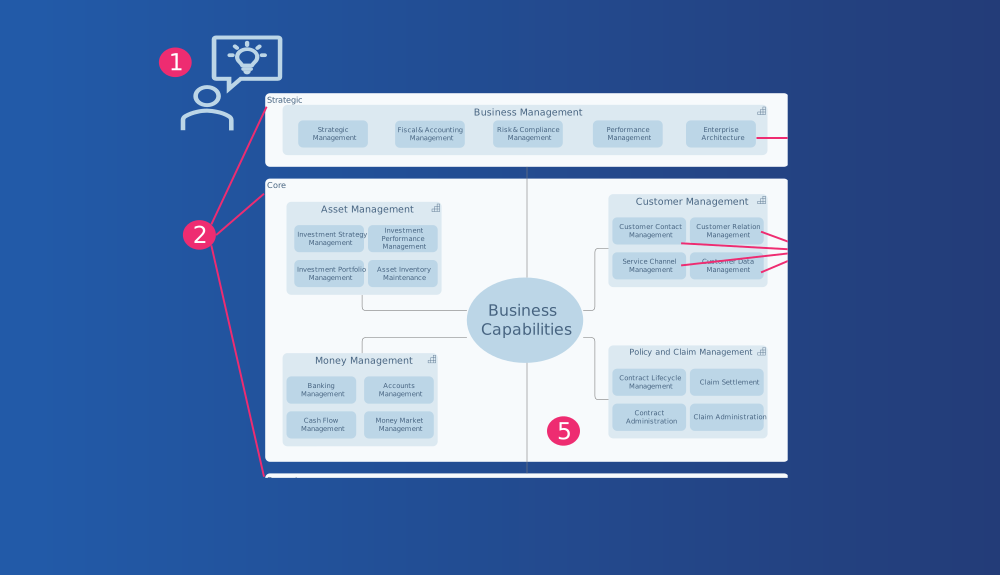 Value is delivered to the enterprise when Capability Maps are readily accepted and adopted as a strategic planning tool. Business stakeholders can make data-driven decisions and align and prioritize investment decisions, among others. In part 1 of our blog series on Business Capability Maps, we’ve identified design principles focusing on the stakeholders consuming the Capability…
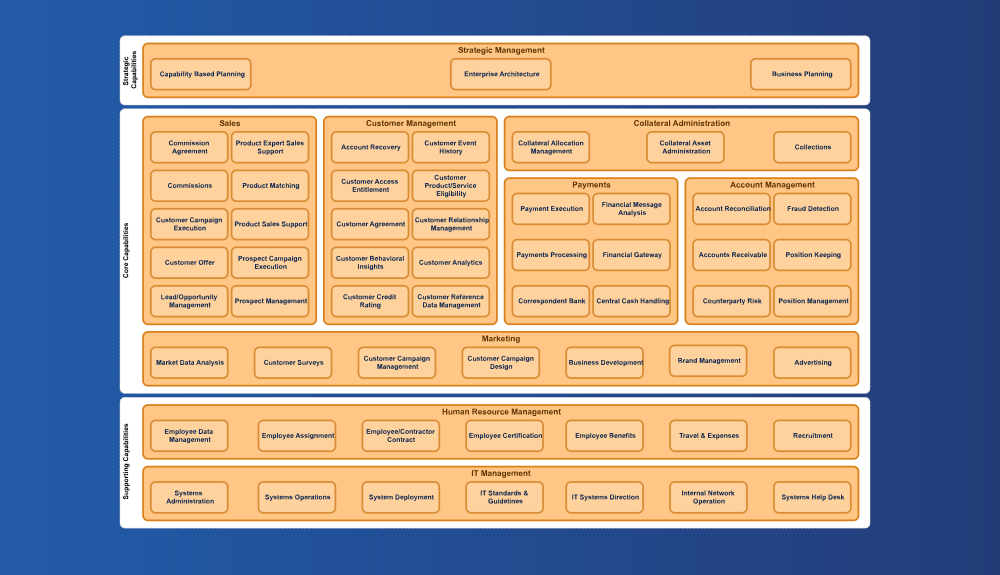 Business Architecture is nowadays gaining more traction among executives because it plays a key role in enabling organizations to transform into a composable enterprise, a term coined by research and advisory firm Gartner, Inc. Business Architecture is used by architects as a form of business analysis to identify business value that’s focused on what the…