Enterprise Architecture driving Private Cloud adoption by U.S. Federal Government

Despite all the incumbent benefits offered to businesses that own and operate their own Private Cloud, adoption rates since its emergence have been slower than anticipated, especially across Government organisations. This is largely the result of repeated reports from experts warning against the associated security risks that come from placing sensitive data in cyber space. …

Read more

6 IT Trends & 15 New Habits for CIOs & Their Teams

The CIO/ITD In Crisis.

Harvard Business Review blogger, Jim Stikeleather, posted recently  The CIO in Crisis: What You Told Us – a few particular points caught my attention:

“The best executives I have met have had a great understanding of how to use technology to gain competitive advantage and improve operations. They also worked with the CIO to help them to understand the business. They worked together to identify the technologies that could improve the company’s competitive advantage versus technologies that were needed to support the business. Once this was done, the executive leadership and CIO focused on implementing technologies that improve the company’s competitive advantage”.

All the parts of the organization have to come together and build a common language to discuss their markets and their enterprise. They need to have a common appreciation of each other’s purpose. The CIO must step up and mentor the C-suite on the potentials, possibilities, threats and opportunities of information technology..”.

If IT and the CIO come to the party talking like engineers, only offer convergent lines of thought(analytical, rational, quantitative, sequential, constraint driven, objective and detailed focus) and don’t offer a more holistic, shaded divergent thinking point of view (creative, intuitive, qualitative, subjective, possibility driven, holistic with conceptual abstractions), then they have missed the point”.

The CEOs were actively aware, concerned, looking at alternatives such as chief digital officers, or creating “not-so-shadow” IT organizations under the CMO”.
For existing CIOs, ask yourself a few questions. Are you generating customer value? Are you (or do you have the potential to be) the best in the world at what you are doing? Are you required to do what you are doing? Using the answers to those questions, what do you need to stop doing, start doing or do differently?..”. [see 15 ways to change the ITD’s habits table later in this post].

In a similar vein, according to a recent CIO event run by Forrester Research: “The IT department of 2020 could disappear as a separate entity and become embedded in departments throughout the entire organization“.
This article posits that the need for change is now undeniable, and that CIOs are looking for practical steps for creating new habits in their teams. These new habits, developed now, will help prove the continuing need for a central Enterprise IT Department.


History & Trends.

The demise of the IT Department is not a new  prediction, it was first suggested in 2004 by Nicolas Carr in his book ‘Does IT Matter?‘ and again in 2007 when Chris Anderson published his ‘Black Wire – White Wire’ article. This post talked about how corporate IT was being over-taken by consumer-IT. Later, in January 2008,  Nicholas Carr famously pronounced “The IT department is dead” referring to the up-take of utility computing since his 2004 prediction. 

Since then, others made further observations about emerging IT trends that appear to strengthen those predictions. Today, around six hard trends are well established. They sit within an umbrella trend we described as ‘Externalization’ back in 2007. Later, in ‘Flash Foresight‘ Daniel Burrus explains how he identified many of the established technology trends and why they are ‘Hard’ trends rather than passing fads. More recently,  in his book ‘Agile Architecture Revolution‘, Jason Bloomberg talks about understanding the enterprise as a Complex System – a System-of-Systems. His book is architectural guide to help IT Departments respond to the Externalization trend and, at the same time, it highlights the need for a change in mindset within the IT community.

In parallel, John R. Rymer of Forrester Research coined the phrase ‘Business Technology’ (BT) to describe the ever-increasing reliance on information technology by businesses of all types to handle and optimize their business processes  and the need for a more integrated & holistic approach to the use of business-embedded information technology.  Here’s what Wikipedia says about BT

The increasing use of the term business technology in IT forums and publications is due to an emerging school of thought that the potential of information technology, its industries and experts, has now moved beyond the meaning of the term. Specifically information is seen by some as a descriptor not broad enough to cover the contribution that technology can make to the success of a business or organization“.

Focus on Externalization and BT.


Acceptance of the Externalization trend, and a deep appreciation of ‘Business Technology’ theme, provide the canvas, on which, we can sketch-out the ways in which the IT Department must change to survive. Probably most importantly, the CIO needs to find the time to think strategically: from ‘Whac-A-Mole-IT-Management’  to strategic, Business-Technology leadership. Thinking strategically means the CIO needs to develop a deep appreciation of  the various ‘markets’ his/her team serve, as both a supplier, and a broker of services, to those markets. Such markets exists within and outside the enterprise and are made up of customers, suppliers, intermediaries and other stakeholders. All with differing values and requiring different sensitivities to protect and enhance trust relationships.

How to prepare for the inevitable change.

At my current company, we use the ‘BT’ label help position our five-year vision & strategy. It helps frame the discussion about the many areas of change required: cultural, technological, procedural, organizational & regulatory. BT is not, however, a new name-tag for the IT department – it represents the new thinking required across the whole business. It might seem ironic, given the predictions, that it was our CIO who initiated the discussion – I suspect, however, this will often be the case: the CIO is frequently the only C-level executive who has a holistic understanding of both the breadth and depth of the business.

Back in May this year, I posted about the work we were doing to establish a BT Vision. This has since been developing gradually and is gaining acceptance across the IT senior leadership team, but more importantly, with C-Level executives.

Recently, I was invited to share, with a large multinational conglomerate, some of the more tangible changes we’re implementing  Our vision & journey towards ‘BT’, and our response to the the ‘Externalization‘ trend set the context for the discussion. Here’s the list of ‘contrasting behaviors‘ I shared: 

15 ways to change the IT Department’s habits

Old Habits
 New Habits
1.The department of ‘No’
2.Products focus
3.Internal SLAs
4.IT Strategy
5.Cyber security tooling
6.CAPEX-first mentality
7.Solution-focused technology architecture
8.Product standardized IT portfolio management
9.Governance of large IT projects
10.IT Cost Centre management
11.Internal procedures & methods
12.‘Family’ of IT vendors
13.Gadget-focused innovation
14.Periodic, internally-focused, measurement
15.Technology focus
1.The department of qualified ‘Yes’
2.Services focus
3.Services internal/external ecosystem –SLA-chains
4.Integrated BT strategy
5.Cyber security culture
6.Balanced, outcome-focused, investment
7.Adaptive, value-focused,  Enterprise Architecture
8.Principle-led architecture & standards-based integration
9.Company-wide, joined-up,  BT-governance
10.BT services broker, innovation-lead and advisory
11.Internal & external engagement
12.Consumer-driven, ecosystem of suppliers
13.Customer-story-based innovation
14.Constant, external & internal, feedback-loops
15.Focus on information value & risk

We’ve made good progress on many of the 15 points, but I’d say the most compelling for the business are: 1) The department of qualified ‘Yes’,  4) Integrated BT strategy, 5) Cyber security culture, and 13) Customer-story-based-innovation. I’m pleased to see these seem resonate with the observations made in the HBR article mentioned above.


Will the IT department will be dead by 2020?

Will the need for a central IT department go away by 2020? No, not in our case at least, but it does need to rapidly adapt and evolve and  we believe those  that don’t will become side-lined. We are seeing, however, other businesses taking a different view: there does seem to a dangerous, frustration-with-the-ITD, pattern emerging where IT departments are being split-up into LOB sub-teams, without considering the need for, holistic, enterprise-wide thinking.

Maybe the IT Department label won’t exist by 2020, but many organizations will require a team that focus on the value of the digitally enabled world that balances agility, resilience, security and cost across the whole enterprise. For these companies, dispersed and unbridled IT (use of consumer-led technologies and commoditized services) would lead to unprecedented levels business risk: operational, financial, commercial, reputational and regulatory. [post addendum: FUD alert! See my response to Nick Gall’s comment].

My hunch is that, once the hype has died down, the Externalization trend will actually strengthen the need for strategic, less operationally-focused, ‘Office of the CIO’ within organizations. I’m sure, however, such an entity will be unlike today’s ‘Operationally-focused’ IT shop, by 2020.

Addendum

Since posting, I was asked where VPEC-T fits in the context of the move towards BT. VPEC-T is a tool for the sense-making of complex systems-of-systems. It deals with the complexities of plurality (e.g.multiple value systems and multiple types of event). Moreover, it is used for sharing stories about such systems which helps: reach common understanding, ensure completeness and make trust explicit. These considerations will be increasingly important in the diverse and emergent world of BT. It’s most applicable to ‘New Habits’ 5,7 & 12-15.
Here’s an example of the preparation for a VPEC-T workshop based on a real session I ran earlier this year – it might help explain plurality need.

What is culture and how does it affect the practice of Enterprise Architecture?

As Architects we often spend countless hours working toward delivering great artifacts, including a future state, current state and roadmap to assist our customers in developing a vision and plan toward transformation or maturity. This work is often completed and finds its place on the CIO’s bookshelf or the Lead Architect’s desk with little action or even a second look. Why is this work not actively embraced by many organizations beyond the IT walls or even within the IT organization?

Don’t misunderstand my position, I believe all of the work completed during an iterative EA process that outputs the artifacts I mentioned above add value, although if the organization is not “culturally” ready to embrace the work and transform then the effort is for not.

Culture is defined in many ways by many scholars, although I find it easiest to define culture as interactions and relationships between members of an organization or unit within that organization. This assumes there is an organizational culture and sub cultures within that organization. With this said, it is important that we as architects focus on the overarching organizational culture to better understand whether our customers are ready for an EA engagement.

Our first priority is to ensure we are engaged with the highest level of sponsorship within the organization. For instance, developing physical architectures with the platform division does not constitute Enterprise Architecture, but rather a Technical Architecture and will only have an effect on that sub culture within the organization. EAs need to ensure they are seated alongside the CIO, CFO, COO or even the Chief Executive to ensure efforts toward cultural transformation can be enabled via strong sponsorship.

In the public sector this can be a difficult task as most executives are focused on business related practices and often see the CIO and vendors as “IT focused.” It is critical for our communication during initial contact to be business focused. Conversations about technology are not held until key items, like capability modeling, guiding principles and governance structures are embraced by the organization as a result of cultural change. Once these cultural elements are embraced and socialized technology decisions will be easily facilitated with little debate or power struggles. Remember, the “sponsor” understands how important organizational transformation is at this point in the evolution and will help sub groups understand the vision. Communication and vision are critical elements at this point in the journey toward transformation.

Once we have commitment from the sponsor it is critical for the sponsor to understand the partnership needed between the EA Team and Executive Team. The EA Team is not chartered with creating mission, vision, strategy etc. but rather with understanding the Executive Team’s goals and objectives for the organization and aligning the technology investments with these goals and objectives. Every investment decision made is a direct representation of how the organization’s culture is manifesting itself physically.

Enterprise Architecture Leaders’ Interview Series – Q&A with Gil Long

Enterprise Architecture Leaders’ Interview Series – Q&A with Gil Long

I caught up with Gil Long who has served IBM as a Business Development Executive, Distinguished Engineer and CIO Office Chief Enterprise Architecture leader. As the Worldwide Enterprise Architecture Community Leader, he specialized in architecture governance, strategic architecture design and infrastructure transition planning. He was responsible for IBM’s enterprise architecture strategy and planning service offerings, global enterprise architecture training programs, and functioned as a member of IBM’s Architect Certification Board.

Gil has had direct management responsibility for large IT organizations and staffing, and substantial ongoing budget accountability. His multi-industry experience includes international banking, securities, education, retail, healthcare, insurance, utilities, manufacturing, semi-conductor, airlines, telecommunications and government.

Gil is a competitive aerobatics and commercial pilot.

In many years of your experience across hundreds of customers, what is the fundamental thing that organizations miss about Enterprise Architecture?
Understanding the value of EA is often an issue.  The value is not only about reducing IT cost, but investing in innovative ways to improve the business. In my opinion, many companies do not understand what EA is!

EA needs the buy-in from upper management, but most upper managements think it is merely a technical or standards issue, and miss the point that it covers all aspects of business and technical structure and management. It is very important to have someone at the sponsorship level who understands what EA is and what value it brings.

In your experience what has been one of the most remarkable transformations enabled by Enterprise Architecture?
Obviously, I am intimately familiar with IBM’s EA and how it has influenced multiple internal transformations.  I shared with you the IBM Transformation Story. Great showcase!

I have seen many other transformations in the client world.  One involved the consolidation of 90 companies (utilities) into a common footprint!  Generally, the more complex the environment, the greater the benefit EA can deliver.

What do you think is one of the most underrated aspects of Enterprise Architecture? 
The leadership role that an Enterprise Architect can provide to the organization.

For an aspiring Enterprise Architect, what are some key things she needs to start working on right now?
[-] Understand what EA is and what value it brings to the organization.

[-] Get EA training. You could start with understanding TOGAF, which is an internationally recognized standard for Enterprise Architecture.

[-] Get certified if you can, it could establish your credibility both within and outside your organization.

[-] Develop strong relationships with stakeholders that are impacted by EA. Its importance cannot be overstated. Involve them in the process.

[-] Understand your industry. Industries have their own context, business process models, histories, politics and challenges. Understanding your industry gives you an edge when working with partners across the company.

[-] Work on your communication skills. Always put yourself in the shoes of your audience. Communicate in a way that the listener will understand. Your message should be simple, concise and actionable, and answer the question, ‘What’s in it for me?’.

[-] An Enterprise Architect needs to stand up and speak, evangelize ideas, develop consensus, work across boundaries. Do not throw up your hands and quit, or be draconian and say if I don’t get what I want, the world will come to an end!

Do you think Enterprise Architecture has a brand issue?
Yes, the name itself implies it is a technical concept, rather than an overall business concept. The word “architecture” conjures an image of a guy with his head down, drawing a complex picture! The word “enterprise” can also be a bit vague.  The enterprise represents the totality of the business; including business partners, customers and other stakeholders, and the infrastructure they use to accomplish their objectives.

However, a good Enterprise Architect will be able to explain EA to anyone in terms they can understand.

At the risk of drawing you into the “war of EA frameworks”, how important is the EA framework brand to you? 

IBM’s EA Method and Framework are important to me, since IBM ‘invented’ EA in the 1980’s and participated in the internationalization of EA via TOGAF involvement.  All frameworks have something to offer, but they essentially are all true to the same basic EA concepts. 
You should select one EA approach for your enterprise, and TOGAF, the international standard for EA, is generally accepted across all industries worldwide.

You have quite a collection of funny “ditties”! Which one is your favorite?
I have many favorites, but the “You are here!” picture always gets a laugh from architects 🙂

How many countries have you traveled to, for business? Which one was the most unique?
Fifty three countries!  I’ve had so many wonderful experiences in these countries.  Each had its challenges and rewards.  Istanbul (banking) was unique, as was China (telecom), as was Taiwan (semiconductor), and Hawaii (education) … working from the top of a mountain overlooking Pearl Harbor.  Also, Prague, with a mixture of former communist and democratic staff, and South Africa (banking). Although cultures can vary from place to place, I find that the Enterprise Architects are universally smart, enthusiastic and hungry for knowledge about EA.
I smile when I think about nap time on sleeping mats during lunch in China, and loud cell phone conversations going on during a serious lecture!!  What is normal in some countries is unusual in others.
Had to ask this – tell us a little bit about your flying hobby and what are your flying plans for 2013?
Just got back from Sun-n-Fun in Lakeland, Florida (major fly-in with thousands of airplanes).  Next stop is Oshkosh, Wisconsin, the largest fly-in in the US, and possibly the world.  
I practice aerobatics every week and feel quite comfortable being upside down, like any good Enterprise Architect 🙂
I hope you all enjoyed my interview with Gil Long. As usual, please keep your comments and feedback coming, I love to hear from you – whether you agree with me or not! Thank you for reading.

Business Architecture & Enterprise Architecture – Match Made in Heaven

I recently spoke at the European BPM and EA Conference in London on this topic. This blog post is a summary version of my session.

Often Business Process Management and associated discipline such as Business Architecture is seen or managed in isolation of the overarching Enterprise Architecture construct. However the Business Architecture and Enterprise Architecture complement each other well to get the best value from each other. I think that the Business Architecture is one of the key enablers of the Enterprise Architecture and makes it real. While the Enterprise Architecture offers much needed context for the Business Architecture.

It might be useful to briefly review the definitions of both Business Architecture and Enterprise Architecture before understanding issues in their relationship. 

As I have been writing on this blog, Enterprise Architecture should not be limited to the IT or Technology concerns of an organisation. Rather it should be focused on addressing much broader scope covering the business, functional, operational, financial and people aspects of the enterprise. 

There are a number of Enterprise Architecture definitions out there. A couple of my favorite ones are as follows:


Enterprise Architecture provides a strategic planning framework that relates and aligns information technology with the business functions that it supports.


Or


Practice of enterprise architecture involves developing a framework to describe a series of “current”, “intermediate” and “target” reference architectures and applying them to align change within the enterprise. Another set of terms for these are “as-is”, “to-be” and the “migration plan”.


The Business Architecture Special Interest Group of Object Management Group (OMG) defines Business Architecture as follows:

“A Blueprint of the Enterprise That Provides A Common Understanding Of The Organization And Is Used To Align Strategic Objectives And Tactical Demands.”


“Business Architecture describes the product and/or service strategy, and the organizational, functional, process, information, and geographic aspects of the business environment”

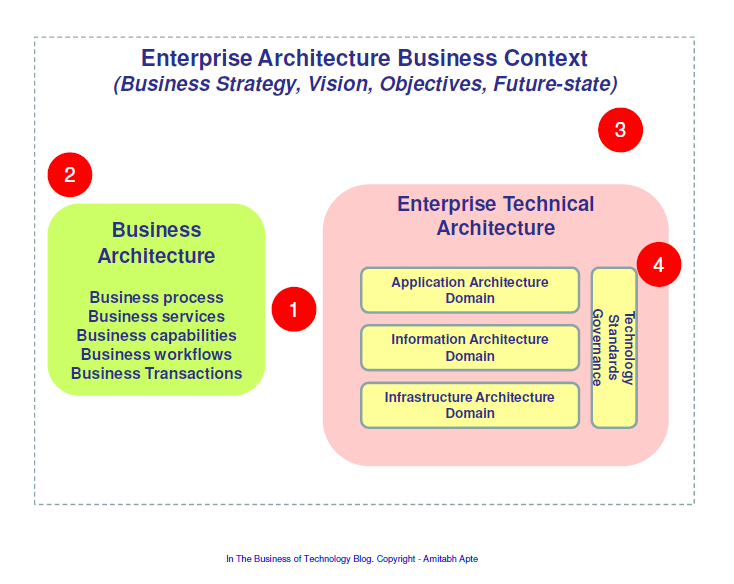
I think that though the practice of both Business Architecture and Enterprise Architecture has matured over the past few years, there certainly are some issues when it comes to these two working well together. I have summarised them in four broad arguments;

  1. Business Architecture not done at all. Enterprise Architecture teams only perform Enterprise Technical Architecture only.
  2. Business Architecture done in isolation of Enterprise Technical Architecture and then (if lucky) artificially superimposed
  3. Business Architecture and Business Context Confusion: confusion between why, what and how
  4. Technology focused governance: only conversations about technical standards, business governance disconnected from IT investment and decisions leading to critical gaps
I have tried to capture this pictorially below:

BA & EA in Isolation

This issue is getting wider acknowledgment given its strategic importance. I particularly like Randy Heffner’s work in this space. He states in one of his blogs;

“Simply positioning business architecture as a layer on top of existing EA domains is a mistake. Traditionally many organisations have pursued EA as Enterprise Technical Architecture (ETA). ETA is technology-centred.  Business architecture is business-centred. Simply layering it on top of ETA will result in tech-centred silo implementation.”


As Business Architecture Special Interest Group of Object Management Group(OMG) states, the Business Architecture defines the structure of the enterprise in terms of its governance structure, business processes, and business information. In defining the structure of the enterprise, business architecture considers customers, finances, and the market to align strategic goals and objectives with decisions regarding products and services; partners and suppliers; organization; capabilities; and key initiatives. Business Architecture primarily should focus on the business motivations, business operations and business analysis frameworks and related networks that link these aspects of the enterprise together and it should be seamlessly integrated with Enterprise Architecture efforts within the organisation. 

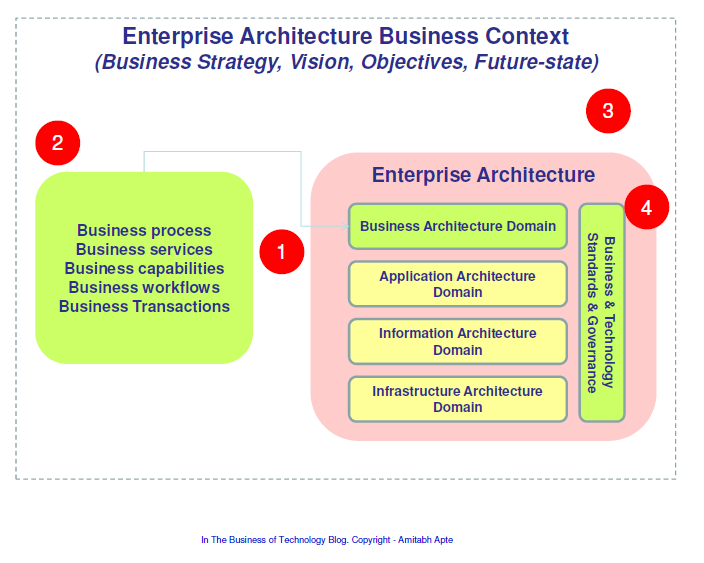
In my experience to tackle above listed issues, following measures can be taken by the Architecture team;

  1. Business Architecture as part of Enterprise Architecture
  2. Business Architecture drives Enterprise Architecture domains
  3. Business Architecture and Business Context clarified and integrate
  4. Business aligned Technology governance


My pictorial representation from earlier changes as below now:


BA & EA in Collaboration

Modern Enterprise Architecture teams and Enterprise Architects can not longer afford to ignore the implications of Business Architecture. Likewise, modern business architects can no longer afford to work in isolation of organisation’s enterprise architecture. 

In conclusion of this article I would like to summarize my thoughts as follows:

  1. Enterprise Architecture in isolation of Business Architecture is simply Enterprise Technical Architecture
  2. Business Architecture should guide the development of Enterprise Architecture domains
  3. Business Architecture combined with Enterprise Architecture is a powerful tool for business-IT alignment
  4. Strategic Frameworks and Models help in achieving this alignment

And as Chris Potts would argue, the Chief Executive of an Organisation should be ultimately accountable for ensuring the two come together as we would expect him or her to be the Chief Enterprise Architect of the Enterprise!

For related articles:

Agile Business Modeling – The Core Heuristic?

How many times have I heard that the real problem with Agile is getting to the start line? There has to be some definition up front, but Agile methods don’t really help. Perhaps it’s a little secret for many organizations that they feel they must do more specification work up front because it makes it easier to control the Sprints. Oh dear!

To get to this starting gate we need to model the agile business in an Agile manner (YES!). Further we do not want to undertake complete or detailed business architecture (NO!!). We don’t have time, and anyway the core of the innovation and architecture should be done in the Agile Delivery project. But before we can fire up Agile projects we need to determine the scope and charter. If we use conventional scoping methods we may well deliver great functionality very quickly, but we probably won’t, unless we are very lucky, have delivered agile business capabilities that map to the business dynamics and can evolve along with the business.

Here’s a technique that may help.

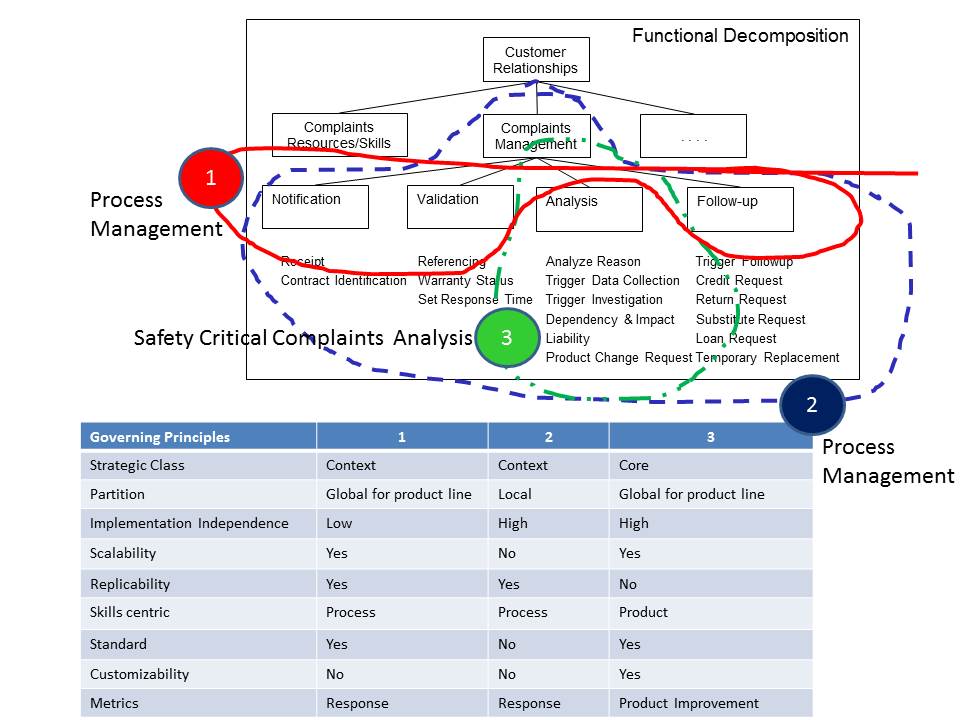
In the first image below I show a functional decomposition for complaints management which I have clustered into “candidate capabilities” labelled 1, 2 and 3, process management, customer relationships and analysis respectively. This usefully shows that capabilities can be varying levels of abstraction; there’s absolutely no necessity to have elegant models!  The table below the decomposition shows various criteria I used to help me decide on the possible clusters. As you will see there’s variation in strategic classification; the partitioning – which may be key for deployment, some could be centralized others local; and the need for implementation independence and so on.

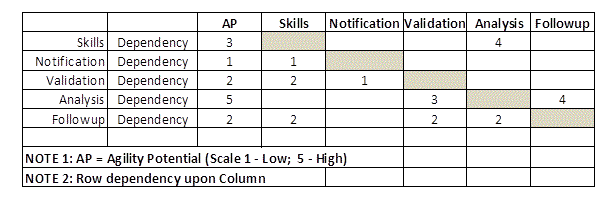
This analysis certainly helps me present some choices. But aside from the independence and scalability criteria and possibly standardization criteria, I feel I have not fully exhausted the analysis of the need for business agility. In the table below I develop this a little further. First I make an assessment of the potential requirement for future change in each function. I call this Agility Potential (AP) on a 1=Low and 5=High scale [1]. Not surprisingly Analysis and Skills are the capabilities that will probably be subject to considerable volatility. Second I look at the dependencies between the functions; note you have to read this as each row dependency upon a column. And low and behold, Skills and Analysis, and Analysis and Follow-up have high dependencies. This causes me to reconsider my initial cut of capability boundaries. I feel that Skills needs to be very close to Analysis as the investigatory function. And Follow-up should be similarly very close to Analysis. And what’s more these three functions score most highly on the AP scale. I feel Follow-up could easily be collapsed into Analysis, and a name change to Investigation would be perfect. I think a little more deeply about Skills. The degree to which the outcomes of Investigation need to be fed into Skills on a dynamic basis will vary depending on the type of business. If this was a safety critical business, I might recommend consolidating Skills and Investigation and renaming it Knowledge Management. But this really would depend on the business sector specific needs. 
To recap, what I have done here is developed a sharper understanding of the capabilities, and I have attributed them with governance criteria (in the first table) – I know what I must have delivered, and I am communicating some really important information to the delivery team, without constraining them at all on the implementation and delivery method. Also I now know the dependencies between the capabilities, and we can very quickly resolve the services that will be required and the inter project dependencies. And it didn’t take me very long at all.

More on Agile Business Modeling 

[1] I first outlined the idea of Agility Potential in the CBDI Journal April, 2010. Let me know if you would like a copy.

EA Myths

A recurring theme in enterprise architecture forums and debates is: “How do we demonstrate the value of EA or justify architectural overhead?” Some may view these discussions as academic, which compounds the problem, because it supports the idea that enterprise architects don’t really understand their role, that they don’t have a common definition of enterprise Read more

James Martin – A personal reflection

James Martin, technologist, methodologist, entrepreneur and philanthropist died Monday 24 June 2013 aged 79.

I first came across James Martin in the early 1970s. I went to a lecture he gave in London, and he captivated an audience of about 100 people for 2 hours on the topic of real time systems design.  Later on I attended his famous seminars in London and Johannesburg. It was extraordinary how he held huge audiences for multi day sessions, with minimal audience interaction as he drove through the thousands of slides, delivered on two overhead projectors. In those days he was the consummate technology seer and he filled a need in the days before industry analysts.

Yet he was so much more than just a showman. I bought his book on real time system design in 1971 and this was my bible. And down the years I relied on his books in data modeling, database design and  information engineering; they were detailed and useful to a practitioner.

I joined James Martin Associates (JMA) in 1986. I think I was employee number 30 and I had the privilege of working in what must have been one of the most extraordinary and innovative companies at that time. Even when I meet ex JMA colleagues today, we always recall how it was such a great place to be, where everyone was on the leading edge and contributing to the overall development of information engineering. We were taking his ideas and turning them into practical method and tools for many of the world’s largest companies and government agencies.

We didn’t see that much of James Martin. He would attend our annual JAM (sic) session, and if he was in town he might drop in, but that was rare. But he did get feedback. I was deeply involved at one stage, together with Richard Veryard and Mike Mills in developing ideas for Rapid Application Development (RAD) that we took to customer projects and of course appeared later in the James Martin book.

The core of his thinking was the idea that model driven systems were the future and at JMA and subsequently Texas Instruments Software (TI) we proved this by delivering the IEF based on James’ ideas, that became the leading mainframe and client server development tool in the early 1990s. Of course we knew even then that this tool was limited to a very narrow set of patterns, and history has taught us that there is a need for a much broader range of patterns, and varying levels of abstraction and intervention. And even as early as the mid-1990s we were working on componentization and service interfaces because we understood the monolithic architecture, however commercially successful for a short few years, was in reality a simplistic first attempt. Today the term CASE tool is widely disparaged. Yet I believe that James’ original vision will be realized, although the method of realization will be radically different, and by strange coincidence I blogged on this topic very recently

James Martin provided inspiration for technologists by identifying big ideas, but he went further by detailing the ideas in his books and teaching and “having the courage of his convictions” by investing in start-up businesses. Which of course made him very wealthy. I would be proud to say that in my work and in everything that CBDI has developed, we have been true to some of the core principles that we hammered out nearly thirty years ago including model driven (including meta model based) and structured with maximum automation. And these are equally applicable to today’s Agile, fast moving world. Of course we (Everware-CBDI) have added and evangelized the  principles of component and service oriented, but the original vision is intact. 
James Martin was an idealist. In several of his works he developed his thinking for a utopian society where technology and automation are used for the greater good in education, health and creating a better world. Sadly I myself came to see some of his works as out of touch with reality. He failed to see the shoddy reality of how politics and politicians are incapable of leveraging technology to deliver better models for society, how the giant Internet companies are creating worldwide networks based on old fashioned capitalistic principles while espousing such things as “do no evil” and practicing tax avoidance, and governments are increasingly using technology to track the every move of citizens without understanding how to govern the use of that data. 
I believe we will remember James Martin, but not necessarily for his big ideas like the early prediction of the Internet or his philanthropy. Rather we will come in time to reflect on his guidance that technology should be leveraged to improve society. Every time we destroy tens of thousands of jobs by introducing new technologies, we should be using the power of technology in education and resource mobilization to ensure that vast numbers of our young people do not remain out of work, or that older people can continue to contribute to society beyond conventional retirement age. 

CEA Credential Renewal Instructions

cea logo

6/3/15 UPDATE: feacinstitute.org is currently under complete overhaul! Please continue to submit your EADUs. Even though they do not show on your profile, we are collecting them. We are excited about the new site and ask for your patience in the credential renewal process while this is being completed. This re-design will make the EADU submittal process more functional, give you more information on your profile and will make update our lookup. Thank you again!

CEA Credential Renewal Instructions:

Our ZCEA and CEA recertification process is being refreshed!  Effective 1 October, 2014 we are implementing new guidance on what qualifies for Enterprise Architecture Development Units (EADUs) as part of the Zachman® and FEAC® enterprise architecture certifications. This guidance (published below) is intended to leverage the broad source of education and professional development opportunities you engage in as a professional as an active source of maintaining your certifications. With this refresh we are establishing a six month transition period for those alumni whose certification renewal has lapsed outside of the three year cycle. From 1 Oct to 1 April, Zachman and FEAC graduates may register their EADUs and submit their renewal fee regardless of the lapse in certification. After 1 April, alumni whose certification has lapsed will be required to take an online exam to re-qualify. If you have questions please send them to info [AT] feacinstitute [DOT] org.

FEAC™ has a triennial process for CEA credential renewals, similar to other professional organizations. Your EADU cycle begins on the month of graduation and you should begin filing and recording EA Development Units (EADUs) accuring 20 per year. For example, if you graduated, as a CEA, in April of 2013 your certification is active until April 2016. During this cycle you should be recording EADUs using the online submission form. In April 2016 you submit a request to renew your certification along with the administrative processing fee.  

Remember you need to document 20 EA Development Units per year for a total of 60 in a refreshment period, with member profiles updated, after payment of the CEA Fellow dues.

1) Log into feacinstitute.org

2) Under the menu EA Zone/My Dashboard/My Renewal, fill out the form with how many EADU you are claiming, the event for credit and the date. You may submit this form more than once for multiple events/claims. We will process your request and your EADU total will be updated on your Registration Profile within 7-8 business days.

3) If you have submitted your 60 hours, they have been approved and you are actually applying for CEA renewal and are looking to pay your $99 renewal fee, hit the “Subscribe Now” on the above (My Renewal) page. Your request will be verified and processed by an administrator within 3-4 business days.


Certified Enterprise Architect: Maintaining Your Certification

Certification as either a Zachman Certified Enterprise Architect or FEAC Certified Enterprise Architect (CEA) is an industry-recognized credential. You have worked hard to earn this prestigious milestone and need to adhere to FEAC’s continuing certification program to retain professional achievement.  To follow the program, you can participate in a range of professional development activities to earn Enterprise Architecture Development Units (EADUs). 

Every credential requires a specific number of EADU in different categories as a part of a three-year certification cycle. If YOU hold a ZCEA (level 1-4) and a CEA (or ACEA) your EADUs count towards both as a part of the triennial certifications.

Certification

EADU in a 3 year cycle

EADU Requirements per Categories

Zachman Certified Enterprise Architect (Level 1 Associate)

15

(5 EADUs per year)

Educational- 15

Zachman Certified Enterprise Architect (Level 2 Practitioner)

30

(10 EADUs per year)

Educational-20

Development of the Profession-10

Zachman Certified Enterprise Architect (Level 3 Professional)

45

(15 EADUs per year)

Educational-30

Development of the Profession-10

Consultant Engagement-5

Zachman Certified Enterprise Architect (Level 4 Educator)

60

(20 EADUs per year)

Educational-20

Development of the Profession-40

(10 must be in Category 5 creating new knowledge)

FEAC Certified Enterprise Architect (CEA)

60

(20EADUs per year)

Educational -40

Development of the Profession-20

FEAC Associate Certified Enterprise Architect (ACEA)

30

(10 EADUs per year)

Educational-20

Development of the Profession-10

EADU categories are intended to ensure your continuing professional development is focused on the broad acquisition of knowledge and engagement with the Enterprise Architecture Community.  Professional Development activities yield different numbers of EADUs, as illustrated below.

EADUs earned in excess of a single triennial cycle may be applied to the next cycle, but will still incur additional processing for review, acceptance and auditing of your professional development efforts. 

The following provides additional detail on the EADU categories and amplifying guidance.  Please note that you may be requested to provide documentation if your request for EADU’s is selected for audit. Accepted documentation normally consists of a copy of completion certificates, letter of attendance, registration forms, etc. This documentation is NOT retained beyond any specific audit. 


Education Category– The acquisition of knowledge is a key element of ensuring growth in the ability to apply EA concepts.  The following categories provide examples of the types of education you can receive credit for.

Category 1: Zachman/FEAC endorsed courses.

You can take courses officially provided by Zachman International or its education clearing house FEAC.  Courses include:

  • FEAC CEA or ACEA certification training.
  • Zachman ZCEA certification training
  • FEAC Continuing Education Courses.

EADU Guidance: Zachman/FEAC courses generally provide 2 EADU per Continuing Education Course.

Obtaining a second certification in either Zachman or FEAC provides 1.5  EADU for each 8 hours of instructional contact time.

Category 2: Continuing Education

Complete Courses in the following areas.

College credit Courses in the areas of:

  • Systems Engineering
  • Computer/Data Science
  • Business Analysis
  • Strategic Planning and Analysis
  • Program Management/General Management

Or

Non-credit granting educational efforts include:

  • Massive Open Online Course offerings in the areas of the college credit areas listed above.
  • TOGAF certification training (independent of obtaining the certification)
  • IIBA certified provider training courses.
  • PMI certified providers (REPS) in the area of :
    • Agile Methodology
    • Risk Management
    • Portfolio Management
  • Six Sigma Training
  • Professional Courses in the field of Information Security or Information Security training. 

EADU Guidance: College Credit Courses generally grant 3 EADUs per course completed regardless of number of semesters or quarters granted.

Non-credit granting education efforts provide for 1 EADU per 8 hours of instructional contact.  These activities should result in a certificate of completion or some other formal means of documentation.

Category 3: Self-Guided Learning

Self-Guided learning are those engaged by a practitioner independent of any professional facilitation. These may involves research or study.

This includes activities such as:

  • Attendance at workshops or conference meetings.
  • Reading articles, peer journals or instructional manuals related to the field of EA.
  • Watching Video, podcasts or other related efforts not resulting in a certificate of completion.
  • May include being mentored by another EA professional.

EADU Guidance: Credit for this category is limited to no more than 10 EADUs in a cycle.

1/2 EADU is provided for each hour spent involved in self-guided learning.


Development of the Profession Category– The development of Enterprise Architecture as a profession is central to the Mission of Zachman International. 

Category 4: Working as an EA Professional

You may earn credit for being an active EA practitioner as a part of your company or in a non-compensated (e.g. volunteer) role as a part of providing support to others as an EA.

This can include:

  • Work as a compensated employee actively engaged in EA activities.
  • Volunteer work for a recognized EA organization.
  • Providing EA services to a recognized non-profit, not-for-profit or other charitable group.

EADU Guidance: Credit for this category is limited to no more than 15 EADUs in a cycle (5 per year).

1 EADU is provided for each hour non-compensated service. (e.g. volunteer)

1 EADU is provided for each 160 hours of compensated service.

Category 5: Creating New Knowledge

You may earn EADUs for creating or supporting the creation of knowledge in the area of Enterprise Architecture.

This can include:

  • Authoring or co-authoring a peer-reviewed article
  • Authoring or co-authoring a non-peer reviewed article
  • Serving as a speaker on an EA related topic (i.e. Zachman Framework, Model Based System Engineering, Strategic Planning etc.).
  • Serve as a Subject Matter Expert on EA or a related topic (e.g. Big Data, Decision Science, etc.).
  • Presenting in a webinar or podcast on the topic of EA or a related area.  (Must be publicly available either free or for purchase).
  • Creating education courses or training content in the area of Enterprise Architecture or related area. (Course work must be publicly available either free or for purchase).

EADU Guidance: There is NO LIMIT for this category.

1 EADU is provided for each hour of activity. 3 EADUs are provided for publication of a peer reviewed article. 1 EADU is provided for publication of a non-peer reviewed article.


Consultant Engagement Category– Unique to the Zachman Level 3 certification is the requirement to maintain proficiency-supporting clients in the field of Enterprise Architecture. This category only applies to the Zachman Level 3 for the purposes of maintaining this unique designation in the field of EA.

Category 6: External Consultant

This requirement is unique to Zachman Level 3 certified Zachman consultant. Part of maintaining this certification is having at least 100 hours or more as a paid consultant for EA services.

EADU Guidance: Each 50 hours of paid consultancy provides 2.5 EADUs.

Proof of completion may be in the form of a redacted invoice or contract form. Contact Zachman International directly for more information.

CEA Credential Renewal Instructions

CEA Logo ZCEA Logo


ZCEA, CEA and ACEA Credential Renewal Instructions:

The following is guidance on what qualifies for Enterprise Architecture Development Units (EADUs) as part of the Zachman® and FEAC® enterprise architecture certifications. This guidance (published below) is intended to leverage the broad source of education and professional development opportunities you engage in as a professional as an active source of maintaining your certifications. With this refresh we are establishing a six month transition period for those alumni whose certification renewal has lapsed outside of the three year cycle. From 1 Oct to 1 April, Zachman and FEAC graduates may register their EADUs and submit their renewal fee regardless of the lapse in certification. After 1 April, alumni whose certification has lapsed will be required to take an online exam to re-qualify. If you have questions please send them to info [AT] feacinstitute [DOT] org.

The FEAC™ Institute and Zachman International® has a triennial process for certification credential renewals, similar to other professional organizations. Your EADU cycle begins on the month of graduation and you should begin filing and recording EA Development Units (EADUs) accruing 20 per year. For example, if you graduated, as a CEA, ACEA or ZCEA in April of 2013 your certification is active until April 2016. During this cycle you should be recording EADUs using the online submission form on your profile. In April 2016 you submit a request to renew your certification along with the administrative processing fee of $99 US.

Remember you need to document 20 EA Development Units per year for a total of 60 in a refreshment period, with member profiles updated, after payment of the CEA Fellow dues.

Instructions:

  1. Log into FEACinstitute.org or Zachman.com
  2. Under the menu My Account/My Profile then the EADU Submissions tab, fill out the form with how many EADUs you are claiming, the event for credit, EADU claim and the date. Click the “Green Plus” button to submit multiple EADU entries. These will post to your profile immediately and be in a “pending” status. Your claim will be “approved” or “denied” (with reasons why) within a week or two.
  3. If you have submitted your 60 hours, and you are actually applying for CEA renewal and are looking to pay your $99 renewal fee, go to the My Account/Certification Renewal menu, click the link and you will be prompted to pay your renewal fee. Your request will be verified and processed by an administrator.’ 

Certified Enterprise Architect: Maintaining Your Certification

Certification as either a Zachman Certified Enterprise Architect or FEAC Certified Enterprise Architect (CEA) is an industry-recognized credential. You have worked hard to earn this prestigious milestone and need to adhere to FEAC’s continuing certification program to retain professional achievement.  To follow the program, you can participate in a range of professional development activities to earn Enterprise Architecture Development Units (EADUs). 

Every credential requires a specific number of EADU in different categories as a part of a three-year certification cycle. If YOU hold a ZCEA (level 1-4) and a CEA (or ACEA) your EADUs count towards both as a part of the triennial certifications.

Certification

EADU in a 3 year cycle

EADU Requirements per Categories

Zachman Certified Enterprise Architect (Level 1 Associate)

15

(5 EADUs per year)

Educational- 15

Zachman Certified Enterprise Architect (Level 2 Practitioner)

30

(10 EADUs per year)

Educational-20

Development of the Profession-10

Zachman Certified Enterprise Architect (Level 3 Professional)

45

(15 EADUs per year)

Educational-30

Development of the Profession-10

Consultant Engagement-5

Zachman Certified Enterprise Architect (Level 4 Educator)

60

(20 EADUs per year)

Educational-20

Development of the Profession-40

(10 must be in Category 5 creating new knowledge)

FEAC Certified Enterprise Architect (CEA)

60

(20EADUs per year)

Educational -40

Development of the Profession-20

FEAC Associate Certified Enterprise Architect (ACEA)

30

(10 EADUs per year)

Educational-20

Development of the Profession-10

EADU categories are intended to ensure your continuing professional development is focused on the broad acquisition of knowledge and engagement with the Enterprise Architecture Community.  Professional Development activities yield different numbers of EADUs, as illustrated below.

EADUs earned in excess of a single triennial cycle may be applied to the next cycle, but will still incur additional processing for review, acceptance and auditing of your professional development efforts. 

The following provides additional detail on the EADU categories and amplifying guidance.  Please note that you may be requested to provide documentation if your request for EADU’s is selected for audit. Accepted documentation normally consists of a copy of completion certificates, letter of attendance, registration forms, etc. This documentation is NOT retained beyond any specific audit. 


Education Category– The acquisition of knowledge is a key element of ensuring growth in the ability to apply EA concepts.  The following categories provide examples of the types of education you can receive credit for.

Category 1: Zachman/FEAC endorsed courses.

You can take courses officially provided by Zachman International or its education clearing house FEAC.  Courses include:

  • FEAC CEA or ACEA certification training.
  • Zachman ZCEA certification training
  • FEAC Continuing Education Courses.

EADU Guidance: Zachman/FEAC courses generally provide 2 EADU per Continuing Education Course.

Obtaining a second certification in either Zachman or FEAC provides 1.5  EADU for each 8 hours of instructional contact time.

Category 2: Continuing Education

Complete Courses in the following areas.

College credit Courses in the areas of:

  • Systems Engineering
  • Computer/Data Science
  • Business Analysis
  • Strategic Planning and Analysis
  • Program Management/General Management

Or

Non-credit granting educational efforts include:

  • Massive Open Online Course offerings in the areas of the college credit areas listed above.
  • TOGAF certification training (independent of obtaining the certification)
  • IIBA certified provider training courses.
  • PMI certified providers (REPS) in the area of :
    • Agile Methodology
    • Risk Management
    • Portfolio Management
  • Six Sigma Training
  • Professional Courses in the field of Information Security or Information Security training. 

EADU Guidance: College Credit Courses generally grant 3 EADUs per course completed regardless of number of semesters or quarters granted.

Non-credit granting education efforts provide for 1 EADU per 8 hours of instructional contact.  These activities should result in a certificate of completion or some other formal means of documentation.

Category 3: Self-Guided Learning

Self-Guided learning are those engaged by a practitioner independent of any professional facilitation. These may involves research or study.

This includes activities such as:

  • Attendance at workshops or conference meetings.
  • Reading articles, peer journals or instructional manuals related to the field of EA.
  • Watching Video, podcasts or other related efforts not resulting in a certificate of completion.
  • May include being mentored by another EA professional.

EADU Guidance: Credit for this category is limited to no more than 10 EADUs in a cycle.

1/2 EADU is provided for each hour spent involved in self-guided learning.


Development of the Profession Category– The development of Enterprise Architecture as a profession is central to the Mission of Zachman International. 

Category 4: Working as an EA Professional

You may earn credit for being an active EA practitioner as a part of your company or in a non-compensated (e.g. volunteer) role as a part of providing support to others as an EA.

This can include:

  • Work as a compensated employee actively engaged in EA activities.
  • Volunteer work for a recognized EA organization.
  • Providing EA services to a recognized non-profit, not-for-profit or other charitable group.

EADU Guidance: Credit for this category is limited to no more than 15 EADUs in a cycle (5 per year).

1 EADU is provided for each hour non-compensated service. (e.g. volunteer)

1 EADU is provided for each 160 hours of compensated service.

Category 5: Creating New Knowledge

You may earn EADUs for creating or supporting the creation of knowledge in the area of Enterprise Architecture.

Examples of what this can include:

  • Authoring or co-authoring a peer-reviewed article
  • Authoring or co-authoring a non-peer reviewed article (this can include posts to LinkedIn, social groups etc.)
  • Serving as a speaker on an EA related topic (i.e. Zachman Framework, Model Based System Engineering, Strategic Planning etc.).
  • Serve as a Subject Matter Expert on EA or a related topic (e.g. Big Data, Decision Science, etc.).
  • Presenting in a webinar or podcast on the topic of EA or a related area.  (Must be publicly available either free or for purchase).
  • Creating education courses or training content in the area of Enterprise Architecture or related area. (Course work must be publicly available either free or for purchase).
  • Other

EADU Guidance: There is NO LIMIT for this category.

1 EADU is provided for each hour of activity. 3 EADUs are provided for publication of a peer reviewed article. 1 EADU is provided for publication of a non-peer reviewed article.


Consultant Engagement Category– Unique to the Zachman Level 3 certification is the requirement to maintain proficiency-supporting clients in the field of Enterprise Architecture. This category only applies to the Zachman Level 3 for the purposes of maintaining this unique designation in the field of EA.

Category 6: External Consultant

This requirement is unique to Zachman Level 3 certified Zachman consultant. Part of maintaining this certification is having at least 100 hours or more as a paid consultant for EA services.

EADU Guidance: Each 50 hours of paid consultancy provides 2.5 EADUs.

Proof of completion may be in the form of a redacted invoice or contract form. Contact Zachman International directly for more information.