Technology moves faster than ecosystems
When Technology Moves Faster Than Ecosystems: An Architectural Framework for…
Aggregated enterprise architecture wisdom
When Technology Moves Faster Than Ecosystems: An Architectural Framework for…
Just an announcement that the video of the ‘fundamentals’ part of my recent talks on essential insights on technology and psychology in relation to the digital revolution is now online on my YouTube channel.
You’re on the Titanic. The engineers are shouting: “The bulkheads are too low! The rudder is too small! There aren’t enough life boats!”. The sailors mumble: “It has been cold, there will be many more icebergs than usual and further south”. The owners …
McKinsey seems to be the first ‘big consultancy’ that really frees itself from outdated, ineffective, orthodox enterprise architecture notions.
Architecture principles are a very popular tool in the enterprise architect’s tool box. The underlying concept of ‘comply or explain’, however, makes them particularly toxic. [This article originally appeared on InfoWorld in 2015. It …
I have given presentations of my story several times in the last years. From guest lectures at a university to conferences (3 hours) to presentations such as the Gartner Enterprise Architecture Summit (45 minutes). I’ve recorded an audio track with the … Continue reading →
I write this post as part of a fond farewell to the University of Bristol as I have now concluded my very enjoyable 4 years as Enterprise Architect there and I have just moved on to the role of Senior Enterprise Architect at the University down the road – UWE! UWE are building quite a […]
This post is part of a fond farewell to the University of Bristol as I have now finished a very enjoyable 4 years as Enterprise Architect there and I have just moved on to the role of Senior Enterprise Architect at the University down the road – UWE! UWE are building quite a significant EA […]
Principles and guidelines are not architecture, and if your main product is principles and guidelines, you’re not an architect. Continue reading →
In my last post Oh No! We need another Practice Framework, I developed the earlier theme commenced in “Beware the New Silos”. I argued that the widely used frameworks are narrowly discipline centric and actually inhibit cross discipline working. I described how my own firm’s experiences have led to the development of a de facto framework, (we call it SOAM) and illustrated how this is essentially a value chain commencing with customer demand and finishing with value add to some enterprise.
I ended by sketching some basic principles concluding that we need a new framework that is goal driven and incorporates the entire value chain of capabilities, which of course may selectively reuse some parts of existing frameworks. In this post, I suggest a strawman that covers a) principles and b) capability model.
Before diving into principles, it will be useful to declare some scope. Our framework has developed from working with larger enterprises, both commercial and government in the area of business service and solution delivery. All of these enterprises share common issues that they have extensive legacy application assets that act as a serious inhibitor to business change, and successive, narrowly scoped solution projects over many years have often resulted in great complexity and technical debt. It is also common in my experience that enterprise architecture functions are routinely bypassed or ignored; that Agile methods have been attempted and found useful on narrow focused projects, but because of the constrained focus, tend to increase overall complexity of the ongoing application asset base; that consistent customer experiences are commonly compromised by narrow focused projects; and line of business managers in large enterprises are frequently dissatisfied with IT application service support.
– describe practices relevant to service and solution delivery in the digital business environment
– achieve a balance between short term goals and longer term objectives
– support progressive transformation to an enterprise comprised of independent business capabilities
– facilitate continuous, short cycle time evolution of business capability
– progressively and continuously resolve legacy portfolio complexities
– enable rapid delivery at low cost without compromise in quality
Principles should be enduring and lead to both excellent policy communication and policy interpretation in everyday situations. I also find it useful to classify principles by subject.
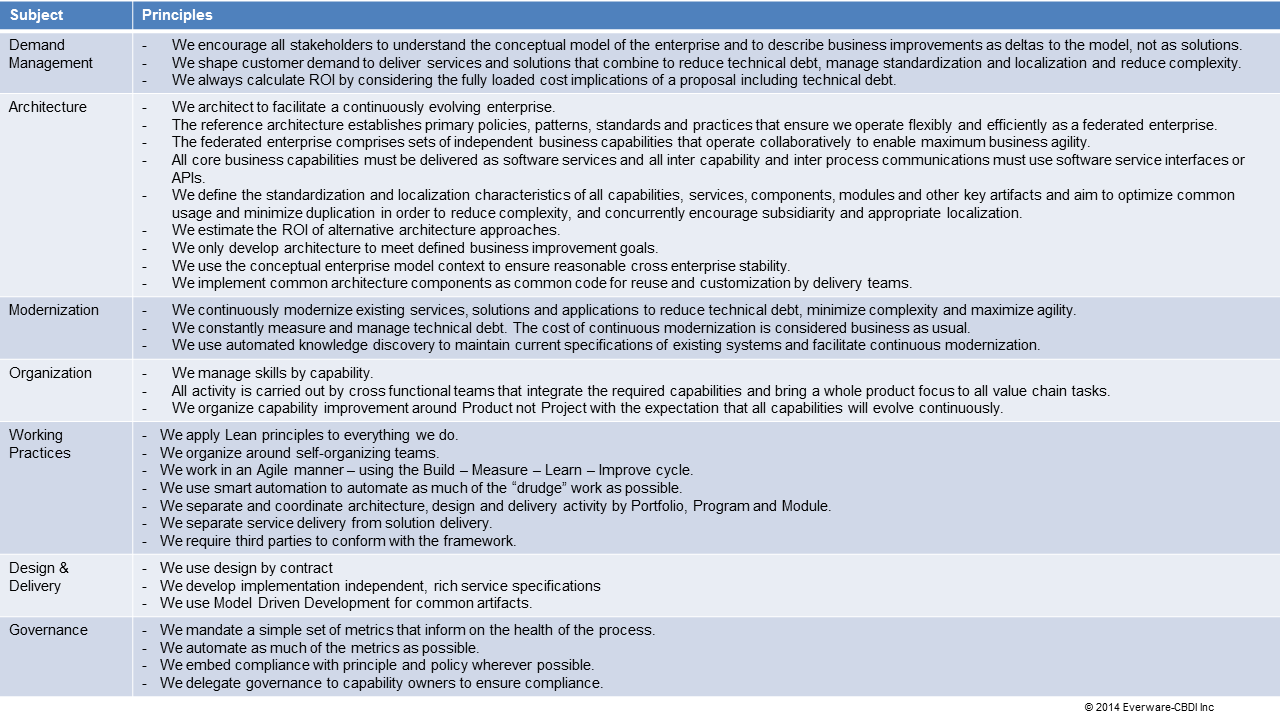
In business architecture the capability model has become ubiquitous. And in thinking organizations I observe delivery of highly independent service and solution components that reduce dependencies and the impact of change, as well as mirroring the IT architecture on the business organization. Why wouldn’t we use the same approach in defining a set of activities to deliver services and solutions?
If you are uncertain about the capability concept, it’s important to appreciate that the optimum business capability is one that enables:
– maximum cohesion of internal functional capability, plus consistency of life cycle, strategic class (core, context, innovating . . . ), business partition (global, local, LoB . . ), standardization, customizability, stability, metrics and drivers
– defined, stable dependencies that are implemented as services
[Further reading on capability optimization ]
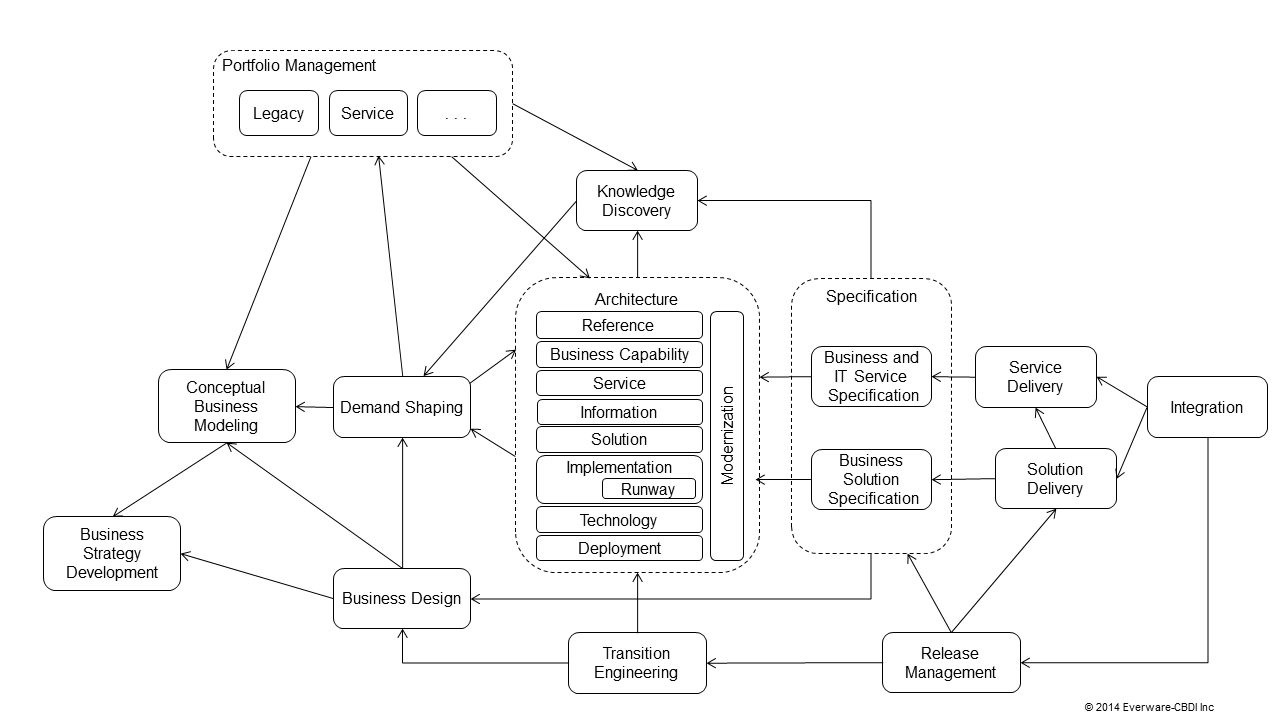
In the capability dependency model below, the arrows are dependencies. For example, Demand Shaping is dependent upon Conceptual Business Modeling and Portfolio Management. So this is not a flow diagram, rather all the capabilities should be regarded as iterative, I will come back and discuss how Lean principles operate in a framework like this, and as discussed above, highly independent.
In my last post Oh No! We need another Practice Framework, I developed the earlier theme commenced in “Beware the New Silos”. I argued that the widely used frameworks are narrowly discipline centric and actually inhibit cross discipline working. I described how my own firm’s experiences have led to the development of a de facto framework, (we call it SOAM) and illustrated how this is essentially a value chain commencing with customer demand and finishing with value add to some enterprise.
I ended by sketching some basic principles concluding that we need a new framework that is goal driven and incorporates the entire value chain of capabilities, which of course may selectively reuse some parts of existing frameworks. In this post, I suggest a strawman that covers a) principles and b) capability model.
Before diving into principles, it will be useful to declare some scope. Our framework has developed from working with larger enterprises, both commercial and government in the area of business service and solution delivery. All of these enterprises share common issues that they have extensive legacy application assets that act as a serious inhibitor to business change, and successive, narrowly scoped solution projects over many years have often resulted in great complexity and technical debt. It is also common in my experience that enterprise architecture functions are routinely bypassed or ignored; that Agile methods have been attempted and found useful on narrow focused projects, but because of the constrained focus, tend to increase overall complexity of the ongoing application asset base; that consistent customer experiences are commonly compromised by narrow focused projects; and line of business managers in large enterprises are frequently dissatisfied with IT application service support.
– describe practices relevant to service and solution delivery in the digital business environment
– achieve a balance between short term goals and longer term objectives
– support progressive transformation to an enterprise comprised of independent business capabilities
– facilitate continuous, short cycle time evolution of business capability
– progressively and continuously resolve legacy portfolio complexities
– enable rapid delivery at low cost without compromise in quality
Principles should be enduring and lead to both excellent policy communication and policy interpretation in everyday situations. I also find it useful to classify principles by subject.
In business architecture the capability model has become ubiquitous. And in thinking organizations I observe delivery of highly independent service and solution components that reduce dependencies and the impact of change, as well as mirroring the IT architecture on the business organization. Why wouldn’t we use the same approach in defining a set of activities to deliver services and solutions?
If you are uncertain about the capability concept, it’s important to appreciate that the optimum business capability is one that enables:
– maximum cohesion of internal functional capability, plus consistency of life cycle, strategic class (core, context, innovating . . . ), business partition (global, local, LoB . . ), standardization, customizability, stability, metrics and drivers
– defined, stable dependencies that are implemented as services
[Further reading on capability optimization ]
In the capability dependency model below, the arrows are dependencies. For example, Demand Shaping is dependent upon Conceptual Business Modeling and Portfolio Management. So this is not a flow diagram, rather all the capabilities should be regarded as iterative, I will come back and discuss how Lean principles operate in a framework like this, and as discussed above, highly independent.