Uncle Sam….Agile??

I subscribe to the free investigative reports generated by the United States Government Accountability Office (GAO). For my foreign readers and those not familiar with GAO, the agency describes itself as follows: "The U.S. Government Accountability Office (GAO) is an…

Will Enterprise Architecture Ever “Cross the Chasm?”

The profession of Enterprise Architecture is beginning to emerge from its early stages of development. The number of people professing the title of Enterprise Architect has grown from a relative few in the 1990s to thousands today. On LinkedIn, a popular social networking site for professionals, the “Enterprise Architecture Network” discussion group boasts over 79,000 members.

There is a great deal of demand for Enterprise Architecture services. Large consulting firms like Accenture, Deloitte, PWC, and Wipro, large software vendors like Microsoft and IBM, large hardware vendors like Fujitsu and Hewlett Packard, and outsourcing firms like Computer Sciences Corporation, have all developed service offerings that revolve around providing Enterprise Architecture as a service to their clients.

While the field has grown, the proliferation of voices, methods, frameworks, and generally inconsistent advice in the field of EA has also grown. The number of “EA Frameworks” has grown to include a wide array of overlapping bodies of work. Included in this list are GERAM, TOGAF, FEAF, MODAF, DODAF, PEAF, E2AF, Zachman, and many others. Jaap Schekkerman has released three editions of his 250+ page book “How to Survive in the Jungle of Enterprise Architecture Frameworks” which attempts to compare only 15 of them!

Unfortunately this proliferation has created a problem that is common among emerging professions: a lack of maturity. As Geoffrey A. Moore pointed out in his landmark book, “Crossing the Chasm,” the market for a high-tech product will self-segment into Early Adopters (accounting for less than 20% of the market) and the more pragmatic customers in the Early Majority, Late Majority, and Laggards categories. Viewing Enterprise Architecture as a new high-tech product provides useful insight into why EA has failed to “cross the chasm” from early adoption to the pragmatic majority.

In order for Enterprise Architecture to cross the chasm, there has to be an intentional strategy to gain a foothold in one target market that is part of the Early Majority, and then to use the success of Enterprise Architecture in that space to build the credibility needed for other segments to adopt.

Unfortunately, while EA has been successful in some target markets in the Early Majority (like Telecom and Federal), the lack of consistency in the approach, terminology, and even value proposition of EA across industries poses an obstacle for increasing EA adoption. In other words, the success of EA in one or two areas is failing to help EA gain a foothold among other industries. Could it be because they don’t use the same words to describe success?

Unable to depend on a broader “EA movement,” each EA team is waging a lonely struggle for relevance and ongoing support within their own enterprise. To remain relevant, EA teams have often focused on “low hanging fruit,” immediately valuable initiatives that generate results quickly but often fail to address long-standing challenges. The mantra of modern Enterprise Architecture has become “provide immediate value immediately,” a position that relegates long-term thinking and investment to another day. Ironically, it is this long-term thinking and investment that EA is supposed to provide.

It should come as no surprise that a profession that is designed to provide value in the long term is struggling with demonstrating short-term results. Many EA programs fail as a result of this struggle. In a widely publicized study commissioned by EA tools vendor IDS Sheer, Jonathan Broer, then an undergraduate researcher from Rotterdam University, conducted a study of 191 organizations. The startling results of his survey suggest that up to 66% of all EA-sponsored efforts have failed to produce the expected results. Of the root causes cited: the lack of business awareness of Enterprise Architecture, lack of executive and stakeholder support, and the inability to provide a rapid return on investment.

There have been a few studies designed to examine the reason for the lack of EA to deliver rapid value. There have been no studies developed to examine the reason that EA success in some sectors have failed to translate to others.

In summary, EA stands at a crossroads. The profession of Enterprise Architecture is plagued by multiple problems.

  1. Enterprise Architecture is poorly defined by a wide array of discordant opinions, overlapping and industry-specific frameworks.
  2. Enterprise Architecture is hobbled by an inability to build momentum among Early Majority companies on the adoption curve.
  3. Enterprise Architecture has responded by focusing on the wrong set of problems: describing short-term-quick-win initiatives using methods and tools designed to produce long-term value.


Visibility, Context, Correctness & Responsiveness — active information meets change-friendly

This week on active information, I offer some observations on the Pew Big Data report in the context of one of my top projects: evolving business-technology architecture and practices to accommodate continuous change. (a.k.a. change-friendly)

My change-friendly tenets:

  1. You can’t change what you can’t see (Visibility)
  2. Context is king (Context)
  3. Not every change is the right change (Correctness)
  4. Delay is the enemy of change (Responsiveness)

The post teaser: “Big data ushers in a new era of visibility, for good and evil. But, visibility without timely, intended action, isnt all that big.”

The post: Visibility, Context, Correctness & Responsiveness … – Input Output.
Related posts:

  1. Active Information: Streaming through Computational World, Changing change via experimentation platforms
  2. Lessons from Bechtel on making information valuable via APIs — active information
  3. Roadmap for Digital Government: Information Centricity — Active Information

Where the CIO sits makes no difference to EA?

Photo titled “sit where you want”.  Pretty apt for this article!
(photo credit: DorteF)

Enterprise Architecture deals with the blueprint of enterprises, so it might make sense that the blueprint function sits close to the Chief Executive Officer in the organization chart to ensure alignment between planning and execution. Is there a correlation between where the Chief Enterprise Architect sits in the organization chart and the Enterprise Architecture maturity of that enterprise?

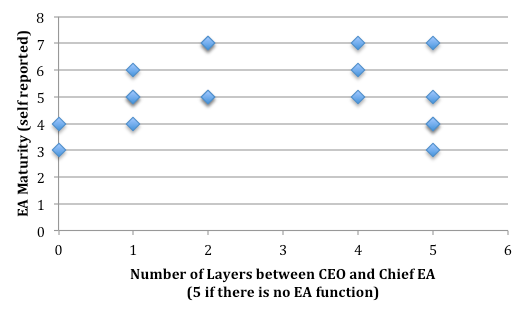
Figure 1 shows the data from an interview of almost 20 government agencies that included questions about their EA maturity as well as the number of layers between their CEO and Chief EA.  No clear pattern can be identified from the interview data.  Some might even argue that having two to four layers between the CEO and the Chief EA is the best!


Figure 1 Relationship between Chief EA’s distance to CEO and EA Maturity

In addition, my discussions with a researcher from Massachusetts Institute of Technology suggests the same finding: that there has been no support in data of correlation between an organization’s Chief EA’s proximity to the CEO and its EA maturity.

Does this mean that it does not matter where the chief EA sits in organizations? In many organizations, the Chief Information Officer is the chief EA, so does that also mean that it does not matter where the CIO sits in organizations?

Through the interviews, I noticed that the organizations who reported having mature EA roughly falls into three groups. The first group is made up of organizations with very influential CIOs who reported either directly into the CEO or to a direct report of the CEO. The second group has stories of their CEO believing strongly in EA, and pushed the EA agenda top-down. The third group consists of organizations that I was not clear why they reported high maturity for their EA. It might be a lack of understanding on my part, but I also suspect some of them are still early in their EA journey and thus not yet equipped to provide an accurate assessment of their EA maturity.

Analyzing the mature organizations gives the following thought: where the chief EA sits is less important to an organization’s EA maturity than EA’s mindshare among senior managers. If the CEO believes in EA, the organization is more likely to have mature EA. If the CIO is influential and believes in EA, it is more likely that he can influence the CEO to think the same. The challenge though is that it is difficult to measure EA’s mindshare among senior managers, but this does reinforce an often-repeated EA best practice on the importance of gaining top management’s sponsorship to achieve successful EA implementation.

Where the CIO sits makes no difference to EA?

Photo titled “sit where you want”.  Pretty apt for this article!
(photo credit: DorteF)

Enterprise Architecture deals with the blueprint of enterprises, so it might make sense that the blueprint function sits close to the Chief Executive Officer in the organization chart to ensure alignment between planning and execution. Is there a correlation between where the Chief Enterprise Architect sits in the organization chart and the Enterprise Architecture maturity of that enterprise?

Figure 1 shows the data from an interview of almost 20 government agencies that included questions about their EA maturity as well as the number of layers between their CEO and Chief EA.  No clear pattern can be identified from the interview data.  Some might even argue that having two to four layers between the CEO and the Chief EA is the best!


Figure 1 Relationship between Chief EA’s distance to CEO and EA Maturity

In addition, my discussions with a researcher from Massachusetts Institute of Technology suggests the same finding: that there has been no support in data of correlation between an organization’s Chief EA’s proximity to the CEO and its EA maturity.


Does this mean that it does not matter where the chief EA sits in organizations? In many organizations, the Chief Information Officer is the chief EA, so does that also mean that it does not matter where the CIO sits in organizations?

Through the interviews, I noticed that the organizations who reported having mature EA roughly falls into three groups. The first group is made up of organizations with very influential CIOs who reported either directly into the CEO or to a direct report of the CEO. The second group has stories of their CEO believing strongly in EA, and pushed the EA agenda top-down. The third group consists of organizations that I was not clear why they reported high maturity for their EA. It might be a lack of understanding on my part, but I also suspect some of them are still early in their EA journey and thus not yet equipped to provide an accurate assessment of their EA maturity.

Analyzing the mature organizations gives the following thought: where the chief EA sits is less important to an organization’s EA maturity than EA’s mindshare among senior managers. If the CEO believes in EA, the organization is more likely to have mature EA. If the CIO is influential and believes in EA, it is more likely that he can influence the CEO to think the same. The challenge though is that it is difficult to measure EA’s mindshare among senior managers, but this does reinforce an often-repeated EA best practice on the importance of gaining top management’s sponsorship to achieve successful EA implementation.