#eavoices
Steering The Enterprise of Brexit
Two contrasting approaches to Brexit from architectural thought leaders.
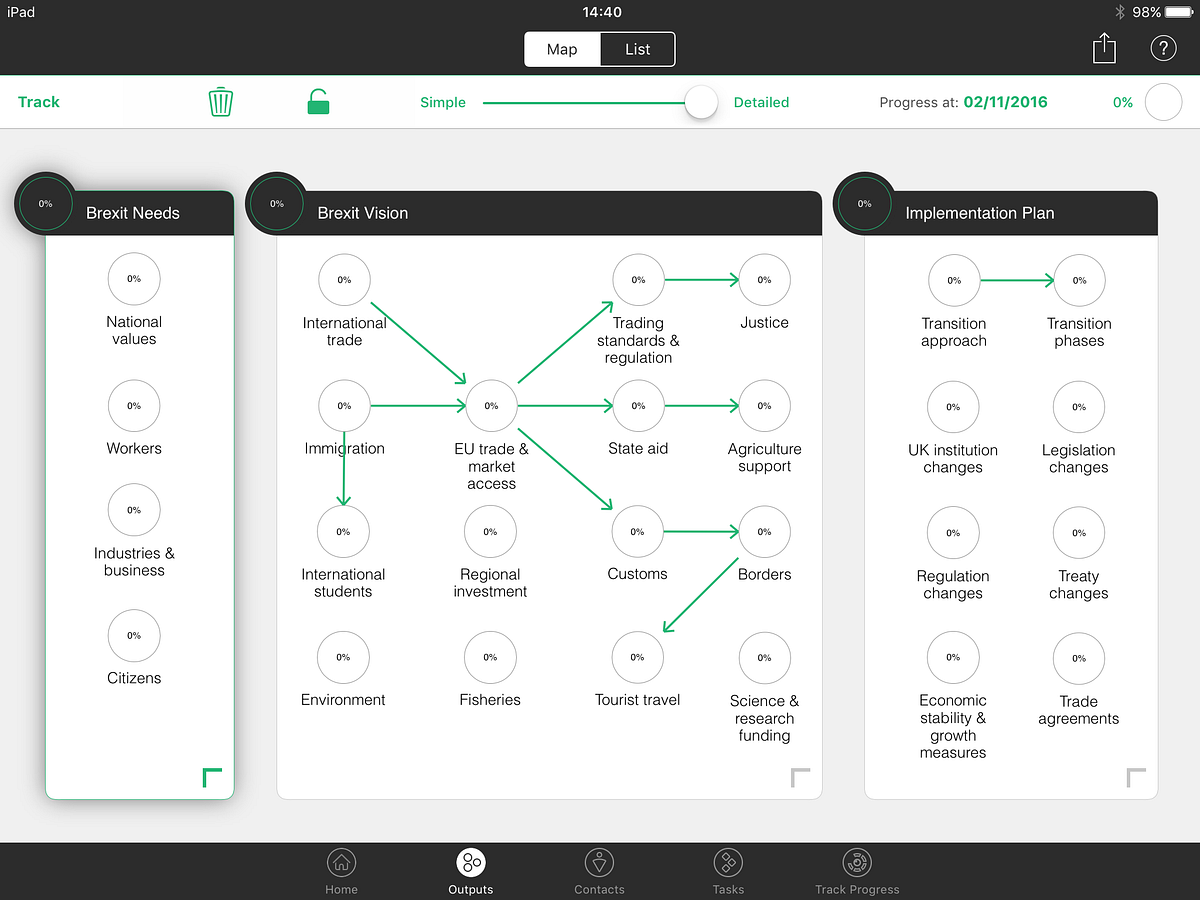
Dan Onions offers an eleven-step decision plan based on his DASH method, showing the interrelated decisions to be taken on Brexit as a DASH output map.
 |
|
| A decision plan for Brexit (Dan Onions) |
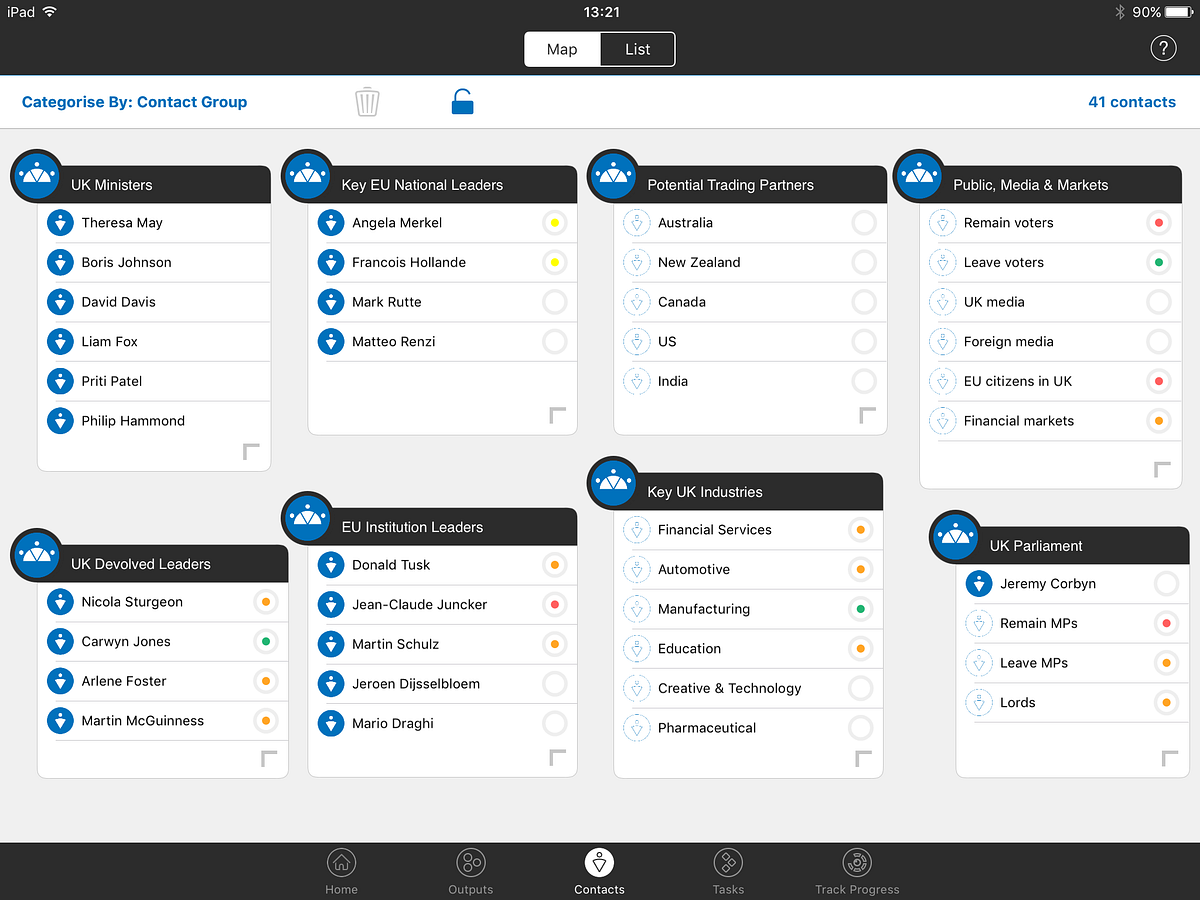 |
| A stakeholder map for Brexit (Dan Onions) |
Let me now contrast Dan’s approach with Simon Wardley’s. Simon had been making a general point about strategy and execution on Twitter.
In 25 years in business, I’ve never seen a problem caused by “poor execution”. It is always crap strategy looking for someone else to blame.— swardley (@swardley) April 29, 2016
Knowing Simon’s views on Brexit, I asked whether he would apply the same principle to the UK Government’s project to exit the European Union.
ah @richardveryard #Brexit could be an opportunity, it depends upon steps taken. Alas, in complex environments it can’t be pre-determined.— swardley (@swardley) November 8, 2016
which goes back to first rule of strategy @richardveryard. it’s iterative. You consider as much as you can and adapt as you play the game.— swardley (@swardley) November 8, 2016
It’s best summed up for me @richardveryard in this diagram pic.twitter.com/k8j8yciXsa— swardley (@swardley) November 8, 2016
@swardley Nice picture. So how do you address strategic governance, given that #Brexit was supposedly about sovereignty and control.— Richard Veryard (@richardveryard) November 8, 2016
@richardveryard : structure / governance is under doctrine (e.g. small autonomous teams, use appropriate methods, remove bias & duplication)— swardley (@swardley) November 8, 2016
@richardveryard : whereas choice / decision / direction is under leadership.— swardley (@swardley) November 8, 2016
@swardley You are answering in abstractions. How do you answer the concrete questions of sovereignty and control in relation to #Brexit?— Richard Veryard (@richardveryard) November 8, 2016
Simon’s diagram revolves around purpose. OODA is a single loop, and the purpose is typically unproblematic. This reflects the UK government’s perspective on Brexit, in which the purpose is assumed to be simply realising the Will of the People. The Prime Minister regards all interpretation, choice, decision and direction as falling under her control as leader. And according to the Prime Minister’s doctrine, attempts by other stakeholders (such as Parliament or the Judiciary) to exert any governance over the process is tantamount to frustrating the Will of the People.
Whereas Dan’s notion is explicitly pluralist – trying to negotiate something acceptable to a broad range of stakeholders with different concerns. He characterizes the challenge as complex and nebulous. Even this characterization would be regarded as subversive by orthodox Brexiteers. It is depressing to compare Dan’s careful planning with Government insouciance.
Elsewhere, Simon has acknowledged that “acting upon your strategic choices (the why of movement) can also ultimately change your goal (the why of purpose)”. Many years ago, I wrote something on what I called Third-Order Requirements Engineering, which suggested that changing the requirements goal led to a change in identity – if your beliefs and desires have changed, then in a sense you also have changed. This is a subtlety that is lost on most conventional stakeholder management approaches. It will be fascinating to see how the Brexit constituency (or for that matter the Trump constituency) evolves over time, especially as they discover the truth of George Bernard Shaw’s remark.
“There are two tragedies in life. One is to lose your heart’s desire. The other is to gain it.”
Dan Onions, An 11 step Decision Plan for Brexit (6 November 2016)
Richard Veryard, Third Order Requirements Engineering (SlideShare)
Based on R.A. Veryard and J.E. Dobson, ‘Third Order Requirements Engineering: Vision and Identity’, in Proceedings of REFSQ 95, Second International Workshop on Requirements Engineering, (Jyvaskyla, Finland: June 12-13, 1995)
Simon Wardley, On Being Lost (August 2016)
Related Posts: VPEC-T and Pluralism (June 2010)
Is a company the sum of its parts ?
It is interesting to hear people sometimes referring to their company as a person; the company did or said this, what my company has (or not) done for me, etc. But a company is not a person, it does not have self-awareness or own will, it is the individuals that make up an organization who are […]
Prepare your Organization for Change: 6 Key Capabilities
Few companies have a systematic and reliable way of translating their business strategy into action across all relevant parts of the organization. Research on digital transformations by MIT Sloan [1] distinguishes between the ‘what’ (what does an organization want to achieve) and the ‘how’ (how can an organization realize change) and shows that organizations that focus on the ‘how’ turn out to be much better at executing transformations.
Events and Context, and cauliflower.
I was chatting with a friend yesterday about composability, events, and other distributed computing concepts.He is quite a fan of doing composition at the point of consumption. Using the idea of eating family style – a group of people, a common table a…
Events and Context, and cauliflower.
I was chatting with a friend yesterday about composability, events, and other distributed computing concepts.He is quite a fan of doing composition at the point of consumption. Using the idea of eating family style – a group of people, a common table a…
Business novel – chapters 00-03
I said in an earlier post that I’m moving more towards describing my ideas on enterprise-architecture and the like into fiction-based form – in the hope that it will make it somewhat more understandable for most folks in and beyond the…
China’s Cybersecurity Law Challenges Foreign Companies To Accelerate Their Digital Transformation
On November 7, China’s top legislature adopted a cybersecurity law to safeguard the sovereignty on cyberspace, national security, and the rights of citizens. The law has seven chapters that define specific regulations in various areas, such as network …
The Art of the Recap
If a meeting occurs, but nobody sends a recap, did the meeting happen? We have blogged about the importance of a meeting recap, but spoke more of the practice of using meeting recaps and less of the art of creating a good recap. We do have internal guidelines that we follow, but through our mentoring […]
Simplicity
Often as architects we have the tendency to over complicate solutions as the first solution often either sounds far too simple or it looks wrong. A typical example is the Clustering, the tendency to erroneously consider the inevitable “streaks” or “clusters” arising in small samples from random distributions to be non-random. Using this illusion you … Continue reading Simplicity →
EA Programs
An effective EA Program session is the best way to ensure that a project gets started correctly. Cutter’s EA Program sessions help establish a project’s team values, vision, mission, objectives, project community, measures of success, scope and boundar…
Reinventing IT
Sign up for 18 Nov webinar with Milan Guenther In this first webinar of a series on Enterprise Design practice, Milan will show how to reposition architecture, analysis and design work to reclaim the driver’s seat in digital transformation. The webinar will cover these themes: Working with the QualiWare modelling environment, we will cover What the new … Read more…
The post Reinventing IT appeared first on QualiWare Center of Excellence.