Meet me at EAC June 2016 London
I’ll be giving the opening EA keynote for the Enterprise Architecture Conference Europe 2016 on 14 June 2016 in London. I’d love to discuss EA with you. So: meet me there? Filed under: Enterprise Architecture
Aggregated enterprise architecture wisdom
I’ll be giving the opening EA keynote for the Enterprise Architecture Conference Europe 2016 on 14 June 2016 in London. I’d love to discuss EA with you. So: meet me there? Filed under: Enterprise Architecture
Often, the work of problem-solving spurs the creation, or escalation of other problems. Most are implications of solution execution; expected or not. Sometimes though, the new problem is a result of poking and prodding the original problem, long before solution work. While considering your problem, you unearth a better problem. Not better as in more […]
There’s an old rhyme about what a bride should wear for luck on her wedding day: “Something old, something new, something borrowed, something blue…”. While reading an article on the origins of the US highway system, I thought about this rhyme in relation to the concept of innovation. Part of that article related the US […]
By Stuart Macgregor, CEO, Real IRM Solutions and The Open Group South Africa These industry insights look at John Kotter’s eight stages of change management, and explore his timeless blueprint for effective change leadership. These change management principles can gel … Continue reading →
Having a vision statement is essential for an organisation to know ‘why’ it is doing what it is doing. A vision statement supports the rationale for why an organisation exists. It provides both guidance and a means to assess the … Continue reading →
Filed under: Enterprise Architecture
Filed under: Enterprise Architecture
Filed under: Enterprise Architecture
Enterprises, in their quest to reduce labor costs are applying RPA technologies. Yet they do not have a well-defined set of principles and best practices including how to position RPA with other process tools and initatives. Today it may have become a bit more clear. Pega is the first tech provider, and only BPM market particpant of substance, to purchase an RPA provider (OpenSpan). The combination brings robotics, analytics, and case management together – and that makes sense. Think of Pega’s process/rules capibility firing off a set of RPA scripts.
RPA in many respects is an alternative, some would say the polar opposite of Pega’s current business model that feasts on the transformitive “big IT spend” for BPM, case management, automation, and customer service projects. RPA does not require invasive integration. It is a quick hit for automation, a “low touch” approach for process improvement for brittle legacy systems. The bottom line. Enterprises that employ labor on a large scale for process work, can gain efficiencies by just automating repetitive human tasks for the “as is” process.
OpenSpan is nice pick up for Pega that will help with back office BPM work, but more so with contact center environments where the agent requires human and machine multi-tasking that often spans multiple windows and web applications, few of which are integrated with each other. Cumbersome process flows, rekeying of data and lack of integration add up to lengthy call times, reduced accuracy and an overall increase in customer frustration. Pega/OpenSpan, will give Jacada, and NICE a run for thier money and the future integartion with Pega’s analytics tarcks where the RPA space is heading.
Bioingine.com; Platform for comprehensive statistical and probability studies for BigData Driven Medicine and Public Health. Importantly helps redefine Data driven Medicine as:- Ontology (Semantics) Driven Medicine Comprehensive Platform that covers Descriptive Statistics and Inferential Probabilities. Beta Platform on the anvil…. Continue Reading →
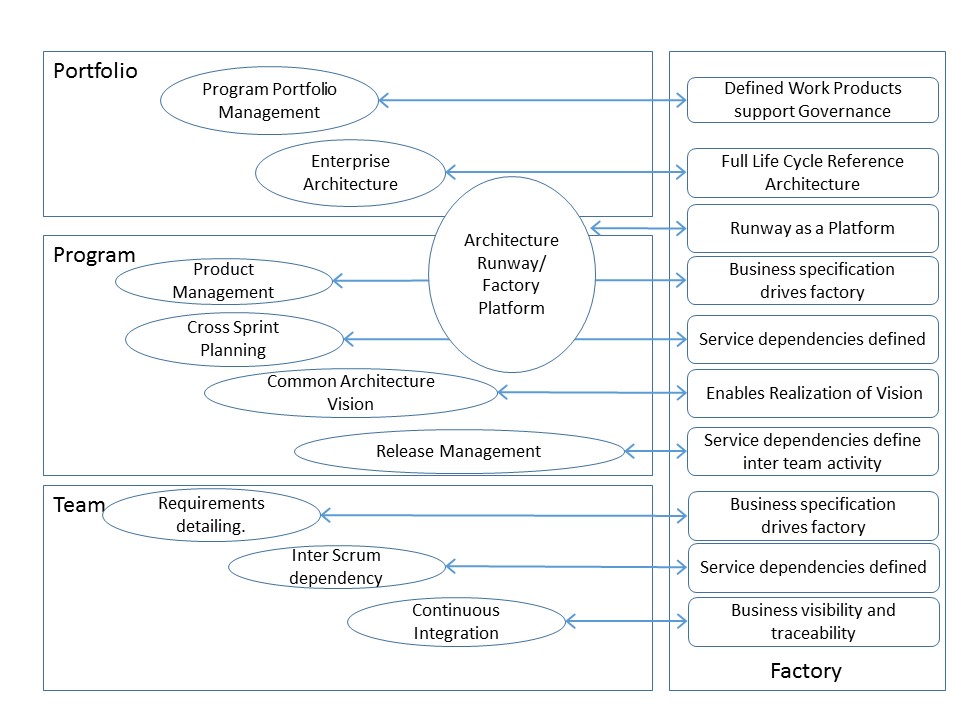
Abstract: If you address the question of how to scale Agile projects by considering what framework to use, you are only looking at one aspect of the problem. Scaling is all about coordination – managing enterprise considerations and cross program dependencies, and the defacto frameworks (SAFe, LeSS and DAD) focus on the people and process dimensions. However, in combination with a factory approach you may be able to automate many of the compliance and dependency management issues.
The question of how to scale Agile development has been around a while. In January 2015 I commented [1] on a clear trend in which my customers were voicing concerns about loss of consistency; inability to govern; lack of coordination and increasing time to market. Since then I have observed many large organizations adopting SAFe (Scaled Agile Framework) perhaps because it appears to be the only game in town, or perhaps there’s good marketing or there’s strength in numbers. But the criticisms of SAFe [2] haven’t gone away. The central and continuing concern is that SAFe compromises core Agile principles of self-organizing, cross functional teams that have full responsibility for the delivery of potentially shippable increments. And that SAFe looks suspiciously like WaterScrumFall because there’s a high overhead of portfolio, value stream and project management and in all probability intentional architecture. Now I have mixed opinions on SAFe; I see positives in value streams and product management which are important. And for organizations that have large programs, highly organized, structured approaches will be seen as lower risk, and indeed something that takes them some way down the Agile path, without straying too far from conventional management comfort zones. But the outcomes are unlikely to be inherently “agile”.
What SAFe does, is provide a rather conventional approach for a complex problem that most enterprises have – that is to deliver high integrity solutions that can work in an enterprise context that demands cross project dependency management, consistent data and reference architecture, collaboration with the existing portfolio complexities, compliance with enterprise standards and governance etc.
There are alternatives. Craig Larman and Bas Vodde in their books [3] and more recently with their LeSS initiative [4] have pursued a very different path that starts with Scrum and scales by understanding the needs for coordination while adhering to core Scrum principles. In their forthcoming book [5] they say, “LeSS is (1) lightweight, (2) simple to understand, and (3) difficult to master—due to essential complexity”. And this allows us to contrast the different approaches; while SAFe clearly works at some level, it has its roots in conventional large scale project management, whereas LeSS is lightweight, but requires much deeper understanding of the systems dynamics because of the inherent complexity of all the coordination requirements.
So the real question underlying Scaling Agile should be, “can we address some of the coordination requirements in a manner that reduces complexity and eliminates some of the need for additional layers of management or events?”
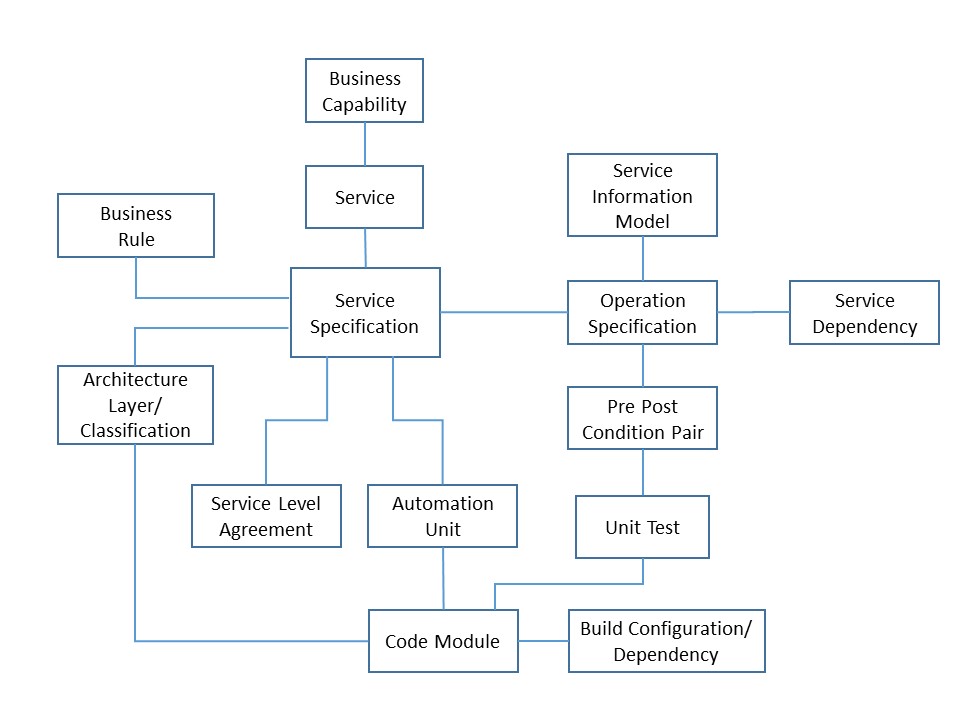
In my post Service Factory 2.0 [6] I describe the conceptual background of the Software Factory, ideas pioneered by my old friend Keith Short and Jack Greenfield while they were at Microsoft. Today these have evolved and become specialized around a framework of tools, repeatable processes and patterns for creation and assembly of services – manifest as first order components with formal interfaces. If you consider that all core business functionality is increasingly composed of services and their operations, this provides us with a reference architecture that by design implements separation of concerns. Figure 1 below is a conceptual view of the scope of the service factory in terms of managed objects.
Organisations often promote themselves by expounding on their capability to deliver goods and services to particular market segments. Organisational capability is only one side of a many sided coin. In an individual it is accepted that an ability is the … Continue reading →