Agile is not Dead, it’s Morphing

I note healthy discussion around whether Agile is Dead [ref 1]. And while I may sympathize (sic) with many of the comments, particularly the commercial trivialization of education, the core issue must surely be the difficulty of adopting de facto Agile practices to support real world enterprise programs and projects. My experience is most of the advice and guidance out there is predicated on scaling the de facto Agile development methods. And this isn’t the best place to start.

An exception is Dean Leffingwell’s SAFe, [ref 2] which does introduce the idea of portfolio, program and project perspectives and intentional architecture. I recommend this framework as an intelligent set of practices, but for me it doesn’t go far enough because it is still primarily about development practices. This is the core problem – that Agile is development specific and practices only. In the enterprise, Agile development needs to be an integral part of a bigger ecosystem spanning business design, architecture, requirements, modernization and operational transformation practices plus architecture, delivery and modernization disciplines.

I am indebted to Dave Thomas whose recent blog, [ref 1] includes a worthy successor to the Agile Manifesto, reducing the original, development specific values and principles to a minimalist, more generic set. He says; “here is how to do something in an agile fashion
Find out where you are
Take a small step towards your goal
Adjust your understanding based on what you learned
Repeat
And this is more useful in the enterprise context because it is relevant to a broader set of activities than purely software development.

The diagram below is an outline maturity model template for Agile in the enterprise. It suggests there are four key views that need to be part of the transformation.  In addition to agile practices we need to be equally focused on what elements of agile architecture are required for an enterprise. What the agile delivery framework is and how the existing application portfolio will be modernized to progressively eliminate the duplication and complexity present in every enterprise on the planet.
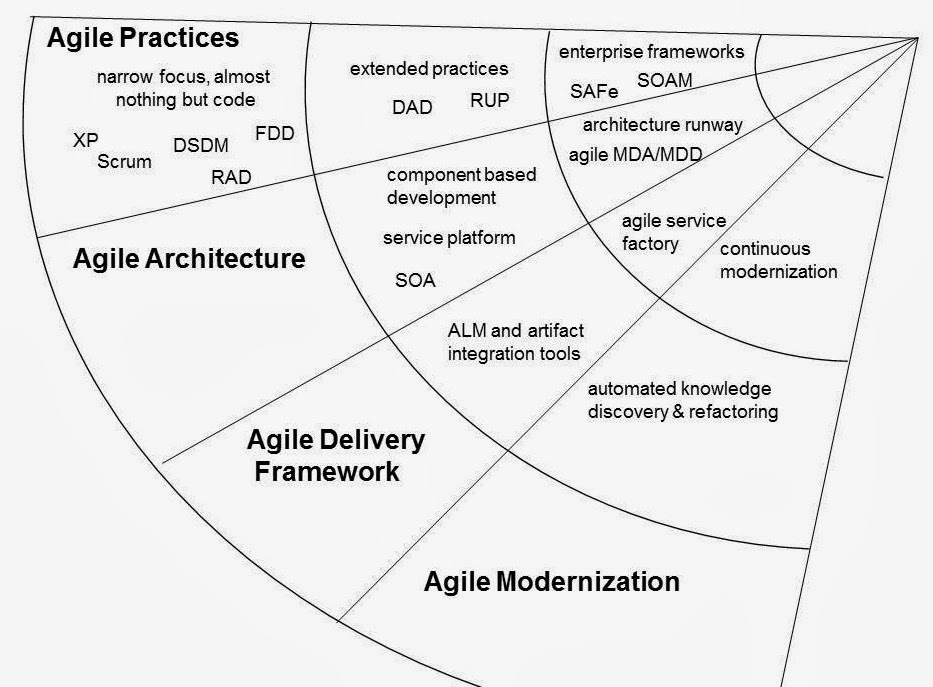
People & Process. Much of the dissatisfaction with Agile arises from the limitations of the basic Agile practices, and the need to compromise these in an enterprise context. Both DAD and RUP (yes it’s an iterative method) are examples of extended or hybrid practices that introduce coordination, phasing and other disciplines that are more acceptable in enterprises that require traceability, governance and compliance with pre-existing life cycle practices. Enterprise frameworks such as Leffingwell’s SAFe as discussed and Everware-CBDI’s SOAM are examples of frameworks that adhere more closely to the purity of Agile principles while addressing enterprise specific needs. SAFe provides a framework which is more strongly Lean, coordinating portfolio, program and project activity to meet agile release train demand. SOAM provides a complementary, full life cycle process framework for software service modernization and delivery.

Agile Architecture. There is a requirement to articulate the enterprise requirements for agility as a reference architecture for business agility. In today’s fast moving world core architecture for the business, services, implementations, technology and deployments needs to be:
under continuous development using Agile principles
derived from the assessment of business needs for response to change, and constantly updated to reflect competitive and technology opportunities and threats.
mapped to service architectures, patterns, policies and modernization strategies
modeled using MDA/MDD to allow delivery as consistent architecture runways for portfolio and demand management, programs and projects.

Agile Delivery Framework. Most enterprises have a well-defined delivery framework of tools, repositories, templates etc that are designed to support well established QA and delivery policies. This is one of the most common inhibitors that Agile projects in the enterprise have to  overcome. In an enterprise Agile context that framework must be realigned to provide maximum automation of life cycle management and governance so that key enterprise requirements for integrity can be met without loss of productivity. Similarly the development  activity must be structured so that developers can extend the architecture runway with business solution specific rules and behaviors in a managed fashion which preserves the integrity of the architecture. Everware-CBDI has pioneered this runway extension capability implemented as a model driven (MDA/MDD) capability in which the runway code is generated and provided to developers enabling very significant productivity gains in both forward engineering and even more so in iteration.

Agile Modernization.  Finally in an enterprise context the elephant in the room is the existing or legacy portfolio. Unless this elephant is addressed, the enterprise will continue to create more and more complexity, increase costs and reduce response times to change. What’s required is a discipline of continuous, Agile modernization. That means, using Dave Thomas’s minimalist manifesto [above] every portfolio item, program and project must include steps to find out the current situation and address minimum goals that reduce complexity and support a progressive modernization strategy. Without that, all enterprise Agile projects will remain narrow focus and simply add technical debt.

I suggest that while Agile is not dead in the enterprise it is certainly struggling to survive. This is because Agile practices alone will be suffocated at birth by enterprise realities of consistency and integrity; or turned into narrow focus, standalone projects; or morphed into BAU. I really don’t want to enter into a debate about nouns or verbs, life is too short.  IMO Agile has considerable momentum and it can be morphed into a ground breaking concept that delivers enterprise business agility.

References
1 Agile is Dead (Long Live Agility)
2 Dean Leffingwell SAFe

Holiday: time to do some in-depth reading

I’m just back from a great, relax holiday. Apart from having good quality time with my family, holiday is also a great time to immerse myself in some books. Instead of the quick information gathering I normally do by scanning my twitter timeline, quick-reading blog posts, and some more in-depth articles from time to time, I really focused on a single book for a couple of hours. Reading books really.

The post Holiday: time to do some in-depth reading appeared first on The Enterprise Architect.

The Project Business Model SWOT

This post is the sixth in a series of ten about real life experiences of using business model thinking as a foundation for planning and delivering change. Writing this post I’ve had the help of a true friend and admirable colleague (Eva Kammerfors) whom I’ve shared many of the referred to business model experiences with. […]

The Project Business Sprintlines

This post is the fifth in a series of ten about real life experiences of using business model thinking as a foundation for planning and delivering change. Writing this post I’ve had the help of a true friend and admirable colleague (Eva Kammerfors) whom I’ve shared many of the referred to business model experiences with. […]

An Agile Enterprise Architecture (EA) Delivers Critical Business and Mission Agility

While working with a recent partner, the question came up; “What changes are made to the EA approach if agile methods are required, or otherwise heavily encouraged?” The initial answer at the time was “Not many – we already have an agile approach to EA embedded in our Oracle Enterprise Architecture Development Process (OADP), and our Oracle Enterprise Architecture Framework (OEAF) is independent of project management and project development approaches.”

Our OADP has always been agile and therefore supportive of business and government agility – particularly in the current context of severely constrained budgeting cycles. We firmly believe in a “just enough, just in time” philosophy, with collaborative insight and contribution across teams and leadership, and delivery of EA artifacts or guidance tuned directly to prioritized results. This means strategic, useful and reusable guidance modeled and delivered in a manner that supports both longer-term initiatives and near-term objectives.

EA delivered as an agile approach, however, does require continual line-of-sight traceability back to the IT investment strategy – which in turn is aligned to the business strategy.  

In other words, a Sprint Iteration approach might be justified (i.e. using the “Scrum” strategy), from all relevant perspectives, to quickly establish a reusable process and metadata model for a common agency function – like “Document Routing and Approval” (DRA). The output might be required to inform a software solicitation (i.e. to explain the requirements).  The output might be to establish a reference model and basic governance (business rules) for identifying and improving process efficiencies around the agency where DRA is occurring.

The actual need for this EA artifact (or “Product”, in Agile terms) may be driven from an unanticipated mandate or regulatory change, and therefore require rapid response.  The need may also be limited in scope to only a portion of the agency’s business (i.e. those who actually know they need it).

So, an EA Sprint will work, and deliver what’s needed quickly and effectively to the target audience.  The highest return on investment (ROI) in this exercise, however, only exists if actual Enterprise traceability and impact assessment occurs. In other words, an agile EA output with a strategic Enterprise outcome.

Note this is a common misunderstanding for Agile software development; Agile programming and project management may deliver useful, rapid and cost-effective “features” from a Backlog of priorities, but much of the supporting infrastructure, integrations and organizational change isn’t delivered using Agile methods, but must evolve in a more strategic, methodic manner.  Preferably with EA guidance.

Here’s what should happen.  The common DRA process, metamodel and business rules begin to shape, in a somewhat parochial “requirements-driven” context, heavily leveraging the impacted SMEs for a short period of time. As this occurs, the Enterprise Architect and stakeholders begin mapping and comparing the DRA process design (at appropriately coarse levels of abstraction) to any similar that may exist within the agency, or among agency partners or stakeholders.  This may require some additional outreach and communication.  The EA may find additional SMEs, risk factors, standards, COTS DRA solution accelerators, overlapping data management projects, etc. – essentially other activities or resources that can be used or might be impacted.

The Enterprise Architect is the Scrum Master!

Strategic oversight and influence is therefore brought to bear on the EA sprint, and by leveraging EA methods, the impacts to the rest of the organization plus any modifications to the focus EA artifact can be addressed – entirely within standard and expected IT Governance. The EA artifact development is a Sprint, but actually leverages our lifecycle methodology – from Business Context through Current and Future States, and then Roadmap (i.e. Transitional Architecture) and Governance.  The EA Sprint may actually kick off or modify a more holistic EA maintenance process.

We are therefore avoiding an “agile everything” philosophy, though we’re delivering agile results.   We contribute over-arching guidance and process for both the DRA project and the organization as a whole, to make sure that all projects underway are still aligned to meet the needs of the business and IT investment constraints.

This is essentially what we believe in applying our EA process, over time or during more Agile response cycles; always raise and maintain focus on the business strategy and drivers to guide the investment of IT budget into those areas that affect the business most – or that are the most immediate priority, such as described above.

Thanks to Oracle Public Sector Enterprise Architect Ted McLaughlan for contributing to this article!

The Project Business Model Timeline

This post is the fourth in a series of ten about real life experiences of using business model thinking as a foundation for planning and delivering change. Writing this post I’ve had the help of a true friend and admirable colleague (Eva Kammerfors) whom I’ve shared many of the referred to business model experiences with. […]