Drawing a line…
Sometimes, however experienced you are as an architect and however “strategic” you are in your work, sometimes it pays to get right back to basics. The issue often is “how effective is our communication?”
Our profess…
Aggregated enterprise architecture wisdom
Sometimes, however experienced you are as an architect and however “strategic” you are in your work, sometimes it pays to get right back to basics. The issue often is “how effective is our communication?”
Our profess…
The LEARN principle extends the NEA principle of the internet to the context of global knowledge: Learning is everywhere. Everyone can use it. Anyone can improve it. Responsibility drives it. No-one possesses it. The NEA acronym stands for the maxim…
 |
| Photo titled “sit where you want”. Pretty apt for this article! (photo credit: DorteF) |
Enterprise Architecture deals with the blueprint of enterprises, so it might make sense that the blueprint function sits close to the Chief Executive Officer in the organization chart to ensure alignment between planning and execution. Is there a correlation between where the Chief Enterprise Architect sits in the organization chart and the Enterprise Architecture maturity of that enterprise?
Figure 1 shows the data from an interview of almost 20 government agencies that included questions about their EA maturity as well as the number of layers between their CEO and Chief EA. No clear pattern can be identified from the interview data. Some might even argue that having two to four layers between the CEO and the Chief EA is the best!
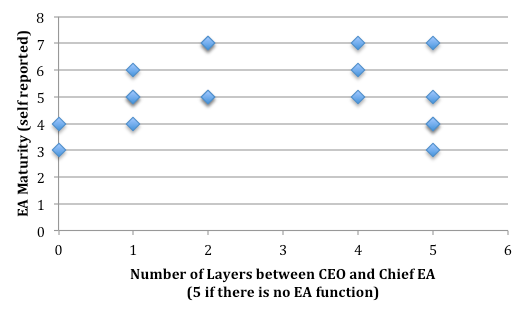
Figure 1 Relationship between Chief EA’s distance to CEO and EA Maturity
In addition, my discussions with a researcher from Massachusetts Institute of Technology suggests the same finding: that there has been no support in data of correlation between an organization’s Chief EA’s proximity to the CEO and its EA maturity.
Through the interviews, I noticed that the organizations who reported having mature EA roughly falls into three groups. The first group is made up of organizations with very influential CIOs who reported either directly into the CEO or to a direct report of the CEO. The second group has stories of their CEO believing strongly in EA, and pushed the EA agenda top-down. The third group consists of organizations that I was not clear why they reported high maturity for their EA. It might be a lack of understanding on my part, but I also suspect some of them are still early in their EA journey and thus not yet equipped to provide an accurate assessment of their EA maturity.
Analyzing the mature organizations gives the following thought: where the chief EA sits is less important to an organization’s EA maturity than EA’s mindshare among senior managers. If the CEO believes in EA, the organization is more likely to have mature EA. If the CIO is influential and believes in EA, it is more likely that he can influence the CEO to think the same. The challenge though is that it is difficult to measure EA’s mindshare among senior managers, but this does reinforce an often-repeated EA best practice on the importance of gaining top management’s sponsorship to achieve successful EA implementation.
|
| Photo titled “sit where you want”. Pretty apt for this article! (photo credit: DorteF) |
Enterprise Architecture deals with the blueprint of enterprises, so it might make sense that the blueprint function sits close to the Chief Executive Officer in the organization chart to ensure alignment between planning and execution. Is there a correlation between where the Chief Enterprise Architect sits in the organization chart and the Enterprise Architecture maturity of that enterprise?
Figure 1 shows the data from an interview of almost 20 government agencies that included questions about their EA maturity as well as the number of layers between their CEO and Chief EA. No clear pattern can be identified from the interview data. Some might even argue that having two to four layers between the CEO and the Chief EA is the best!
Figure 1 Relationship between Chief EA’s distance to CEO and EA Maturity
In addition, my discussions with a researcher from Massachusetts Institute of Technology suggests the same finding: that there has been no support in data of correlation between an organization’s Chief EA’s proximity to the CEO and its EA maturity.
Through the interviews, I noticed that the organizations who reported having mature EA roughly falls into three groups. The first group is made up of organizations with very influential CIOs who reported either directly into the CEO or to a direct report of the CEO. The second group has stories of their CEO believing strongly in EA, and pushed the EA agenda top-down. The third group consists of organizations that I was not clear why they reported high maturity for their EA. It might be a lack of understanding on my part, but I also suspect some of them are still early in their EA journey and thus not yet equipped to provide an accurate assessment of their EA maturity.
Analyzing the mature organizations gives the following thought: where the chief EA sits is less important to an organization’s EA maturity than EA’s mindshare among senior managers. If the CEO believes in EA, the organization is more likely to have mature EA. If the CIO is influential and believes in EA, it is more likely that he can influence the CEO to think the same. The challenge though is that it is difficult to measure EA’s mindshare among senior managers, but this does reinforce an often-repeated EA best practice on the importance of gaining top management’s sponsorship to achieve successful EA implementation.
Jim Hietala, VP of security at The Open Group, provides a summary of The Open Group conference in Washington, D.C. (July 16-18). Continue reading →
Re-reading Atul Gawande’s The Checklist Manifesto, to write a book-review for the current edition of the Journal of Enterprise Architecture, it struck me that the SCAN frame provides a useful means to understand and describe the relationship between checklists and…
Over on LinkedIn, on the EA People list, Frank Guerino asked about EA tools: Question about EA Tools… What tools do you use to help you with EA tasks and why? What do you perceive their Pros and Cons to…
The number of individuals certified in the TOGAF® 9 certification program as of July 1st 2012 is 14,851. This represents a doubling of the number of individuals certified in the last 12 months with 7,640 new certifications during that period. The late…
Available very soon: August 2012 – Volume 8, Number 3 of CONTENT Editor’s Corner John Gøtze introduces this number. Architect in the Spotlight: Eric Stephens John Gøtze interviews Eric Stephens. Enterprise Architecture, IT Service Management and Service Oriented Architecture: relationships, approaches and operative guidelines (part 2 of 2) Carlo Randone Enterprise Architecture, IT Service Management (and Governance) …read more
We have, obviously, the problem of regulating the EA profession. Currently, many do take EA training and certifications in the hope they’d improve their career prospects. But do they improve or guarantee the practitioners’ prowess to do the job?
 |
| Even star war troopers need mirrors! photo credit: Kalexanderson |
 |
| Can you tell if something is out of line? photo credit: chekobero |
|
| Even star war troopers need mirrors! photo credit: Kalexanderson |
|
| Can you tell if something is out of line? photo credit: chekobero |