The Open Group Conference to Emphasize Healthcare as Key Sector for Ecosystem-Wide Interactions

By Dana Gardner, Interarbor Solutions Listen to the recorded podcast here:  Dana Gardner: Hello, and welcome to a special BriefingsDirect Thought Leadership Interview series, coming to you in conjunction with The Open Group Conference on July 15, in Philadelphia. Registration … Continue reading

Business Architecture & Enterprise Architecture – Match Made in Heaven

I recently spoke at the European BPM and EA Conference in London on this topic. This blog post is a summary version of my session.

Often Business Process Management and associated discipline such as Business Architecture is seen or managed in isolation of the overarching Enterprise Architecture construct. However the Business Architecture and Enterprise Architecture complement each other well to get the best value from each other. I think that the Business Architecture is one of the key enablers of the Enterprise Architecture and makes it real. While the Enterprise Architecture offers much needed context for the Business Architecture.

It might be useful to briefly review the definitions of both Business Architecture and Enterprise Architecture before understanding issues in their relationship. 

As I have been writing on this blog, Enterprise Architecture should not be limited to the IT or Technology concerns of an organisation. Rather it should be focused on addressing much broader scope covering the business, functional, operational, financial and people aspects of the enterprise. 

There are a number of Enterprise Architecture definitions out there. A couple of my favorite ones are as follows:


Enterprise Architecture provides a strategic planning framework that relates and aligns information technology with the business functions that it supports.


Or


Practice of enterprise architecture involves developing a framework to describe a series of “current”, “intermediate” and “target” reference architectures and applying them to align change within the enterprise. Another set of terms for these are “as-is”, “to-be” and the “migration plan”.


The Business Architecture Special Interest Group of Object Management Group (OMG) defines Business Architecture as follows:

“A Blueprint of the Enterprise That Provides A Common Understanding Of The Organization And Is Used To Align Strategic Objectives And Tactical Demands.”


“Business Architecture describes the product and/or service strategy, and the organizational, functional, process, information, and geographic aspects of the business environment”

I think that though the practice of both Business Architecture and Enterprise Architecture has matured over the past few years, there certainly are some issues when it comes to these two working well together. I have summarised them in four broad arguments;

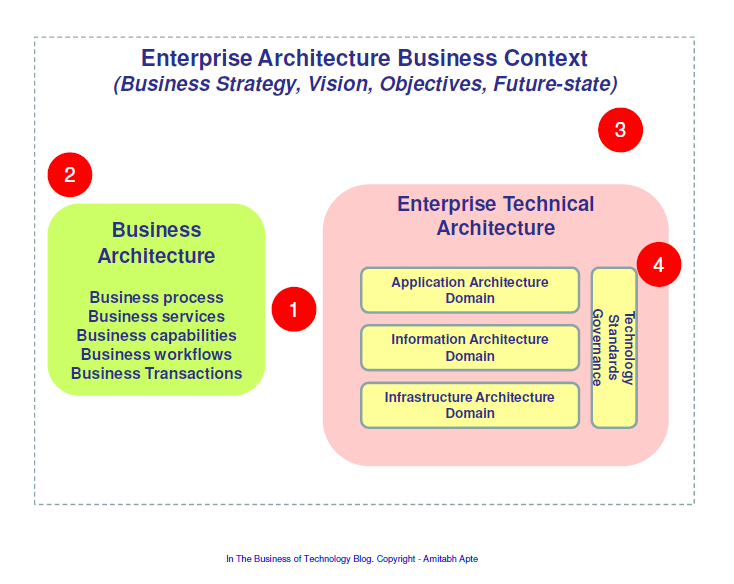
  1. Business Architecture not done at all. Enterprise Architecture teams only perform Enterprise Technical Architecture only.
  2. Business Architecture done in isolation of Enterprise Technical Architecture and then (if lucky) artificially superimposed
  3. Business Architecture and Business Context Confusion: confusion between why, what and how
  4. Technology focused governance: only conversations about technical standards, business governance disconnected from IT investment and decisions leading to critical gaps
I have tried to capture this pictorially below:
BA & EA in Isolation

This issue is getting wider acknowledgment given its strategic importance. I particularly like Randy Heffner’s work in this space. He states in one of his blogs;

“Simply positioning business architecture as a layer on top of existing EA domains is a mistake. Traditionally many organisations have pursued EA as Enterprise Technical Architecture (ETA). ETA is technology-centred.  Business architecture is business-centred. Simply layering it on top of ETA will result in tech-centred silo implementation.”


As Business Architecture Special Interest Group of Object Management Group(OMG) states, the Business Architecture defines the structure of the enterprise in terms of its governance structure, business processes, and business information. In defining the structure of the enterprise, business architecture considers customers, finances, and the market to align strategic goals and objectives with decisions regarding products and services; partners and suppliers; organization; capabilities; and key initiatives. Business Architecture primarily should focus on the business motivations, business operations and business analysis frameworks and related networks that link these aspects of the enterprise together and it should be seamlessly integrated with Enterprise Architecture efforts within the organisation. 

In my experience to tackle above listed issues, following measures can be taken by the Architecture team;

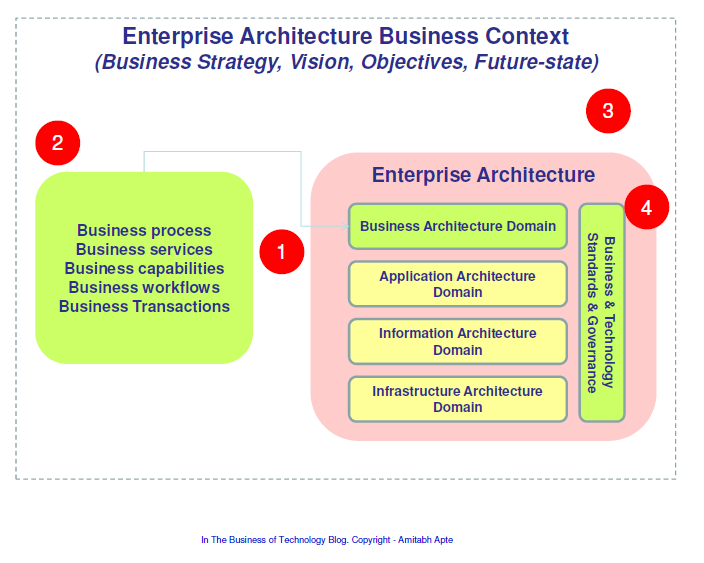
  1. Business Architecture as part of Enterprise Architecture
  2. Business Architecture drives Enterprise Architecture domains
  3. Business Architecture and Business Context clarified and integrate
  4. Business aligned Technology governance


My pictorial representation from earlier changes as below now:

BA & EA in Collaboration

Modern Enterprise Architecture teams and Enterprise Architects can not longer afford to ignore the implications of Business Architecture. Likewise, modern business architects can no longer afford to work in isolation of organisation’s enterprise architecture. 

In conclusion of this article I would like to summarize my thoughts as follows:

  1. Enterprise Architecture in isolation of Business Architecture is simply Enterprise Technical Architecture
  2. Business Architecture should guide the development of Enterprise Architecture domains
  3. Business Architecture combined with Enterprise Architecture is a powerful tool for business-IT alignment
  4. Strategic Frameworks and Models help in achieving this alignment

And as Chris Potts would argue, the Chief Executive of an Organisation should be ultimately accountable for ensuring the two come together as we would expect him or her to be the Chief Enterprise Architect of the Enterprise!

For related articles:

Business Architecture & Enterprise Architecture – Match Made in Heaven

I recently spoke at the European BPM and EA Conference in London on this topic. This blog post is a summary version of my session.

Often Business Process Management and associated discipline such as Business Architecture is seen or managed in isolation of the overarching Enterprise Architecture construct. However the Business Architecture and Enterprise Architecture complement each other well to get the best value from each other. I think that the Business Architecture is one of the key enablers of the Enterprise Architecture and makes it real. While the Enterprise Architecture offers much needed context for the Business Architecture.

It might be useful to briefly review the definitions of both Business Architecture and Enterprise Architecture before understanding issues in their relationship. 

As I have been writing on this blog, Enterprise Architecture should not be limited to the IT or Technology concerns of an organisation. Rather it should be focused on addressing much broader scope covering the business, functional, operational, financial and people aspects of the enterprise. 

There are a number of Enterprise Architecture definitions out there. A couple of my favorite ones are as follows:


Enterprise Architecture provides a strategic planning framework that relates and aligns information technology with the business functions that it supports.


Or


Practice of enterprise architecture involves developing a framework to describe a series of “current”, “intermediate” and “target” reference architectures and applying them to align change within the enterprise. Another set of terms for these are “as-is”, “to-be” and the “migration plan”.


The Business Architecture Special Interest Group of Object Management Group (OMG) defines Business Architecture as follows:

“A Blueprint of the Enterprise That Provides A Common Understanding Of The Organization And Is Used To Align Strategic Objectives And Tactical Demands.”


“Business Architecture describes the product and/or service strategy, and the organizational, functional, process, information, and geographic aspects of the business environment”

I think that though the practice of both Business Architecture and Enterprise Architecture has matured over the past few years, there certainly are some issues when it comes to these two working well together. I have summarised them in four broad arguments;

  1. Business Architecture not done at all. Enterprise Architecture teams only perform Enterprise Technical Architecture only.
  2. Business Architecture done in isolation of Enterprise Technical Architecture and then (if lucky) artificially superimposed
  3. Business Architecture and Business Context Confusion: confusion between why, what and how
  4. Technology focused governance: only conversations about technical standards, business governance disconnected from IT investment and decisions leading to critical gaps
I have tried to capture this pictorially below:

BA & EA in Isolation

This issue is getting wider acknowledgment given its strategic importance. I particularly like Randy Heffner’s work in this space. He states in one of his blogs;

“Simply positioning business architecture as a layer on top of existing EA domains is a mistake. Traditionally many organisations have pursued EA as Enterprise Technical Architecture (ETA). ETA is technology-centred.  Business architecture is business-centred. Simply layering it on top of ETA will result in tech-centred silo implementation.”


As Business Architecture Special Interest Group of Object Management Group(OMG) states, the Business Architecture defines the structure of the enterprise in terms of its governance structure, business processes, and business information. In defining the structure of the enterprise, business architecture considers customers, finances, and the market to align strategic goals and objectives with decisions regarding products and services; partners and suppliers; organization; capabilities; and key initiatives. Business Architecture primarily should focus on the business motivations, business operations and business analysis frameworks and related networks that link these aspects of the enterprise together and it should be seamlessly integrated with Enterprise Architecture efforts within the organisation. 

In my experience to tackle above listed issues, following measures can be taken by the Architecture team;

  1. Business Architecture as part of Enterprise Architecture
  2. Business Architecture drives Enterprise Architecture domains
  3. Business Architecture and Business Context clarified and integrate
  4. Business aligned Technology governance


My pictorial representation from earlier changes as below now:


BA & EA in Collaboration

Modern Enterprise Architecture teams and Enterprise Architects can not longer afford to ignore the implications of Business Architecture. Likewise, modern business architects can no longer afford to work in isolation of organisation’s enterprise architecture. 

In conclusion of this article I would like to summarize my thoughts as follows:

  1. Enterprise Architecture in isolation of Business Architecture is simply Enterprise Technical Architecture
  2. Business Architecture should guide the development of Enterprise Architecture domains
  3. Business Architecture combined with Enterprise Architecture is a powerful tool for business-IT alignment
  4. Strategic Frameworks and Models help in achieving this alignment

And as Chris Potts would argue, the Chief Executive of an Organisation should be ultimately accountable for ensuring the two come together as we would expect him or her to be the Chief Enterprise Architect of the Enterprise!

For related articles:

NASCIO Defines State of Enterprise Architecture at The Open Group Conference in Philadelphia

By E.G. Nadhan, HP I have attended and blogged about many Open Group conferences. The keynotes at these conferences like other conferences provide valuable insight into the key messages and the underlying theme for the conference – which is Enterprise Architecture … Continue reading

Data Management 5: Master Data Management

This is the fifth blog post in the Data Management series. We have covered several basic topics so far. This time we zoom in on one of the sub disciplines of Data Management: Master Data Management.TheoryLoosely defined and following Loshins excellen…

Categories Uncategorized

Enterprise Architecture for Dummies

In part 8 of “Memoirs of an Enterprise Architect” I discussed how rationalizing your applications can allow you to do more with your organizational budget.  This week I would like to have an open dialog about Capabilities, Business Process, the Se…

Categories Uncategorized

As Platform 3.0 ripens, expect agile access and distribution of actionable intelligence across enterprises, says The Open Group panel

By Dana Gardner, Interarbor Solutions Listen to the recorded podcast here:  This latest BriefingsDirect discussion, leading into the The Open Group Conference on July 15 in Philadelphia, brings together a panel of experts to explore the business implications of the … Continue reading