It has been a while since my last post about Value Creation and GLUE. Interesting enough this created some discussions via twitter about what is a real value add and what not. I still stick to my statements that the only value add is located in the GLUE Discipline Develop and methods and tools to be able to deliver real value are not value in itself (despite the moment when they are created and/or added to an environment).
“The world is given to me only once, not one existing and one perceived. Subject and object are only one.”,
Erwin Schrödinger (1887 – 1961)
The interesting challenge I personally observe in Enterprise Architecture each and every day is to ensure that the existing and perceived world are synchronized to be recognized as the same. On top of that the IT world has created another challenge which now requires that the existing world, the artificial reflection of the world, the perceived existing world and the perceived artificial reflection of hte world needs to be synchronized. As I have written in “Always remember the next larger context” the challenge is to find the one-to-many mapping in the GLUE Space to ensure an accurate artificial reflection of the world and therefore synchronize the real world with the artificial world.
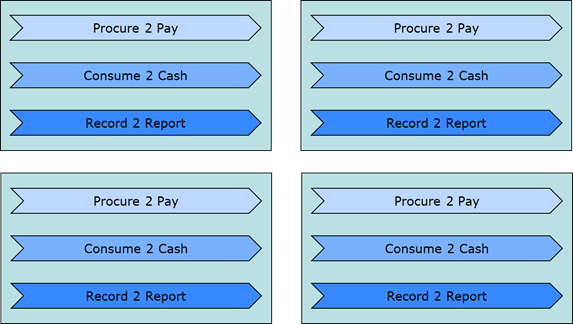
Imagine a company which is multinational and organized with a global, regional and local organizational setup. To keep it simple the artificial reflection of the world could be done by harmonizing all processes in the world and deliver a one size fits all approach:
In most situations this is a fairly good marketing statement and looks very good to justify huge initiatives to align processes around the world. The pushback of the real world is most likely enormeous and depending on the size of the company and the diversity of the markets there is literally no chance to squeeze the whole into the same concept. But maybe a regionalized approach does work where there is one process fits all for one region approach:
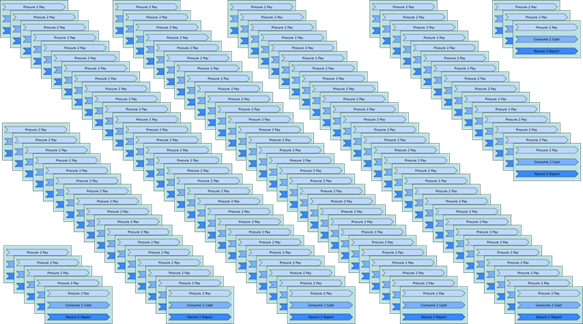
This will give a fairly large amount of alignment but at the same moment in time neglects the necissity for local deviations and specialities of single elements in a corporation. This can be fairly simple reasons like local legal law or more complex reasons like a different approach to the market, because the market situation is different in that specific country and legal entity. Therefore the answer can easily look fairly diversified:
So in many cases the final architecture will be federated. No matter if it was a structured educated approach to reach a federated architecture or evolution over time due to created necessity by restructuring the organization and therefore creating the implicit demand for a federated architecture (Conway’s Law). The end result (from a conceptual point of view) is the same. A mixture of Global, Regional and Local elements:

The interesting thing from an Enterprise Architecture point of view to me now is the perspective in such an architecture. It might be very interesting to find the right federated architecture, but I believe it is not really relevant. Relevant is to help the people who must live and work in such a federated architecture to see the whole holistic view. So in the discussion between a global and a local owner the tension between the two perspectives is fairly easy to observe. From the global point of view the local part of the architecture is just another Customer which of course has to follow all rules and boundaries of the global architecture:
From a Local point of view the Global System is just another part of the architecture in the complete holistic local architecture. The business case for success for the local part of the corporation is in most cases motivated by local demand and conflicting with global demand.
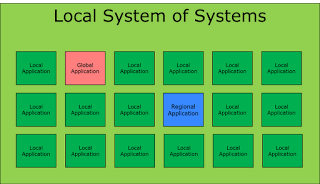
The interesting discussion now is to find the right federated architecture. Unfortunately that is a moving target and does change as fast as the business changes. The discussion about the right To-Be Architecture (even though it indeed is interesting) can easily be an endless ivory tower discussion never coming to a final conclusion. The relevant discussion in my mind is helping all involved stakeholders (and that includes of course the regional elements as well in this example) to see the holistic picture. The real joy of Enterprise Architecture to me is that Enterprise Architects should apply the concept of Schrödinger’s Cat in the Architecture all the time: The Cat is alive and Dead at the same moment in time.
And here (once again) it is more relevant to help the people than to apply a specific method or tool to come to a final recommendation, which I tried to picture in my GLUE framework:

As always questions and comments more than welcome, but I am already happy if you continue to read my blog posts. 🙂