Interview on enterprise-architecture at AE-Rio 2011

I must admit I’m pleased with this brief interview, filmed by the AV crew at AE Rio 2011 (many thanks, guys!). It covers a lot of ground in barely four minutes: the importance of stories and culture in enterprise-architecture, key differences in the Latin America market compared to elsewhere, and much else besides.

(There’s supposed to […]

Incremental Progress in (EA) Strategy Execution

I hate watching sports. Period. Except curling where I am confused yet fascinated all at the same time. Despite my aversion, I can still see lessons for EAs and those executing strategy. So here goes…

Consider soccer and (American) football. In soccer, patterns and plays are improvised and executed very quickly. Goals are scored when you put the ball in the other team’s goal. You run until you score, get hurt, or just pass out. That’s about it. In football, plays are thought out, deliberated by an overstaffed sideline, and then executed. Incremental progress is measured in yards and downs. At some point, someone either kicks a field goal (3 pts) or moves the ball into the end zone (6 pts). The game moves slower and more deliberately than soccer. This is where I see the lesson.

Regardless of EA methodology or framework, one needs to construct some sort of roadmap for their architecture. Otherwise, all those massive architecture diagrams are nothing more than 21st century art. The roadmap articulates the various steps an organization needs to execute in order to reach a target state in the architecture. There may be multiple target states before arriving to the next "future state". And within each target state there are incremental steps. Sometimes, its baby steps, and that is OK. 

To paraphrase a previous tweet or blog post, EA (strategy execution)  is a set of executed tactics orchestrated to achieve a desired end state. EA programs should take great care to crisply define the target states and the incremental tactics used to achieve each target state. And, when those tactics or states are realized, examine closely if one is still on track and is moving forward. I always advocate the value of  "advancing 1 yard" on a project or other initiative regarding the architecture. 

Sometimes, a yard is all you can get. Take it, and keep moving.

Archimate::Business actor <= Togaf::Organization unit

Yes, the Business actor concept in Archimate do make sense in conjunction with the organization unit concept in Togaf. At least the Archimate concept covers the Togaf concept good enough to make it usable. The match is to be found in how Archimate uses “departments” and “business units” as examples. Archimate TOGAF Business actor Organization […]

Incremental Progress in (EA) Strategy Execution

I hate watching sports. Period. Except curling where I am confused yet fascinated all at the same time. Despite my aversion, I can still see lessons for EAs and those executing strategy. So here goes…

Consider soccer and (American) football. In soccer, patterns and plays are improvised and executed very quickly. Goals are scored when you put the ball in the other team’s goal. You run until you score, get hurt, or just pass out. That’s about it. In football, plays are thought out, deliberated by an overstaffed sideline, and then executed. Incremental progress is measured in yards and downs. At some point, someone either kicks a field goal (3 pts) or moves the ball into the end zone (6 pts). The game moves slower and more deliberately than soccer. This is where I see the lesson.

Regardless of EA methodology or framework, one needs to construct some sort of roadmap for their architecture. Otherwise, all those massive architecture diagrams are nothing more than 21st century art. The roadmap articulates the various steps an organization needs to execute in order to reach a target state in the architecture. There may be multiple target states before arriving to the next “future state”. And within each target state there are incremental steps. Sometimes, its baby steps, and that is OK. 

To paraphrase a previous tweet or blog post, EA (strategy execution)  is a set of executed tactics orchestrated to achieve a desired end state. EA programs should take great care to crisply define the target states and the incremental tactics used to achieve each target state. And, when those tactics or states are realized, examine closely if one is still on track and is moving forward. I always advocate the value of  “advancing 1 yard” on a project or other initiative regarding the architecture. 

Sometimes, a yard is all you can get. Take it, and keep moving.

Enterprise Climatologist?

Some of us on Twitter (#entarch) were noodling around for alternative names for Enterprise Architects. Someone chimed in about using "meteorologist" and suggested "climatologist". Then I thought more about the definitions of these words and how these roles operate.

These individuals work on massive amounts of historical data and seek patterns in nature to predict weather patterns and then issue forecasts. But at this point, the best we can do is react to the coming weather. If its a tornado, we head to the SW corner of the basement. If its a hurricane, we try to get out of town (at least most do). We cannot stop a tornado or steer it in a more favorable direction. And while there are proactive measures one can take to endure a storm and bolster structures, one cannot control or shape the weather. 

And that is where the meteorologist/climatologist analogy breaks down for EA. EAs need to be strategic in their thinking and help clients shape their future, not solely react to enterprise events. Like the weather, there are forces (e.g., Porters Five Forces) that one cannot control and must formulate a response. But the EAs job is to provide a vision and executable plan to a desired end state. Smart EAs leverage the experiences of others in design patterns and strategy execution. The discipline of EA provides the way to proactively shape the future for an enterprise. 

What are your thoughts? What lessons can EAs and the discipline of EA garner from other disciplines?

Enterprise Climatologist?

Some of us on Twitter (#entarch) were noodling around for alternative names for Enterprise Architects. Someone chimed in about using “meteorologist” and suggested “climatologist”. Then I thought more about the definitions of these words and how these roles operate.

These individuals work on massive amounts of historical data and seek patterns in nature to predict weather patterns and then issue forecasts. But at this point, the best we can do is react to the coming weather. If its a tornado, we head to the SW corner of the basement. If its a hurricane, we try to get out of town (at least most do). We cannot stop a tornado or steer it in a more favorable direction. And while there are proactive measures one can take to endure a storm and bolster structures, one cannot control or shape the weather. 

And that is where the meteorologist/climatologist analogy breaks down for EA. EAs need to be strategic in their thinking and help clients shape their future, not solely react to enterprise events. Like the weather, there are forces (e.g., Porters Five Forces) that one cannot control and must formulate a response. But the EAs job is to provide a vision and executable plan to a desired end state. Smart EAs leverage the experiences of others in design patterns and strategy execution. The discipline of EA provides the way to proactively shape the future for an enterprise. 

What are your thoughts? What lessons can EAs and the discipline of EA garner from other disciplines?

Managing Requirements from a Business Analyst or an Enterprise Architect perspective using BABOK 2.0 and/or TOGAF 9

Many Business Analysts are using the IIBA’s BABOK 2.0 (Business Analyst Body of Knowledge ) which contains information about a Requirements Management process, from identifying organizational situations that give cause to a project, through to starting the requirements gathering process, to delivering a solution to the business or a client. TOGAF 9 from an Enterprise Architecture viewpoint also provides some techniques to gather requirements to equally deliver business solutions. This paper illustrates the two processes, defines the mapping between the two approaches and identifies gaps in each.
image

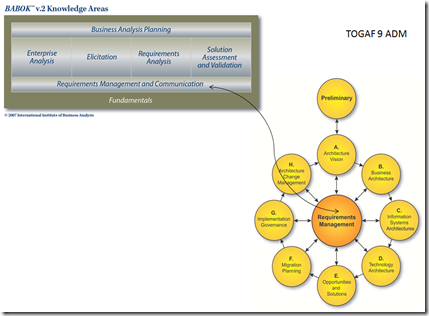
BABOK 2.0 Knowledge Area (KA) 4 covers Requirements Management and Communication which “describes the activities and considerations for managing and expressing Requirements to a broad and diverse audience” (The other KAs: Plan Requirements, Management Process, and Requirement Analysis will not be included here).

The tasks from this KA “are performed to identify business needs (the why of the project; whereas requirements are the how), the state the scope of their business solutions, ensure that all stakeholders have a shared understanding of the nature of these solutions and that those stakeholders with approval authority are in agreement as to the requirements that the business solution shall meets.

It manages a baseline, tracks different versions of Requirements documents, and trace requirements from origin to implementation.

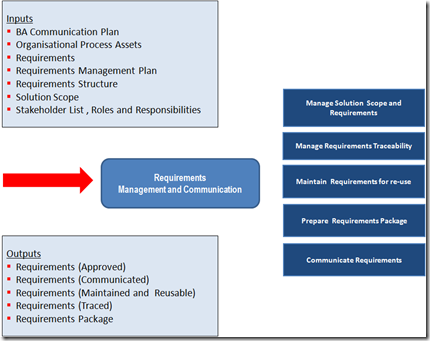
This area includes five steps described below.
image

1. Manage Solution Scope and Requirements

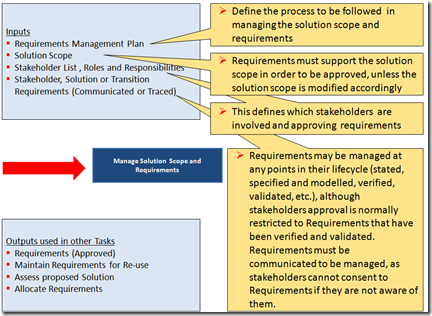
In this step, we “obtain and maintain consensus among stakeholders regarding the overall solution scope and the requirements that will be implemented”. Requirements may be baseline following an approval and a signoff. That means that all future changes are recorded and tracked, and the current state may be compared to the baselined state. Subsequent changes to the requirements must follow a Change Management process and will require additional approval. As changes are approved, a Requirements Management Plan may require that the baselined version of the requirements be maintained in addition to the changed Requirement. Additional information is often maintained such as a description of the change, the person who made the change, and the reason for the change. As requirements are refined or changed as the result of new information, changes will be tracked as well.
image

A signoff formalises an acceptance by all stakeholders that the content and presentation of documented requirements is accurate and complete. This can be done in a face to face meeting.

2. Manage Requirements Traceability

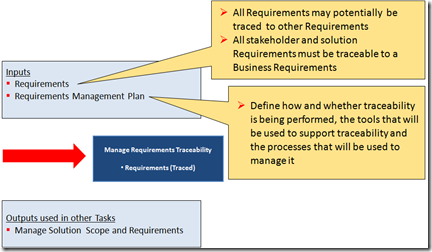
Traceability consists of understanding the relationship between Business Objectives, the requirements, the stakeholders, other deliverables and components to support the business analysis among other activities. It also allows documenting “the lineage of each requirement, its backward and forward traceability, and its relationship to other requirements”. The reasons for creating relationships are “Impact Analysis”, and “Requirements coverage and allocation”. A coverage matrix may be used to manage tracing.
image

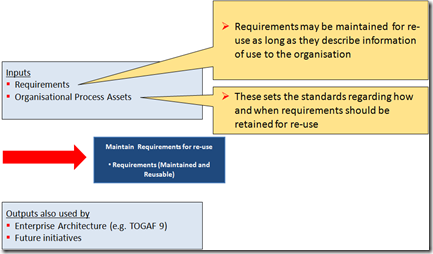
3. Maintain Requirements for re-use

Requirements re-use is another important aspect in the process and there is a need to manage knowledge of requirements following their implementation, identify the requirements that are candidates for long-term usage by the organisation. “These may include requirements that an organisation must meet on an ongoing basis, as well requirements that are implemented part of a solution” (e.g. regulatory, contractual obligations, quality standards, service level requirements, etc.). Each will have to be clearly named, defined, and available to all analysts.
image

4. Prepare Requirements Package

This step consists in selecting and structuring a set of requirements “in an appropriate fashion to ensure that the requirements are effectively communicated to, understood and usable” by the various stakeholders. This Requirements Package could have different forms such as a documentation (can be managed in a Requirements Repository), presentations, templates, etc.

image

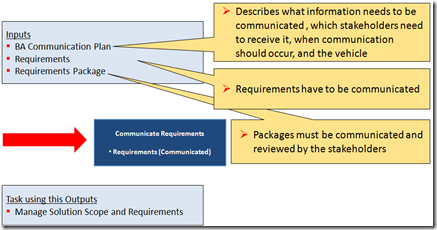
5. Communicate Requirements

This step relates to the communication of requirements to the various stakeholders for a common understanding. It may happen that new requirements have to be considered.
image

The BABOK bundles Requirements Communication together with Requirements Management.

Requirements Analysis is another KA which describes “how we progressively elaborate the solution definition in order to enable the project team to design and build a solution that will meet the needs of the business and stakeholders. In order to do that, we have to analyze the stated requirements of our stakeholders to ensure that they are correct, assess the current state of the business to identify and recommend improvements, and ultimately verify and validate the results”. BABOK 2.0 Requirements Analysis being not really covered within TOGAF 9, there are no comparisons done at this stage.

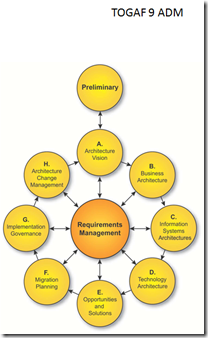
Within TOGAF 9, the objective of the Requirements Management activity is to define a process whereby all kinds of requirements, including most notably business drivers, concerns, and new functionality and change requests for Enterprise Architecture are identified, stored, and fed into and out of the relevant Architecture Development Method (ADM) phases. As such it forms part of the activities and steps carried out in each of the ADM Phases. Architecture requirements are subject to constant change, and requirements management happens throughout the entire Enterprise Architecture implementation lifecycle.

It is important to note that the Requirement Management circle denotes, not a static set of requirements, but a dynamic process.

As indicated by the Requirements Management circle at the centre of the ADM graphic, the ADM is continuously driven by the Requirements Management process.
image

Enterprise Architecture has specific techniques to gather requirements. TOGAF as a framework uses a method based on what we call a “Business Scenario” which is used heavily in the initial phases A & B of the ADM to define the relevant business requirements and build consensus with business management and other stakeholders.

A Business Scenario ensures that there is a complete description of business problem in business and architectural terms. Individual requirements are viewed in relation to one another in the context of the overall problem; the architecture is based on complete set of requirements that add up to a whole problem description; the business value of solving the problem is clear and the relevance of potential solutions is clear.

Below is a mapping between the two approaches.
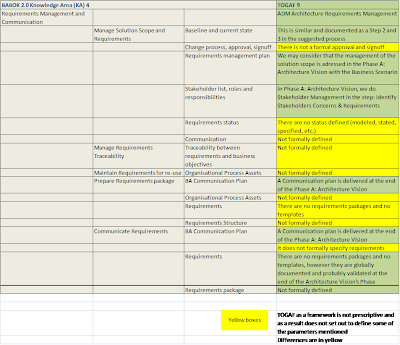
BABOK 2.0 sets up a framework for the requirements development and management, which seems to appear as a standard used by many organizations around the world. Between TOGAF 9 and BABOK 2.0, there is almost 1:1 correspondence but there may be more details and activities in the first one. TOGAF is a methodology whereas the BABOK is methodology agnostic, so it can be tricky to translate between the two but nothing prevent an Enterprise Architecture team to use this analogous technique.

If an organization follows the TOGAF methodology and Business Analysts use BABOK, the later will provide a lot of useful information, as a reference; BABOK won’t give you direction for an Enterprise Architecture.

Sources: Chapter 4 IIBA’s BABOK 2.0, TOGAF 9

Managing Requirements from a Business Analyst or an Enterprise Architect perspective using BABOK 2.0 and/or TOGAF 9

Many Business Analysts are using the IIBA’s BABOK 2.0 (Business Analyst Body of Knowledge ) which contains information about a Requirements Management process, from identifying organizational situations that give cause to a project, through to starting the requirements gathering process, to delivering a solution to the business or a client. TOGAF 9 from an Enterprise Architecture viewpoint also provides some techniques to gather requirements to equally deliver business solutions. This paper illustrates the two processes, defines the mapping between the two approaches and identifies gaps in each.

image

BABOK 2.0 Knowledge Area (KA) 4 covers Requirements Management and Communication which “describes the activities and considerations for managing and expressing Requirements to a broad and diverse audience” (The other KAs: Plan Requirements, Management Process, and Requirement Analysis will not be included here).

The tasks from this KA “are performed to identify business needs (the why of the project; whereas requirements are the how), the state the scope of their business solutions, ensure that all stakeholders have a shared understanding of the nature of these solutions and that those stakeholders with approval authority are in agreement as to the requirements that the business solution shall meets.

It manages a baseline, tracks different versions of Requirements documents, and trace requirements from origin to implementation.

This area includes five steps described below.

image

1. Manage Solution Scope and Requirements

In this step, we “obtain and maintain consensus among stakeholders regarding the overall solution scope and the requirements that will be implemented”. Requirements may be baseline following an approval and a signoff. That means that all future changes are recorded and tracked, and the current state may be compared to the baselined state. Subsequent changes to the requirements must follow a Change Management process and will require additional approval. As changes are approved, a Requirements Management Plan may require that the baselined version of the requirements be maintained in addition to the changed Requirement. Additional information is often maintained such as a description of the change, the person who made the change, and the reason for the change. As requirements are refined or changed as the result of new information, changes will be tracked as well.

image

A signoff formalises an acceptance by all stakeholders that the content and presentation of documented requirements is accurate and complete. This can be done in a face to face meeting.

2. Manage Requirements Traceability

Traceability consists of understanding the relationship between Business Objectives, the requirements, the stakeholders, other deliverables and components to support the business analysis among other activities. It also allows documenting “the lineage of each requirement, its backward and forward traceability, and its relationship to other requirements”. The reasons for creating relationships are “Impact Analysis”, and “Requirements coverage and allocation”. A coverage matrix may be used to manage tracing.

image

3. Maintain Requirements for re-use

Requirements re-use is another important aspect in the process and there is a need to manage knowledge of requirements following their implementation, identify the requirements that are candidates for long-term usage by the organisation. “These may include requirements that an organisation must meet on an ongoing basis, as well requirements that are implemented part of a solution” (e.g. regulatory, contractual obligations, quality standards, service level requirements, etc.). Each will have to be clearly named, defined, and available to all analysts.

image

4. Prepare Requirements Package

This step consists in selecting and structuring a set of requirements “in an appropriate fashion to ensure that the requirements are effectively communicated to, understood and usable” by the various stakeholders. This Requirements Package could have different forms such as a documentation (can be managed in a Requirements Repository), presentations, templates, etc.

image

5. Communicate Requirements

This step relates to the communication of requirements to the various stakeholders for a common understanding. It may happen that new requirements have to be considered.

image

The BABOK bundles Requirements Communication together with Requirements Management.

Requirements Analysis is another KA which describes “how we progressively elaborate the solution definition in order to enable the project team to design and build a solution that will meet the needs of the business and stakeholders. In order to do that, we have to analyze the stated requirements of our stakeholders to ensure that they are correct, assess the current state of the business to identify and recommend improvements, and ultimately verify and validate the results”. BABOK 2.0 Requirements Analysis being not really covered within TOGAF 9, there are no comparisons done at this stage.

Within TOGAF 9, the objective of the Requirements Management activity is to define a process whereby all kinds of requirements, including most notably business drivers, concerns, and new functionality and change requests for Enterprise Architecture are identified, stored, and fed into and out of the relevant Architecture Development Method (ADM) phases. As such it forms part of the activities and steps carried out in each of the ADM Phases. Architecture requirements are subject to constant change, and requirements management happens throughout the entire Enterprise Architecture implementation lifecycle.

It is important to note that the Requirement Management circle denotes, not a static set of requirements, but a dynamic process.

As indicated by the Requirements Management circle at the centre of the ADM graphic, the ADM is continuously driven by the Requirements Management process.

image

Enterprise Architecture has specific techniques to gather requirements. TOGAF as a framework uses a method based on what we call a “Business Scenario” which is used heavily in the initial phases A & B of the ADM to define the relevant business requirements and build consensus with business management and other stakeholders.

A Business Scenario ensures that there is a complete description of business problem in business and architectural terms. Individual requirements are viewed in relation to one another in the context of the overall problem; the architecture is based on complete set of requirements that add up to a whole problem description; the business value of solving the problem is clear and the relevance of potential solutions is clear.

Below is a mapping between the two approaches.

BABOK 2.0 sets up a framework for the requirements development and management, which seems to appear as a standard used by many organizations around the world. Between TOGAF 9 and BABOK 2.0, there is almost 1:1 correspondence but there may be more details and activities in the first one. TOGAF is a methodology whereas the BABOK is methodology agnostic, so it can be tricky to translate between the two but nothing prevent an Enterprise Architecture team to use this analogous technique.

If an organization follows the TOGAF methodology and Business Analysts use BABOK, the later will provide a lot of useful information, as a reference; BABOK won’t give you direction for an Enterprise Architecture.

Sources: Chapter 4 IIBA’s BABOK 2.0, TOGAF 9

@tetradian on Architecture v Design – my observations

I just read Tom’s thought-provoking post 

Great conversations on enterprise-architecture here http://tinyurl.com/3uu2bn3

In this post Tom notes:
“The other point was an easy way to resolve the age-old argument about architecture versus design. They’re actually part of the same spectrum from vision to realisation, from ‘why’ to ‘how’ and so on. The only difference between them is which way they face: architecture tends to face ‘upward’, towards the big-picture,  the vision, or ‘why’, whilst design tends to face ‘downward’, towards the detail, the real-world realisation, the how and who and where and when and with-what”.

I’m afraid I believe  it’s not as simple as that. The design work I do is the design of the “big” not the detail. I also do architecture work and make use of the work of other architects. This helps constrain the “big” design with useful principles, patterns, reference models, standards and policies. These designs are the ‘action-focused’ means-by-which the business Vision is realised. This, IMO, has more do with mindset than with level of detail – I refer here to Roger Martin’s Design Thinking (I believe to be the basis of Gartner’s Hybrid Thinking) and his thought on Validity-Reliability continuum – I posted about a while ago here http://tinyurl.com/3488rlj – Balancing Reliability-X and Validity-Y

You can see from this post, made in 2009, I too, can be accused of ‘smudging’ the boundaries between Design and Architecture ( and sometimes strategy as well!). In my defence, these concepts often manifest as different views of essentially the same desired business outcome.

Maybe the difference is that architecture is more focused, on the contextual, structural and codes-of-parctice whereas design is more focused on a specific outcome. Both are pinned to Vision regardless of size and scope. The architecture frames the design and ensures consistency and coherence over the long term and, I would argue, that a Biz-Vision-focused EA is the foundation for good design. I strongly agree that the architecture should be business-led and therefore also facing ‘up’ alongside ‘Big Design’ of business change (aka Business Change Design). To put another way,  my work is mostly facing ‘up’ wether I’m acting as architect or designer.

One final observation is that in IT circles the term Design seems to have a narrower meaning than elsewhere. So the debate within IT-centric worldview seems to be rooted in the traditional argument about the differences between Analysis and Design, from an Systems Development Life-Cycle PoV, rather than Roger Martin’s more philosophical Design Thinking. I’m concerned that Tom’s observation “design tends to face ‘downwards'” adds fuel to this IT-centric understanding (which I know from many discussions he would be very unhappy about!).

Does EA practice include both ‘Architecture’ and ‘Big Design’? The debate continues.

N.

Nigel Green

5Di Ltd.
Mobile: +44 (0)7818  53 22 43
Sent from my iPad

Permalink

| Leave a comment  »

Categories Uncategorized