The Open Group Philadelphia – Day Two Highlights

By Loren K. Baynes, Director, Global Marketing Communications at The Open Group. Day 2 at The Open Group conference in the City of Brotherly Love, as Philadelphia is also known, was another busy and remarkable day. The plenary started with … Continue reading

For Who The Heck is Enterprise Architecture Not?

While thinking of ideas discussed in this blog, have been probing the tenants that creates the fundamental characteristics of the system such as :- Division Of Labor – the most important idea that revolutionized industrialization and for rise of capitalism Commodiitization vs Specialization Production of cost by Economy Of Scale by Division vs Multiplexing (manual […]

The Open Group Philadelphia – Day One Highlights

By Loren K.  Baynes, Director, Global Marketing Communications at The Open Group. On Monday, July 15th, we kicked off our conference in Philadelphia. As Allen Brown, CEO of The Open Group, commented in his opening remarks, Philadelphia is the birthplace … Continue reading

Enterprise Architecture Leaders’ Interview Series – Q&A with Gil Long

Enterprise Architecture Leaders’ Interview Series – Q&A with Gil Long

I caught up with Gil Long who has served IBM as a Business Development Executive, Distinguished Engineer and CIO Office Chief Enterprise Architecture leader. As the Worldwide Enterprise Architecture Community Leader, he specialized in architecture governance, strategic architecture design and infrastructure transition planning. He was responsible for IBM’s enterprise architecture strategy and planning service offerings, global enterprise architecture training programs, and functioned as a member of IBM’s Architect Certification Board.

Gil has had direct management responsibility for large IT organizations and staffing, and substantial ongoing budget accountability. His multi-industry experience includes international banking, securities, education, retail, healthcare, insurance, utilities, manufacturing, semi-conductor, airlines, telecommunications and government.

Gil is a competitive aerobatics and commercial pilot.

In many years of your experience across hundreds of customers, what is the fundamental thing that organizations miss about Enterprise Architecture?
Understanding the value of EA is often an issue.  The value is not only about reducing IT cost, but investing in innovative ways to improve the business. In my opinion, many companies do not understand what EA is!

EA needs the buy-in from upper management, but most upper managements think it is merely a technical or standards issue, and miss the point that it covers all aspects of business and technical structure and management. It is very important to have someone at the sponsorship level who understands what EA is and what value it brings.

In your experience what has been one of the most remarkable transformations enabled by Enterprise Architecture?
Obviously, I am intimately familiar with IBM’s EA and how it has influenced multiple internal transformations.  I shared with you the IBM Transformation Story. Great showcase!

I have seen many other transformations in the client world.  One involved the consolidation of 90 companies (utilities) into a common footprint!  Generally, the more complex the environment, the greater the benefit EA can deliver.

What do you think is one of the most underrated aspects of Enterprise Architecture? 
The leadership role that an Enterprise Architect can provide to the organization.

For an aspiring Enterprise Architect, what are some key things she needs to start working on right now?
[-] Understand what EA is and what value it brings to the organization.

[-] Get EA training. You could start with understanding TOGAF, which is an internationally recognized standard for Enterprise Architecture.

[-] Get certified if you can, it could establish your credibility both within and outside your organization.

[-] Develop strong relationships with stakeholders that are impacted by EA. Its importance cannot be overstated. Involve them in the process.

[-] Understand your industry. Industries have their own context, business process models, histories, politics and challenges. Understanding your industry gives you an edge when working with partners across the company.

[-] Work on your communication skills. Always put yourself in the shoes of your audience. Communicate in a way that the listener will understand. Your message should be simple, concise and actionable, and answer the question, ‘What’s in it for me?’.

[-] An Enterprise Architect needs to stand up and speak, evangelize ideas, develop consensus, work across boundaries. Do not throw up your hands and quit, or be draconian and say if I don’t get what I want, the world will come to an end!

Do you think Enterprise Architecture has a brand issue?
Yes, the name itself implies it is a technical concept, rather than an overall business concept. The word “architecture” conjures an image of a guy with his head down, drawing a complex picture! The word “enterprise” can also be a bit vague.  The enterprise represents the totality of the business; including business partners, customers and other stakeholders, and the infrastructure they use to accomplish their objectives.

However, a good Enterprise Architect will be able to explain EA to anyone in terms they can understand.

At the risk of drawing you into the “war of EA frameworks”, how important is the EA framework brand to you? 

IBM’s EA Method and Framework are important to me, since IBM ‘invented’ EA in the 1980’s and participated in the internationalization of EA via TOGAF involvement.  All frameworks have something to offer, but they essentially are all true to the same basic EA concepts. 
You should select one EA approach for your enterprise, and TOGAF, the international standard for EA, is generally accepted across all industries worldwide.

You have quite a collection of funny “ditties”! Which one is your favorite?
I have many favorites, but the “You are here!” picture always gets a laugh from architects 🙂

How many countries have you traveled to, for business? Which one was the most unique?
Fifty three countries!  I’ve had so many wonderful experiences in these countries.  Each had its challenges and rewards.  Istanbul (banking) was unique, as was China (telecom), as was Taiwan (semiconductor), and Hawaii (education) … working from the top of a mountain overlooking Pearl Harbor.  Also, Prague, with a mixture of former communist and democratic staff, and South Africa (banking). Although cultures can vary from place to place, I find that the Enterprise Architects are universally smart, enthusiastic and hungry for knowledge about EA.
I smile when I think about nap time on sleeping mats during lunch in China, and loud cell phone conversations going on during a serious lecture!!  What is normal in some countries is unusual in others.
Had to ask this – tell us a little bit about your flying hobby and what are your flying plans for 2013?
Just got back from Sun-n-Fun in Lakeland, Florida (major fly-in with thousands of airplanes).  Next stop is Oshkosh, Wisconsin, the largest fly-in in the US, and possibly the world.  
I practice aerobatics every week and feel quite comfortable being upside down, like any good Enterprise Architect 🙂
I hope you all enjoyed my interview with Gil Long. As usual, please keep your comments and feedback coming, I love to hear from you – whether you agree with me or not! Thank you for reading.

Enterprise Architecture Leaders’ Interview Series – Q&A with Gil Long

Enterprise Architecture Leaders’ Interview Series – Q&A with Gil Long

I caught up with Gil Long who has served IBM as a Business Development Executive, Distinguished Engineer and CIO Office Chief Enterprise Architecture leader. As the Worldwide Enterprise Architecture Community Leader, he specialized in architecture governance, strategic architecture design and infrastructure transition planning. He was responsible for IBM’s enterprise architecture strategy and planning service offerings, global enterprise architecture training programs, and functioned as a member of IBM’s Architect Certification Board.

Gil has had direct management responsibility for large IT organizations and staffing, and substantial ongoing budget accountability. His multi-industry experience includes international banking, securities, education, retail, healthcare, insurance, utilities, manufacturing, semi-conductor, airlines, telecommunications and government.

Gil is a competitive aerobatics and commercial pilot.

In many years of your experience across hundreds of customers, what is the fundamental thing that organizations miss about Enterprise Architecture?
Understanding the value of EA is often an issue.  The value is not only about reducing IT cost, but investing in innovative ways to improve the business. In my opinion, many companies do not understand what EA is!

EA needs the buy-in from upper management, but most upper managements think it is merely a technical or standards issue, and miss the point that it covers all aspects of business and technical structure and management. It is very important to have someone at the sponsorship level who understands what EA is and what value it brings.

In your experience what has been one of the most remarkable transformations enabled by Enterprise Architecture?
Obviously, I am intimately familiar with IBM’s EA and how it has influenced multiple internal transformations.  I shared with you the IBM Transformation Story. Great showcase!

I have seen many other transformations in the client world.  One involved the consolidation of 90 companies (utilities) into a common footprint!  Generally, the more complex the environment, the greater the benefit EA can deliver.

What do you think is one of the most underrated aspects of Enterprise Architecture? 
The leadership role that an Enterprise Architect can provide to the organization.

For an aspiring Enterprise Architect, what are some key things she needs to start working on right now?
[-] Understand what EA is and what value it brings to the organization.

[-] Get EA training. You could start with understanding TOGAF, which is an internationally recognized standard for Enterprise Architecture.

[-] Get certified if you can, it could establish your credibility both within and outside your organization.

[-] Develop strong relationships with stakeholders that are impacted by EA. Its importance cannot be overstated. Involve them in the process.

[-] Understand your industry. Industries have their own context, business process models, histories, politics and challenges. Understanding your industry gives you an edge when working with partners across the company.

[-] Work on your communication skills. Always put yourself in the shoes of your audience. Communicate in a way that the listener will understand. Your message should be simple, concise and actionable, and answer the question, ‘What’s in it for me?’.

[-] An Enterprise Architect needs to stand up and speak, evangelize ideas, develop consensus, work across boundaries. Do not throw up your hands and quit, or be draconian and say if I don’t get what I want, the world will come to an end!

Do you think Enterprise Architecture has a brand issue?
Yes, the name itself implies it is a technical concept, rather than an overall business concept. The word “architecture” conjures an image of a guy with his head down, drawing a complex picture! The word “enterprise” can also be a bit vague.  The enterprise represents the totality of the business; including business partners, customers and other stakeholders, and the infrastructure they use to accomplish their objectives.

However, a good Enterprise Architect will be able to explain EA to anyone in terms they can understand.

At the risk of drawing you into the “war of EA frameworks”, how important is the EA framework brand to you? 

IBM’s EA Method and Framework are important to me, since IBM ‘invented’ EA in the 1980’s and participated in the internationalization of EA via TOGAF involvement.  All frameworks have something to offer, but they essentially are all true to the same basic EA concepts. 
You should select one EA approach for your enterprise, and TOGAF, the international standard for EA, is generally accepted across all industries worldwide.

You have quite a collection of funny “ditties”! Which one is your favorite?
I have many favorites, but the “You are here!” picture always gets a laugh from architects 🙂

How many countries have you traveled to, for business? Which one was the most unique?
Fifty three countries!  I’ve had so many wonderful experiences in these countries.  Each had its challenges and rewards.  Istanbul (banking) was unique, as was China (telecom), as was Taiwan (semiconductor), and Hawaii (education) … working from the top of a mountain overlooking Pearl Harbor.  Also, Prague, with a mixture of former communist and democratic staff, and South Africa (banking). Although cultures can vary from place to place, I find that the Enterprise Architects are universally smart, enthusiastic and hungry for knowledge about EA.
I smile when I think about nap time on sleeping mats during lunch in China, and loud cell phone conversations going on during a serious lecture!!  What is normal in some countries is unusual in others.
Had to ask this – tell us a little bit about your flying hobby and what are your flying plans for 2013?
Just got back from Sun-n-Fun in Lakeland, Florida (major fly-in with thousands of airplanes).  Next stop is Oshkosh, Wisconsin, the largest fly-in in the US, and possibly the world.  
I practice aerobatics every week and feel quite comfortable being upside down, like any good Enterprise Architect 🙂
I hope you all enjoyed my interview with Gil Long. As usual, please keep your comments and feedback coming, I love to hear from you – whether you agree with me or not! Thank you for reading.

The Open Group Conference to Emphasize Healthcare as Key Sector for Ecosystem-Wide Interactions

By Dana Gardner, Interarbor Solutions Listen to the recorded podcast here:  Dana Gardner: Hello, and welcome to a special BriefingsDirect Thought Leadership Interview series, coming to you in conjunction with The Open Group Conference on July 15, in Philadelphia. Registration … Continue reading

Business Architecture & Enterprise Architecture – Match Made in Heaven

I recently spoke at the European BPM and EA Conference in London on this topic. This blog post is a summary version of my session.

Often Business Process Management and associated discipline such as Business Architecture is seen or managed in isolation of the overarching Enterprise Architecture construct. However the Business Architecture and Enterprise Architecture complement each other well to get the best value from each other. I think that the Business Architecture is one of the key enablers of the Enterprise Architecture and makes it real. While the Enterprise Architecture offers much needed context for the Business Architecture.

It might be useful to briefly review the definitions of both Business Architecture and Enterprise Architecture before understanding issues in their relationship. 

As I have been writing on this blog, Enterprise Architecture should not be limited to the IT or Technology concerns of an organisation. Rather it should be focused on addressing much broader scope covering the business, functional, operational, financial and people aspects of the enterprise. 

There are a number of Enterprise Architecture definitions out there. A couple of my favorite ones are as follows:


Enterprise Architecture provides a strategic planning framework that relates and aligns information technology with the business functions that it supports.


Or


Practice of enterprise architecture involves developing a framework to describe a series of “current”, “intermediate” and “target” reference architectures and applying them to align change within the enterprise. Another set of terms for these are “as-is”, “to-be” and the “migration plan”.


The Business Architecture Special Interest Group of Object Management Group (OMG) defines Business Architecture as follows:

“A Blueprint of the Enterprise That Provides A Common Understanding Of The Organization And Is Used To Align Strategic Objectives And Tactical Demands.”


“Business Architecture describes the product and/or service strategy, and the organizational, functional, process, information, and geographic aspects of the business environment”

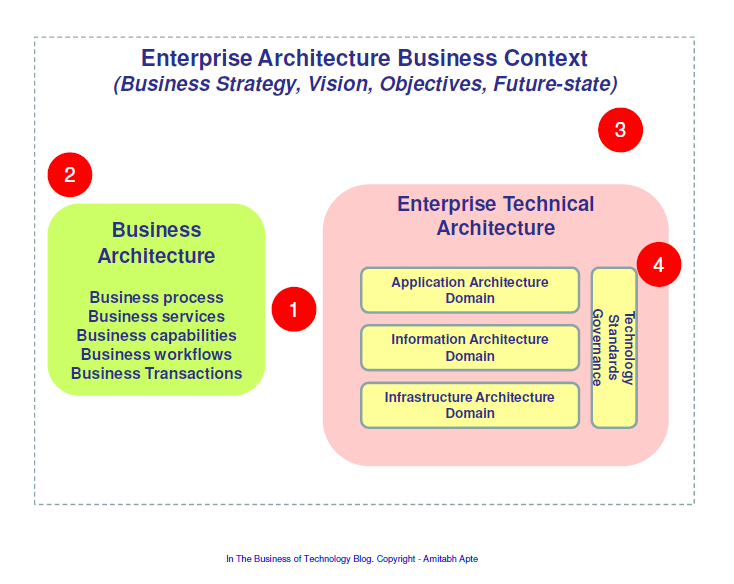
I think that though the practice of both Business Architecture and Enterprise Architecture has matured over the past few years, there certainly are some issues when it comes to these two working well together. I have summarised them in four broad arguments;

  1. Business Architecture not done at all. Enterprise Architecture teams only perform Enterprise Technical Architecture only.
  2. Business Architecture done in isolation of Enterprise Technical Architecture and then (if lucky) artificially superimposed
  3. Business Architecture and Business Context Confusion: confusion between why, what and how
  4. Technology focused governance: only conversations about technical standards, business governance disconnected from IT investment and decisions leading to critical gaps
I have tried to capture this pictorially below:

BA & EA in Isolation

This issue is getting wider acknowledgment given its strategic importance. I particularly like Randy Heffner’s work in this space. He states in one of his blogs;

“Simply positioning business architecture as a layer on top of existing EA domains is a mistake. Traditionally many organisations have pursued EA as Enterprise Technical Architecture (ETA). ETA is technology-centred.  Business architecture is business-centred. Simply layering it on top of ETA will result in tech-centred silo implementation.”


As Business Architecture Special Interest Group of Object Management Group(OMG) states, the Business Architecture defines the structure of the enterprise in terms of its governance structure, business processes, and business information. In defining the structure of the enterprise, business architecture considers customers, finances, and the market to align strategic goals and objectives with decisions regarding products and services; partners and suppliers; organization; capabilities; and key initiatives. Business Architecture primarily should focus on the business motivations, business operations and business analysis frameworks and related networks that link these aspects of the enterprise together and it should be seamlessly integrated with Enterprise Architecture efforts within the organisation. 

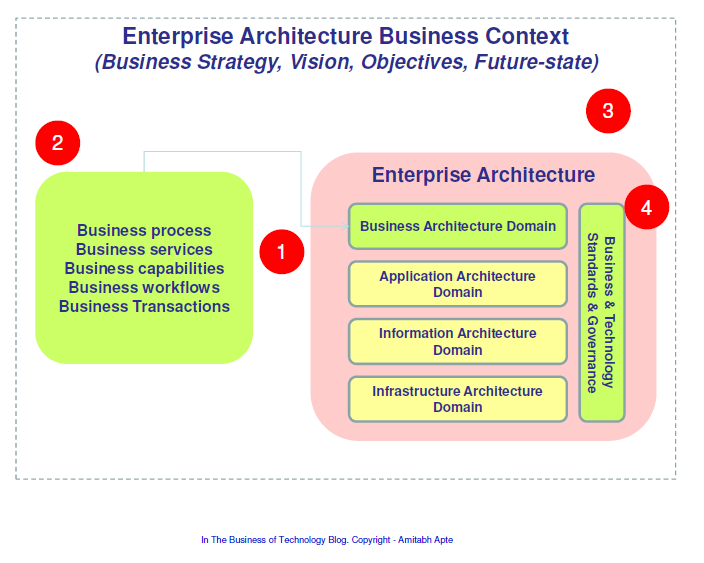
In my experience to tackle above listed issues, following measures can be taken by the Architecture team;

  1. Business Architecture as part of Enterprise Architecture
  2. Business Architecture drives Enterprise Architecture domains
  3. Business Architecture and Business Context clarified and integrate
  4. Business aligned Technology governance


My pictorial representation from earlier changes as below now:


BA & EA in Collaboration

Modern Enterprise Architecture teams and Enterprise Architects can not longer afford to ignore the implications of Business Architecture. Likewise, modern business architects can no longer afford to work in isolation of organisation’s enterprise architecture. 

In conclusion of this article I would like to summarize my thoughts as follows:

  1. Enterprise Architecture in isolation of Business Architecture is simply Enterprise Technical Architecture
  2. Business Architecture should guide the development of Enterprise Architecture domains
  3. Business Architecture combined with Enterprise Architecture is a powerful tool for business-IT alignment
  4. Strategic Frameworks and Models help in achieving this alignment

And as Chris Potts would argue, the Chief Executive of an Organisation should be ultimately accountable for ensuring the two come together as we would expect him or her to be the Chief Enterprise Architect of the Enterprise!

For related articles:

Business Architecture & Enterprise Architecture – Match Made in Heaven

I recently spoke at the European BPM and EA Conference in London on this topic. This blog post is a summary version of my session.

Often Business Process Management and associated discipline such as Business Architecture is seen or managed in isolation of the overarching Enterprise Architecture construct. However the Business Architecture and Enterprise Architecture complement each other well to get the best value from each other. I think that the Business Architecture is one of the key enablers of the Enterprise Architecture and makes it real. While the Enterprise Architecture offers much needed context for the Business Architecture.

It might be useful to briefly review the definitions of both Business Architecture and Enterprise Architecture before understanding issues in their relationship. 

As I have been writing on this blog, Enterprise Architecture should not be limited to the IT or Technology concerns of an organisation. Rather it should be focused on addressing much broader scope covering the business, functional, operational, financial and people aspects of the enterprise. 

There are a number of Enterprise Architecture definitions out there. A couple of my favorite ones are as follows:


Enterprise Architecture provides a strategic planning framework that relates and aligns information technology with the business functions that it supports.


Or


Practice of enterprise architecture involves developing a framework to describe a series of “current”, “intermediate” and “target” reference architectures and applying them to align change within the enterprise. Another set of terms for these are “as-is”, “to-be” and the “migration plan”.


The Business Architecture Special Interest Group of Object Management Group (OMG) defines Business Architecture as follows:

“A Blueprint of the Enterprise That Provides A Common Understanding Of The Organization And Is Used To Align Strategic Objectives And Tactical Demands.”


“Business Architecture describes the product and/or service strategy, and the organizational, functional, process, information, and geographic aspects of the business environment”

I think that though the practice of both Business Architecture and Enterprise Architecture has matured over the past few years, there certainly are some issues when it comes to these two working well together. I have summarised them in four broad arguments;

  1. Business Architecture not done at all. Enterprise Architecture teams only perform Enterprise Technical Architecture only.
  2. Business Architecture done in isolation of Enterprise Technical Architecture and then (if lucky) artificially superimposed
  3. Business Architecture and Business Context Confusion: confusion between why, what and how
  4. Technology focused governance: only conversations about technical standards, business governance disconnected from IT investment and decisions leading to critical gaps
I have tried to capture this pictorially below:

BA & EA in Isolation

This issue is getting wider acknowledgment given its strategic importance. I particularly like Randy Heffner’s work in this space. He states in one of his blogs;

“Simply positioning business architecture as a layer on top of existing EA domains is a mistake. Traditionally many organisations have pursued EA as Enterprise Technical Architecture (ETA). ETA is technology-centred.  Business architecture is business-centred. Simply layering it on top of ETA will result in tech-centred silo implementation.”


As Business Architecture Special Interest Group of Object Management Group(OMG) states, the Business Architecture defines the structure of the enterprise in terms of its governance structure, business processes, and business information. In defining the structure of the enterprise, business architecture considers customers, finances, and the market to align strategic goals and objectives with decisions regarding products and services; partners and suppliers; organization; capabilities; and key initiatives. Business Architecture primarily should focus on the business motivations, business operations and business analysis frameworks and related networks that link these aspects of the enterprise together and it should be seamlessly integrated with Enterprise Architecture efforts within the organisation. 

In my experience to tackle above listed issues, following measures can be taken by the Architecture team;

  1. Business Architecture as part of Enterprise Architecture
  2. Business Architecture drives Enterprise Architecture domains
  3. Business Architecture and Business Context clarified and integrate
  4. Business aligned Technology governance


My pictorial representation from earlier changes as below now:


BA & EA in Collaboration

Modern Enterprise Architecture teams and Enterprise Architects can not longer afford to ignore the implications of Business Architecture. Likewise, modern business architects can no longer afford to work in isolation of organisation’s enterprise architecture. 

In conclusion of this article I would like to summarize my thoughts as follows:

  1. Enterprise Architecture in isolation of Business Architecture is simply Enterprise Technical Architecture
  2. Business Architecture should guide the development of Enterprise Architecture domains
  3. Business Architecture combined with Enterprise Architecture is a powerful tool for business-IT alignment
  4. Strategic Frameworks and Models help in achieving this alignment

And as Chris Potts would argue, the Chief Executive of an Organisation should be ultimately accountable for ensuring the two come together as we would expect him or her to be the Chief Enterprise Architect of the Enterprise!

For related articles:

NASCIO Defines State of Enterprise Architecture at The Open Group Conference in Philadelphia

By E.G. Nadhan, HP I have attended and blogged about many Open Group conferences. The keynotes at these conferences like other conferences provide valuable insight into the key messages and the underlying theme for the conference – which is Enterprise Architecture … Continue reading