The English language is well known for its subtlety. Sometimes it’s a delight, but on other occasions it can be very frustrating. If I use the term Gothic Architecture you will immediately understand I am describing a style of architecture that flourished in medieval times. And if like me you are interested in ecclesiastical architecture you will know that this style was used in many of the great cathedrals and churches across Europe, which were distinctive because of key architectural patterns that enabled great increases in height and internal light of the buildings without increasing the size of supporting pillars.
Now if I use the term Agile Architecture, what am I referring to? In today’s Agile world I would hazard a guess that most readers will think I am referring to the architecture techniques and tasks undertaken in the context of an Agile software development project, not the collection of patterns and practices that enable agile business systems. That is, an architecture that enables agility.
This potential for miscommunication is a core issue for enterprises. There is ample evidence that Agile Architecture is a primary contributor to business agility, yet we do not have a well understood architecture management system that integrates with Agile methods.
What Bezos did here was to lay down key business and technology architecture principles that you might reasonably conclude were central to the extraordinary level of business agility that we have seen demonstrated by Amazon.com, Inc. That widely circulated edict contained the foundations of the Amazon reference architecture.
In the October 2004 CBDI Journal[2] we commented, “Two of the most successful and enduring dotcom start-ups, Amazon and eBay, now expose their core applications as Web Services. In doing so they have created a new class of platform that could have a profound impact on end-user organizations and IT vendors alike.”
And so the reference architecture became the enabler of growth and agility for the Amazon business, not we understand[3] as a grand plan, but through natural technological evolution. The services formed the platform that allowed the extraordinary expansion of the Amazon business that I would be certain not even Jeff Bezos imagined, back then in 2004. That is real business agility, and it was delivered by smart architecture backed up by clear policies and realized by agile processes.
Although Amazon has clearly evolved in pursuit of solutions to specific business opportunities and challenges, it’s also clear they have established a de facto architecture and architecture management system that guides the work of the many product delivery teams and ensures consistency of approach where it’s required. Let’s consider how an enterprise might establish a similar agile architecture management system.
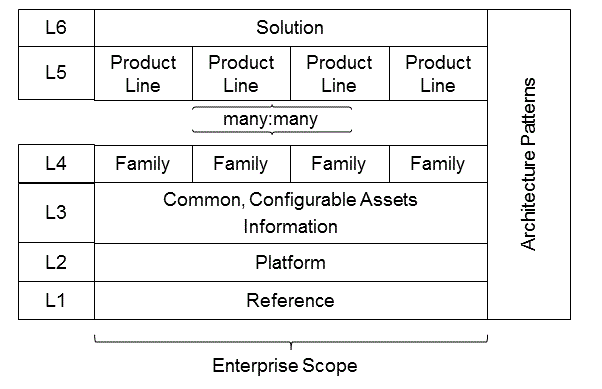
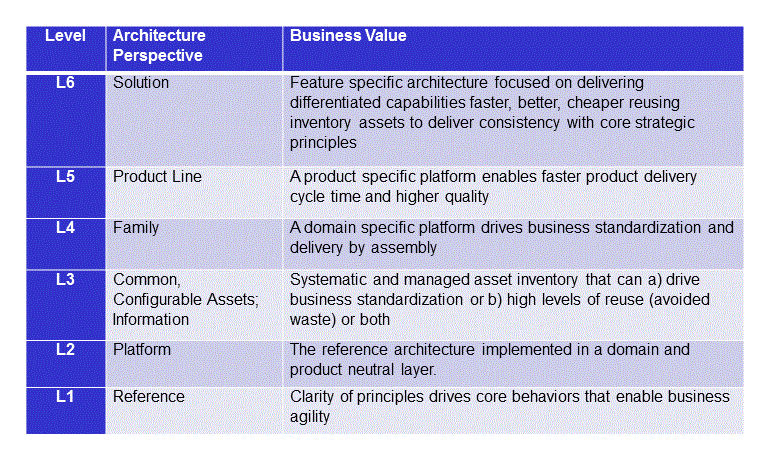
A reference architecture articulates primary principles that are typically central to an entire enterprise. Principles should be focused on establishing the product and solution independent environment in which agility can be delivered and maintained, so they would be stable over time. We might refer to reference architecture as a Level 1 architecture perspective (L1) that exists purely as a set of models and guidelines.
Larger enterprises should explore the business value potential of platform based architecture as a mechanism to deliver cross enterprise consistency of core reference architecture behaviors and to enable closer integration with the wider ecosystem including customers, suppliers, end consumers etc. This is an extended management services platform which encapsulates the technology infrastructure and enables rapid delivery of business services.
The platform architecture defines common services that manage business delivery including security, life cycle management, change management, release management and operations, as well as catalogs, eCommerce, B2B, regulatory control and risk management, standardizing these key capabilities and reducing the footprint of business domain services. The platform will also manage important behaviors that deliver on specific business goals such as scalability and availability. For example, Amazon services are usually very fine grained, specifically to reduce the scope of each service in order to facilitate narrow focus SLAs and maximize scalability by reducing individual service complexity. We might refer to platform architecture as a Level 2 architecture perspective, engineered to be relatively stable in support of large numbers of business services and consumers, but also engineered to evolve and respond rapidly to business and technology change. Not all enterprises will see business value in making their platform and business services available to their ecosystem, but some will.
Enterprises clearly vary considerably in their make up in terms of geographic and organizational, product and process standardization and differentiation, but typically there will be considerable potential for an inventory of shared assets that leverage agile architecture to support business agility. The assets may include:
· Common services, frameworks and components that are designed to deliver common behaviors to all parts of the enterprise. For example core services that establish genuinely enterprise wide services such as Customer, Ticket, eCommerce etc; services that deliver business value by standardizing common business services and processes.
· Configurable services, frameworks and components that are designed to provide common behaviors but are engineered to be customizable in local situations to accommodate many aspects of localization ranging from the simple – taxation, geography etc, to the complex – variant ordering patterns, variations in event and process sequence dictated by local de facto business practices. Configurable services may provide business value simply by providing reusable components, or they may establish a common core of business process and information that establishes common reporting and regulatory control in a local context, or both. Configurable services may also be an important time to market strategy for service providers who customize their services for each client or customer group.
· Information architecture and services. Establishing a coherent approach to information is commonly a major issue for large enterprises and this architecture level defines an integrated approach for structured and unstructured (big) data, transactional and reference, enterprise reporting and regulatory control and so on.
Common and Configurable assets together with the Information Architecture might form a Level 3 architecture perspective and be widely applicable across a large, distributed enterprise.
We then have two further levels which are closely related, Family Architecture and Product Line Architecture. Whilst many architects chose to view Family and Product Line as synonyms, I recommend that they are kept separate. A Family architecture is a domain framework that is much more specialized that L3 assets that would be applicable on a broader basis. The Family architecture establishes core business (domain) services and possibly other artifacts specific to the domain, where the domain is likely to be a subject area or a cluster of major types. For example Customer, Supply Chain, Manufacturing, Risk etc. Families are also commonly acquired products.
In contrast Product Line architecture is what it says – it’s the architecture for a product offering. The product is an offering that has direct relationship to end customer revenue and usually continuity of purpose over multiple releases. Although from a narrow technical perspective the Product and Family architectures might be similar, the way a product is managed must mirror the business product life cycle. Family architectures may therefore be engineered for stability, whereas, depending on the industry sector, product line architectures may be engineered for maximum agility and minimum response time.
Finally we have the Solution architecture level, the architecture specific to solution project delivery, where the focus is on feature architecture and integrating solution architecture with the Level 1 to 5 architecture perspectives. It’s important to note that where product line architecture is used, then this may subsume the Solution architecture.
These six architecture levels provide us with a nomenclature for agile architecture that will be central to managing agility into the delivered product/solution. The architecture perspective guides the structure of programs and projects and the incorporation of architecture and reuse goals into delivery charters. The architecture also provides traceability and governance over realization of core architecture principles.
The question of how Agile Architecture integrates with Agile delivery is likely to prove contentious because architecture introduces a form of direction that contradicts Agile concepts. Yet the lessons from Amazon are insightful. The most senior business management need to be fully engaged and actively leading the development of architectural direction. Further in large enterprises customer project demand needs to be managed and aligned with business strategy and architectural direction.
There’s no reason why these Demand and Definition processes shouldn’t adopt Agile concepts, notably cross functional teams, time boxes and backlogs. The outcomes should be excellent visibility and traceability of key strategies and policies that provide real clarity of purpose for projects, that will increase the probability of success. In a typical large enterprise use of existing (or well understood) organizational concepts, adjusted to use aspects of Agile methods as discussed, will meet less organizational resistance. For example:
1. Architecture Review Board (ARB) or equivalent, a cross functional team (senior representatives of business, product management, architecture and delivery), that provide direction and funding to all architecture development.
2. Design Authority (DA), also a cross functional team (domain specific expert level representatives of business, product management, architecture and delivery), that transform raw customer demand stream into project charters and manage the portfolio view. It is the DA that takes responsibility for aggregating and decomposing customer and strategic demand, chartering Common, Product Line and Family architecture, typically as integral elements of delivery projects, which can demonstrate business value.
3. Investigatory architecture projects – short duration projects that validate assumptions prior to chartering composite architecture/delivery projects. Sometimes carried out as part of a Definition Phase activity concurrent with outline requirements and knowledge discovery. Using patterns as a mechanism to increase consistency of architecture decisions and communicate them to delivery projects at sensible level of detail that is useful to delivery teams. Recommend includes delivery team members as appropriate.
Note this is a recursive model, and the process may executed at enterprise and program level.
You may ask where Enterprise Architecture is in this. The answer is that enterprise architecture is a role and responsibility that must coordinate and govern all levels of architecture. Enterprise Architects are most likely to be assigned to a specific architecture perspective level. The notion of, “one architecture to rule them all” really doesn’t exist.
Each enterprise should develop its own architecture management approach, and integrate this into an end to end architecture, delivery and governance process. The term Agile Architecture should be used to describe and deliver architecture that facilitates the agile business by compliance with reference, platform and other architectures that facilitate evolution, customization and plug and play. Faster cycle time and quality outcomes are then a function of both the reusable patterns and parts available for assembly and the Agile delivery process.
In medieval times the builders of the Gothic cathedrals didn’t start their designs from scratch. But equally they didn’t have finely detailed (ivory tower) plans – the technology didn’t exist to support that. Master builders moved from city to city bringing their proven architecture in their heads, often together with experienced craftsmen, to new projects. Craftsmen and master builders together tried out new designs and gradually evolved core patterns such as the flying buttress, which became standard components in cathedrals across Europe. Sometimes the great buildings fell down during construction and the builders had to adapt the architecture and try again. They were truly early adopters of Agile methods as they combined architecture and build in what clearly was from time to time an empirical delivery approach, but they also had their equivalent of a reference architecture and patterns that enabled systematic reuse of proven designs. Of course their delivery cycle time was a little longer than today’s Agile project!
Talk to Everware-CBDIabout the Agile Enterprise Workshop. This is currently available as an in-house, intensive workshop. Public scheduled classes will hopefully follow next year.
[1] Amazon and eBay Web Services, The New Enterprise Applications? By Lawrence Wilkes, CBDI Journal October 2004
[2] Inadvertently published by Steve Yegge, 2011, in a comparison of Google and Amazon practices. http://upalc.com/google-amazon.php
[3] Werner Vogels, 2006, SOA creates order out of chaos @ Amazon, Rich Seeley, Search SOA