SEAS Inc. and OAGi in formal Collaboration Talks
SEAS has formally engaged with the Open Applications Gr […]
Aggregated enterprise architecture wisdom
SEAS has formally engaged with the Open Applications Gr […]
For the past few months I have been busy helping Retail, Financial Services and Public Sector on their Digital, Multi-Channel and E-Commerce Transformation programs. Very early on in such transformation challenge, defining the business case for change …
For the past few months I have been busy helping Retail, Financial Services and Public Sector on their Digital, Multi-Channel and E-Commerce Transformation programs. Very early on in such transformation challenge, defining the business case for change …
Sometimes I really do despair of the ‘Just Do It’ crowd… In a previous post, I described the practical challenges faced by anyone starting out on something new, and used a few personal examples in my own work to illustrate this.…
This is the time of year when I seem to notice the speed at which other drivers on the road are traveling, and when I say "speed" what I mean is the plodding, lethargic, and dawdling forward movement of my roadway cohabitants. What is it that causes drivers to suddenly assume that speed limits are upper-end suggestions, and not the result of engineering to balance safety and throughput?
I’m
This is the time of year when I seem to notice the speed at which other drivers on the road are traveling, and when I say "speed" what I mean is the plodding, lethargic, and dawdling forward movement of my roadway cohabitants. What is it that causes drivers to suddenly assume that speed limits are upper-end suggestions, and not the result of engineering to balance safety and throughput?
I’m
Thanksgiving is truly one of the best holidays. Food, football, family. As I have young kids I find myself getting back to the basics of actually giving thanks. When I ask my kids what they are thankful for, I get all kinds of funny responses. When I ask myself what I am thankful for, I get more functional responses in my brain: I am thankful for working with talented people. […]
I was reading early this morning and ran across this quote from Henry Ford: “I am looking for a lot of men [and women] who have an infinite capacity to not know what can’t be done.” It struck me that this nicely captures many of the conversations that we have around Phase One and the thought pattern that I would like to see happening more often around town. There is […]
Strategy is hard to craft and even harder to implement. Executives naively believe because they said it everyone will follow. I wish it were that simple. The innovation diffusion curve, an interesting model used by marketing can help explain how strategy adoption moves through an organization. What is innovation diffusion? The original Innovation diffusion theory […]
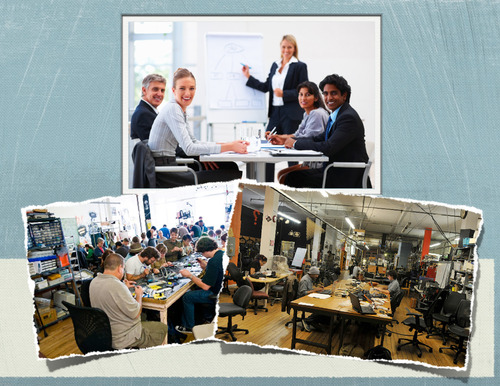
If thought precedes action, what idea does enterprise architecture move towards?
The clarity of a signal lifted out of the noise? Tidy cubicles or hacker spaces?
To find a form that accommodates the mess, that that now the task of the enterprise architect.
(Apologies to Beckett).
If thought precedes action, what idea does enterprise architecture move towards?
The clarity of a signal lifted out of the noise? Tidy cubicles or hacker spaces?
To find a form that accommodates the mess, that that now the task of the enterprise arc…
 |
| IBM MobileFirst |
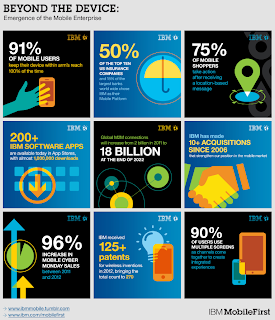
The Strategic Intent and drivers behind Enterprise Mobile Investment –
Before committing funds on Mobile strategy a valid question to ask is, what is your Enterprise attempting to achieve by mobile investment? For instance do you see mobile evolving as one of your primary channel to market? Are you attempting to gather insights from mobile data which may provide new opportunities for product and services expansion?
Or are you simply trying to increase your business transactions though Mobile media. In some instances it may be seen as a media for extending the brand experience for more personal shopping or browsing experience.

Some of the demos / case studies during the session further underlined some of above points. The Barclays Pingit case study and how it is driving the C2C is a prime example of how Apps can bring success and create new Operating Models for large Enterprises. While the Tealeaf demo effectively showcased the power of analytics behind smart Mobile strategy.
One of the key takeaway for me was, “Why limit Mobile conversations to IT? Focus must be on exploring business opportunities & enhancing business capabilities”. Iwould like to congratulate IBM for putting together a smart, effective and useful summit. I certainly hope to apply some of the above lessons learnt for my customers in Retail and Logistics in near future.
For more on IBM Mobilefirst read here