Are you an Architect or an Engineer?

If you share any of my professional background and work experiences, I am sure this question must have popped in your head a few times! 

Zachman Framework clearly differentiates between the above two perspectives. As a matter of fact, Zachaman Framework clearly distinguishes between six perspectives, namely; Executive, Business Management, Architect, Engineer, Technician and the Enterprise. But I find the differentiation between Architect and Engineer perspective most interesting, probably because I started my professional life as a Software Engineer and then went onto play a range of Architect roles (Business, System, EA etc.) over the last fifteen years. 

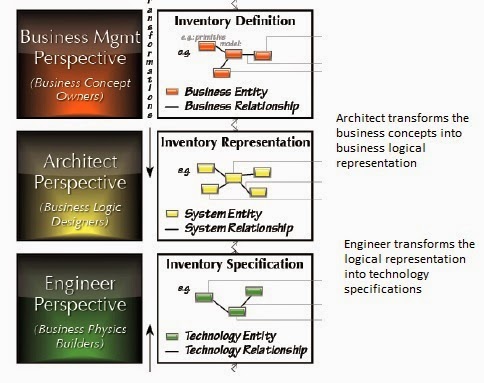
I probably can recollect a dozen instances where these roles overlapped and can also recollect may be another dozen when there was a gap between the two. That probably is more a comment on the Operating Model issues! Referring back to Zachman Framework’s definitions, the two perspectives are defined as below;
Architect and Engineer Perspectives – in Zachman Framework
All Copyrights with Zachman International
The Architecture Perspective is about the Business Logic Designers. People who manage this perspective, namely Architect role profile works closely with Business Managers to understand the key business concepts and then turn them into representations. Zachman actually names them as System Entity and System Relationship representations. The Engineer Perspective is about as Zachman calls it, Business Physics Builders. In other words, Engineers work closely with Architects to turn System representations into Technology Specifications. Zachman actually uses an example of Technology Entity Relationship specifications.


TOGAF though defines Architect roles well; it probably does not clearly differentiate between an Architect and an Engineer at a role profile level. But it does offer a good methodical (as you can expect from TOGAF) and well defined classification of view; namely, Business Architecture View, Data Architecture View, Software Engineering View, System Engineering View and so on. In my opinion that works well too as with these views an organisation can then map roles, responsibilities of Architects and Engineers onto its operating model. 

While many readers of this blog may or may not agree with precise definitions, I think this is still a good enough framework for us to start building operating model constructs around how best do Architects work with Engineers? Or vice versa! In some organisation they may be played by single role profile, in large environments it may be spread across say two or three role profiles. In an outsourced environment, Architect role may still be part of the retained IT staff and Engineers (or Engineering Services) may be procured from suppliers. I suppose, individual organisational operating model will dictate the specifics on these.


What is your experience in your organisation? How do architects work with engineers in your organisation?

References and additional reading: 


Are you an Architect or an Engineer?

If you share any of my professional background and work experiences, I am sure this question must have popped in your head a few times! 

Zachman Framework clearly differentiates between the above two perspectives. As a matter of fact, Zachaman Framework clearly distinguishes between six perspectives, namely; Executive, Business Management, Architect, Engineer, Technician and the Enterprise. But I find the differentiation between Architect and Engineer perspective most interesting, probably because I started my professional life as a Software Engineer and then went onto play a range of Architect roles (Business, System, EA etc.) over the last fifteen years. 

I probably can recollect a dozen instances where these roles overlapped and can also recollect may be another dozen when there was a gap between the two. That probably is more a comment on the Operating Model issues! Referring back to Zachman Framework’s definitions, the two perspectives are defined as below;
Architect and Engineer Perspectives – in Zachman Framework
All Copyrights with Zachman International
The Architecture Perspective is about the Business Logic Designers. People who manage this perspective, namely Architect role profile works closely with Business Managers to understand the key business concepts and then turn them into representations. Zachman actually names them as System Entity and System Relationship representations. The Engineer Perspective is about as Zachman calls it, Business Physics Builders. In other words, Engineers work closely with Architects to turn System representations into Technology Specifications. Zachman actually uses an example of Technology Entity Relationship specifications.


TOGAF though defines Architect roles well; it probably does not clearly differentiate between an Architect and an Engineer at a role profile level. But it does offer a good methodical (as you can expect from TOGAF) and well defined classification of view; namely, Business Architecture View, Data Architecture View, Software Engineering View, System Engineering View and so on. In my opinion that works well too as with these views an organisation can then map roles, responsibilities of Architects and Engineers onto its operating model. 

While many readers of this blog may or may not agree with precise definitions, I think this is still a good enough framework for us to start building operating model constructs around how best do Architects work with Engineers? Or vice versa! In some organisation they may be played by single role profile, in large environments it may be spread across say two or three role profiles. In an outsourced environment, Architect role may still be part of the retained IT staff and Engineers (or Engineering Services) may be procured from suppliers. I suppose, individual organisational operating model will dictate the specifics on these.


What is your experience in your organisation? How do architects work with engineers in your organisation?

References and additional reading: 


ArchiMate® Users Group Meeting

By The Open Group During a special ArchiMate® users group meeting on Wednesday, May 14 in Amsterdam, Andrew Josey, Director of Standards within The Open Group, presented on the ArchiMate certification program and adoption of the language. Andrew is currently … Continue reading →

Enterprise Architecture Approach in an HE Institution: 10 Practical Steps

What’s particular about doing EA in a research-intensive HE Institution like the University of Bristol? For one thing the HE sector has some interesting dichotomies to grapple with such as the dual activities of a University like Bristol of both research and education. In a sense we are two businesses: the business of conducting research […]

Enterprise Architecture Approach in an HE Institution: 10 Practical Steps

What’s particular about doing EA in a research-intensive HE Institution like the University of Bristol? For one thing the HE sector has some interesting dichotomies to grapple with such as the dual activities of a University like Bristol of both research and education. In a sense we are two businesses: the business of conducting research […]

National Decision Model

@antlerboy asks does anyone know theoretical underpinning of the (rather good) police decision-making model?

The National Decision Model (NDM) is a risk assessment framework, or decision making process, that is used by police forces across the UK. It replaces the former Conflict Management Model. Some sources refer to it as the National Decision-Making Model.

Looking around the Internet, I have found two kinds of description of the model – top-down and bottom-up.

The top-down (abstract) description was published by the Association of Chief Police Officers (ACPO) sometime in 2012, and has been replicated in various items of police training material including a page on the College of Policing website. It is fairly abstract, and provides five different stages that officers can follow when making any type of decision – not just conflict management.

Some early responses from the police force regarded the NDM as an ideal model, only weakly connected to the practical reality of decision-making on the ground. See for example The NDM and decision making – what’s the reality? (Inspector Juliet Bravo, April 2012).

In contrast, the bottom-up (context-specific) description emerges when serving police officers discuss using the NDM. According to Mr Google, this discussion tends to focus on one decision in particular – to Taser or not to Taser.

“For me the Taser is a very important link in the National Decision Making Model . It bridges that gap between the baton and the normal firearm that has an almost certain risk of death when used.” (The Peel Blog, July 2012). See also Use of Force – Decision Making (Police Geek, July 2012).

ACPO itself adopts this context-specific perspective in its Questions and Answers on Taser (February 2012, updated July 2013), where it is stated that Taser may be deployed and used as one of a number of tactical options only after application of the National Decision Model (NDM).

Of course, the fact that Taser-related decisions have a high Google ranking doesn’t imply that these decisions represent the most active use of the National Decision Model. The most we can infer from this is that these are the decisions that police and others are most interested in discussing.

(Argyris and Schön introduced the distinction between Espoused Theory and Theory-In-Use. Perhaps we need a third category to refer to what people imagine to be the central or canonical examples of the theory. We might call it Theory-in-View or Theory-in-Gaze.)

In a conflict situation, a police officer often has to decide how much force to use. The officer needs to have a range of tools at his disposal and the ability to select the appropriate tool – in policing, this is known as a use-of-force continuum. More generally, it is an application of the principle of Requisite Variety.

In a particular conflict situation, the police can only use the tools they have at their disposal. The decision to use a Taser can only be taken if the police have the Taser and the training to use it properly. In which case the operational decision must follow the NDM.

More strategic decisions operate on a longer timescale – whether to equip police with certain equipment and training, what rules of engagement to apply, and so on. A truly abstract decision-making model would provide guidance for these strategic decisions as well as the operational decisions.

And that’s exactly what the top-down description of NDM asserts. “It can be applied to spontaneous incidents or planned operations by an individual or team of people, and to both operational and non-operational situations.”

Senior police officers have described the use of the NDM for non-conflict situations. For example, Adrian Lee (Chief Constable of Northants) gave a presentation on the Implications of NDM for Roads Policing (January 2012).

The NDM has also been adapted for use in other organizations. For example, Paul Macfarlane (ex Strathclyde Police) has used the NDM to produced a model aimed at Business Continuity and Risk Management. which he calls Defensive Decision-Making.


How does the NDM relate to other decision-making models? According to Adrian Lee’s presentation, the NDM is based on three earlier models:

  • The Conflict Management Model (CMM). For a discussion from 2011, see Police Oracle.
  • The SARA model (Scan, Analyze, Respond, Assess) – which appears to be similar to the OODA loop.
  • Something called the PLANE model. (I tried Googling this, and I just got lots of Lego kits. If anyone has a link, please send.)

There is considerable discussion in the USA about the relevance of the OODA loop to policing, and this again focuses on conflict management situations (the “Active Shooter”). There are two important differences between combat (the canonical use of OODA) and conflict management. Firstly, the preferred outcome is not to kill the offender but to disarm him (either physically or psychologically). This means that you sometimes need to give the offender time to calm down, orienting himself into making the right decision.

And the cop needs to stay calm. George “Doc” Thompson, who taught US police a de-escalation technique known as Verbal Judo, once said “We know that the most deadly weapon we carry is not the .45 or the 9mm, it is in fact the cop’s tongue … A single sentence fired off at the wrong person at the wrong time can get you fired, it can get you sued, it can get you killed.”

So it’s not just about having a faster OODA loop than the other guy (although clearly some American cops think this is important). And secondly, there is a lot of talk about situation awareness and anticipation. For example, Dr. Mike Asken, who is a State Police psychologist, has developed a model called AAADA (Anticipating, Alerting, Assessing, Deciding and Acting). There is also a Cognitive OODA model I need to look into.

However, I interpret @antlerboy’s request for theoretical underpinning as not just a historical question (what theories of decision-making were the creators of NDM consciously following) but a methodological question (what theories of decision-making would be relevant to NDM and any other decision models). But this post is already long enough, and the sun is shining outside, so I shall return to this topic another day.


Sources

Michael J. Asken, From OODA to AAADA ― A cycle for surviving violent police encounters (Dec 2010)

Erik P. Blasch et al, User Information Fusion Decision-Making Analysis with the C-OODA Model (Jan 2011)

Tom Dart, ‘Verbal judo’: the police tactic that teaches cops to talk before they shoot (Guardian 21 July 2016)

Adrian Lee, Implications of NDM for Roads Policing (January 2012).

Steve Papenfuhs, The OODA loop, reaction time, and decision making (PoliceOne, 23 February 2012)

National Decision Model (ACPO, 2012?)

National Decision Model (College of Policing, 2013)

SARA model (Center for Problem-Oriented Policing)

Related Posts
National Decision Model and Lessons Learned (Feb 2017)

Updated 28 February 2017

National Decision Model

@antlerboy asks does anyone know theoretical underpinning of the (rather good) police decision-making model?

The National Decision Model (NDM) is a risk assessment framework, or decision making process, that is used by police forces across the UK. It replaces the former Conflict Management Model. Some sources refer to it as the National Decision-Making Model.

Looking around the Internet, I have found two kinds of description of the model – top-down and bottom-up.

The top-down (abstract) description was published by the Association of Chief Police Officers (ACPO) sometime in 2012, and has been replicated in various items of police training material including a page on the College of Policing website. It is fairly abstract, and provides five different stages that officers can follow when making any type of decision – not just conflict management.

Some early responses from the police force regarded the NDM as an ideal model, only weakly connected to the practical reality of decision-making on the ground. See for example The NDM and decision making – what’s the reality? (Inspector Juliet Bravo, April 2012).

In contrast, the bottom-up (context-specific) description emerges when serving police officers discuss using the NDM. According to Mr Google, this discussion tends to focus on one decision in particular – to Taser or not to Taser.

“For me the Taser is a very important link in the National Decision Making Model . It bridges that gap between the baton and the normal firearm that has an almost certain risk of death when used.” (The Peel Blog, July 2012). See also Use of Force – Decision Making (Police Geek, July 2012).

ACPO itself adopts this context-specific perspective in its Questions and Answers on Taser (February 2012, updated July 2013), where it is stated that Taser may be deployed and used as one of a number of tactical options only after application of the National Decision Model (NDM).

Of course, the fact that Taser-related decisions have a high Google ranking doesn’t imply that these decisions represent the most active use of the National Decision Model. The most we can infer from this is that these are the decisions that police and others are most interested in discussing.

(Argyris and Schön introduced the distinction between Espoused Theory and Theory-In-Use. Perhaps we need a third category to refer to what people imagine to be the central or canonical examples of the theory. We might call it Theory-in-View or Theory-in-Gaze.)

In a conflict situation, a police officer often has to decide how much force to use. The officer needs to have a range of tools at his disposal and the ability to select the appropriate tool – in policing, this is known as a use-of-force continuum. More generally, it is an application of the principle of Requisite Variety.

In a particular conflict situation, the police can only use the tools they have at their disposal. The decision to use a Taser can only be taken if the police have the Taser and the training to use it properly. In which case the operational decision must follow the NDM.

More strategic decisions operate on a longer timescale – whether to equip police with certain equipment and training, what rules of engagement to apply, and so on. A truly abstract decision-making model would provide guidance for these strategic decisions as well as the operational decisions.

And that’s exactly what the top-down description of NDM asserts. “It can be applied to spontaneous incidents or planned operations by an individual or team of people, and to both operational and non-operational situations.”

Senior police officers have described the use of the NDM for non-conflict situations. For example, Adrian Lee (Chief Constable of Northants) gave a presentation on the Implications of NDM for Roads Policing (January 2012).

The NDM has also been adapted for use in other organizations. For example, Paul Macfarlane (ex Strathclyde Police) has used the NDM to produced a model aimed at Business Continuity and Risk Management. which he calls Defensive Decision-Making.


How does the NDM relate to other decision-making models? According to Adrian Lee’s presentation, the NDM is based on three earlier models:

  • The Conflict Management Model (CMM). For a discussion from 2011, see Police Oracle.
  • The SARA model (Scan, Analyze, Respond, Assess) – which appears to be similar to the OODA loop.
  • Something called the PLANE model. (I tried Googling this, and I just got lots of Lego kits. If anyone has a link, please send.)

There is considerable discussion in the USA about the relevance of the OODA loop to policing, and this again focuses on conflict management situations (the “Active Shooter”). There are two important differences between combat (the canonical use of OODA) and conflict management. Firstly, the preferred outcome is not to kill the offender but to disarm him (either physically or psychologically). This means that you sometimes need to give the offender time to calm down, orienting himself into making the right decision. So it’s not just about having a faster OODA loop than the other guy (although clearly some American cops think this is important). And secondly, there is a lot of talk about situation awareness and anticipation. For example, Dr. Mike Asken, who is a State Police psychologist, has developed a model called AAADA (Anticipating, Alerting, Assessing, Deciding and Acting). There is also a Cognitive OODA model I need to look into.

However, I interpret @antlerboy’s request for theoretical underpinning as not just a historical question (what theories of decision-making were the creators of NDM consciously following) but a methodological question (what theories of decision-making would be relevant to NDM and any other decision models). But this post is already long enough, and the sun is shining outside, so I shall return to this topic another day.


Sources

Michael J. Asken, From OODA to AAADA ― A cycle for surviving violent police encounters (Dec 2010)

Adrian Lee, Implications of NDM for Roads Policing (January 2012).

Erik P. Blasch et al, User Information Fusion Decision-Making Analysis with the C-OODA Model (Jan 2011)

National Decision Model (ACPO, 2012?)

National Decision Model (College of Policing, 2013)

SARA model (Center for Problem-Oriented Policing)

Updated 19 May 2014

Enterprise Architecture for Mergers and Acquisitions

EA describes the operation of the Enterprise and the roadmap to achieve its goals. It offers a view of the enterprise value chains, business functions and flows, technology systems and organisation, all aligned. Beside analysing, improving an…

Categories Uncategorized

The Internet of Things Means Business

According to a survey by the research arm of The Economist, businesses are slightly more likely to be using the Internet of Things for internal operations and processes than in external products or services. It’s important to draw a distinction between forward-facing IoT and what I call the Internet of Business Things (IoBT). The knowledge, skills and alliances it will take to instrument the business are different than outfitting consumer products with connected technology. The […]