How to Ensure Enterprise Architecture Success

Last week I asked everyone to get creative with Enterprise Architecture and bring sexy back. This week I would like to know how you arrived at the decision of implementing Enterprise Architecture and would like to guide you through the next steps.
Ensu…

Categories Uncategorized

Agile SOA in the Digital Economy

Are you and your enterprise a prisoner of the past? I don’t mean legacy applications and technologies, I mean today’s business processes and applications. I work with many different enterprises and what’s common to the great majority is the centrality of business processes and applications, and the difficulty in evolving these existing solutions.

Actually I am frequently amazed at the understanding of many business managers. I marvel at how they use the lingua franca of their applications to describe their business. I will readily admit that when I first meet someone like this it’s a bit scary, because their vocabulary is like a foreign language. But frequently I find that it’s also a foreign language to their colleagues and it represents a rather primitive form of power play! Believe me. And that vocabulary of course often pervades the business process also. But the even scarier thing is that these organizations don’t realize they are locked into yesterday; or looking in the rear view mirror is you prefer. And just like Fred Brooks mythical beasts, struggling against the grip of the tar pits [1], they will eventually be overwhelmed by the complexity and their inability to change. Yes they may be delivering Cloud based Web and mobile applications to their customers, but are they just adding to the inherent business complexity?

I observe smart, successful companies making major mistakes as they enter the digital economy. First they set up an eServices project or division. This is treated as an innovation center and separated from the core business, in order to get to market quickly. But of course when they get to market the new products don’t integrate with the core business. Sure there’s application and service integration, anyone can patch old and new together at that level; but what about the way the business works; the business model and the vocabulary used, the opportunities for channel switching, and the development of distinctive sales and customer support systems and internal and external company culture that transcends the technology channels. And the ability to evolve the old and new in a way that they complement each other?

This problem is visible in the decreasing agility of organizations. Many have adopted Agile development but, and I say this as a certified Scrum Master, how many Agile projects think about the vocabulary and integrated business model issue? Yes Agile projects generally deliver faster, better and cheaper, but are they basically adding to the size and eventual grip of the tar pit? Just getting there faster!

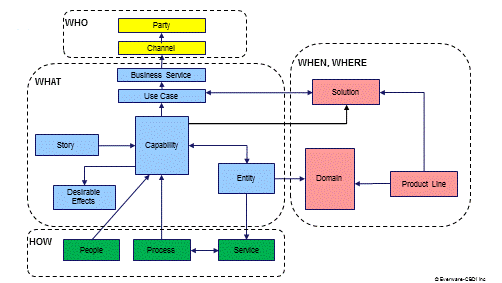
In the digital economy enterprises must turn themselves inside-out! Expose their core business capabilities as services through multiple, interconnected channels for internal and external use. Today’s SOA best practice is primarily inwards looking. What’s required is a new form of business model that details the new world from the customers’ perspective. And this needs to be reflected in the way the business operates internally also.

The new business model needs to be a radical departure from de facto practices in business architecture, enterprise architecture or business requirements. And it needs to be developed to govern Agile development projects. Key characteristics include:
– A service oriented business model that transcends business and IT.
– Understandable by all stakeholders
– Owned by the business.
– All enterprise capabilities are (eventually) published as externalized business services and supported by common software services
– Implementation independent models
– Developed as part of an Agile process – initial scoping sprint, followed by drill down modeling sprints by domain and or capability; delivering just sufficient detail to charter Agile delivery projects.

[1] The Mythical Man-Month, Fred Brooks, 1972
Agile SOA in the Digital Economy

Are you and your enterprise a prisoner of the past? I don’t mean legacy applications and technologies, I mean today’s business processes and applications. I work with many different enterprises and what’s common to the great majority is the centrality of business processes and applications, and the difficulty in evolving these existing solutions.

Actually I am frequently amazed at the understanding of many business managers. I marvel at how they use the lingua franca of their applications to describe their business. I will readily admit that when I first meet someone like this it’s a bit scary, because their vocabulary is like a foreign language. But frequently I find that it’s also a foreign language to their colleagues and it represents a rather primitive form of power play! Believe me. And that vocabulary of course often pervades the business process also. But the even scarier thing is that these organizations don’t realize they are locked into yesterday; or looking in the rear view mirror is you prefer. And just like Fred Brooks mythical beasts, struggling against the grip of the tar pits [1], they will eventually be overwhelmed by the complexity and their inability to change. Yes they may be delivering Cloud based Web and mobile applications to their customers, but are they just adding to the inherent business complexity?

I observe smart, successful companies making major mistakes as they enter the digital economy. First they set up an eServices project or division. This is treated as an innovation center and separated from the core business, in order to get to market quickly. But of course when they get to market the new products don’t integrate with the core business. Sure there’s application and service integration, anyone can patch old and new together at that level; but what about the way the business works; the business model and the vocabulary used, the opportunities for channel switching, and the development of distinctive sales and customer support systems and internal and external company culture that transcends the technology channels. And the ability to evolve the old and new in a way that they complement each other?

This problem is visible in the decreasing agility of organizations. Many have adopted Agile development but, and I say this as a certified Scrum Master, how many Agile projects think about the vocabulary and integrated business model issue? Yes Agile projects generally deliver faster, better and cheaper, but are they basically adding to the size and eventual grip of the tar pit? Just getting there faster!

In the digital economy enterprises must turn themselves inside-out! Expose their core business capabilities as services through multiple, interconnected channels for internal and external use. Today’s SOA best practice is primarily inwards looking. What’s required is a new form of business model that details the new world from the customers’ perspective. And this needs to be reflected in the way the business operates internally also.

The new business model needs to be a radical departure from de facto practices in business architecture, enterprise architecture or business requirements. And it needs to be developed to govern Agile development projects. Key characteristics include:
– A service oriented business model that transcends business and IT.
– Understandable by all stakeholders
– Owned by the business.
– All enterprise capabilities are (eventually) published as externalized business services and supported by common software services
– Implementation independent models
– Developed as part of an Agile process – initial scoping sprint, followed by drill down modeling sprints by domain and or capability; delivering just sufficient detail to charter Agile delivery projects.

[1] The Mythical Man-Month, Fred Brooks, 1972

The Art of Banking: How Financial Services Approach Great Customer Experiences

During a recent conversation with colleagues from the Financial Services sector, one person challenged: “Is there really anything new and innovative for banking technology, or have we already seen it all?” The lively discussion led to a far more interesting and important question: “Where are banks finding the inspiration and tools to drive customer-focused innovation?” […]

Related posts:

  1. Three Big Topics in Financial Services In the wake of this historic, global economic downturn there…
  2. Customer-Driven Conversation Understanding how to handle customer needs and expectations is critical…
  3. OpenText Smart Process Applications: In The Age of the Customer BPMS is not enough We live in “In the Age of the Customer” a…

Related posts brought to you by Yet Another Related Posts Plugin.

Career Paths – Project Management

Career Path for Project Management Roles There are two job descriptions in the project management career path for our IT department.  The entry level position is Project Manager.  This role supports the Director of Information Technology with small project management functions. The next and final level is Senior Project Manager.  This role continues to provide […]

The post Career Paths – Project Management appeared first on Enterprise Architecture in Higher Education.

Strategy and Tactics – We need them both

In past posts, I have addressed the difference between strategic thinking and tactical thinking. Here I want to take a deeper, more explicit look into the differences. As business architects we can often be overly focused on strategy and think of tactics as bad. However, this is not the case. We need tactical thinking to […]

Survey: Information Security Attacks Up 25%

Guest post by Mark Lobel If you want to protect your information assets in today’s interconnected business environment, you need to know your enemy. What are they after, how do they aim to get it and how are you going to stop them? New hacker strategies, the Bring Your Own Device trend, and Cloud Computing are all combining to expose companies to unprecedented information security risks. Yet, companies are acting as if nothing has changed. […]

IT Technology Trends – a Risky Business?

By Patty Donovan, The Open Group On Wednesday, September 25, The Open Group will host a tweet jam looking at a multitude of emerging/converging technology trends and the risks they present to organizations who have already adopted or are looking … Continue reading