Searching For A Better Answer?

bg outline

Ben Geller, VP Marketing, Troux
 

google day 091013 blogI read over the weekend that Google recently turned 15 years old. While the exact date the search giant came into existence is essentially a matter of opinion, and the company moves the celebration each year to a convenient date, reflecting on the accomplishments of this organization since 1998 never ceases to impress.

Any business 101 course will tell you the foundation of a solid company is to solve a problem (like answering any question you can possibly dream up), for a cost that people are willing to pay (how about free?). The team at Google, or “Backrub” as it was first called, created a tool that allowed people to discreetly ask the genie behind the curtain anything they wanted. And the tool only got better and better as the vast amount of data on the Web grew exponentially over time.

The Google search engine now logs an average of 2 billion searches daily. The company name is commonly used as a verb for asking the Internet about anything from when John Zachman was born to how many EA frameworks exist (more than 40 according to wikipedia). Thinking back to what was not so long ago in the grand scheme of existence, answering these types of questions would require hunting down a wise human expert or heading to the reference section of the library. Hardly instantaneous, particularly if your needs were time sensitive.

While we would not suggest our brand be recognized with consumer innovation powerhouses like Google, at Troux we have similarly invented a better way of doing things in our own world.  Like Backrub and its “webcrawler” providing visibility across the internet, Troux provides visibility and important insights from across the entire enterprise. Consumers use search engines to find answers and at Troux we provide answers to our customers’ complex business questions and show the impact decisions will have before they are implemented.  This means enterprise leaders can make smart decisions about business and technology strategy.

However, we’re more than just a search tool, Troux EPM Solutions take it one step further to show enterprises where to make better business and technology decisions , while optimizing for maximum agility, minimum cost and minimum risk. Rather than being based on an ever changing secret algorithm, our technology is designed to provide the best visibility and answers for aligning your technology environment with the strategic needs of your business.

Now if someone could take the power of Google’s search engine and answer the age of old question of which came first Business Process or Business Capability– that would really change the world. For now, at Troux, we’ve got the important business decisions covered so you can focus on weeding through the 16.8 million results returned on your search for “EA best practices.”


New Call\u002Dto\u002DAction

Categories Uncategorized

Where do you put the Ugly?

As a programmer I found that the realities of deadlines and costs resulted in one unassailable truth; every program had some ugly code, and that code had to go somewhere. Sometimes this meant a special “Utility” class, or a “Worker” object….

Business Architecture 101 – It’s results that count!

Business Architecture may not be a new term, but it is certainly one that is grabbing a lot of headlines lately. Indeed we had record registrations for our “7 Steps to Business Architecture” webinar in July, and now that record looks like it’s being smashed again (judging by registrations to date) with our new webinar […]

Related posts:

  1. Using the “Wheel of Change” to justify Business Architecture It’s not about the methods, it’s not about models, it’s…
  2. The Reality of Process Excellence Whether we like to admit it, most organizations are still…
  3. ProVision Comes to Gartner EA Summit: architecture projects have a greater focus more on business value “For our session I am delighted that we will be…

Related posts brought to you by Yet Another Related Posts Plugin.

Variety – part 1

The cybernetic concept of variety is enjoying some increase in usage. And that’s both in frequency and in number of different contexts. Even typing “Ross Ashby” in Google Trends supports that impression. In the last two years the interest seems stable, while in the previous six – non-existing, save for the lonely peak in May […]

Holiday: time to do some in-depth reading

I’m just back from a great, relax holiday. Apart from having good quality time with my family, holiday is also a great time to immerse myself in some books. Instead of the quick information gathering I normally do by scanning my twitter timeline, quick-reading blog posts, and some more in-depth articles from time to time, I really focused on a single book for a couple of hours. Reading books really.

The post Holiday: time to do some in-depth reading appeared first on The Enterprise Architect.

Holiday: time to do some in-depth reading

I’m just back from a great, relax holiday. Apart from having good quality time with my family, holiday is also a great time to immerse myself in some books. Instead of the quick information gathering I normally do by scanning my twitter timeline, quick-reading blog posts, and some more in-depth articles from time to time, I really focused on a single book for a couple of hours. Reading books really helps me to practice my ability to focus (which is necessary in today’s distraction culture – being offline helps a lot by the way) and, if I read the right books, is very interesting and inspiring.

In this post I just want to share two of the books I read during my holiday, they are very different, but both interesting and inspiring in their own way.

Small Giants

The tagline of “Small Giants” by Bo Burlingham basically says it all: “companies that choose to be great instead of big”. In the book Bo Burlingham describes 14 companies that he selected to be examples of what he calls “small giants”. These small giants are businesses with soul, with mojo (as he calls it). These companies do seven things to generate mojo:

  • Their founders and leaders do not accept the standard menu of options, they recognize the full range of choices they have about the type of company they can create. They question the usual definitions of success in business and imagine possibilities other than the ones all of us are familiar with.
  • Their leaders have overcome the enormous pressures on successful companies to take paths they have not chosen and do not necessarily want to follow. The people in charge have remained in control. The author emphasizes here that private ownership is key, later he states that it is possible to do the same with publicly owned companies, but explains that it is more difficult.
  • Each of these companies have an extraordinary intimate relationship with the local city, town, or country in which they do business. A relationship that went well beyond the usual concept of “giving back”.
  • They cultivate exceptionally intimate relationships with customers and suppliers, based on personal contact, one-on-one interaction, and mutual commitment to delivering on promises.
  • They have unusually intimate workplaces. They care for their people in the totality of their lives.
  • These companies have come up with an impressive variety of corporate structures and modes of governance. Some of them created their own management systems and practices. My interpretation: they also innovated and continuously improved their way of working, not just their product.
  • Their leaders have passion for what the companies do, they love the subject matter. They have deep emotional attachments to the business, to the people that work in the company, and to its customers and suppliers.

All these concepts are explained in the book with examples and stories of one or more of the 14 selected companies. This book is an easy read with a lot of stories that inspire and invite you to keep on reading. I really liked the book, it is different, thought-provoking, and inspiring!

The principles of Product Development Flow

One of the other books I read was “The principles of Product Development Flow – second generation lean product development” by Donald G. Reinertsen. This book was a whole different cup of tea. In the introduction the author already states it: “I aspire to write books with more content than fluff”. He definitely achieves this goal: it is not a business novel, not a collection of stories of successful companies, but a book with a high density of information organized in 175 principles.

What I like about the book is that it takes (and shares) lessons from many different fields. The key idea sources are lean manufacturing (of course one of the main sources, but it goes way beyond that), economics, queueing theory, statistics, telecommunications networks, computer operating system design, control engineering, and maneuver warfare. Lessons from all these fields are applied to the subject of product development and lead to principles that describe how the product development flow can be influenced.

What I also like is the design of the book. Because of the focus on principles the applicability of the book is quite broad. It doesn’t eliminate the need for thinking, but it helps to think more deeply about your choices. After reading the book you will be able to understand and explain why things like Scrum (or other agile approaches) improve software development processes a lot in comparison to some other approaches. The book does barely mention the term agile by the way. I think that’s one of it powers: it focuses on grounded principles that can be applied (and yes, that will lead you to what some people will call an agile process).

This book really inspires to focus on the the things that really matter, to not measure and act on proxy variables. It conveys a mindset of having proper economics reasons for everything you change (and thus improve) in your product development process. I will definitely use this book as a reference in the future.


Please let me know in the comments what recommendations you have for me to read next!

Using CMU/SEI Quality Attribute Workshop (QAW) while developing an Architecture Vision

Business Scenarios are a proven technique to link business requirements to architectural models. According to TOGAF a Business Scenario is a description of:

  • A business process, application, or set of applications that can be enabled by the architecture
  • The business and technology environment
  • The people and computing components (called “actors”) who execute the scenario
  • The desired outcome of proper execution”

Recently I have been working with another technique which is commonly used by Software Engineering People but mainly for Software Architecture: Quality Attribute Workshops (QAWs) from CMU SEI (Carnegie Mellon Software Engineering Institute. This technique make use of interactive workshops with the main stakeholders of a project. Where you the solution is to be developed either internally or externally (not a COTS), then this technique could be combined with the Business Scenario.
A Quality Attribute Workshop (QAW) is a systematic approach to elicit the needed requirements. This will ensure that all quality attributes are included in the final design. To This end it:

  • is a facilitated method that engages system stakeholders early in the life cycle to discover the driving quality attributes of a software-intensive system
  • provides a way to identify important quality attributes and clarify system requirements before the software architecture has been created (Implementation Governance)
  • is based on the qualities and the non-functional requirements that may be captured in the Architecture Vision document, the team will identify and elaborate specific quality attribute scenarios and document them
  • produces a documentation that includes most of the quality attributes specified by the stakeholders

QAW defines two kinds of architectures:

  • System Architecture: the fundamental and unifying system structure defined in terms of system elements, interfaces, processes, constraints, and behaviours
  • Software Architecture: the structure or structures of the system, which comprise software elements, the externally visible properties of those elements and the relationships among them

The TOGAF specification considers the Enterprise as a System, however the term System in QAW is more related to IT Systems. QAW provides an opportunity to gather stakeholders together to provide input about their needs and expectations with respect to key quality attributes that are of particular concern to them. A similar concept to what we try to achieve with the TOGAF Business Scenario but with a focus on IT systems quality attributes.

It is also a purpose of identifying scenarios from the point of view of a diverse group of stakeholders which can then be used by the system engineers to analyse the system’s architecture and identify concerns. QAW is mainly addressing non-functional requirements and there is still needs to understand the problems we try to solve, gather functional requirements like in Business Scenarios.
clip_image002
Quality Attribute Workshops ensure that quality attribute scenarios are identified, prioritized, and refined before the software architecture is completed. Individual requirements are viewed in a forum in relation to one another in the context of the overall problem. Architecture is based on complete set of requirements that add up to a whole problem description.

Technique requires involvement – at an early stage in architecture project

  • Business stakeholders (end users)
  • Systems stakeholders (installers, administrators, DBAs; network, training, acquirers, system and software engineers, etc.)
  • Other stakeholders (such as Operations amongst others)

The QAW provides:

  • Increased stakeholder communication, an informed basis for architectural decisions
  • Improved architectural documentation, and support for analysis and testing throughout the life of the system

And the results include:

  • A list of architectural drivers
  • Raw scenarios
  • A prioritized list of raw scenarios
  • Refined scenarios

During the workshops the Stakeholders receive a “participant’s handbook” providing example quality attribute taxonomies, questions, and scenarios.

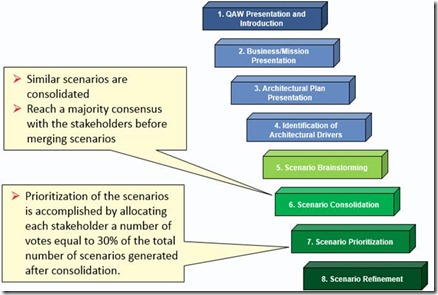
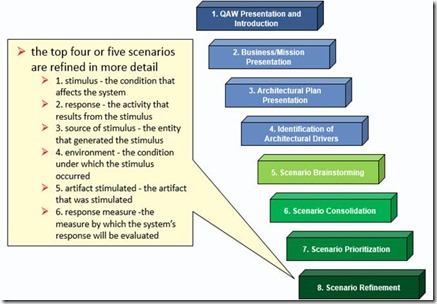
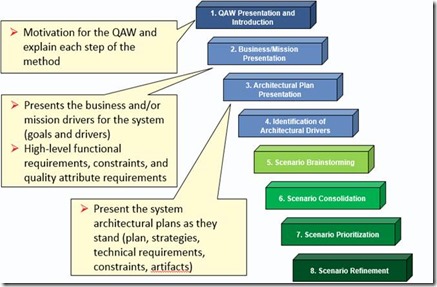
Below are the steps of the QAW.
clip_image004
clip_image006
clip_image008
clip_image010
Business and/or mission drivers for the system (goals and drivers), plan, strategies, high-level functional requirements, constraints, artifacts and quality attribute requirements should be presented to the stakeholders. Using Business Scenario in conjunction with QAWs can be an appropriate approach.

A QAW lends itself to the capture of many architecturally relevant materials:

  • Software architectural documentation is a collection of view packets plus any documentation that applies to more than one view
  • Each view packet contains a primary presentation, a catalogue of the view’s elements (including element behaviour), use case diagrams, sequence diagram, context diagrams, collaboration diagram, a variability guide, architecture background (rationale, analysis results, and assumptions about the environment), and other information including mapping to requirements

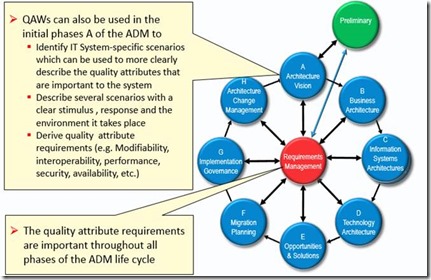
These elements may also be produced in a Business Scenario or produced later in the ADM phases A : Architecture Vision, C: Information Systems Architectures (stakeholders management and taxonomy of artifacts).

clip_image012
The outputs from the QAW can be summarised as:

  • A list of architectural drivers
  • Raw scenarios
  • A prioritized list of raw scenarios
  • Refined scenarios
  • Questionnaire

Quality attribute requirements are the means by which a system is intended to meet its business goals and QAW helps to document them.

Software architectures must be designed so that their quality attributes are met.

The QAWs technique can be utilised as a complementary approach to gather all sort of requirements including those from Software Architectures when appropriate.

Using CMU/SEI Quality Attribute Workshop (QAW) while developing an Architecture Vision

Business Scenarios are a proven technique to link business requirements to architectural models. According to TOGAF a Business Scenario is a description of:

  • A business process, application, or set of applications that can be enabled by the architecture
  • The business and technology environment
  • The people and computing components (called “actors”) who execute the scenario
  • The desired outcome of proper execution”

Recently I have been working with another technique which is commonly used by Software Engineering People but mainly for Software Architecture: Quality Attribute Workshops (QAWs) from CMU SEI (Carnegie Mellon Software Engineering Institute. This technique make use of interactive workshops with the main stakeholders of a project. Where you the solution is to be developed either internally or externally (not a COTS), then this technique could be combined with the Business Scenario.
A Quality Attribute Workshop (QAW) is a systematic approach to elicit the needed requirements. This will ensure that all quality attributes are included in the final design. To This end it:

  • is a facilitated method that engages system stakeholders early in the life cycle to discover the driving quality attributes of a software-intensive system
  • provides a way to identify important quality attributes and clarify system requirements before the software architecture has been created (Implementation Governance)
  • is based on the qualities and the non-functional requirements that may be captured in the Architecture Vision document, the team will identify and elaborate specific quality attribute scenarios and document them
  • produces a documentation that includes most of the quality attributes specified by the stakeholders

QAW defines two kinds of architectures:

  • System Architecture: the fundamental and unifying system structure defined in terms of system elements, interfaces, processes, constraints, and behaviours
  • Software Architecture: the structure or structures of the system, which comprise software elements, the externally visible properties of those elements and the relationships among them

The TOGAF specification considers the Enterprise as a System, however the term System in QAW is more related to IT Systems. QAW provides an opportunity to gather stakeholders together to provide input about their needs and expectations with respect to key quality attributes that are of particular concern to them. A similar concept to what we try to achieve with the TOGAF Business Scenario but with a focus on IT systems quality attributes.

It is also a purpose of identifying scenarios from the point of view of a diverse group of stakeholders which can then be used by the system engineers to analyse the system’s architecture and identify concerns. QAW is mainly addressing non-functional requirements and there is still needs to understand the problems we try to solve, gather functional requirements like in Business Scenarios.

clip_image002
Quality Attribute Workshops ensure that quality attribute scenarios are identified, prioritized, and refined before the software architecture is completed. Individual requirements are viewed in a forum in relation to one another in the context of the overall problem. Architecture is based on complete set of requirements that add up to a whole problem description.

Technique requires involvement – at an early stage in architecture project

  • Business stakeholders (end users)
  • Systems stakeholders (installers, administrators, DBAs; network, training, acquirers, system and software engineers, etc.)
  • Other stakeholders (such as Operations amongst others)

The QAW provides:

  • Increased stakeholder communication, an informed basis for architectural decisions
  • Improved architectural documentation, and support for analysis and testing throughout the life of the system

And the results include:

  • A list of architectural drivers
  • Raw scenarios
  • A prioritized list of raw scenarios
  • Refined scenarios

During the workshops the Stakeholders receive a “participant’s handbook” providing example quality attribute taxonomies, questions, and scenarios.

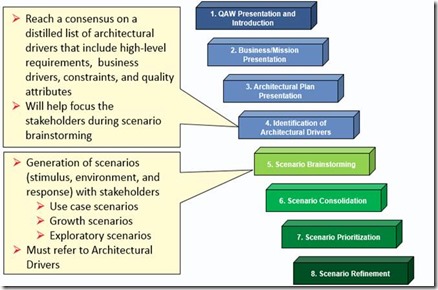
Below are the steps of the QAW.
clip_image004
clip_image006
clip_image008
clip_image010
Business and/or mission drivers for the system (goals and drivers), plan, strategies, high-level functional requirements, constraints, artifacts and quality attribute requirements should be presented to the stakeholders. Using Business Scenario in conjunction with QAWs can be an appropriate approach.

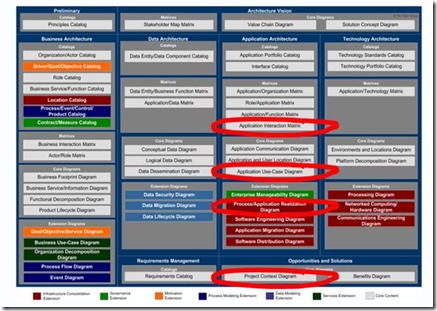
A QAW lends itself to the capture of many architecturally relevant materials:

  • Software architectural documentation is a collection of view packets plus any documentation that applies to more than one view
  • Each view packet contains a primary presentation, a catalogue of the view’s elements (including element behaviour), use case diagrams, sequence diagram, context diagrams, collaboration diagram, a variability guide, architecture background (rationale, analysis results, and assumptions about the environment), and other information including mapping to requirements

These elements may also be produced in a Business Scenario or produced later in the ADM phases A : Architecture Vision, C: Information Systems Architectures (stakeholders management and taxonomy of artifacts).
clip_image012
The outputs from the QAW can be summarised as:

  • A list of architectural drivers
  • Raw scenarios
  • A prioritized list of raw scenarios
  • Refined scenarios
  • Questionnaire

Quality attribute requirements are the means by which a system is intended to meet its business goals and QAW helps to document them.

Software architectures must be designed so that their quality attributes are met.

The QAWs technique can be utilised as a complementary approach to gather all sort of requirements including those from Software Architectures when appropriate.

Cost, Time, & Architecture – The Zen of Options Analysis

Solution architecture is typically designed within a project context. Although we focus on the right process for this design activity frequently in our blog, the intersection of that process with the process of delivering an actual production solution is very important. Constraints are a key reality in projects, and often they compete with achieving the […]

Categories Uncategorized Tags