Link Collection — September 30, 2012

  • The Corporate Executive Board Says IT budgets will rise only 1.8%, leave little room for new projects – The CIO Report – WSJ

    CIOs need to get creative… optimize to fund innovation:

    “Corporate Executive Board collected 2013 IT budget projections from almost 200 companies globally, which expect to spend a total of more than $50 billion on IT. Based on this benchmark data, we expect IT budgets to rise 1.8% on average, with operating expenditures rising 2.5%. Following large increases in capital expenditures from 2011 to 2012 (9.7%), CIOs are expecting to hold capex relatively flat. Two-thirds of CIOs expect to see increases in operating expenditures in 2013, while one-fifth plan to reduce them. Despite economic woes, European organizations are expecting a 2% increase in IT budgets as they cautiously embark on a search for corporate growth.

    Compounding the woes of sub-inflation budget growth, more than two-thirds of the IT budget is already spoken for before a single new business project can be launched.

    Despite CIOs’ efforts to reduce maintenance and mandatory spending, those areas continue to represent nearly 70% of the budget.  By contrast, innovation accounts for only 7% of the total…”

    tags: cio it budget

  • Google reveals Spanner, the database tech that can span the planet | ZDNet

    “With the aid of atomic clocks, GPS receivers and some of the most esteemed figures in computer science, Google has crafted a planet-spanning distributed database.

    Google published information about the database, named Spanner, over the weekend in a wide-ranging research paper. The paper (PDF) describes Spanner as “the first system to distribute data at global scale and support externally-consistent distributed transactions”.

    In simple terms, Google has managed to design an information store that spans its fleet of datacentres around the world and lets applications read (and, to a lesser extent write) data without being crushed by huge latencies. Software using the system can replicate data across countries and continents, while having extremely fast read times.”

    tags: google database

  • When IT Tries To Do Too Much – Chuck’s Blog

    “My days are now full of IT transformational discussions.  Dozens of conversations have become literally hundreds, and — better yet — more of our partners are seriously interested.  All good.

    More data points means — of course — more patterns observed: inherent mindsets and behaviors that inhibit any sort of serious IT transformation. 

    When I find them, I share them: realizing you have a problem is always part of the answer.

    One aspect of the problem?  IT people have an inherent engineering bent.  They try to fix the entire problem — all aspects — as if IT production and consumption was a self-contained, optimally-designed system with full access to all the components and knobs…”

    tags: IT entrenchment

  • Shadow IT Is Out of the Closet – Jill Dyche – Harvard Business Review

    “Five years ago, “shadow IT” efforts were the dirty little secret of organizations. An impatient marketing or finance manager would, on the sly, secure some extra budget money and hire a contractor to build a little database that tracked mailing addresses or top-line financials. Slowly but surely, as the little database grew bigger and bigger, the manager would wedge the cost into her operating budget. Other managers might take notice and started building their own databases. Then came the cloud, which only heightened frustration with IT’s lack of velocity in delivery, and managers flocked to outside vendors to automate various business processes, from customer relationship management to supply chain reporting to social media analytics.

    Now Shadow IT has burst out of the closet and is waltzing around the corporation, leaving IT departments rushing to do damage control.”

    tags: hbr shadowIT

  • 5 ideas to help everyone make the most of big data — Data | GigaOM

    “Big data is going mainstream, but there are still plenty of lessons to be learned from Silicon Valley data scientists whose businesses depend on data to survive. Although their use cases don’t always align with what more-traditional businesses are doing, they know enough about the science and technology to save big-data newcomers a lot of frustration.”

    tags: bigdata

  • Experimentation Is The New Planning | Fast Company

    “Technology is a bitch. It affects every industry, often in ways that are difficult (if not impossible) to anticipate. There’s always the possibility that a Napster or a Netflix or a Wikipedia will arrive to completely disrupt your business or industry.

    So it makes sense to have some kind of system that allows you to continually develop options and explore possibilities, so that when the day of disruption does arrive, it finds you ready with a few alternatives in hand. The time to seek those alternatives is now–not later, after a crisis has already arrived.”

    tags: strategy innovation experimentation change-friendly

  • The Power of Defining the Problem – Dwayne Spradlin – Harvard Business Review

    Why it is my job to ask questions, rather than proclaim answers:

    “Well-defined problems lead to breakthrough solutions. When developing new products, processes, or even businesses, most companies aren’t sufficiently rigorous in defining the problems they’re attempting to solve and articulating why those issues are important. Without that rigor, organizations miss opportunities, waste resources, and end up pursuing innovation initiatives that aren’t aligned with their strategies. How many times have you seen a project go down one path only to realize in hindsight that it should have gone down another? How many times have you seen an innovation program deliver a seemingly breakthrough result only to find that it can’t be implemented or it addresses the wrong problem? Many organizations need to become better at asking the right questions so that they tackle the right problems.”

    tags: problem-solving hbr analysis

  • Dear Customer: The Truth About IT Projects | Agile

    Good post. Agree with author, Allan Kelly, there is a need to “reset” expectations and relationships.

    “Dear Customer,

    I think it’s time we in the IT industry come clean about how we charge you, why our bills are sometimes a bit higher than you might expect, and why so many IT projects result in disappointment. The truth is that when we start an IT project, we don’t know how much time and effort it will take to complete. Consequently, we don’t know how much it will cost. This may not be a message you like to hear, particularly since you are absolutely certain you know what you want.

    Herein lies another truth, which I’ll try to put as politely as I can. You are, after all, a customer, and, really, I shouldn’t offend you. You know the saying “The customer is always right”? The thing is, you don’t know what you want. You may know in general terms, but the devil is in the details—and the more details you try to give us beforehand, the more likely your desires are to change. Each time you give us more detail, you are offering more hostages to fortune…”

    tags: IT projects failure governance change

Posted from Diigo. The rest of my favorite links are here.

EA Forum Report

#entarch
#bizarch
#UnicomEA An excellent day at Unicom’s regular Enterprise Architecture Forum on September 27th in London. Here are some of the blogposts from the day.

Tom Graves (Tetradian)


At Unicom EA: breaking free from IT-centrism&nb…

How would you know that the architecture is right?

Not a simple question to answer, but perhaps we can find some guidance in Aldo Leopold’s statement “A thing is right when it tends to preserve the integrity, stability and beauty of the biotic community. It is wrong when it tend otherwise.” Transforming that statement into architecture for the enterprises could be done in many […]

EA Questions

#entarch
#bizarch
#UnicomEA Some interesting questions arising at the EA Forum yesterday. I’ll post the questions first, and then try and assemble a summary of the answers. (Other participants at the Forum are welcome to chip in.)

Are there any co…

Beyond Multiview

#entarch
#bizarch
#UnicomEA
#SSM
#VSM
#VPEC-T
At yesterday’s EA Forum, a rich picture of the oil industry was presented by
Mesbah Khan, who then posed a question about the possible use of such a picture, for enterprise architecture and beyond.

Th…

A Whole New World

Marhaba!  This is my first post from my new home at the American University of Sharjah in the United Arab Emirates.  I have been here for 10 days and am finally feeling like a human being again.  The +11 hour time difference and jet lag really took a toll on me (aside from jumping right […]

The post A Whole New World appeared first on Enterprise Architecture in Higher Education.

Does Rigour Matter?

#entarch
#bizarch
#UnicomEA
One of the topics discussed at yesterday’s EA Forum was the question of architectural rigour. This was stimulated by a rich picture of the oil industry, presented by Mesbah Khan, which I intend to cover in a separate post….

A matter of perspective

It has been a while since my last post about Value Creation and GLUE. Interesting enough this created some discussions via twitter about what is a real value add and what not. I still stick to my statements that the only value add is located in the GLUE Discipline Develop and methods and tools to be able to deliver real value are not value in itself (despite the moment when they are created and/or added to an environment).

“The world is given to me only once, not one existing and one perceived. Subject and object are only one.”,
Erwin Schrödinger (1887 – 1961)

The interesting challenge I personally observe in Enterprise Architecture each and every day is to ensure that the existing and perceived world are synchronized to be recognized as the same. On top of that the IT world has created another challenge which now requires that the existing world, the artificial reflection of the world, the perceived existing world and the perceived artificial reflection of hte world needs to be synchronized. As I have written in “Always remember the next larger context” the challenge is to find the one-to-many mapping in the GLUE Space to ensure an accurate artificial reflection of the world and therefore synchronize the real world with the artificial world.

Imagine a company which is multinational and organized with a global, regional and local organizational setup. To keep it simple the artificial reflection of the world could be done by harmonizing all processes in the world and deliver a one size fits all approach:


In most situations this is a fairly good marketing statement and looks very good to justify huge initiatives to align processes around the world. The pushback of the real world is most likely enormeous and depending on the size of the company and the diversity of the markets there is literally no chance to squeeze the whole into the same concept. But maybe a regionalized approach does work where there is one process fits all for one region approach:


This will give a fairly large amount of alignment but at the same moment in time neglects the necissity for local deviations and specialities of single elements in a corporation. This can be fairly simple reasons like local legal law or more complex reasons like a different approach to the market, because the market situation is different in that specific country and legal entity. Therefore the answer can easily look fairly diversified:


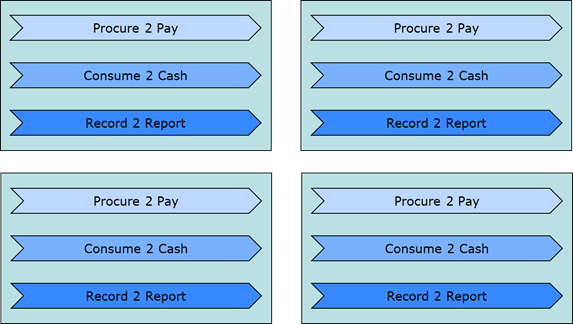
So in many cases the final architecture will be federated. No matter if it was a structured educated approach to reach a federated architecture or evolution over time due to created necessity by restructuring the organization and therefore creating the implicit demand for a federated architecture (Conway’s Law). The end result (from a conceptual point of view) is the same. A mixture of Global, Regional and Local elements:


The interesting thing from an Enterprise Architecture point of view to me now is the perspective in such an architecture. It might be very interesting to find the right federated architecture, but I believe it is not really relevant. Relevant is to help the people who must live and work in such a federated architecture to see the whole holistic view. So in the discussion between a global and a local owner the tension between the two perspectives is fairly easy to observe. From the global point of view the local part of the architecture is just another Customer which of course has to follow all rules and boundaries of the global architecture:


From a Local point of view the Global System is just another part of the architecture in the complete holistic local architecture. The business case for success for the local part of the corporation is in most cases motivated by local demand and conflicting with global demand.


The interesting discussion now is to find the right federated architecture. Unfortunately that is a moving target and does change as fast as the business changes. The discussion about the right To-Be Architecture (even though it indeed is interesting) can easily be an endless ivory tower discussion never coming to a final conclusion. The relevant discussion in my mind is helping all involved stakeholders (and that includes of course the regional elements as well in this example) to see the holistic picture. The real joy of Enterprise Architecture to me is that Enterprise Architects should apply the concept of Schrödinger’s Cat in the Architecture all the time: The Cat is alive and Dead at the same moment in time.

And here (once again) it is more relevant to help the people than to apply a specific method or tool to come to a final recommendation, which I tried to picture in my GLUE framework:


As always questions and comments more than welcome, but I am already happy if you continue to read my blog posts. 🙂


Categories Uncategorized Tags

How the Operating System Got Graphical

In 1995, under the auspices of The Open Group, the Common Desktop Environment (CDE) was developed and licensed for use by HP, IBM, Novell and Sunsoft to make open systems desktop computers as easy to use as PCs. It was the first successful attempt to standardize on a desktop GUI on multiple, competing platforms. The Open Group is now passing the torch to a new CDE community, led by CDE suppliers and users such as Peter Howkins and Jon Trulson. Continue reading