drEAmtime – PACE SCAN

I continue to explore the red line laid out by the great post from Ivo Velitchkov. So far I have created following posts:drEAmtime – Communication drEAmtime – Bridging the Silo drEAmtime – Capability Cemetery drEAmtime – EPIC SCANd…

drEAmtime – WISE SCAN

Time for post number 6 in exploring the great post from Ivo Velitchkov step-by-step. Here is what I have created so far:

  1. drEAmtime – Communication
  2. drEAmtime – Bridging the Silo
  3. drEAmtime – Capability Cemetery 
  4. drEAmtime – EPIC SCAN
  5. drEAmtime – Archetypes 

To quote Ivo:

Some attempts to achieve IT rationalisation fail spectacularly. I’m not going to list out the reasons for that. But it is may be sad that such failures discredit EA as a management discipline as whole. But sometimes Enterprise Architect are really able to find ways to discover what’s not needed and how to remove it, or what is underutilised and how to achieve better ROI for it. After all  most of them are smart people using good tools. And indeed they shoot inefficiencies and get all the glory and the money to shoot more. But as they rarely get to the cause of the inefficiencies or are in the position to influence the bigger system that produces these inefficiencies, the overall result is an oscillation or even increase in overall IT spending. The increase is because the success of the EA justifies bigger EA budget which is almost without exception a part of the IT budget.

Here Ivo points at one of the most common pitfalls of Enterprise Architecture applied: fighting symptoms instead of the root cause. This has several reasons. First of all external Enterprise Architects coming with a consulting company might not have the needed inside or full pain awareness to truly fight the root cause (some might even look for future business, and a permanent broken information flow is a permanent revenue stream). Internal Enterprise Architects might have a huge reputation problem which quite often is based on Ivos observation. So as mentioned in the other posts a clear focus on fixing the information flow is a good start to shoot at the root cause and get it eliminated or at least plant some seeds to eliminate the root cause later.

But this is clearly not enough. So with respect to fixing the content I apply the WISE SCAN approach, which looks into the future (GLUE Destination):

  • Worth – The future capability must be worthwhile to trigger a transformation. (Ivo:  But sometimes Enterprise Architect are really able to find ways to discover what’s not needed and how to remove it, or what is underutilised and how to achieve better ROI for it.)
  • Informed – The future capability must contain all the relevant information as much as needed containing the necessary facts. (Ivo: After all  most of them are smart people using good tools.)
  • Simple – The  future capability must be the most simple solution which fits the purpose. (Here Ivo seems to have lost trust and is pointing to Perverse Complexity: “Some attempts to achieve IT rationalisation fail spectacularly.”)
  • Environment – The future capability must be embedded in the greater context. (Here Ivo also seems to have lost trust: “But as they rarely get to the cause of the inefficiencies or are in the position to influence the bigger system that produces these inefficiencies, the overall result is an oscillation or even increase in overall IT spending.”)

I share the observation with Ivo that in many cases so called Enterprise Architects do indeed promote decisions which are not following the WISE approach but are focusing to much on some aspects and therefore add to the EPIC complexity. After all the core reason  why emergent complexity exists.

The next post will most likely be about the PACE SCAN. Feedback as always more than welcome to help me improve (or get another red line through my own thoughts. Only some posts to go till Ivos input has done its job for me).

drEAmtime – WISE SCAN

Time for post number 6 in exploring the great post from Ivo Velitchkov step-by-step. Here is what I have created so far:

  1. drEAmtime – Communication
  2. drEAmtime – Bridging the Silo
  3. drEAmtime – Capability Cemetery 
  4. drEAmtime – EPIC SCAN
  5. drEAmtime – Archetypes 

To quote Ivo:

Some attempts to achieve IT rationalisation fail spectacularly. I’m not going to list out the reasons for that. But it is may be sad that such failures discredit EA as a management discipline as whole. But sometimes Enterprise Architect are really able to find ways to discover what’s not needed and how to remove it, or what is underutilised and how to achieve better ROI for it. After all  most of them are smart people using good tools. And indeed they shoot inefficiencies and get all the glory and the money to shoot more. But as they rarely get to the cause of the inefficiencies or are in the position to influence the bigger system that produces these inefficiencies, the overall result is an oscillation or even increase in overall IT spending. The increase is because the success of the EA justifies bigger EA budget which is almost without exception a part of the IT budget.

Here Ivo points at one of the most common pitfalls of Enterprise Architecture applied: fighting symptoms instead of the root cause. This has several reasons. First of all external Enterprise Architects coming with a consulting company might not have the needed inside or full pain awareness to truly fight the root cause (some might even look for future business, and a permanent broken information flow is a permanent revenue stream). Internal Enterprise Architects might have a huge reputation problem which quite often is based on Ivos observation. So as mentioned in the other posts a clear focus on fixing the information flow is a good start to shoot at the root cause and get it eliminated or at least plant some seeds to eliminate the root cause later.

But this is clearly not enough. So with respect to fixing the content I apply the WISE SCAN approach, which looks into the future (GLUE Destination):

  • Worth – The future capability must be worthwhile to trigger a transformation. (Ivo:  But sometimes Enterprise Architect are really able to find ways to discover what’s not needed and how to remove it, or what is underutilised and how to achieve better ROI for it.)
  • Informed – The future capability must contain all the relevant information as much as needed containing the necessary facts. (Ivo: After all  most of them are smart people using good tools.)
  • Simple – The  future capability must be the most simple solution which fits the purpose. (Here Ivo seems to have lost trust and is pointing to Perverse Complexity: “Some attempts to achieve IT rationalisation fail spectacularly.”)
  • Environment – The future capability must be embedded in the greater context. (Here Ivo also seems to have lost trust: “But as they rarely get to the cause of the inefficiencies or are in the position to influence the bigger system that produces these inefficiencies, the overall result is an oscillation or even increase in overall IT spending.”)

I share the observation with Ivo that in many cases so called Enterprise Architects do indeed promote decisions which are not following the WISE approach but are focusing to much on some aspects and therefore add to the EPIC complexity. After all the core reason  why emergent complexity exists.

The next post will most likely be about the PACE SCAN. Feedback as always more than welcome to help me improve (or get another red line through my own thoughts. Only some posts to go till Ivos input has done its job for me).

Four principles – 2: There are no rights

What rights do we need to design for in enterprise-architecture? At the really big-picture scale? This is the third in a series of posts on principles for a sane society: Four principles for a sane society: Introduction Four principles: #1: There are no rules

drEAmtime – EPIC SCAN

I continue to explore the great post from Ivo Velitchkov step-by-step, because his posts allow my thoughts to follow a red line. He pretty much eliminated a GLUE Disease in my very own head. Once again (and I will continue to say that till I reach the end of the red line) thank you for unplugging me.

So here again a quote from Ivo:

Big organizations in all sectors, especially in the service industries, tend to gather huge number of applications until they find themselves in a situation where there are far too many to manage. A good number of them are not used at all. Some other part is underutilized. Most of the critical applications have high maintenance or high replacement cost or both. Inevitably there are many which automate different parts of the same process but they don’t talk to each other. And this justifies new spending on building interfaces, or buying application integration packages first and then replacing them with BPMS and then probably with something better than BPMS. As a result – more spending and more applications to manage.

Ivo keeps continuing exploring that with some more statements, which all point to one specific problem: Unneeded complexity as the root cause of too high costs. Once again  a great observation and a situation I have also faced more than once (and most likely will face each and every day as long as I stay in Enterprise Architecture drEAmland. So what am I doing? Actually I am applying the EPIC SCAN approach to analyze the past (GLUE Defence).

  • Emergent Complexity – consequence of many small and unrelated decisions. (Ivo: “Inevitably there are many which automate different parts of the same process but don’t talk to each other”)
  • Perverse Complexity – consequence of clumsy attempts to reduce complexity. (Ivo: “And this justifies new spending on building interfaces, or buying application integration packages first and then replacing them with BPMS and then probably with something better than BPMS.”)
  • Irreducible Complexity – consequence of the real complexity of the demand environment. (Ivo touches this only between the lines: “Big organizations in all sectors […] tend to gather huge number of applications […]”)
  • Contrived Complexity – consequence of deliberately creation to benefit some stakeholders. (Ivo: “But as they rarely get to the cause of the inefficiencies or are in the position to influence the bigger system that produces these inefficiencies, the overall result is an oscillation or even increase in overall IT spending.”)

By analyzing the problem at hand with the EPIC SCAN approach I am able to create transparency and visibility on the root cause of the problem. And then it is (once again) all about communication and people to optimize the information flow and by that find the best fit-to-purpose solution.

It does help quite a lot, if you don’t panic and stop thinking to be an Enterprise Architect but start knowing that you are one. Remember, in the Enterprise Architecture Matrix you just have to let it all go, fear, doubt and disbelief. Free your mind.

As always over to you for commenting to help me improving my thinking and share as much knowledge as possible.
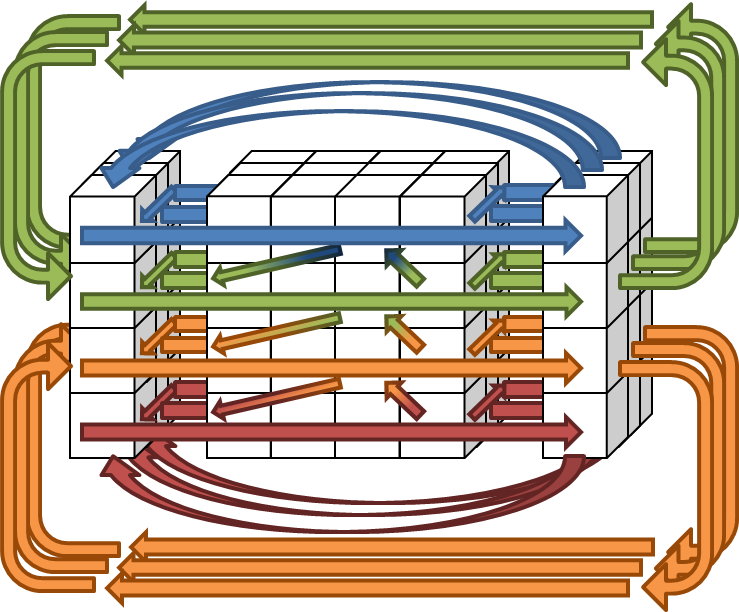
drEAmtime – EPIC SCAN

I continue to explore the great post from Ivo Velitchkov step-by-step, because his posts allow my thoughts to follow a red line. He pretty much eliminated a GLUE Disease in my very own head. Once again (and I will continue to say that till I reach the end of the red line) thank you for unplugging me.

So here again a quote from Ivo:

Big organizations in all sectors, especially in the service industries, tend to gather huge number of applications until they find themselves in a situation where there are far too many to manage. A good number of them are not used at all. Some other part is underutilized. Most of the critical applications have high maintenance or high replacement cost or both. Inevitably there are many which automate different parts of the same process but they don’t talk to each other. And this justifies new spending on building interfaces, or buying application integration packages first and then replacing them with BPMS and then probably with something better than BPMS. As a result – more spending and more applications to manage.

Ivo keeps continuing exploring that with some more statements, which all point to one specific problem: Unneeded complexity as the root cause of too high costs. Once again  a great observation and a situation I have also faced more than once (and most likely will face each and every day as long as I stay in Enterprise Architecture drEAmland. So what am I doing? Actually I am applying the EPIC SCAN approach to analyze the past (GLUE Defence).

  • Emergent Complexity – consequence of many small and unrelated decisions. (Ivo: “Inevitably there are many which automate different parts of the same process but don’t talk to each other”)
  • Perverse Complexity – consequence of clumsy attempts to reduce complexity. (Ivo: “And this justifies new spending on building interfaces, or buying application integration packages first and then replacing them with BPMS and then probably with something better than BPMS.”)
  • Irreducible Complexity – consequence of the real complexity of the demand environment. (Ivo touches this only between the lines: “Big organizations in all sectors […] tend to gather huge number of applications […]”)
  • Contrived Complexity – consequence of deliberately creation to benefit some stakeholders. (Ivo: “But as they rarely get to the cause of the inefficiencies or are in the position to influence the bigger system that produces these inefficiencies, the overall result is an oscillation or even increase in overall IT spending.”)

By analyzing the problem at hand with the EPIC SCAN approach I am able to create transparency and visibility on the root cause of the problem. And then it is (once again) all about communication and people to optimize the information flow and by that find the best fit-to-purpose solution.

It does help quite a lot, if you don’t panic and stop thinking to be an Enterprise Architect but start knowing that you are one. Remember, in the Enterprise Architecture Matrix you just have to let it all go, fear, doubt and disbelief. Free your mind.

As always over to you for commenting to help me improving my thinking and share as much knowledge as possible.

Four principles – 1: There are no rules

What rules do we need in enterprise-architecture? At the really big-picture scale? This is the second in a series of posts on principles for a sane society: Four principles for a sane society: Introduction Four principles: #1: There are no rules – only

Four principles for a sane society

How do we make sense of the big-picture in enterprise-architecture? The really big-picture? Yep, it’s that time of year again: the lead-up to the annual Integrated EA conference, where they allow me to go somewhat off-the-wall and present the current ‘big-idea’

The over-certainties of certification

A strange kind of annual ritual that they did there, that subtle ‘work-to-rule’, every year that I worked at that place. Each autumn, up would come the new crop of graduates, each with their shiny new graduation-certificate and their own

Enterprise-architecture and organisational health

My mother is a retired general-practitioner (family doctor), and still has the BMJ (British Medical Journal) delivered here each week. It’s always a useful contrast to my ‘day-job’ in enterprise-architecture, and every-now-and-then there’s a real jewel of an article there