The Open Group July Conference Emphasizes Value of Placing Structure and Agility Around Enterprise Risk Reduction Efforts

By Dana Gardner, Interarbor Solutions Listen to the recorded podcast here:  Dana Gardner: Hello, and welcome to a special BriefingsDirect Thought Leadership Interview series, coming to you in conjunction with The Open Group Conference on July 15 in Philadelphia. I’m … Continue reading

Achieving Universal Healthcare Interoperability by Algebra instead of System Integration – Solving Uncertainties in Large Complex System

For discussion on algebra behind Universal healthcare Interoperability :- Discussion by Dr. Barry Robson who has pioneered in computational biology; developed Quantitative Semantic Algebra to realize Probabilistic Ontology to solve large systems riddled by complexity and afflicted by uncertainties. http://www.linkedin.com/groupAnswers?viewQuestionAndAnswers=&discussionID=242195622&gid=3105178&commentID=138621684&goback=%2Eanp_3105178_1369067682268_1%2Eamf_3105178_69634045&trk=NUS_DISC_Q-subject&_mSplash=1 Difference between Algebra vs Arithmetic  Algebra vs Arithmetic On Tom Munnecke’s blog discussion Dear Chuck […]

How to build a Roadmap – Prioritize (Part II)

This post continues an earlier discussion about how to use the results from steps 1 – 3 to prioritize the actions we have identified to close the gap or difference (delta) from where we are to what we aspire to be. This is usually driven by evaluating the relative business value AND the technical complexity, plotting the results in a quadrant graph using an Action Priority Matrix. Other complimentary methods are discussed to help IDENTIFY what is feasible and what has the highest business value balancing business need with the capability to execute.

Are You Certifiable?

I am asked this far more than you might imagine. Often it is after I’ve recalled some obtuse nugget of information like, Q is the only letter that does not appear in the name of any U.S. State.

Over the course of my life, as the conditions have c…

The Key to a Successful ITAM Practice

 
The Elephant in the Room Few See
What is the single most important goal of IT Asset Management (ITAM)?  Providing the enterprise an Asset Repository comprised of all in-scope assets (“Complete”) and accurate asset information (“Accurate

Categories Uncategorized

Capabilities Demystified – Part 4

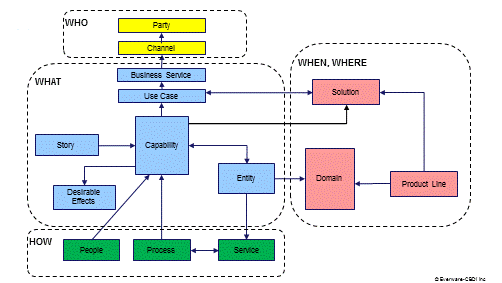
Applying Capabilities to Business Challenges Business capabilities have quickly become the core element of most business architecture models. Their appeal is driven largely by three factors. First, business leaders at all levels find capabilities an appealing and useful way to think about growing their organization’s impact. Second, capabilities are versatile, easily applied to high-level strategic […]

The 1st Belgian ArchiMate User Group Meeting

<p><span style=”color: rgb(80, 80, 80); font-size: 11px; line-height: 19px;”>Last week I was proud to chair the first Belgian </span><a href=”http://pubs.opengroup.org/architecture/archimate2-doc/” style=”font-size: 11px; line-height: 19px;”>ArchiMate</a><span style=”color: rgb(80, 80, 80); font-size: 11px; line-height: 19px;”> User Group meeting in Brussels, hosted by </span><a href=”http://www.itworks.be/” style=”font-size: 11px; line-height: 19px;”>IT Works</a><span style=”color: rgb(80, 80, 80); font-size: 11px; line-height: 19px;”>. With three good speakers and a group of about 30 participants, the meeting was a big success. Hopefully we will have many more of such sessions in the years to come. </span></p><p>In this short blogpost I’ll present some of the highlights from the session. Rather than attempting to summarize the excellent talks by Jan Casteels (AXA, ING), Geert Cannaerts &amp; Christof Nikolay (both HP), and Pieter van Ostaeyen (de Lijn), I’ll stick to presenting some of the highlights.</p><ul><li>A common element in each of the three stories is “business-focused analyses”. Or, to put it differently: we spoke a lot about the type of analyses we can do for various (business) stakeholders as well as creating powerful visualizations to support decision making.</li> <li>The three speakers each used different tools (including <a href=”http://archi.cetis.ac.uk/”>Archi</a>, <a href=”http://www.sparxsystems.com.au/”>Sparx</a>, and <a href=”http://www.bizzdesign.nl/tools/architect/”>BiZZdesign Architect</a>).  The consensus seemed to be that all tools work as long as the focus is on modeling / entry of concepts and relations. A “proper” tool like Architect is needed when the focus shifts to analyses (i.e., color views, label views, generating views and cross tables, roadmapping and so on)</li> <li>There was a lot of discussion about different levels of models. <ul><li>On the one hand this refers to the difference between “architecture” and “design” (i.e., growing attentions to linking architecture models at the enterprise level to process management, business rule management, and data management at the design level).</li> <li>It also appeals to the difference between three levels of abstraction: conceptual, logical, and physical models. A crisp and clear distinction between these levels is far from easy, yet it is important to at least distinguish (and create links) between a “conceptual/logical” model and a “physical” model of the enterprise</li> </ul></li> <li>Other topics that were briefly discussed include </li> <li>The use of reference models for re-use and a head-start in creating consistent models across the enterprise.</li> <li>Starting ArchiMate modeling projects from the bottom-up. That is: rather than shooting for a top-down, enterprise-wide initiative, we see more and more organizations where the first ArchiMate models are developed in projects. This has the added advantage of adding business value early, as well as establishing good practices in modeling from the start!</li></ul><p>After a good discussions, we also found several areas where more support and guidance would be useful for the ArchiMate community at large. These boil down to the following:</p><ul><li>Easy exchange of models between tools: we see that different stakeholders and groups of professionals require different types of tools. At some point the necessity to integrate these models / to upgrade to a full-blown EA tool like Architect arises. Being able to seamlessly switch between tools is important. After all, it is about the content, not the tool.</li> <li>In line with the discussion on different levels of models, more guidance on conceptual / logical / physical modeling as well as tool support (i.e., the use of dependency relations in BiZZdesign Architect) will help the community to deal with this issue consistently and effectively</li> <li>Last but not least: in many situations it would be valuable to be able to represent the modality of relations between concepts. This goes for “cardinality” of associations, but it goes further than that. Being able to represent the fact that “a process always uses a services” versus “a process may optionally use a service” can be equally important</li></ul><p> All in all a great session with plenty of tips, real-world stories, and suggestions for taking ArchiMate initiatives to the next level.</p>

Categories Uncategorized

Leadership Quotes

Here is a compilation of some quotes on leadership that I like.  It is far from being extensive … enjoy! “Real leaders know the difference between leading and commanding. Leading results in people wanting to follow your commands. Commanding results in people having to follow your leadership. Which of those two are most likely to […]

The post Leadership Quotes appeared first on Enterprise Architecture in Higher Education.

We do what you say we will do – Integrity By Architecture

One of the chief complaints of senior executives in midsize and large companies is that their organizations don’t “execute” on the goals that they set.  This concern is so common, it’s the butt of jokes.  Entire systems of governance and measurement are created specifically to provide assurance to senior execs so that they can maintain some level of public integrity.  Yet, when Enterprise Architects describe their roles to their peers, it is surprisingly rare to hear them talk about this issue.  That is a mistake.  Let’s talk about how to tell the story of Enterprise Architecture as the maintainer of executive integrity.

In 2003, when Motorola sent their CEO Chris Galvin packing, USA Today wrote about what a “good guy” he was:

He turned out to be a lackluster CEO, which, sadly, often seems to be the case when good guys land in the corner office. Friday, Motorola said Galvin would resign. Motorola under Galvin had suffered through six years of disappointing results, laid off one-third of its workforce, failed hugely on new ventures like Iridium, and waited for turnarounds that never happened. The board apparently had had enough; Galvin thought he’d better leave.

I have to say I feel bad for Galvin. Of course, I wasn’t a Motorola shareholder who watched the stock go from $60 (split-adjusted) in 2000 to about $11 last week. Nor am I a laid-off Motorola employee. And yes, Galvin was paid handsomely: $2.8 million in salary and bonus last year.

Did Galvin fail, or did Motorola fail to execute on Galvin’s strategy?  The board of Motorola, and the board of any company, won’t see a difference.  Note that this story has happened over and over in high-tech, from Steve Ballmer to Michael Dell, usually without the board firing their CEO.  Far from being limited to high-tech, stories abound of retailers (Best Buy), manufacturers (General Motors), and financial services companies (too many to name) that have suffered through strategies that failed to pay off.

Here’s what stockholders see: you said “X” would happen and it didn’t.  You lied. 

From their perspective, the CEO loses credibility for lack of integrity.

Integrity is a personality trait and a virtue.  A person has integrity when they can be trusted to perform exactly as they said that they would perform.  In other words, they “do what they said they would do.”  This person makes a commitment and keeps it.  This means that they make commitments that they are fairly sure that they CAN keep, and they don’t forget the commitments that they made.  In every high-performing team that I’ve been a part of, each member had a high level of integrity.  Integrity is key to developing trust.  If you do what you say you will do, people will trust you.

Executives need to develop trust just as much as individual contributors do.   For private for-profit organizations, those stakeholders own stock, and purchase the goods and services of the company.  For public organizations, those stakeholders are voters and legislators.  Where an individual contributor must earn the trust of his manager and his or her peers, an executive is in a very visible position.  They have to build trust daily. 

Building that trust requires that they make bold pronouncements about the things that the organization will do under their leadership… and then their organization has to perform those activities.  And that’s a key difference.  When an individual contributor says “I will do this,” they are talking about their own performance.  Rarely are individual contributors held accountable for failures of the people that they cannot control.  Executives, on the other hand, are not talking about their personal performance.  They are talking about the performance of the many (often hundreds, sometimes thousands) of people under them. 

An executive doesn’t actually “control” the people under him.  He or she must lead them.  Sure, there can be an occasional “public hanging” (as Jack Welsh used to encourage), but, for the most part, the executive’s ability to speak with integrity comes from the trust he has in his organization to perform.  In other words, how will with “they” correctly do what “I” said they would do?

Enterprise Architecture is a keeper of executive integrity

Enterprise Architecture is the only profession (that I know of) that is focused on making sure that the strategy announced by an executive actually comes to pass.  Enterprise Architects exist to make sure that the needed programs are created, and executed well, keeping in mind the end goals all along the way.  EA’s go where angels fear to tread: to execute strategies and produce the desired results if they can be produced. 

If you value executive integrity, EA is an investment worth making.