The title of my new blog post is provocative. Why would I ask such a question, especially after covering number of CIO surveys, trends, leading CIO thought leaders and underlining the strategic importance of IT in this very blog? I am asking this question because the IT Landscape as you and I know it, is changing and very fast. Even by IT industry standards the pace of recent developments is remarkable. The business technology is undergoing rapid evolution. And the central argument which I am presenting here is that the conventional role of CIO or CIO function as it stands today will either be ineffective, redundant or out-dated and hence not required by end of this decade. Let me explain…
There are a number of reasons and drivers for the rapid evolution of business technology. However according to me there are five major forces which are influencing this evolution. They are Business Services, Application Services, Business Analytics, Consumerisation of IT and Cloud Computing. I will try to explain them briefly
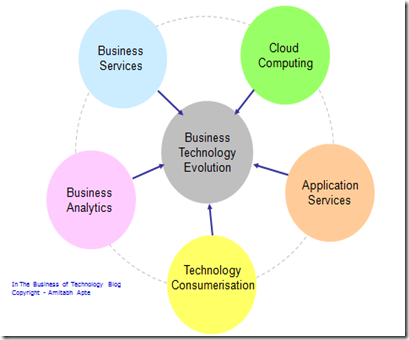
Rise of Business Services – Awareness of the fact that, “Organisations purchase technology to fulfil business needs” is growing like never before. Given economic challenges very few organisations can now justify technology investment for pure technology advantages. Your CEO, COO, CXO and CFO will be demanding “Return on Investment” (ROI) and “Value for Money” (VFM) from each technology $ invested and they will be demanding that most likely in year one. Days of five or even three year technology pay-back are certainly behind us. And this is where purchasing business services independent of large technology investment is becoming so attractive. There are a number of examples of this trend ranging from payment processing to HR processing. Google is taking business services to new dimensions.
A test question for you – If you are CEO of a mid-size organisation would you invest $5 Million in back office processing software, hardware, network, back-up, security etc.? Or would you sign up for business outcome based contract with niche business services supplier? I know your answer and mine is the same!
Maturing Cloud Computing Industry – Enough is written about benefits of Cloud Computing (including this blog) so I won’t repeat it. However it is safe to conclude that Cloud is more than hype. It is real and there is an entire industry being built around Cloud propositions by all major IT vendors as well as rising number of niche players. Cloud computing if adopted in right manner frees your organisation from capital intensive infrastructure and operations investments. The business justification will not be far different than arguments which I have listed above. Cloud computing however gives organisations added flexibility of building solutions to suit their requirements yet allows them to offload its capital and resource intensive aspects to infrastructure specialists. It can be easily argued that business services are a variant of cloud computing.
Another test question for you – You are a CFO of retail chain and you have a legacy retail management application. Your peak business transactions are expected only in the months of March, September and December but for all other months you operate at half the transactions of peak. Would you like to scale up and down the capacity and hence the cost of your retail application operations? I know your answer and mine is the same!
Business Analytics Coming of Age – A large number of small niche companies and even large companies like IBM and Oracle are investing millions of $ in developing and enhancing business analytics products and services and they are doing this for a very good reason. People like you and me (and multiply that number by millions of Indians and Chinese) are adapting to self-service shopping lifestyle. When was the last time you went into your bank branch? Or when was the last time you bought a book in a book shop? When was the last time you called your airline or visited its city booking office to purchase your airline tickets? I know your answer….we are more and more relying on smart, intuitive ecommerce sites, price comparison sites, shopping portals, kiosks, ATMs, etc. to buy everyday and occasional things of need and desire. The merchants are looking for smarter ways to know you, your preferences, your wish lists and keep your loyalty. This is true for brick and mortar businesses too by the way. And smart merchants are turning to business analytics to make more sense of their business transactions, shopping patterns, supplier dependencies, seasonality and thousands of other trends which affect their business.
Another test question for you – if you are a mid-size or small company COO running a brick and mortar plus an ecommerce portal for your business would you rely on your in-house MI experts to keep up with 1000s of changing patterns, equations, behaviours and trends? Or would you secure an external niche business analytics company to analyse tons of your business transactions, do the number crunching and present predictions for next quarter along with benchmarks? I know your answer and mine is not too different!
Popularity of Application Services – This may be very specific development but worth making a note of. You may recollect my earlier blog on ASOS and how smartly they are leveraging open access to their applications of catalogues. Apple App Store is another example of this model. These smart technology and business models are making middleware software, hardware and tools almost redundant by giving core access to application tier of your business systems. You suppliers and partners deliver direct to your application and data tier, why bother with message brokering? See my proposed revised retail reference architecture and you will know what I mean.
Let me not ask you a question but pass you my verdict on this one – No I don’t need an internal IT department to develop interface to launch my catalogue on Apple App Store. I will go to a niche small firm who will do it for me at fraction of cost to much better response times than internal development and test department.
Spread of Technology Consumerisation – Again enough is said about Apple ipad, Amazon Kindle, and Android smart-phones. The fact is if you are reading this you have either all of minimum one of them. And I know that you will prefer to carry your own ipad to work and do your office email, documents as well look for best place for Thurs after-work drinks on Google map on one of those boring conference calls. And if you organisation is not funding your smart-phone then you do not mind getting on an attractive tariff to join swelling ranks of smart mobile workers of next generation. I am not even mentioning Google Docs, Microsoft Office 365 and other similar offerings which liberate corporate IT.
You know where I am going next – If your data privacy and security concerns were addressed would you mind if your employees brought their own IT equipment to work? I would not if I am a CFO of a business which made loss of double digit last year and who do not understand why I pay three times for a desk top compared to retail cost of ipad!
To summarise my argument – given these very influential forces which are shaping the world of business technology and the fact that they are here and will be growing in their influence….and their strong commercial as well as functional advantages; how long before your conventional CIO function turns into out-dated, ineffective and irrelevant cost centre? If the trajectory of this evolution continues like this, will your organisation need a CIO by 2020? I know your answer and mine is very similar!

