Enterprise Agile: One Size Does Not Fit All

Guest post by Tim Mattix It’s no surprise that agile development software methods are quickly claiming ground over waterfall methods.  The linear waterfall model and its sequential design process run counter to the reality that customers often don’t know exactly what they want up-front; rather, they tend to fine-tune their requirements through ongoing two-way interactions during the life cycle of the project. On the other hand, the evolutionary development approach inherent in agile gives designers […]

The Power of Storytelling for Enterprise Architects

Last week I talked about the power of storytelling and how Enterprise Architects need to become effective communicators. This week I will continue to dig into the storytelling concept and how it can be used to help you communicate the value of Enterp…

Categories Uncategorized

CMDB Deployment: Where to start? – Part 1

Your company has finally come to the conclusion that Configuration Management is critical to effective service based operations. You’ve now been tasked with finding and deploying a Configuration Management Database solution. The question now is, wher…

Categories Uncategorized

Agile is not Dead, it’s Morphing

I note healthy discussion around whether Agile is Dead [ref 1]. And while I may sympathize (sic) with many of the comments, particularly the commercial trivialization of education, the core issue must surely be the difficulty of adopting de facto Agile practices to support real world enterprise programs and projects. My experience is most of the advice and guidance out there is predicated on scaling the de facto Agile development methods. And this isn’t the best place to start.

An exception is Dean Leffingwell’s SAFe, [ref 2] which does introduce the idea of portfolio, program and project perspectives and intentional architecture. I recommend this framework as an intelligent set of practices, but for me it doesn’t go far enough because it is still primarily about development practices. This is the core problem – that Agile is development specific and practices only. In the enterprise, Agile development needs to be an integral part of a bigger ecosystem spanning business design, architecture, requirements, modernization and operational transformation practices plus architecture, delivery and modernization disciplines.

I am indebted to Dave Thomas whose recent blog, [ref 1] includes a worthy successor to the Agile Manifesto, reducing the original, development specific values and principles to a minimalist, more generic set. He says; “here is how to do something in an agile fashion
Find out where you are
Take a small step towards your goal
Adjust your understanding based on what you learned
Repeat
And this is more useful in the enterprise context because it is relevant to a broader set of activities than purely software development.

The diagram below is an outline maturity model template for Agile in the enterprise. It suggests there are four key views that need to be part of the transformation.  In addition to agile practices we need to be equally focused on what elements of agile architecture are required for an enterprise. What the agile delivery framework is and how the existing application portfolio will be modernized to progressively eliminate the duplication and complexity present in every enterprise on the planet.
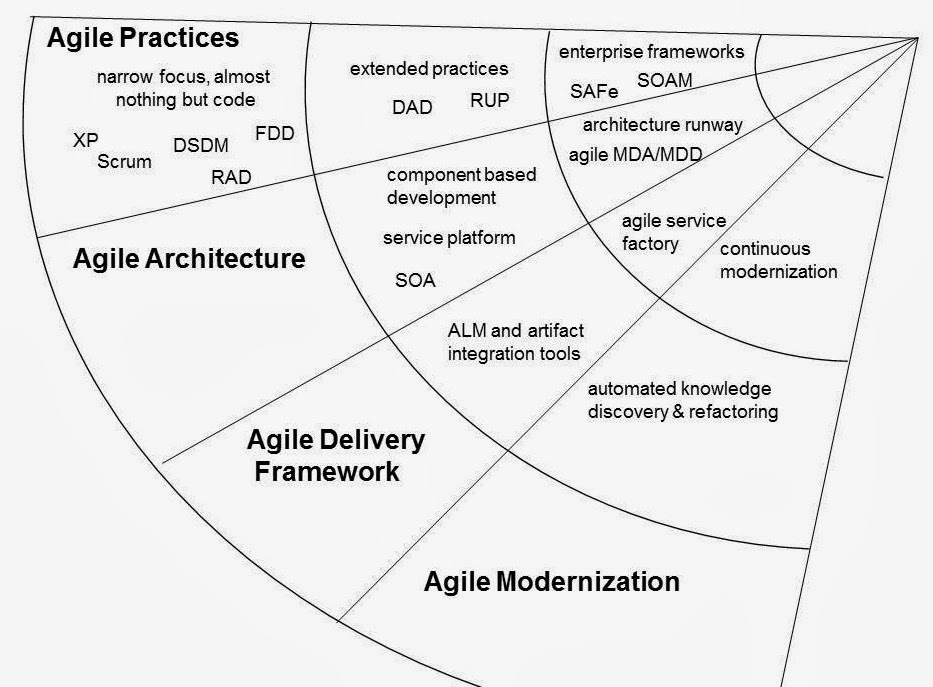
People & Process. Much of the dissatisfaction with Agile arises from the limitations of the basic Agile practices, and the need to compromise these in an enterprise context. Both DAD and RUP (yes it’s an iterative method) are examples of extended or hybrid practices that introduce coordination, phasing and other disciplines that are more acceptable in enterprises that require traceability, governance and compliance with pre-existing life cycle practices. Enterprise frameworks such as Leffingwell’s SAFe as discussed and Everware-CBDI’s SOAM are examples of frameworks that adhere more closely to the purity of Agile principles while addressing enterprise specific needs. SAFe provides a framework which is more strongly Lean, coordinating portfolio, program and project activity to meet agile release train demand. SOAM provides a complementary, full life cycle process framework for software service modernization and delivery.

Agile Architecture. There is a requirement to articulate the enterprise requirements for agility as a reference architecture for business agility. In today’s fast moving world core architecture for the business, services, implementations, technology and deployments needs to be:
under continuous development using Agile principles
derived from the assessment of business needs for response to change, and constantly updated to reflect competitive and technology opportunities and threats.
mapped to service architectures, patterns, policies and modernization strategies
modeled using MDA/MDD to allow delivery as consistent architecture runways for portfolio and demand management, programs and projects.

Agile Delivery Framework. Most enterprises have a well-defined delivery framework of tools, repositories, templates etc that are designed to support well established QA and delivery policies. This is one of the most common inhibitors that Agile projects in the enterprise have to  overcome. In an enterprise Agile context that framework must be realigned to provide maximum automation of life cycle management and governance so that key enterprise requirements for integrity can be met without loss of productivity. Similarly the development  activity must be structured so that developers can extend the architecture runway with business solution specific rules and behaviors in a managed fashion which preserves the integrity of the architecture. Everware-CBDI has pioneered this runway extension capability implemented as a model driven (MDA/MDD) capability in which the runway code is generated and provided to developers enabling very significant productivity gains in both forward engineering and even more so in iteration.

Agile Modernization.  Finally in an enterprise context the elephant in the room is the existing or legacy portfolio. Unless this elephant is addressed, the enterprise will continue to create more and more complexity, increase costs and reduce response times to change. What’s required is a discipline of continuous, Agile modernization. That means, using Dave Thomas’s minimalist manifesto [above] every portfolio item, program and project must include steps to find out the current situation and address minimum goals that reduce complexity and support a progressive modernization strategy. Without that, all enterprise Agile projects will remain narrow focus and simply add technical debt.

I suggest that while Agile is not dead in the enterprise it is certainly struggling to survive. This is because Agile practices alone will be suffocated at birth by enterprise realities of consistency and integrity; or turned into narrow focus, standalone projects; or morphed into BAU. I really don’t want to enter into a debate about nouns or verbs, life is too short.  IMO Agile has considerable momentum and it can be morphed into a ground breaking concept that delivers enterprise business agility.

References
1 Agile is Dead (Long Live Agility)
2 Dean Leffingwell SAFe

Agile is not Dead, it’s Morphing

I note healthy discussion around whether Agile is Dead [ref 1]. And while I may sympathize (sic) with many of the comments, particularly the commercial trivialization of education, the core issue must surely be the difficulty of adopting de facto Agile practices to support real world enterprise programs and projects. My experience is most of the advice and guidance out there is predicated on scaling the de facto Agile development methods. And this isn’t the best place to start.

An exception is Dean Leffingwell’s SAFe, [ref 2] which does introduce the idea of portfolio, program and project perspectives and intentional architecture. I recommend this framework as an intelligent set of practices, but for me it doesn’t go far enough because it is still primarily about development practices. This is the core problem – that Agile is development specific and practices only. In the enterprise, Agile development needs to be an integral part of a bigger ecosystem spanning business design, architecture, requirements, modernization and operational transformation practices plus architecture, delivery and modernization disciplines.

I am indebted to Dave Thomas whose recent blog, [ref 1] includes a worthy successor to the Agile Manifesto, reducing the original, development specific values and principles to a minimalist, more generic set. He says; “here is how to do something in an agile fashion
Find out where you are
Take a small step towards your goal
Adjust your understanding based on what you learned
Repeat
And this is more useful in the enterprise context because it is relevant to a broader set of activities than purely software development.

The diagram below is an outline maturity model template for Agile in the enterprise. It suggests there are four key views that need to be part of the transformation.  In addition to agile practices we need to be equally focused on what elements of agile architecture are required for an enterprise. What the agile delivery framework is and how the existing application portfolio will be modernized to progressively eliminate the duplication and complexity present in every enterprise on the planet.

People & Process. Much of the dissatisfaction with Agile arises from the limitations of the basic Agile practices, and the need to compromise these in an enterprise context. Both DAD and RUP (yes it’s an iterative method) are examples of extended or hybrid practices that introduce coordination, phasing and other disciplines that are more acceptable in enterprises that require traceability, governance and compliance with pre-existing life cycle practices. Enterprise frameworks such as Leffingwell’s SAFe as discussed and Everware-CBDI’s SOAM are examples of frameworks that adhere more closely to the purity of Agile principles while addressing enterprise specific needs. SAFe provides a framework which is more strongly Lean, coordinating portfolio, program and project activity to meet agile release train demand. SOAM provides a complementary, full life cycle process framework for software service modernization and delivery.

Agile Architecture. There is a requirement to articulate the enterprise requirements for agility as a reference architecture for business agility. In today’s fast moving world core architecture for the business, services, implementations, technology and deployments needs to be:
under continuous development using Agile principles
derived from the assessment of business needs for response to change, and constantly updated to reflect competitive and technology opportunities and threats.
mapped to service architectures, patterns, policies and modernization strategies
modeled using MDA/MDD to allow delivery as consistent architecture runways for portfolio and demand management, programs and projects.

Agile Delivery Framework. Most enterprises have a well-defined delivery framework of tools, repositories, templates etc that are designed to support well established QA and delivery policies. This is one of the most common inhibitors that Agile projects in the enterprise have to  overcome. In an enterprise Agile context that framework must be realigned to provide maximum automation of life cycle management and governance so that key enterprise requirements for integrity can be met without loss of productivity. Similarly the development  activity must be structured so that developers can extend the architecture runway with business solution specific rules and behaviors in a managed fashion which preserves the integrity of the architecture. Everware-CBDI has pioneered this runway extension capability implemented as a model driven (MDA/MDD) capability in which the runway code is generated and provided to developers enabling very significant productivity gains in both forward engineering and even more so in iteration.

Agile Modernization.  Finally in an enterprise context the elephant in the room is the existing or legacy portfolio. Unless this elephant is addressed, the enterprise will continue to create more and more complexity, increase costs and reduce response times to change. What’s required is a discipline of continuous, Agile modernization. That means, using Dave Thomas’s minimalist manifesto [above] every portfolio item, program and project must include steps to find out the current situation and address minimum goals that reduce complexity and support a progressive modernization strategy. Without that, all enterprise Agile projects will remain narrow focus and simply add technical debt.

I suggest that while Agile is not dead in the enterprise it is certainly struggling to survive. This is because Agile practices alone will be suffocated at birth by enterprise realities of consistency and integrity; or turned into narrow focus, standalone projects; or morphed into BAU. I really don’t want to enter into a debate about nouns or verbs, life is too short.  IMO Agile has considerable momentum and it can be morphed into a ground breaking concept that delivers enterprise business agility.

References
1 Agile is Dead (Long Live Agility)
2 Dean Leffingwell SAFe

New – EA training-course

Yep, I’ve finally Got Round To It: I’ve created a full set of materials for an EA training-course, building on the whole-of-enterprise approach that I’ve championed all of these years. (Whole-of-enterprise, that is, in contrast to the arbitrarily-constrained IT-is-the-centre-of-everything approach

OIOEA and QualiWare

The Danish government’s OIOEA framework and method is the de facto standard for the Danish state’s enterprise architecture practitioners. The OIO framework is today widely adopted across all tiers and levels of the Danish government. Various parts of the framework are also used outside government in private business sectors including the financial sector. The framework […]

QualiWare Center of Excellence

Farum, March 2014 For many enterprises operating in a dynamic market, it is a challenge to keep employees up to date on the latest research, the latest technology and the latest trends and hype. The enterprise’s agility, innovation and growth is at risk, and for the individual, the competition from colleagues, outsourcing agents and offshoring […]

Software is disrupting Industries: are you Trendwatcher or Trendsetter?

A couple of months ago I was keynote speaker at an event about modern application development environments. Here are the slides and a brief abstract. Software is disrupting industries. Startups are changing the playing field. This trend is only speeding up. Existing companies struggle to deal with this. It feels like their IT is stuck in groundhog day. They need to radically change how they manage application lifecycles to get.

The post Software is disrupting Industries: are you Trendwatcher or Trendsetter? appeared first on The Enterprise Architect.

The CIO’s Role in the Internet of Things

In our soon-to-be-released Digital IQ survey of over 1,400 business and technology executives, 20% of respondents say they plan to invest in sensors. We feel confident in predicting that the Internet of Things (IoT) or the Internet of Everything will finally begin to take off this year, as futurists have forecasted for years. What remains to be seen is whether or not CIOs will win their rightful place in product design planning and the development […]

Four Skills for the 21st Century Leader

A couple of weeks ago, Accelare collaborated with Penn State and Gartner Research to produce a 3 ½ day executive education workshop entitled “Enterprise Transformation and Integration: Beyond IT/Business Alignment”. One of most interesting presentations was by Al Vicere, Executive Education Professor of Strategic Leadership for The Smeal College of Business on the 21st century […]