Danish metamodels

My Danish friends @gotze and @aojensen comment on the latest release of OIO EA, which is a national enterprise architecture framework and meta-model published by the Danish Government Agency for Digitization.

Both John and Anders feel that certain key artefacts have been placed at the wrong layer of abstraction. John writes

“In my view, Business Rules should not be located at the strategic level at all. I would argue that Business Rules primarily “belongs” to the Business sub-architecture domain.”

What is the basis for this argument? Anders points out a consequence

“business rules are located in the government strategy layer and thus tightly coupled to the long term vision of the government agency”

“Business rules are operationalisations of the long term strategy and strategic intent.
Whilst the vision, mission, and purpose of the enterprise do not change very often (i.e. provide the best available services our citizens), the business rules and processes involved in realising this will definitely change.”

and therefore

“Business rules belong in the business architecture.”

Thus Anders is basing his argument on a statement about the frequency of certain classes of change.

This statement appears to be empirically testable, although I know from my own experience that it is a lot difficult than one might think to gather data to test this kind of statement.

Part of the problem of measuring rates of change is that we don’t have a particularly robust theory of change in the first place. Let’s look at an example. From time to time, perhaps every year, Steve Ballmer restates the vision of Microsoft. Obviously he doesn’t use exactly the same words every year. And of course Microsoft-watchers will seek to interpret even the slightest change of wording or emphasis as a sign of a strategic change in direction. So even if Ballmer himself insists that the vision hasn’t changed, we might not believe him. Looking back in time, we might find that major changes in direction had already been hinted at in previous years. So at what point does an apparently minor change in wording become a substantially new vision?

Conversely, when a company has been exposed as unethical, the CEO will go public with an apology and an assertion of a new ethical vision. (Recent example: Barclays Bank.) We might not believe him either.

In both cases, we will probably judge whether there is a new vision or not by observing whether the company behaviour and rules changes or not. (And this is not just external observers – Microsoft and Barclays employees and managers are also making these judgements.) So the rate of change of vision might be epistemologically indistinguishable from the rate of change of behaviour.

However, despite the difficulties in conceptualizing and measuring change, I think it does make sense to derive architectural layers from the idea that certain things have a characteristic rate of change, and that things with a different rate of change should be in different layers. This means that there is at least a possibility of subjecting an architecture to empirical evaluation. I have published this idea in articles for the CBDI Forum, and suggested that architectural theory needs to be based on the Pace Layering principle

In contrast, Anders’ appeal to the IAF seems to be purely an argument from authority. The IAF establishes some “fundamental” categories, and so any framework that deviates from these categories must be wrong. I think this line of argumentation is weaker. Even though you may assert some attractive consequences of following IAF, I cannot see any reason for believing that these consequences follow only from IAF and not from any rival framework.

Frameworks and categories may be embedded in metamodels. But how do we know what is the basis for choosing between alternative metamodels?

John Gøtze, Metamodels (January 2013)
Anders Ø. Jensen, Enterprise Architecture and abstraction layers (February 2013)

Ethics, Barclays and totalitarianism (Catholic Commentary January 2013)
Barclays boss tells staff ‘sign up to ethics or leave’ (BBC News January 2013)
Did Barclays suffer an Ethics Meltdown? (CSR Zone, July 2012)
Sure Kamhunga, Barclays to re-examine its core values(October 2012)
Naven Johal, Barclay’s Does Something Right! (January 2013)

Updated 29 April 2013

Attack of the Vegan Zombie Business Cases

The Business Analyst and the Project Manager have yet another impossible timeframe forced upon them, which they accept.  Faced with the prospect of losing the confidence of their Project Sponsor, they somehow manage to squeeze out their Business Case.  The Business Case is such a success that they circulate it to the usual suspects for […]

Managing Business Transformation

Just putting together the material for my new workshop next week.

This is the third day of my Business Architecture series. The first two days cover the six business architecture viewpoints. The idea is that people can tale these separately or together.

Day One – Modelling Business Operations 
Exploring process quality issues using the Activity Viewpoint, Knowledge (Information) Viewpoint and Motivation (Purpose) Viewpoint.

Day Two – Modelling Business Organization 
Exploring business relationships and strategy, using the Capability Viewpoint, Responsibility (Organizational) Viewpoint and Cybernetic Viewpoint.

Day Three – Managing Business Transformation 
Process guidelines and roadmap for business architects to analyse and manage structural change in large complex organizations.

Read more »

Metamodels

The Danish Agency for Digitisation has announced some coming updates of the national enterprise architecture framework and reference models. In a consultation draft about these, Et fælles overblik, the agency also introduces the OIO EA metamodel. The consultation also involves an update to STORM, the Service and Technology Reference Model. All documents are in Danish. Interested parties can submit comments to the agency until 14 …read more

Leveraging Roadmaps to Link Business and Technology

Enterprise Architects have used roadmaps as a standard model to describe the transition from the current state architecture to the future state architecture.   Many of my fellow enterprise architects have described the many different ways to create a roadmap and to show how they link to an organization’s strategic goals.  Nick Malik (@nickmalik) wrote […]

The post Leveraging Roadmaps to Link Business and Technology appeared first on Enterprise Architecture in Higher Education.

Understanding Business Services 2

In December 2006 I blogged on the topic of Explaining SOA to the Business Audience. It started out “I note resurgent interest in LegoTM blocks as a metaphor for explaining to the business audience the value of SOA. My advice is don’t treat the business audience as dummies!” The blog goes on to explain business services using the Laundry metaphor, and how business people get the concept because they understand “services”.

However, while my explanation was and remains perfectly OK, I will be the first to admit that I have moved on. The basic service model works perfectly, but in today’s fast moving, business innovating world, we need new vocabulary that is even more compelling, that goes beyond SOA and transactional efficiency.  

In their book Competing for the Future [1], Gary Hamel and C. K. Prahalad advise that traditional business responses to market and competitive pressure such as reengineering, downsizing and outsourcing are inadequate and insufficient. The outcome of this activity is typically just keeping one step ahead of declining margins and profits of yesterday’s business. Instead senior management need to get off the treadmill of restructuring and reengineering and instead reinvent their industry, imagining and creating their future.

What I didn’t say in 2006 was that you don’t reinvent an industry by analyzing business processes! The business process is “how” the enterprise works. Instead we need to be looking at “what” the business is – business services, the external, composite offering that enables core capabilities to be used in many different contexts. We need to elevate the concept of Business Service to the level of business offering and business product that externalizes the enterprise capability. I suggest simple definitions as follows:

Business Service: A service provided by an enterprise to its ecosystem of customers, suppliers or partners that provides one or more capabilities that facilitate a discrete business outcome according to a contract.  Example: Amazon EC2 
Business Service Operation: An execution of one or more capabilities provided by an enterprise to its ecosystem of customers, suppliers or partners according to a service contract. Example: Data load under Amazon EC2.

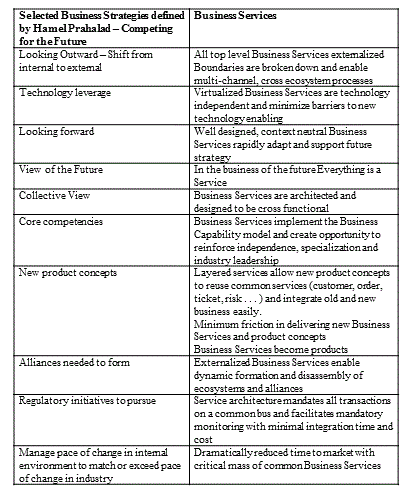
In Table below I have summarized some of the Hamel Prahalad strategies and shown how these are implemented as Business Services.

Hamel and Prahalad go on to pose the question, “Why did it take US automakers 40 years to decode the principles of lean manufacturing pioneered by Toyota?” Answer – because those principles challenged the core assumptions of US auto executives.

I suggest we need to establish a business centric perspective of Business Service that is as closely linked to business offering implementation as it is to the internal SOA. This will cause us to challenge some of our core principles and assumptions. It’s NOT about LegoTM, it’s about business services and business agility.
[1] Gary Hamel and C. K. Prahalad , Competing for the Future, published by Harvard Business School Publishing, Reprint 1996