5 Cyber Security Benefits Of Application Modernization
Application modernization is about more than just a one-off cloud migration. Discover five ways updating your application portfolio can cut your cyber security risk.
Aggregated enterprise architecture wisdom
Application modernization is about more than just a one-off cloud migration. Discover five ways updating your application portfolio can cut your cyber security risk.
Agile is still alive and well and in demand, according to Forrester’s Agile adoption panel. This year, our biannual survey tracking the health of Agile initiatives focused on the main challenge: Agile at scale. As software teams get further along their…
These days every company is in the software business. Fast, iterative delivery of high-quality software means better customer engagement and higher satisfaction, so an effective development organization is more important than ever. But in 2018 software…
I was fortunate to participate in a historic morning gathering last week at the White House! Industry-leading private sector CIOs discussed and shared their technology business management (TBM) best practices, approaches, and ideas with CIOs and technology leaders of federal agencies. The White House leader for strategic initiatives kicked off the morning by setting expectations […]
I was amused this week to be contacted by Researchgate, a syndication platform that have somehow republished my paper Enterprise resource planning: Componentizing the enterprise application packages that was originally published in April 2000 by the ACM. [ref 1] It was entertaining reading something I authored over 15 years ago, but quite refreshing that much of the thinking makes sense today. The gist of the paper was to discuss how some of the package vendors had responded to the impending Y2K event by componentizing and service enabling their packages, many of which at that time were exemplars of the worst monolithic application architecture (sic). At that time I observed that the componentization was a key factor in the huge growth of the EAI (enterprise application integration) market, and provided a genuine alternative to the conventional “buy or build” choice by enabling “buy, build or reuse”.
And this is really where my thinking has evolved considerably. Fifteen years ago we were very focused on transactional systems with a much lower requirement for flexibility. Today, and indeed for the past decade, I advise a radically different approach which is much more strongly business focused.
All too often the big question that bubbles to the surface is “should we buy or build?” And not surprisingly the buy option is often seen as an easier option because current systems are viewed as problematic and the organization has little or no competence in large scale systems development. In fact, for many organizations that have outsourced IT, development is not seen as a core business capability. So the question of buy or build becomes focused on whether a suitable package exists at an affordable price, where suitable means “supports our processes and information needs as we understand them today”. And package vendors are well equipped to demonstrate how they have readymade and low risk capabilities that have high levels of configurability.
These days I advise a focus on just two important questions:
“We tend to think the strong will survive, but a virus is a very small thing that kills big things.” Horace Dediu, Clayton Christensen Institute, speaking about the fall of Nokia.
All enterprises, be they large or small, national or multinational, commercial or government agency, American or Chinese, Japanese or European, are carrying the dead weight of their history and almost certainly continuing to add unnecessary complexity and excessive cost that will progressively reduce effectiveness, with the potential to trigger existential crises. Newer enterprises including Internet platform and Cloud based companies are not immune from this effect. As Horace Dediu has commented, Nokia is a classic case of a large enterprise brought from market leadership to irrelevance and zero value in an extremely short space of time.
In the past, modernization has become synonymous with technically related “application modernization” The term “modernization” is commonly used to refer to information systems, applications and technologies. And it is very common for systems or applications to be “modernized” because a technology has come to the end of its life, or an application is so antiquated that it cannot support newer business process patterns such as multi-channel and mobile. More generally organizations clearly implement modernizing programs without necessarily using the modernizing name. For example transformation programs or projects will often involve considerable elements of modernization. Similarly adoption of Agile methods may be considered a form of process modernization. Or the introduction of DevOps practices, enterprise architecture, master data management, life cycle management etc. But it is notable that each of these forms of modernization are discipline centric. It is very rare for an enterprise to undertake concerted effort to understand what modernization really means for a specific enterprise and to plan and execute modernization that delivers inter-discipline collaboration in support of specific modernization objectives and goals.
Each enterprise has unique modernization needs. A bank may see a primary modernization goal to establish core banking systems that reduce the risk of negative customer impact, such as delays or errors in transaction processing. Also to be able to introduce price and product change in days or weeks. A healthcare company may similarly see the requirement to change prices rapidly but equally the need to rapidly implement new legislation. A retail enterprise may see the ability to interact with customers using processes that span multiple technology, shopping and delivery channels, and to be able to influence the customer decision making process to achieve maximum customer satisfaction. A key element apparent in all these modernizing goals is that modernization is not about achieving a new plateau of capability and functionality. Rather it is about enabling continuous, short cycle time response to change, targeted at the very specific areas that are mission critical for the individual enterprise.
The problem with modernization is that it is widely perceived as slow, very expensive and high risk because the core business legacy systems are hugely complex as a result of decades of tactical change projects that inevitably compromise any original architecture. But modernization activity must not be limited to the old, core systems; I observe all enterprises old and new, traditional and internet based delivering what I call “instant legacy” [Note 1] generally as outcomes of Agile projects that prioritize speed of delivery over compliance with a well-defined reference architecture that enables ongoing agility and continuous modernization.
What’s required is a modernization approach and strategy that progressively breaks out business and technology components that establish highly independent units of business capability that comply with a reference model and architecture that ensures architecture agility and implements clear fire breaks between the components.

But as discussed, enterprises are extremely reluctant to undertake modernization as they see it as all cost and risk. Transformation projects are widely viewed in the same way. And anyway immediate business priorities always trump housekeeping!
There are various aspects to a successful modernization approach. But the most important are:
1. Define Agility Vectors. Identify the top priorities for business agility and integrate relevant actions into all business projects. Here are some examples:
a. Radical improvement (time and cost) in response to legislative change
b. Generalization of existing capabilities to support new products and services
c. Dramatic reduction in new product time to market
d. Integration of existing capabilities to leverage disparate channels
e. Separation of common and customer/channel specific capabilities
I refer to these as “vectors”. Mission critical goals that will require actions and change right across the organization. Single projects are generally not going to cut it. Therefore the vectors provide a mechanism to exert influence (demand shaping) over the incoming application demand management pipeline and to select and coordinate multiple project actions.
2. Mandate Reference Architecture for Agility. Establish a reference architecture for business agility that defines the minimum necessary architecture compliance to ensure continuous business evolution. Mandate that all core business capabilities are implemented as software services and components.
3. Integrate Agile Architecture AND methods. Implement Agile practices that give equal weight to agile architecture and agile project delivery. Demonstrate small, incremental delivery steps, business capability by capability, service by service.
4. Govern business agility. Automate governance by establishing model driven architecture and development tooling that ensures compliance with the reference architecture.
5. Integrate Business and IT. Practice conceptual business modelling to establish common business and IT vocabulary independent of existing applications, align business and software services and reengineer the organization around business capabilities and services.
6. Get top level sponsorship for the Enterprise Modernization Roadmap. Recognize enterprise modernization as a major business priority and elevate to the highest levels of the enterprise to make it happen.
The enormous, disruptive creativity of Silicon Valley is transforming how companies make decisions, store data, reach potential customers, outsource activities, processes and capabilities, and how people communicate, make friends, protest and shop. No enterprise is immune from this effect.
Accordingly, modernization today means reinventing the way enterprises work, the business model and systems, and being genuinely agile. You only do this by ripping up today’s world and turning it into a genuinely flexible structure of independent components that can flex and morph continuously.
Application Modernization should be long dead and buried. Enterprise Modernization is an existential priority for all enterprises, not just those with mainframes and COBOL!
“We tend to think the strong will survive, but a virus is a very small thing that kills big things.” Horace Dediu, Clayton Christensen Institute, speaking about the fall of Nokia.
All enterprises, be they large or small, national or multinational, commercial or government agency, American or Chinese, Japanese or European, are carrying the dead weight of their history and almost certainly continuing to add unnecessary complexity and excessive cost that will progressively reduce effectiveness, with the potential to trigger existential crises. Newer enterprises including Internet platform and Cloud based companies are not immune from this effect. As Horace Dediu has commented, Nokia is a classic case of a large enterprise brought from market leadership to irrelevance and zero value in an extremely short space of time.
In the past, modernization has become synonymous with technically related “application modernization” The term “modernization” is commonly used to refer to information systems, applications and technologies. And it is very common for systems or applications to be “modernized” because a technology has come to the end of its life, or an application is so antiquated that it cannot support newer business process patterns such as multi-channel and mobile. More generally organizations clearly implement modernizing programs without necessarily using the modernizing name. For example transformation programs or projects will often involve considerable elements of modernization. Similarly adoption of Agile methods may be considered a form of process modernization. Or the introduction of DevOps practices, enterprise architecture, master data management, life cycle management etc. But it is notable that each of these forms of modernization are discipline centric. It is very rare for an enterprise to undertake concerted effort to understand what modernization really means for a specific enterprise and to plan and execute modernization that delivers inter-discipline collaboration in support of specific modernization objectives and goals.
Each enterprise has unique modernization needs. A bank may see a primary modernization goal to establish core banking systems that reduce the risk of negative customer impact, such as delays or errors in transaction processing. Also to be able to introduce price and product change in days or weeks. A healthcare company may similarly see the requirement to change prices rapidly but equally the need to rapidly implement new legislation. A retail enterprise may see the ability to interact with customers using processes that span multiple technology, shopping and delivery channels, and to be able to influence the customer decision making process to achieve maximum customer satisfaction. A key element apparent in all these modernizing goals is that modernization is not about achieving a new plateau of capability and functionality. Rather it is about enabling continuous, short cycle time response to change, targeted at the very specific areas that are mission critical for the individual enterprise.
The problem with modernization is that it is widely perceived as slow, very expensive and high risk because the core business legacy systems are hugely complex as a result of decades of tactical change projects that inevitably compromise any original architecture. But modernization activity must not be limited to the old, core systems; I observe all enterprises old and new, traditional and internet based delivering what I call “instant legacy” [Note 1] generally as outcomes of Agile projects that prioritize speed of delivery over compliance with a well-defined reference architecture that enables ongoing agility and continuous modernization.
What’s required is a modernization approach and strategy that progressively breaks out business and technology components that establish highly independent units of business capability that comply with a reference model and architecture that ensures architecture agility and implements clear fire breaks between the components.
But as discussed, enterprises are extremely reluctant to undertake modernization as they see it as all cost and risk. Transformation projects are widely viewed in the same way. And anyway immediate business priorities always trump housekeeping!
There are various aspects to a successful modernization approach. But the most important are:
1. Define Agility Vectors. Identify the top priorities for business agility and integrate relevant actions into all business projects. Here are some examples:
a. Radical improvement (time and cost) in response to legislative change
b. Generalization of existing capabilities to support new products and services
c. Dramatic reduction in new product time to market
d. Integration of existing capabilities to leverage disparate channels
e. Separation of common and customer/channel specific capabilities
I refer to these as “vectors”. Mission critical goals that will require actions and change right across the organization. Single projects are generally not going to cut it. Therefore the vectors provide a mechanism to exert influence (demand shaping) over the incoming application demand management pipeline and to select and coordinate multiple project actions.
2. Mandate Reference Architecture for Agility. Establish a reference architecture for business agility that defines the minimum necessary architecture compliance to ensure continuous business evolution. Mandate that all core business capabilities are implemented as software services and components.
3. Integrate Agile Architecture AND methods. Implement Agile practices that give equal weight to agile architecture and agile project delivery. Demonstrate small, incremental delivery steps, business capability by capability, service by service.
4. Govern business agility. Automate governance by establishing model driven architecture and development tooling that ensures compliance with the reference architecture.
5. Integrate Business and IT. Practice conceptual business modelling to establish common business and IT vocabulary independent of existing applications, align business and software services and reengineer the organization around business capabilities and services.
6. Get top level sponsorship for the Enterprise Modernization Roadmap. Recognize enterprise modernization as a major business priority and elevate to the highest levels of the enterprise to make it happen.
The enormous, disruptive creativity of Silicon Valley is transforming how companies make decisions, store data, reach potential customers, outsource activities, processes and capabilities, and how people communicate, make friends, protest and shop. No enterprise is immune from this effect.
Accordingly, modernization today means reinventing the way enterprises work, the business model and systems, and being genuinely agile. You only do this by ripping up today’s world and turning it into a genuinely flexible structure of independent components that can flex and morph continuously.
Application Modernization should be long dead and buried. Enterprise Modernization is an existential priority for all enterprises, not just those with mainframes and COBOL!
Subhead: Modernization is NOT Optional!
Once again customers of The Royal Bank of Scotland (RBS) and its subsidiaries Ulster, Natwest etc are in trouble! Unable to use their debit cards, or access their funds! And the new Chief Executive Ross McEwan admitted today that RBS has failed to invest properly in its systems for decades! RBS has given no explanation of the crash, except that it was not related to the high volumes of transactions on Cyber Monday.
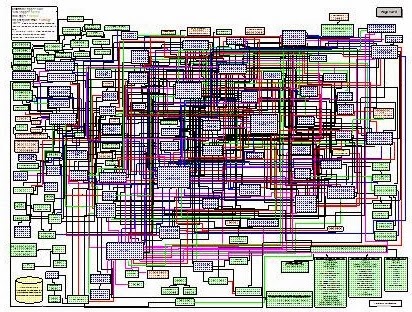
Actually the root problem for RBS, and many other banks and other very large organizations, is NOT that they haven’t invested in their systems for decades. The problem is that they have allowed the systems to evolve without good architecture and governance. Banking systems in particular used to be leading edge. But over the years the core systems that actually run the bank, have become badly out of date. Instead of modernizing the core systems, many banks have responded to demand for new products and services by surrounding the old legacy systems with new bolt on systems. As a result the old systems are held together with sticky tape and sealing wax, and modified piecemeal to adjust to new requirements, and the new systems create more and more interfaces and dependencies (including duplicated, hard coded business rules), so that eventually the systems resemble a hair ball. And as you know, a hairball is a tightly packed cylinder of fur, which also includes all manner of foreign particles, which can be quite hazardous in humans and animals. In systems terms we would more usually refer to the resulting mess as a monolithic systems portfolio.
The root problem therefore is twofold:
1. The increasing complexity and risk inherent in making change.
2. Increasing horizon of any change.
And the issues become apparent either when extremely complex operational processes execute incorrectly, or when changes in process, software or environment are made, often unavoidably without full knowledge of all the implications due to lack of experience, documentation or even code!
Although I have no doubt that in all the large banks there are fierce debates about the IT budget, strangely the solution to this problem isn’t about the amount of money that needs to be spent. Rather it’s about how the organization embraces a real modernization program, which is led by good architecture and managed with strong governance.
Sadly in the IT industry the term modernization has come to mean something quite specific – the re-platforming or technology upgrade of some application. Whereas modernization should really encompass a much broader remit including:
1. Establishing a lingua franca between business and IT so that modernization issues and implications are genuinely understood by both business and IT management.
2. Defining a business systems architecture that a) facilitates transformation with low risk and b) progressively develops an inherently agile architecture, that can evolve continuously.
3. A roadmap for progressively rationalizing the business systems portfolio to comply with the architecture.
4. Implementing an integrated business and IT organization that owns the business systems.
5. Implementing knowledge management around business systems that ensures integrity and consistency and ownership of processes, information and rules.
6. Implementing a continuous Agile modernization and ongoing evolution process in both business and IT.
7. Establishing coordination, governance and risk management that ensures architectural integrity at all stages of the life cycle.
It would be easy for business management to think that the sort of problems experienced by RBS and other banks as IT problems. The above list suggests this is nonsense. The only way to properly resolve the issues is for business management to accept co-responsibility for IT. And it’s no accident that the first point in the list above is to ensure that business management understand the issues they are dealing with, and can communicate effectively with the IT organization. This isn’t just attending an education class; it’s embracing a common language that allows critical decisions to be taken on a properly balanced understanding of business and IT assumptions, costs and risks.
Retailers, manufacturers, power companies, logistics companies, government departments etc etc should not be complacent or smug when they see the problems at the banks. In fact almost all very large organizations have these problems. And the message for all enterprises is Modernization is not Optional!
Links:
RBS Crash – Management Prefer Offshoring to Modernization?
CBDI Journal Reports on Modernization
Subhead: Modernization is NOT Optional!
Once again customers of The Royal Bank of Scotland (RBS) and its subsidiaries Ulster, Natwest etc are in trouble! Unable to use their debit cards, or access their funds! And the new Chief Executive Ross McEwan admitted today that RBS has failed to invest properly in its systems for decades! RBS has given no explanation of the crash, except that it was not related to the high volumes of transactions on Cyber Monday.
Actually the root problem for RBS, and many other banks and other very large organizations, is NOT that they haven’t invested in their systems for decades. The problem is that they have allowed the systems to evolve without good architecture and governance. Banking systems in particular used to be leading edge. But over the years the core systems that actually run the bank, have become badly out of date. Instead of modernizing the core systems, many banks have responded to demand for new products and services by surrounding the old legacy systems with new bolt on systems. As a result the old systems are held together with sticky tape and sealing wax, and modified piecemeal to adjust to new requirements, and the new systems create more and more interfaces and dependencies (including duplicated, hard coded business rules), so that eventually the systems resemble a hair ball. And as you know, a hairball is a tightly packed cylinder of fur, which also includes all manner of foreign particles, which can be quite hazardous in humans and animals. In systems terms we would more usually refer to the resulting mess as a monolithic systems portfolio.
The root problem therefore is twofold:
1. The increasing complexity and risk inherent in making change.
2. Increasing horizon of any change.
And the issues become apparent either when extremely complex operational processes execute incorrectly, or when changes in process, software or environment are made, often unavoidably without full knowledge of all the implications due to lack of experience, documentation or even code!
Although I have no doubt that in all the large banks there are fierce debates about the IT budget, strangely the solution to this problem isn’t about the amount of money that needs to be spent. Rather it’s about how the organization embraces a real modernization program, which is led by good architecture and managed with strong governance.
Sadly in the IT industry the term modernization has come to mean something quite specific – the re-platforming or technology upgrade of some application. Whereas modernization should really encompass a much broader remit including:
1. Establishing a lingua franca between business and IT so that modernization issues and implications are genuinely understood by both business and IT management.
2. Defining a business systems architecture that a) facilitates transformation with low risk and b) progressively develops an inherently agile architecture, that can evolve continuously.
3. A roadmap for progressively rationalizing the business systems portfolio to comply with the architecture.
4. Implementing an integrated business and IT organization that owns the business systems.
5. Implementing knowledge management around business systems that ensures integrity and consistency and ownership of processes, information and rules.
6. Implementing a continuous Agile modernization and ongoing evolution process in both business and IT.
7. Establishing coordination, governance and risk management that ensures architectural integrity at all stages of the life cycle.
It would be easy for business management to think that the sort of problems experienced by RBS and other banks as IT problems. The above list suggests this is nonsense. The only way to properly resolve the issues is for business management to accept co-responsibility for IT. And it’s no accident that the first point in the list above is to ensure that business management understand the issues they are dealing with, and can communicate effectively with the IT organization. This isn’t just attending an education class; it’s embracing a common language that allows critical decisions to be taken on a properly balanced understanding of business and IT assumptions, costs and risks.
Retailers, manufacturers, power companies, logistics companies, government departments etc etc should not be complacent or smug when they see the problems at the banks. In fact almost all very large organizations have these problems. And the message for all enterprises is Modernization is not Optional!
Links:
RBS Crash – Management Prefer Offshoring to Modernization?
CBDI Journal Reports on Modernization
Do you remember when computers were hard to use? In fact it’s just nine years since a GM press release asserted that if they developed technology like Microsoft, we would all be driving cars that for no reason at all, would crash twice a day, shut down and refuse to restart. Since then Apple has showed Microsoft the way, and we all use smart phones, tablets and PCs that are genuinely easy to use and remarkably resilient.
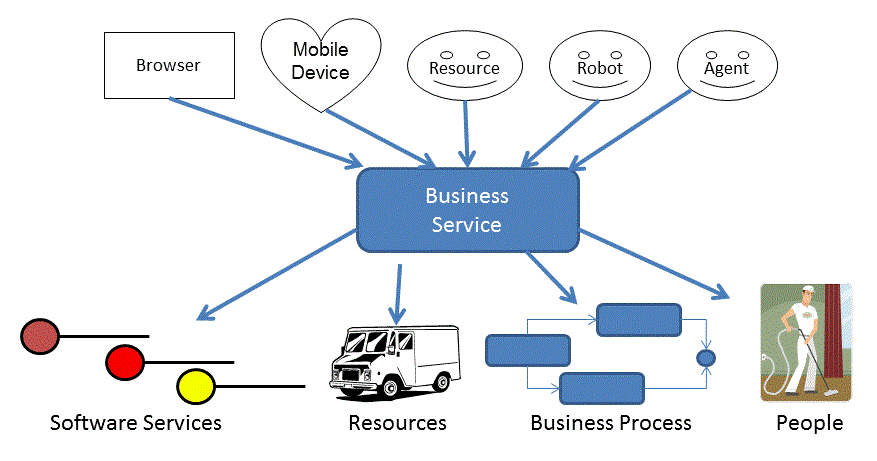
Using a common business and IT concept permits sensible analysis of whether a service is just a unit of cost, or what the strategic value is now and in the future, and what it adds to the business value chain. Given so many line-of-business managers are thoroughly familiar with the very high technology in their smart phones and other devices, it really is time for IT to treat the business as a mature partner and for the line-of-business manager to take real responsibility for the business service as a whole product.
When you slump into your aircraft seat you don’t give a seconds thought to whether the aircraft is properly maintained. Same on the Eurostar or TGV, and you don’t worry either about the air traffic control systems or the railway signalling systems. We …