The Open Group Conference to Emphasize Healthcare as Key Sector for Ecosystem-Wide Interactions

By Dana Gardner, Interarbor Solutions Listen to the recorded podcast here:  Dana Gardner: Hello, and welcome to a special BriefingsDirect Thought Leadership Interview series, coming to you in conjunction with The Open Group Conference on July 15, in Philadelphia. Registration … Continue reading

Using the “Wheel of Change” to justify Business Architecture

It’s not about the methods, it’s not about models, it’s not about the tools – it’s about having the ability to make smarter decisions. Those decisions might be related to improving business operations or processes, undertaking significant business transformations, merging organizations, or any one of the hundred and one other projects that we seem to need to deliver by yesterday!

Related posts:

  1. Impacting Business with Enterprise Architecture: What the Future Holds for EA Efforts Cliché as it may be, I can’t stop myself from…
  2. Who Drives an Enterprise Architecture Initiative? Who drives an enterprise architecture initiative? Does it come from…
  3. The Road Ahead for Enterprise & Business Architecture With a new year upon us it’s always exciting to…

Related posts brought to you by Yet Another Related Posts Plugin.

The Open Group Sydney – My Conference Highlights

By Mac Lemon, MD Australia at Enterprise Architects Well the dust has settled now with the conclusion of The Open Group ‘Enterprise Transformation’ Conference held in Sydney, Australia for the first time on April 15-20. Enterprise Architects is proud to have been recognised at the event by The Open Group as being pivotal in the success of … … Continue reading

Corso Introduces Roadmapping Support for TOGAF® 9 in its Strategic Planning Platform

By Martin Owen, CEO, Corso Last week, we announced new roadmapping support for TOGAF® in IBM Rational System Architect®, a leading Enterprise Architecture and modeling software. The new TOGAF extension supports the modeling, migration and implementation of an Enterprise Architecture within Corso’s Strategic Planning Platform, which integrates Enterprise Architecture, IT planning and strategic planning into … … Continue reading

An Agile Enterprise Architecture (EA) Delivers Critical Business and Mission Agility

While working with a recent partner, the question came up; “What changes are made to the EA approach if agile methods are required, or otherwise heavily encouraged?” The initial answer at the time was “Not many – we already have an agile approach to EA embedded in our Oracle Enterprise Architecture Development Process (OADP), and our Oracle Enterprise Architecture Framework (OEAF) is independent of project management and project development approaches.”

Our OADP has always been agile and therefore supportive of business and government agility – particularly in the current context of severely constrained budgeting cycles. We firmly believe in a “just enough, just in time” philosophy, with collaborative insight and contribution across teams and leadership, and delivery of EA artifacts or guidance tuned directly to prioritized results. This means strategic, useful and reusable guidance modeled and delivered in a manner that supports both longer-term initiatives and near-term objectives.

EA delivered as an agile approach, however, does require continual line-of-sight traceability back to the IT investment strategy – which in turn is aligned to the business strategy.  

In other words, a Sprint Iteration approach might be justified (i.e. using the “Scrum” strategy), from all relevant perspectives, to quickly establish a reusable process and metadata model for a common agency function – like “Document Routing and Approval” (DRA). The output might be required to inform a software solicitation (i.e. to explain the requirements).  The output might be to establish a reference model and basic governance (business rules) for identifying and improving process efficiencies around the agency where DRA is occurring.

The actual need for this EA artifact (or “Product”, in Agile terms) may be driven from an unanticipated mandate or regulatory change, and therefore require rapid response.  The need may also be limited in scope to only a portion of the agency’s business (i.e. those who actually know they need it).

So, an EA Sprint will work, and deliver what’s needed quickly and effectively to the target audience.  The highest return on investment (ROI) in this exercise, however, only exists if actual Enterprise traceability and impact assessment occurs. In other words, an agile EA output with a strategic Enterprise outcome.

Note this is a common misunderstanding for Agile software development; Agile programming and project management may deliver useful, rapid and cost-effective “features” from a Backlog of priorities, but much of the supporting infrastructure, integrations and organizational change isn’t delivered using Agile methods, but must evolve in a more strategic, methodic manner.  Preferably with EA guidance.

Here’s what should happen.  The common DRA process, metamodel and business rules begin to shape, in a somewhat parochial “requirements-driven” context, heavily leveraging the impacted SMEs for a short period of time. As this occurs, the Enterprise Architect and stakeholders begin mapping and comparing the DRA process design (at appropriately coarse levels of abstraction) to any similar that may exist within the agency, or among agency partners or stakeholders.  This may require some additional outreach and communication.  The EA may find additional SMEs, risk factors, standards, COTS DRA solution accelerators, overlapping data management projects, etc. – essentially other activities or resources that can be used or might be impacted.

The Enterprise Architect is the Scrum Master!

Strategic oversight and influence is therefore brought to bear on the EA sprint, and by leveraging EA methods, the impacts to the rest of the organization plus any modifications to the focus EA artifact can be addressed – entirely within standard and expected IT Governance. The EA artifact development is a Sprint, but actually leverages our lifecycle methodology – from Business Context through Current and Future States, and then Roadmap (i.e. Transitional Architecture) and Governance.  The EA Sprint may actually kick off or modify a more holistic EA maintenance process.

We are therefore avoiding an “agile everything” philosophy, though we’re delivering agile results.   We contribute over-arching guidance and process for both the DRA project and the organization as a whole, to make sure that all projects underway are still aligned to meet the needs of the business and IT investment constraints.

This is essentially what we believe in applying our EA process, over time or during more Agile response cycles; always raise and maintain focus on the business strategy and drivers to guide the investment of IT budget into those areas that affect the business most – or that are the most immediate priority, such as described above.

Thanks to Oracle Public Sector Enterprise Architect Ted McLaughlan for contributing to this article!

Complexity from Big Data and Cloud Trends Makes Architecture Tools like ArchiMate and TOGAF More Powerful, Says Expert Panel

We recently assembled a panel of Enterprise Architecture (EA) experts to explain how such simultaneous and complex trends as big data, Cloud Computing, security, and overall IT transformation can be helped by the combined strengths of The Open Group Architecture Framework (TOGAF®) and the ArchiMate® modeling language. … Continue reading

Framework for Service Oriented Ecosystem

I note interesting debates about the need for a next generation EA framework. However I am disappointed by the less than radical nature of debate that, at least I, have observed. I submit a good place to start is with the fundamental nature of business and how it is evolving and to consider what the enterprise of the future looks like. There are many indicators that we are entering a new phase of IT exploitation that will represent a real paradigm shift. Paul Krugman suggests IT is at last becoming significant, enabling a technology revolution to rival previous technology revolutions. Krugman cites driverless cars as an example of the technology moving into the physical world that has the potential to power growth. I will also instance a wave of disruptive technology delivering high bandwith always on connectivity for billions of workers and consumers, mobility, BYOD, social networks, big data and next generation analytics, robotics and Cloud. And the widespread adoption of Agile methods is also highly significant.

This stream of disruptive technologies is having a major impact on enterprises and the way they work. A Gartner report released this week predicts that by 2017, 25 per cent of enterprises will have enterprise app stores where workers can browse and download apps to their computers and mobile devices. I think that prediction will turn out to be conservative. It’s striking that many if not most enterprises are already being run as a continuous stream of initiatives, driven by business competitive pressures which in many cases are triggered by the disruptive technologies mentioned. And strategic innovation is typically being delivered in Agile projects which will increasingly combine business and IT expertise in defining the architecture and requirements.

But this is still a conventional view, doing what we do today, faster, better cheaper. What’s more importantly is to look at how the technology will enable profound change that spans existing enterprise boundaries. Consider Krugman’s Driverless Cars. This revolution is set to change the shape of personal transport in the relatively near term and will involve capabilities such as telematics, insurance, road tolling, mapping, navigation, vehicle recognition, which span car manufacturers, the financial industry, local or state government, emergency services and so on. This is a new ecosystem in the making which will require near real time, collaborative services spanning multiple business sectors.

Is this driverless cars ecosystem an isolated revolution? I don’t think so; consider smart shopping which is already taking off like a rocket with showrooming, or the extension of mobile devices to sector specific applications such as drug testing, health monitoring. I could go on. The future is going to look like many, many ecosystems, rapidly evolving usually not in the control of a single enterprise.

So returning to the question about a next generation EA framework, we might put a few stakes in the ground:
1. The pace of change is increasing so fast that conventional approaches (frameworks) for modelling will be left behind.
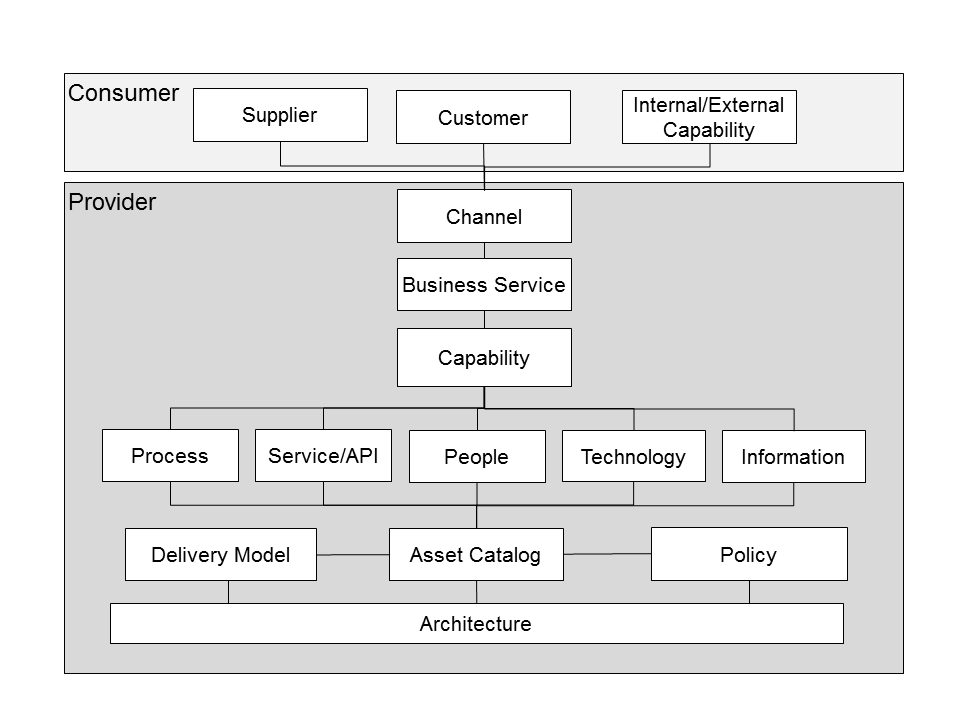
2. Ecosystem architecture should be primarily about identifying how an enterprise leverages an ecosystem by providing capabilities and their business services that collaborate and evolve along with the wider landscape.
3. The future is “business service” oriented. The application is dead. Business Service Implementation would be a better term.
4. The Capability and Service architecture will be a strategic business asset.
5. Capabilities as highly independent units of business function will be the way the business is organized.
6. The primary task of enterprise architects will be to develop the Capability and Service architectures as part of the business design.
7. Enterprise architects will probably be renamed Capability and Business Service Architects and report to the CMO.
8. The framework scope must span the entire Agile life cycle. Architecture is no longer a top down precursor to delivery, it must be an evolving set of deliverables and inherently implementable. The framework therefore needs to support concurrent development of business requirements, ecosystem, service and solution architecture, modernization, plus service and solution specification and delivery.

What’s needed is a new framework that recognizes the enterprise itself is a series of overlapping business ecosystems that are in turn part of a series of ecosystems that transcend the scope of the enterprise itself. A new framework should be focused on the capabilities and their inter-connections and manage the development of the business ecosystem(s) to the advantage of the enterprise.

While Capability is a widely used concept, notwithstanding some significant divergence of definition, the missing link is the realization of the Capability. In our work we use the Business Service concept – which delivers the capability in a context free manner. It’s extraordinary that our business vocabulary doesn’t include the formal Business Service concept in the same way that we are able to talk unequivocally about Business Process and know we will be understood.

The core model underlying the framework for future business needs to be service oriented, but it’s essential that the model is fully integrated with business concerns, and enables an implementable architecture in a way that current EA models manifestly do not. The new framework is also highly supporting of Agile methods in the entire life cycle being lightweight, twin track, narrow scope based on the Capability and Business Service, and contract based dependencies.
We will be running a workshop that explores these ideas in London in April in conjunction with the IASA UK Summit. If you can’t make the London event, (for geographic of schedule reasons) talk to me about how we can accommodate.

Paul Krugman: We Are On The Brink Of A Technology Revolution That WillTransform Our Economy