Case Management Top Influencers Study: Academics and Standards Organizations Driving Case Management Knowledge, Growth, Adoption and Evolution

Continuing our series of articles announcing The Case Management Top Influencers within specific segments of the Case Management community, we’re excited to unveil the most influential individuals within academic and standards organizations that are driving Case Management knowledge, growth, adoption, and the ideas to evolve Case Management into a more strategic business platform. View the […]

Related posts:

  1. Case Management Top Influencers Study: End Users Driving Case Management Knowledge, Growth, Adoption and Evolution Continuing our series of articles announcing The Case Management Top…
  2. Case Management Top Influencers Study: System Integrators and Vendors Driving Case Management Knowledge, Growth, Adoption and Evolution Continuing our series of articles announcing The Case Management Top…
  3. The Case Management Top Influencers Study: Who are the main influencers for Case Management? This week, we are starting a series of articles, making…

Related posts brought to you by Yet Another Related Posts Plugin.

The Planning Paradox

One of my uncle’s favorite jokes goes like this:

Greg: “Hey Gabriel, say to me ‘what’s the most important thing about humor?’”

Gabriel: “Okay Greg, what’s the mo-“

Greg: “Timing.”

[At this point, you’re supposed to laugh]

“Timing” is the most important thing to business strategy planning

As it turns out, timing is also the most important thing to support business performance management in terms of managing scorecards and synchronizing them with their project portfolios across a company.

Organizational Hierarchy Strategy Alignment. Organizational Hierarchy Strategy Alignment is the linkage between organization’s scorecards and budgets based on an organization’s hierarchy. The head of an organization’s scorecard and budget links to its children’s organizational scorecards and budgets forming a pyramid-like structure of strategy alignment like the illustration below.

Organizational Hierarchy

Value Stream Strategy Alignment. From a business strategy perspective, there are two types of organizations in a company; Business Organizations and Support Organizations. A Business Organization is an organization that is responsible for a product with scorecard KPIs related to market share, revenue and customer satisfaction.. All other organizations in a company are Support Organizations with scorecard KPIs related to cost, productivity, quality and risk. Business Strategy is set by the Business Organizations and Support Organizations mobilize to enable them, ideally in a sequential flow based on the Product’s value stream (aka core value stream, value chain and operating model). That is, organizations that deliver a product define their scorecards to express what success look like normally using KPIs like “units delivered”, “revenue received”, “customer satisfaction”. Then, working back up the value stream, Support Organizations determine how to sell the product to hit the desired success targets set by the deliver organization. Then, Support Organizations that market the product define KPIs on their scorecards to express what success looks like to hit the sale’s organization’s KPI Targets. Of course, not all processes are directly involved in the core value stream. Support Organizations that support customers, invoice/bill customers, hire people, manage partners, etc all have an enabling/support role and should work back from the core value stream process to determine what their success looks like based on the organization’s processes that they support. Here’s an illustration of a business strategy cascaded via value streams.

Value Stream Cascade 


The Planning Paradox

More common than you think, organization’s use a planning schedule to arrive at organizational scorecards and budgets that starts at the top of an organizational hierarchy and flows down from there. The problem is that organizations are rarely organized by value streams. In situations where the Business Organization is a sibling organization to Support Organizations, they both have to produce their scorecards and budgets at the same time forcing Support Organizations to scramble to discover the Business Organization’s strategy to then set their own scorecard for success and the budget necessary to achieve it. Even further, there are times when Business Organization functions report to Support Organizations forcing the Support Organization scorecards and budgets to be set before the Business Organization can declare what they need to be successful. In my experience, this situation causes several intense activities in brief stints that ultimately result in a undocumented alignment of business strategy leaving open the possibility of gaps, overlaps and conflicts in plans to execute the business’ strategy.

To add to the problem, it’s also worth mentioning these challenges posed when business strategy is poorly aligned:

  • Lack of ability to perform impact analysis to make upstream groups aware of dependent projects slipping/failing to set expectations
  • 60% of Organizations don’t map Organizational Scorecard KPIs to funded projects *
  • 66% of HR and IT organizations have no link to the business strategy *
  • 70% of middle manager’s and 90% front-line employee’s compensation not linked to the business’ strategy *
  • 95% of employees in most organizations do not understand their business’ strategy *

* Harvard Business School, 2006, “The Office of Strategy Management”, http://hbswk.hbs.edu/item/5269.html

Categories Uncategorized

Conflicting Narratives

@queenchristina_ writes an excellent article on Google, Starbucks, and Amazon, arguing that “for these multinationals immorality is now standard practice” (Independent 13 November 2012). See also Martin Hickman, Good Bean Counters (Independent 16 October 2012).

It is much too easy for British politicians, journalists and taxpayers to get a sense of moral outrage when they discover how little UK tax these American companies pay on their UK earnings. There may be nothing illegal about the fact that the coffee beans are purchased from a Starbucks subsidiary in Switzerland, or that the UK subsidiary pays a royalty for the use of the Starbucks brand to another Starbucks subsidiary in the Netherlands. By a strange coincidence, the Netherlands charges a very low tax rate on royalty payments. Of course there are many British companies that use similar devices to reduce their UK tax bill.

The word “account” essentially means “story”. The Starbucks accountants have constructed a story in which Switzerland and the Netherlands are essential links in the Starbucks value chain. British politicians have constructed a different story in which Starbucks is ripping off its British hosts. The moral outrage comes from the clash between these two narratives.

When two narratives clash, it seems natural for us to want to impose our preferred narrative on the Other. Wouldn’t it be grand if Starbucks saw the error of its ways and started to pay a fair rate of UK tax. Or wouldn’t it be equally grand if the UK tax laws were changed to regulate against these tax avoidance schemes? Or from Starbuck’s point of view, wouldn’t it be grand if UK corporate tax rates were reduced, so it could simplify its value chain at no cost to its shareholders? (Obviously words like “grand” and “fair” depend on the narrative.)

Of course, what is more likely is that the politicians will issue some threat of tighter regulation, the companies will make some temporary gesture to alleviate public hostility, and that the media will move onto the next target. In the meantime, politicians and the media can make things uncomfortable for corporate executives in the public eye.

And here’s a slightly older example – the attempts by the US Government to hold BP to account for the oil spill in the Gulf of Mexico. One BP executive complained that “The administration keeps pushing the boundaries on what we are responsible for.” (Wall Street Journal 1 June 2010 via NakedCapitalism)

In any case, there are always going to be conflicting narratives. I was at a workshop in the City this morning discussing how externalities might affect the future of money and the future of commerce. We discussed a range of topics, from mega-cities to carbon trading. 

But what exactly are these externalities? Almost anything that one person thinks to be part of The System and another person thinks to be outside The System. As William P. Fisher, Jr points out, “If we have to articulate and communicate a message that people then have to act on, we remain a part of the problem and not part of the solution.” (Reimagining Capitalism Again, Sept 2011).

Oliver Greenfield identifies the following challenge:

“The externalities created by companies – or, for that matter, nation states – in their pursuit of self-interest can seem rational at the local, country and even regional level.  But at a global level, in a closed system, externalities are costs. What is rational at a company or nation state level is irrational at a global level.” (Green Economy Coalition, April 2012)

Thus we have conflicting narratives, which result from disagreement about system boundaries (including time horizon as a type of boundary). A true systems approach might give us a systematic way of playing contested narratives off against each other.


See also

William P. Fisher, Jr, Question Authority (Oct 2011)

José M. Ramos, Temporalities of the Commons: Toward Narrative Coherence and Strategic Vision (Nov 2012)

Linked-In discussion on Good Bean Counters

and my post on Regulation and Complexity (Oct 2012)

Agile Architecture

The English language is well known for its subtlety. Sometimes it’s a delight, but on other occasions it can be very frustrating. If I use the term Gothic Architecture you will immediately understand I am describing a style of architecture that flourished in medieval times. And if like me you are interested in ecclesiastical architecture you will know that this style was used in many of the great cathedrals and churches across Europe, which were distinctive because of key architectural patterns that enabled great increases in height and internal light of the buildings without increasing the size of supporting pillars.
Now if I use the term Agile Architecture, what am I referring to? In today’s Agile world I would hazard a guess that most readers will think I am referring to the architecture techniques and tasks undertaken in the context of an Agile software development project, not the collection of patterns and practices that enable agile business systems. That is, an architecture that enables agility.

This potential for miscommunication is a core issue for enterprises. There is ample evidence that Agile Architecture is a primary contributor to business agility, yet we do not have a well understood architecture management system that integrates with Agile methods.
 

Let’s use an example readers may be familiar with. Amazon CEO Jeff Bezos famously[1]issued an edict that laid down some key architecture principles to Amazon development teams that I will summarize as:

·       All teams will henceforth expose their data and functionality through service interfaces.

·       Teams must communicate with each other through these interfaces. There will be no other form of interprocess communication allowed.

·       It doesn’t matter what technology they use.

·       All service interfaces, without exception, must be designed from the ground up to be externalizable.

·       No exceptions.

What Bezos did here was to lay down key business and technology architecture principles that you might reasonably conclude were central to the extraordinary level of business agility that we have seen demonstrated by Amazon.com, Inc. That widely circulated edict contained the foundations of the Amazon reference architecture.  

In the October 2004 CBDI Journal[2] we commented, “Two of the most successful and enduring dotcom start-ups, Amazon and eBay, now expose their core applications as Web Services. In doing so they have created a new class of platform that could have a profound impact on end-user organizations and IT vendors alike.”

And so the reference architecture became the enabler of growth and agility for the Amazon business, not we understand[3] as a grand plan, but through natural technological evolution. The services formed the platform that allowed the extraordinary expansion of the Amazon business that I would be certain not even Jeff Bezos imagined, back then in 2004. That is real business agility, and it was delivered by smart architecture backed up by clear policies and realized by agile processes.

Although Amazon has clearly evolved in pursuit of solutions to specific business opportunities and challenges, it’s also clear they have established a de facto architecture and architecture management system that guides the work of the many product delivery teams and ensures consistency of approach where it’s required. Let’s consider how an enterprise might establish a similar agile architecture management system.

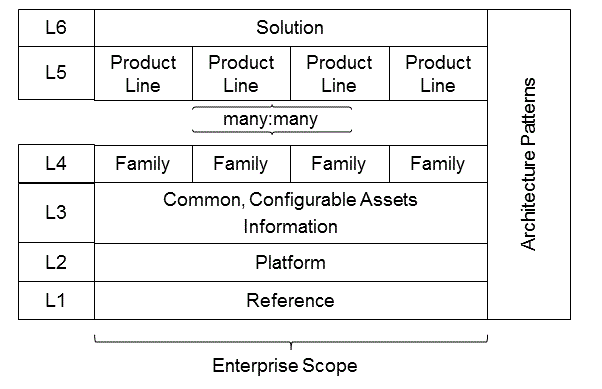
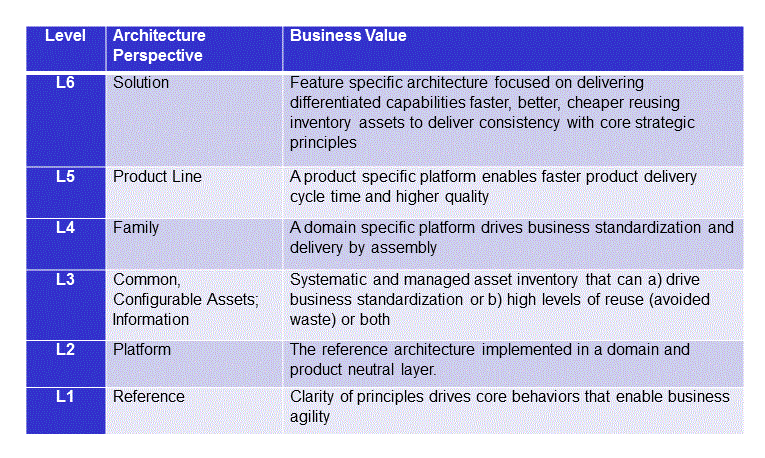
A reference architecture articulates primary principles that are typically central to an entire enterprise. Principles should be focused on establishing the product and solution independent environment in which agility can be delivered and maintained, so they would be stable over time. We might refer to reference architecture as a Level 1 architecture perspective (L1) that exists purely as a set of models and guidelines.

Larger enterprises should explore the business value potential of platform based architecture as a mechanism to deliver cross enterprise consistency of core reference architecture behaviors and to enable closer integration with the wider ecosystem including customers, suppliers, end consumers etc. This is an extended management services platform which encapsulates the technology infrastructure and enables rapid delivery of business services.
The platform architecture defines common services that manage business delivery including security, life cycle management, change management, release management and operations, as well as catalogs, eCommerce, B2B, regulatory control and risk management, standardizing these key capabilities and reducing the footprint of business domain services. The platform will also manage important behaviors that deliver on specific business goals such as scalability and availability. For example, Amazon services are usually very fine grained, specifically to reduce the scope of each service in order to facilitate narrow focus SLAs and maximize scalability by reducing individual service complexity. We might refer to platform architecture as a Level 2 architecture perspective, engineered to be relatively stable in support of  large numbers of business services and consumers, but also engineered to evolve and respond rapidly to business and technology change. Not all enterprises will see business value in making their platform and business services available to their ecosystem, but some will.
Enterprises clearly vary considerably in their make up in terms of geographic and organizational, product and process standardization and differentiation, but typically there will be considerable potential for an inventory of shared assets that leverage agile architecture to support business agility. The assets may include:

·       Common services, frameworks and components that are designed to deliver common behaviors to all parts of the enterprise. For example core services that establish genuinely enterprise wide services such as Customer, Ticket, eCommerce etc; services that deliver business value by standardizing common business services and processes.

·       Configurable services, frameworks and components that are designed to provide common behaviors but are engineered to be customizable in local situations to accommodate many aspects of localization ranging from the simple – taxation, geography etc, to the complex – variant ordering patterns, variations in event and process sequence dictated by local de facto business practices. Configurable services may provide business value simply by providing reusable components, or they may establish a common core of business process and information that establishes common reporting and regulatory control in a local context, or both. Configurable services may also be an important time to market strategy for service providers who customize their services for each client or customer group.

·       Information architecture and services. Establishing a coherent approach to information is commonly a major issue for large enterprises and this architecture level defines an integrated approach for structured and unstructured (big) data, transactional and reference, enterprise reporting and regulatory control and so on.

Common and Configurable assets together with the Information Architecture might form a Level 3 architecture perspective and be widely applicable across a large, distributed enterprise.  

We then have two further levels which are closely related, Family Architecture and Product Line Architecture. Whilst many architects chose to view Family and Product Line as synonyms, I recommend that they are kept separate. A Family architecture is a domain framework that is much more specialized that L3 assets that would be applicable on a broader basis. The Family architecture establishes core business (domain) services and possibly other artifacts specific to the domain, where the domain is likely to be a subject area or a cluster of major types. For example Customer, Supply Chain, Manufacturing, Risk etc. Families are also commonly acquired products.
In contrast Product Line architecture is what it says – it’s the architecture for a product offering. The product is an offering that has direct relationship to end customer revenue and usually continuity of purpose over multiple releases. Although from a narrow technical perspective the Product and Family architectures might be similar, the way a product is managed must mirror the business product life cycle. Family architectures may therefore be engineered for stability, whereas, depending on the industry sector, product line architectures may be engineered for maximum agility and minimum response time.  

Finally we have the Solution architecture level, the architecture specific to solution project delivery, where the focus is on feature architecture and integrating solution architecture with the Level 1 to 5 architecture perspectives. It’s important to note that where product line architecture is used, then this may subsume the Solution architecture.
These six architecture levels provide us with a nomenclature for agile architecture that will be central to managing agility into the delivered product/solution. The architecture perspective guides the structure of programs and projects and the incorporation of architecture and reuse goals into delivery charters. The architecture also provides traceability and governance over realization of core architecture principles.
The question of how Agile Architecture integrates with Agile delivery is likely to prove contentious because architecture introduces a form of direction that contradicts Agile concepts. Yet the lessons from Amazon are insightful. The most senior business management need to be fully engaged and actively leading the development of architectural direction. Further in large enterprises customer project demand needs to be managed and aligned with business strategy and architectural direction.

There’s no reason why these Demand and Definition processes shouldn’t adopt Agile concepts, notably cross functional teams, time boxes and backlogs. The outcomes should be excellent visibility and traceability of key strategies and policies that provide real clarity of purpose for projects, that will increase the probability of success. In a typical large enterprise use of existing (or well understood) organizational concepts, adjusted to use aspects of Agile methods as discussed, will meet less organizational resistance. For example:  

1.     Architecture Review Board (ARB) or equivalent, a cross functional team (senior representatives of business, product management, architecture and delivery), that provide direction and funding to all architecture development.

2.     Design Authority (DA), also a cross functional team (domain specific expert level representatives of business, product management, architecture and delivery), that transform raw customer demand stream into project charters and manage the portfolio view. It is the DA that takes responsibility for aggregating and decomposing customer and strategic demand, chartering Common, Product Line and Family architecture, typically as integral elements of delivery projects, which can demonstrate business value.

3.     Investigatory architecture projects – short duration projects that validate assumptions prior to chartering composite architecture/delivery projects. Sometimes carried out as part of a Definition Phase activity concurrent with outline requirements and knowledge discovery. Using patterns as a mechanism to increase consistency of architecture decisions and communicate them to delivery projects at sensible level of detail that is useful to delivery teams.  Recommend includes delivery team members as appropriate.

Note this is a recursive model, and the process may executed at enterprise and program level.

You may ask where Enterprise Architecture is in this. The answer is that enterprise architecture is a role and responsibility that must coordinate and govern all levels of architecture. Enterprise Architects are most likely to be assigned to a specific architecture perspective level. The notion of, “one architecture to rule them all” really doesn’t exist.


Each enterprise should develop its own architecture management approach, and integrate this into an end to end architecture, delivery and governance process. The term Agile Architecture should be used to describe and deliver architecture that facilitates the agile business by compliance with reference, platform and other architectures that facilitate evolution, customization and plug and play. Faster cycle time and quality outcomes are then a function of both the reusable patterns and parts available for assembly and the Agile delivery process.  

In medieval times the builders of the Gothic cathedrals didn’t start their designs from scratch. But equally they didn’t have finely detailed (ivory tower) plans – the technology didn’t exist to support that. Master builders moved from city to city bringing their proven architecture in their heads, often together with experienced craftsmen, to new projects. Craftsmen and master builders together tried out new designs and gradually evolved core patterns such as the flying buttress, which became standard components in cathedrals across Europe. Sometimes the great buildings fell down during construction and the builders had to adapt the architecture and try again. They were truly early adopters of Agile methods as they combined architecture and build in what clearly was from time to time an empirical delivery approach, but they also had their equivalent of a reference architecture and patterns that enabled systematic reuse of proven designs. Of course their delivery cycle time was a little longer than today’s Agile project!
Talk to Everware-CBDIabout the Agile Enterprise Workshop. This is currently available as an in-house, intensive workshop. Public scheduled classes will hopefully follow next year.


[1] Amazon and eBay Web Services, The New Enterprise Applications? By Lawrence Wilkes, CBDI Journal October 2004


[2] Inadvertently published by Steve Yegge, 2011, in a comparison of Google and Amazon practices. http://upalc.com/google-amazon.php

[3] Werner Vogels, 2006, SOA creates order out of chaos @ Amazon, Rich Seeley, Search SOA

What is Enterprise 2.0?

Enterprise 1.0

Enterprise 2.0

Hierarchy
Flat Organization

Friction
Ease of Organization Flow

Bureaucracy
Agility

Inflexibility
Flexibility

IT-driven technology / Lack of user control
User-driven technolog…

Categories Uncategorized

The Planning Paradox

One of my uncle’s favorite jokes goes like this: Greg: “Hey Gabriel, say to me ‘what’s the most important thing about humor?’” Gabriel: “Okay Greg, what’s the mo-“ Greg: “Timing.” [At this point, you’re supposed to laugh] “Timing” is the most important thing to business strategy planning As it turns out, timing is also the…

Metaframeworks in practice, Part 5: Enterprise Canvas

What frameworks do we need, to link across all domains and layers of the enterprise-architecture space? How can we create such frameworks? This is the fifth and final item in this series of worked-examples of metaframeworks in practice – on how to

Embrace Emotions to Induct Innovation

Today I had some great discussions at Sapphire TechEd in Madrid. Despite all the very interesting content driven discussions I really enjoyed a discussion around Enterprise Architecture. Even though I heard mostly Enterprise IT Architecture, there was …

Categories Uncategorized Tags

Planning Is Not Enough

bg outline

By: Bill Cason – CTO, Troux

As terminology for the practice of Enterprise Architecture has evolved from Enterpriseblog nov13 pic 1 Architecture to Enterprise Architecture Management or in our (Troux) case Enterprise Portfolio Management, I occasionally hear the term “IT Planning”.  Although IT Planning per se is an important clog in the strategic IT management wheel, it alone is insufficient to a successful Enterprise Portfolio Management (aka EA) program.

Conventional theory defines management as a set of interconnected processes: Plan, Organize, Control, and Direct.  Planning — here too —as you can see is necessary but not sufficient on its on own for successful strategic IT management

Likewise we can think of Enterprise Portfolio Management supporting a set of interconnected processes that include “planning” but extend well beyond to ensure strategic IT management decisions are made with a recognition of the other interconnected management processes.

The IT Management Processes

Enterprises have invested in their current IT management systems (e.g. ITSM, ALM, PPM et al) to support a wide variety of IT processes.  Today most of these processes are siloed within a particular system, but in fact if we step back and take a “big picture” view of these processes it is possible to identify a set of interacting management value chains that span IT in its entirety.   These value chains can be characterized into five fundamental management processes as shownin Figure 2.

  1. IT Change Management:describe the image The objective of change management is to
    ensure processes are defined for  efficient and prompt handling of all changes to IT infrastructure, in order to minimize the number and impact of any related incidents upon service (paraphrased from Wikipedia).
  2. IT Portfolio Governance: The processes of managing the risk, health, standards, and compliance of the IT assets such as technology, applications, and information.
  3. IT Demand to Delivery: The process of managing the investment portfolio including business demand, funding, solution architecture, governance, and delivery.
  4. IT Financial Management: The processes of IT financial budgeting, measurement, reporting, and forecasting.
  5. Business and IT Planning: The process of business and IT strategic planning and roadmapping.

These value chains do not exist independently, but instead create a value network through their interactions.  Figure 3 depicts an example showing how they might interact.  For example, in this case a new business need identified in the Business/IT Planning value chain drives budget needs in the IT Financial Management value chain resulting in a new program request in the Demand to Delivery value chain that needs to be coordinated with investment needs (for example an application modernization need) coming from the IT Portfolio Management value chain – hence Planning is not enough.

blog nov13 pic 3 revisedEnterprise Portfolio Management comprises of a broad set of rich information sources and a number of interacting value chains and processes that are each dependent on the other.  It is clearly a complex system and due to that complexity it can be chaotic and subject to the “IT butterfly effect” where small changes in the environment can have unexpected and potentially disastrous  results. 

The purpose of Enterprise Portfolio Management is to give insight into the interconnected nature of these portfolios and value chains in order to manage the chaos.  That certainly goes well beyond the requisite “IT Planning”.  To quote an ancient saying: “Planning without action is futile, action without planning is fatal.”  EPM delivers both planning and action.

For more information on EPMs role in the IT Management process click here http://www.troux.com/solutions/ .

Categories Uncategorized

Functional Organization at Microsoft

@iamjaygreene and @jimkerstetter of @CNETNews are not surprised by the departure of unpopular Windows boss Steven Sinofsky from Microsoft.

Some pundits (e.g. ZDnet’s Larry Dignan) had predicted that Sinofsfy would survive if Windows 8 was a
commercial success. By letting him go immediately after Windows 8 went live rather than waiting,
Ballmer has clearly signalled that it is not about Windows 8 success but
about something else.

In pieces written in the weeks before Sinofsky’s departure, Greene and Kerstetter mention the following issues.

  • Sinofsky successfully battled with Ray Ozzie for control of Windows Live Mesh. Ray Ozzie left Microsoft immediately after Ballmer folded Windows Live Mesh into Sinofsky’s organization.
  • According to unnamed critics within Microsoft, Sinofsky created a rigid product development process that puts more control in
    his hands and diminishes Microsoft’s ability to innovate.
  • In a similar fashion to Scott Forstall at Apple (who also lost his job recently), Sinofsky zealously promoted his group’s work at the expense of the rest of the company.
  • Manu Cornet’s cartoon of Microsoft’s organization chart is thought to be a reference to Sinofsky.

The comic is a set of 6 organizational charts, edges with arrows show who reports to whom. Amazon's is very traditional, each manager has exactly 2 people below her. Google's is colorful (nodes are colored red, green, yellow, blue) and is extremely messy. Edges are overlapping all over the place, it's unclear who reports to whom. Facebook looks like a social network with bidirectional arrows and a distributed structure. Microsoft's is divided in three sub-structures that are pointing guns at each other. Apple's is a circle with a large red dot in the center, and everyone around it reports to that red dot -- the arrow heads are particularly large and even the people two levels away from the center red dot also have arrows point at them coming directly from the red dot. Oracle's is divided into two sections, the first section is labelled 'Legal' and is huge, the second section is labelled 'Engineering' and is tiny.
Original cartoon by Manu Cornet

But this story isn’t just about personality clashes and organizational politics. Sinofsky has championed an approach to organization structure, which he calls Functional Organization, and this is described in a book called “One Strategy: Organization, Planning, and Decision Making,” (2009) co-written with Harvard Business School professor Marco Iansiti.

The Functional Organization builds management reporting lines around job functions — such as
product management, development, software testing. This may be contrasted with a Product Organization where multi-disciplinary teams work on specific
feature sets together.

Sinofsky and Iansiti argue that functional
organizations create clearer road maps for workers to march toward a
final goal. However, critics within Microsoft disagree. Apparently referring to Sinofsky’s Functional Organization, Charlie Kindel, another ex-Microsoft executive is quoted as saying that “it represents a siloed perspective, it represents an us versus them perspective”.  Another former senior executive (unnamed) has referred to the approach as “Soviet central-planning”, where tight control from the top squeezes out innovative thinking from below.

Announcing Sinofsky’s departure, and the appointment of Julie Larson-Green as his successor, Steve Ballmer wrote “The products and services we have
delivered to the market in
the past few months mark the launch of a new era at Microsoft. To
continue this success it is imperative that we continue
to drive alignment across all Microsoft teams, and have more integrated
and rapid development cycles for our offerings. …  Her unique product and innovation perspective and proven ability to
effectively collaborate and drive a cross company agenda will serve us
well as she takes on this new leadership role”.

(BBC News 13 November 2012)

So is this the end of the Functional Organization in Microsoft? Martin Fowler talks about the oscillation between FunctionalStaffOrganization and
TechnicalStaffOrganization, essentially the same dynamics (he reckons) as drive the
boom-bust cycle of EnterpriseArchitecture. (PreferFunctionalStaffOrganization). So perhaps now the cross-company silo-busting agenda will have the ascendency for a little while.

Read more »