So, have you asked these two questions lately: What…

So, have you asked these two questions lately:

  • What possibilities for action does a system allow its participants?
     
  • How might participants in a system overcome or subvert its constraints?

If you haven’t asked yourself some version of these questions then you have not yet understood, social identity, consumerisation, BYOD, mobile, and a whole host of so-called disruptive technologies – because you don’t understand how they disrupt your system.

Never fear, these two discussions of cell-phone subjectivity should help fire up your imagination.

The Architecture of the Cell Phone

Cell Phones and Meeting Points in a Featureless Landscape

On the Causes of Business Complexity

#bizarch
#complexity  @lawrencewilkes asks if business is “inherently complex”, or have businesses just allowed it to become so? Are there vested interests at work who are striving for complexity?

(In my blogpost on The Future of Enterprise Arc…

A Simple Plan: How Adaptive Case Management Helps Financial Institutions Overcome Challenges

This is a cross-post of this month’s CMSWire article. Continuing our discussion from last month’s article in my series on case management, we’re ready to move forward with insights into how case management can help lenders resolve business challenges, including obstacles brought about by the recent financial market crisis. The recipe for success I have […]

Related posts:

  1. Human vs. Machine: How Adaptive Case Management Helps Insurance Firms Serve Customers Have you seen the movie Real Steel? In the storyline…
  2. Forrester Business Process Conference: How Dynamic Case Management Helps Businesses Hit High Velocity Improvements I just returned from this year’s Forrester Business Process Conference…
  3. Being Human: Why Knowledge Workers Need Adaptive Case Management How important is the human factor in driving meaningful process…

Related posts brought to you by Yet Another Related Posts Plugin.

Lessons Learned from Social Networking: How CIOs Can Use EPM to Break Down Organizational Silos

bg outline

By: Ben Geller – VP Marketing, Troux

In a recent Wall Street Journal (WSJ) blog1 Michael Krigsman stated, “Modern CIOs must reconcile
the gap between their role as protector of corporate information assets and the need to drive organizational innovation and openness. Although bridging these two dimensions of the CIO mandate is difficult, this struggle creates perhaps the greatest opportunity that most CIOs will see [in their career].”

Krigsman went on to state, “Todays CIOs need to balance [stakeholder] demand for transparency while maintaining strict controls and governance to protect the organization creates a demanding situation for even the most seasoned leaders. Nonetheless, the cultural changes [brought] about by the introduction of social networking are a lever that forward-thinking CIOs can use to drive innovation and transform their role in the business.”

istock ballsIn the blog the CIO of Intel Corporation, Kim Stevenson, explains that social networking solves an important problem in large organizations: “The flow of information unintentionally becomes gated as an organization grows, creating silos and making it difficult to find the right person who has the information you need.”

The concept of social networking as a means to liberate important information and streamline its dissemination into the hands of the organization at-large is built on the same core premise that drives Enterprise Portfolio Management (see The Secret to Better Decision Making: How EPM Adds Value to Your Organization).  Enterprise Portfolio Management (EPM) seeks to break down the organization into portfolios that categorize and represent the business.  EPM seeks to ensure that information contained within these portfolios (Goals & Strategy, Business Capabilities, Investments, Applications, Information and Technology) establishes the business connection and context to the IT assets spread across the organization.  EPM seeks to offer a more dynamic means to reach into and across the organization to make sure decision-quality information no longer stagnates in silos.  EPM seeks to ensure decision-quality information quickly and efficiently finds its way into the hand of business leaders and decision-makers.

To put it simply, Enterprise Portfolio Management offers a more dynamic means of removing organizational silos, improving the flow of decision making information and, as a consequence, boosting collaboration and an organization’s agility.

We all are quite aware that promoting collaboration inside a large organization doesn’t just happen; it requires a thoughtful plan, coordination, and effort.  When it comes to making sure decision-makers have the information they need, the same requirements apply.  Traditional office productivity applications such as Excel, Visio and PowerPoint are thought to be a sufficient proxy for decision-making tools.  But if you take a closer look they just don’t cut it.  While they may be good to capture the inventory of assets that reside within the CIOs’ domain, they fail to capture the connection and relationship of these assets back to the business – in the context of Business Goals and Strategy, Business Capabilities, and Investments.  These applications are typically used to capture static information about an organization’s applications, information, and technology assets.  By the time this information finds it’s way into the decision-making, it has become stale and inaccurate. Furthermore, the very nature of these applications do not promote collaboration.  It’s usually up to the document owner to share the information that has been collected.  Certainly not a step in the right direction for organization’s looking to break down silos.

Enterprise Portfolio Management can help create a culture of collaboration. In the WSJ blog Intel’s Stevenson states social networking is a means to transform critical aspects of her company’s culture, especially in relation to power, influence, and knowledge sharing.

She goes on to say that traditional organizations rely on a “one-to-one anointed expertise model,” in which individuals gain power by hoarding, rather than sharing, their knowledge. In this environment, which dominates the private sector and government, collecting knowledge is an important basis for career advancement and prestige. Power and influence based on withholding knowledge creates information silos and disincentives for cooperation across departments or groups; these silos breed inefficiency and inhibit corporate agility.

Enterprise Portfolio Management like social networking can help CIOs change that type of unwanted behavior and create a culture of collaboration. When it comes to social networking adoption and use in enterprise there are many lessons to be learned.  These lessons can be directly applied to Enterprise Portfolio Management and the role it plays in decision-making.  EPM, like social networking, offers CIOs the means to shift the conversation from technology to strategy and innovation. In addition, because technology inevitably becomes commoditized, focusing on leadership, promoting information transparency, and equipping the organization to make better decisions by seeing IT in the context of business can help CIOs become transformational leaders.


Categories Uncategorized

Future State versus Vision – Where are you headed?

Many business architects and strategists use the terms “vision” and “future state” synonymously. While similar in the sense that both are describing a future target, they are distinctly different concepts aiming at different types of change. Since creating a long range target is often the first step of major change initiatives, getting this wrong can […]

Is Enterprise Architecture accountable for improving customer experience?

A recent experience with poor customer service has got me thinking about the role of EA in addressing customer experience issues. 

One of the last things I was working on, while still in Microsoft IT, was working on an initiative to systematically help improve customer experience.  With that experience fresh in mind, I was dealing with an issue with my Tivo DVR today where the Tivo box started to misbehave.  I began a chat with their representative and the experience was less than ideal.  (If someone from Tivo wants to chat, just drop me a line for details).

That got me thinking.  Can EA help?  In general, can EA be part of the solution to problems caused by poor customer experiences? 

The Official Dilbert Website featuring Scott Adams Dilbert strips, animations and more

Customer Services is important to the success of any organization

First off, I’d like to say that customer experience is one of the most important elements of the highly competitive online world.  The Web has made it very easy for customers to abandon their existing relationships and switch to new ones.  Even the slightest provocation can send a customer in search of a competitor, and the features of a product are not as “sticky” as they once were.  It is increasingly easy for new small companies to appear that copy all of the key features of a technology and release a competing product, sometimes within a few months of the first one.  The results can be fierce competition that, unfortunately, is often addressed in courtrooms instead of the marketplace (Samsung vs. Apple, Google vs. Microsoft, Apple vs. Microsoft, etc.).

Some companies will not pay proper attention to their customer’s experience.  This is fairly common, especially in manufacturing companies where there are both software and hardware components involved.  For some reason, the fact that two different engineering teams are involved often produces a disjointed experience.  (Apple has been leading the way in addressing these kinds of problems.  The rest of us need to do so as well).

What are the questions you must always be ready to answer?  (The Ten Strategic Questions)

In general, an Enterprise Architect assists with the development of strategic alignment, not by deciding what is important, but making sure that executives don’t miss the important stuff while they are overwhelmed with the mundane.  One way to anchor your analysis to ensure that YOU don’t miss the important stuff is to consider some of the high level tools suggested in traditional strategic analysis… tools like SWOT analysis, Five Forces analysis, and partner accountability mapping.  However, most of those tools do a poor job of considering the importance of customer experience to enterprise success.

The model that I use is the EA metamodel behind business models.  In a prior post, I created a rationalized ontology for the business model canvas that addressed the gaps left by Osterwalder in his analysis.  However, in keeping with the effort to make that kind of model useful, I followed the pattern of Osterwalder and created a visual table that represented the corrected business model ontology.

image

The guidance that you can get from this is to look at each of the blocks in the canvas and consider the possibility that you have not missed anything important in that block.  Therefore, if you use this model, you would ask the following ten questions:

  • Are we targeting the right customers for the growth that we need?  (Customer Profile)
  • Do we have a good understanding of what our customers want and need? (VOC)
  • Do we have a compelling value proposition to address the needs and demands of those customers? (Value Proposition)
  • Are we developing products and services that deliver on our value proposition, or is there a gap in our products and/or services that we need to address? (Products and Services)
  • Have we considered all of the channels we should be using, or are we using too many channels, to distribute our products and services to our customers? (Channels)
  • Do we have a good idea of the resources we need to deliver on our value proposition? (Resources)
  • Do we know how to use our resources sufficiently well to produce the results that customers expect? (Required Competencies)
  • Have we addressed all the cost and revenue implications of the resources, competencies, and channels that we’ve selected? (Cost and Revenue Models)
  • Are we reaching our customers in the geographies and locales in which they live and work, and if not, why not? (Geographies and Locales)
  • Have we relied on partners in the right way, leveraging their strengths and the cost implications of using them without opening ourselves to problems of key dependencies? (partner profiles)

This list of questions includes the core questions that we need to be asking in order to address customer experience issues at the strategic level.  This is a far more comprehensive list that “5 forces” or “SWOT” and will help you to ensure that you are not missing anything. 

How does Enterprise Architecture address customer experience?

The actual experience of a customer is a function of their needs and your products.  If a customer needs to drive a nail, a hammer will do.  If the customer needs to drive their car to an unfamiliar place, then a Global Positioning System with turn-by-turn directions would be more compelling.  If you offer the customer a product that does NOT meet their needs (like a GPS that only shows maps, but doesn’t tell the driver where and when to turn), then they will not be loyal to the product.  Their experience will be poor and they will quickly find better products.

Customers don’t want ten inch drills.  They want ten inch holes.

When doing a strategy workshop, it is best for the Enterprise Architect to walk in to the workshop with all their preparation in place.  Walking in unprepared will produce really poor results.  To be prepared, the Enterprise Architect will have already collected the list of “proposed strategies” for the coming period and will have analyzed those strategies from the standpoint of the organization’s business model(s).  In other words, for each of the questions above, which ones are being answered by strategy.  Now, for the kicker, which ones are not? 

Customer experience may already be covered by a strategy, and if it is, you have to do very little.  Simply make sure that everyone sees the relative value of that strategy when compared to others (like reducing costs or negotiating new boundaries with existing partners).  That is not simple, but not as difficult as the alternative: no strategy for customer experience.

On the other hand, let’s assume that there are goals, or objectives, or themes (rarely actual strategies) already articulated that address the other areas of business model considerations, like costs, or products, or partners.  Address the lack of customer focus in your interviews PRIOR to the strategic workshop.  Ask your key stakeholders what their customers need.  Specifically don’t ask for how those needs are being met… ask what the needs are!  Make sure that you plant, in the minds of your stakeholders, the seeds of doubt: do we KNOW what our customers want and need?  Is it written down?  Would our customers agree with what we wrote down?

During the workshop, propose an initiative to capture the needs of the customers (of each business model) and to map the products and services to those needs.  This will let you answer the question: are our products and services meeting the needs of customers?  This may involve the development of user personas, scenarios, and competitive surveys.  This initiative, when complete, will provide the ammunition that you will need later to propose initiatives to address customer experience gaps. 

Note that gaps can exist in many places… not just in the products themselves, but also in the customer service experience that occurs when customers are not happy with their products or have an issue with them. 

Conclusion

Enterprise Architecture is a strategic planning function that uses a methodical scientific approach to address the gaps between the goals of a business and the execution of strategy needed to reach them.  Using the TEN STRATEGIC QUESTIONS above, Enterprise Architects can capture opportunities and oversights that senior executives may miss.  One of those key questions addresses customer experience issues. 

Therefore, when an organization fails to deliver good customer experiences, Enterprise Architecture, when used properly, can help to address the situation.

Survey: Data Breaches Driving Customers Away

Guest post by Mark Lobel According to our new Global State of Information Security Survey 2013, data breaches are driving customers away from businesses around the world. In conjunction with CIO Magazine and CSO Magazine, we recently surveyed 9,300 c-Suite executives, vice presidents and directors of IT & information security from 128 countries. 52% of executives confessed they have lost customers as a result of inadequate information security. I can’t think of a more compelling […]

Management, change and big data — active information

In my most recent active information post, I highlight management implications of effective big data usage, as articulated in HBR article by McAfee and Brynjolfsson.

An excerpt:

As investment in data analysis small, big, fast is worthless without a willingness to act, Im choosing to highlight McAfee and Brynjolfsson’s submission on Big Data: The Management Revolution.

After setting a context on Big Data volume, velocity, variety and showcasing tangible business results of Big Data PASSURs RightETA and Sears Holdings, McAfee and Brynjolfsson get to the heart of the matter:

“The technical challenges of using big data are very real. But the managerial challenges are even greater—starting with the role of the senior executive team.”

“One of the most critical aspects of big data is its impact on how decisions are made and who gets to make them.”

read the full post: Management in the Big Data era: Rethink or be Repl… – Input Output.

Implementing SOA through TOGAF 9.1: the Center Of Excellence

Service-oriented architecture (SOA) has at times been challenged but is now on the verge of mainstream acceptance. It now shows maturity, success and even signs of popularity. Service Oriented Architecture (SOA) is an enterprise scale architecture for linking resources as needed. These resources are represented as business-aligned services which can participate and be composed in a set of choreographed processes to fulfil business needs.

The primary structuring element for SOA applications is a service as distinct from subsystems, systems, or components. A service is an autonomous and discoverable software resource which has a well defined service description.

SOA is based on a fundamental architectural model that defines an interaction model between three primary parties, the service provider, who publishes a service description and provides the implementation for the service, a service consumer, who can either use the uniform resource identifier (URI) for the service description directly or can find the service description in a service registry and bind and invoke the service. The service broker is the third party who provides and maintains the service registry in addition to providing mediation services between providers and consumers.

In 2012, the use of SOA for pivotal emerging technologies, especially for mobile applications and cloud computing, suggests that the future prospect for SOA is favourable. SOA and cloud will begin to fade as differentiating terms because it will just be “the way we do things”. We’re now at the point where everything we deploy is done in a service-oriented way, and cloud is being simply accepted as the delivery platform for applications and services. Also many enterprise architects are wondering if the mobile business model will drive SOA technologies in a new direction.  Meanwhile, a close look at mobile application integration today tells us that pressing mobile trends will prompt IT and business leaders to ensure mobile-friendly infrastructure.

To be successful in implementing a SOA initiative, it is highly recommended that a company create a Center of Excellence and the Open Group clearly explains how this can be achieved through the use of TOGAF 9.1. This article is based on the specification and specifically the section (in italics) 22.7.1.3 Partitions and Centers of Excellence with some additional thoughts on sections 22.7.1.1 Principle of Service-Orientation and 22.7.1.2 Governance and Support Strategy.

I have looked at the various attributes and provided further explanations or referred to previous experiences based on existing CoEs or sometimes called Integration Competency Centers.
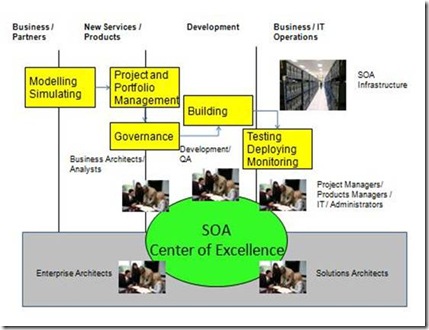
The figure below illustrates below a SOA Center of Excellence as part of the Enterprise Architecture team with domain and solution architects as well as developers, QAs and business architects and analysts coming from a delivery organization.
clip_image002
This center of excellence support methodologies, standards, governance processes and manage a service registry. The main goal of this core group is to establish best practices at design time to maximize reusability of services.
Below is then what is written in the TOGAF 9.1 specification.


A successful CoE will have several key attributes:

  • A clear definition of the CoE’s mission: why it exists, its scope of responsibility, and what the organization and the architecture practice should expect from the CoE.

Any SOA Center of Excellence must have a purpose. What do we want to achieve? What are the problems we need to solve?

It may sound obvious, but having a blueprint for SOA is critical. It’s very easy for companies, especially large enterprises with disparate operations, to buy new technologies or integrate applications without regard to how they fit into the overall plan. The challenge in building a SOA is to keep people, including IT and business-side staff focused on the Enterprise Architecture goals.

In order to realize the vision of SOA the following topics should be addressed:

· What to build: A Reference Architecture
· How to build: Service-Oriented Modeling Method
· Whether to build: Assessments, roadmaps, and Maturity evaluations
· Guidance on Building: Architectural and Design patterns
· Oversight: Governance
· How to build: Standards and Tools

The Center of Excellence would first have a vision which could be something like:

ABCCompany will effectively utilize SOA in order to achieve organizational flexibility and improve responsiveness to our customers”.

Then a mission statement should be communicated across the organization. Below a few examples of mission statements:

“To enable dynamic linkage among application capabilities in a manner that facilitates business effectiveness, maintainability, customer satisfaction, rapid deployment, reuse, performance and successful implementation.”
“The mission of the COE for SOA at ABCCompany is to promote, adopt, support the development and usage of ABCCompany standards, best practices, technologies and knowledge in the field of SOA and have a key role in the business transformation of ABCCompany. The COE will collaborate with the business to create an agile organization, which in turn will facilitate ABCCompany to accelerate the creation of new products and services for the markets, better serve its customers, and better collaborate with partners and vendors.”

The Center of Excellence would also define a structure and the various interactions with
· the enterprise architecture team
· the project management office
· the business process/planning & strategy group
· the product management group
· etc.

And create a steering committee or board (which could be associated to an architecture board).

They will provide different types of support:

· Architecture decision support
     o Maintain standards, templates and policies surrounding Integration and SOA
     o Participate in Integration and SOA design decisions
· Operational support
     o Responsible for building and maintaining SOA Infrastructure
     o Purchasing registries and products to grow infrastructure
· Development support
     o Development of administrative packages and services
     o Develop enterprise services based on strategic direction

  • Clear goals for the CoE including measurements and Key Performance Indicators (KPIs). It is important to ensure that the measures and KPIs of the CoE do not drive inappropriate selection of SOA as the architecture style.

Measurements and metrics will have to be identified. The common ones could be:

· Service revenue
· Service vitality
· Ratio between services used and those created
· Mean Time To Service Development or Service change
· Service availability
· Service reuse
· Quality assurance
· Etc.

  • The CoE will provide the “litmus test” of a good service.

Clearly comprehensive testing activities must be described by the Center of Excellence. In addition to a set of defined processes related to Web Service Definition Language (WSDL) testing, functional unit testing, regression testing, security testing, interoperability testing, vulnerability testing and load, performance testing, an analysis tool suite may be used to tailor the unique testing and validation needs of Service Oriented Architectures.

This helps test the message layer functionality of their services by automating their testing and supports numerous transport protocols including: (here a few examples) HTTP 1.0, HTTP/1.1, JMS, MQ, RMI, SMTP, .NET WCF HTTP, .NET WCF TCP, Electronic Data Interchange, ESBs, etc.
Only by adopting a comprehensive testing stance, enterprises can ensure that their SOA is robust, scalable, interoperable, and secure.

  • The CoE will disseminate the skills, experience, and capabilities of the SOA center to the rest of the architecture practice.

The Center of Excellence will promote best practices, methodologies, knowledge, and pragmatic leading-edge solutions in the area of SOA to the project teams.

  • Identify how members of the CoE, and other architecture practitioners, will be rewarded for success.

This may sounds like a good idea but I have never seen this as an applied practice.

  • Recognition that, at the start, it is unlikely the organization will have the necessary skills to create a fully functional CoE. The necessary skills and experience must be carefully identified, and where they are not present, acquired. A fundamental skill for leading practitioners within the CoE is the ability to mentor other practitioners transferring knowledge, skills, and experience.

Competency and skills building is needed for any initiative. SOA is not just about integrating technologies and applications but it is a culture change within the enterprise which requires IT to move from being a technology provider to a business enabler. There may be a wide range of skills required such as:

· Enterprise Architecture
· Value of SOA
· Governance model for SOA
· Business Process Management and SOA
· Design of SOA solutions
· Modeling
· Technologies and standards
· Security
· Business communication
· Etc.

It has to be said that lack of SOA skills is the number one inhibitor to SOA adoption.

  • Close-out plan for when the CoE has fulfilled its purpose.

Here again, I am not sure that I have observed any Center of Excellence being closed…
The Center of Excellence will then also define a Reference Architecture for the organization.

A Reference Architecture is an abstract realization of an architectural model showing how an architectural solution can be built while omitting any reference to specific concrete technologies. Reference Architecture is like an abstract machine. It is built to realize some function and it, in turn, relies on a set of underlying components and capabilities that must be present for it to perform. The capabilities are normally captured into layers which in their own right require an architectural definition. However, the specific choice of the components representing the capabilities is made after various business and feasibility analysis are performed. A Reference Architecture can be used to guide the realization of implementations where specific properties are desired of the concrete system.

The purpose of the Reference Architecture is reflected in the set of requirements that the Reference Architecture must satisfy. We can structure these requirements into a set of goals, a set of critical success factors associated with these goals and a set of requirements that are connected to the critical success factors that ensure their satisfaction.

A Reference Architecture for SOA describes how to build systems according to the principles of SOA. These principles direct IT professionals to design, implement, and deploy information systems from components (i.e. services) that implement discrete business functions. These services can be distributed across geographic and organizational boundaries, can be independently scaled and can be reconfigured into new business processes as needed. This flexibility provides a range of benefits for both IT and business organizations.

Using the pattern approach the SOA Reference Architecture is a means for generating other more specific reference architectures, or even concrete architectures depending on the nature of the patterns. Or to put it another way, it is a machine for generating other machines.

The Open Group Standard for SOA Reference Architecture (SOA RA) is a good way of considering how to build systems.

The center of Excellence needs also to define the SOA life cycle management which consists of various activities such as governing, modelling, assembling, deploying and controlling/monitoring.
Simply put, without management and control, there is no SOA only an “Experience”. The SOA infrastructure must be managed in accordance with the goals and policies of the organization, which include hardware and software IT resource utilization, performance standards as well as goals for service level objectives (SLOs) for the services provided to IT users as well as business goals and policies for businesses that run and use IT. To be truly agile, enactment of all these different types of policies requires automated control that allows goals to be met with only the prescribed level of human interaction.

For every layer of the SOA infrastructure a corresponding Manage and Control component needs to exist / be in place. Moreover, the “manage and control” components must be integrated in a way that they can provide an end-to-end view of the entire SOA infrastructure.

These manage and control functions provide the run-time management and control of the entire enterprise IT execution environment. This includes all of the enterprise’s business processes and information services, including those associated with the IT organization’s own business processes.

The “Principle of Service orientation” must exist as defined in 22.7.1.1 Principle of Service-Orientation, but lower levels of principles, rules, and guidelines are required.

Needs and capabilities are not mechanisms in the SOA Reference Architecture. They are the guiding principles for building and using a particular SOA. Nonetheless, the usefulness of a particular SOA depends on how well the needs and capabilities are defined, understood, and satisfied.

Architecture principles define the underlying general rules and guidelines for the use and deployment of all IT resources and assets across the enterprise. They reflect a level of consensus among the various elements of the enterprise, and form the basis for making future IT decisions.

Guiding principles define the ground rules for development, maintenance, and usage of the SOA. Specific principles for architecture design or service definition, are derived from these guiding principles, focusing on specific themes. These principles are the characteristics that provide the intrinsic behaviour for the style of design.

SOA principles should be clearly related back to the business objectives and key architecture drivers. They will be constructed on the same mode as TOGAF 9.1 principles with the use of statement, rationale and implications. Below examples of the types of services which may be created:

· Put the computing near the data
· Services are technology neutral
· Services are consumable
· Services are autonomous
· Services share a formal contract
· Services are loosely coupled
· Services abstract underlying logic
· Services are reusable
· Services are composable
· Services are stateless
· Services are discoverable
· Location Transparency
· Etc.

Here is a detailed principle example:

· Service invocation
     o All service invocations between application silos will be exposed through the Enterprise Service Bus (ESB)
     o The only exception to this principle will be when the service meets all the following criteria:
          § It will be used only within the same application silo
          § There is no potential right now or in the near future for re-use of this service
          § The service has already been right-sized
          § The Review Team has approved the exception

As previously indicated, the Center of Excellence would also have to provide guidelines on SOA processes and related technologies. This may include:

· Service analysis (Enterprise Architecture, BPM, OO, requirements and models, UDDI Model)
· Service design (SOAD, specification, Discovery Process, Taxonomy)
· Service provisioning (SPML, contracts, SLA)
· Service implementation development (BPEL, SOAIF)
· Service assembly and integration (JBI, ESB)
· Service testing
· Service deployment (the software on the network)
· Service discovery (UDDI, WSIL, registry)
· Service publishing (SLA, security, certificates, classification, location, UDDI, etc.)
· Service consumption (WSDL, BPEL)
· Service execution (WSDM)
· Service versioning (UDDI, WSDL)
· Service Management and monitoring
· Service operation
· Programming, granularity and abstraction
· Etc.

Other activities may be considered by the Center of Excellence such as providing a collaboration platform, asset management (service are just another type of assets), compliance with standards and best practices, use of guidelines, etc. These activities could also be supported by an Enterprise Architecture team.

As described in TOGAF 9.1, the Center of Excellence can act as the governance body for SOA implementation, work with the Enterprise Architecture team, overseeing what goes into a new architecture that the organization is creating and ensuring that the architecture will meet the current and future needs of the organization.

The Center of Excellence provides expanded opportunities for organizations to leverage and re-use service oriented infrastructure and knowledgebase to facilitate the implementation of cost-effective and timely SOA based solutions.