Mission Impossible? Or how to achieve the SOA vision.

When I am asked about the state of SOA, I sometimes comment that anything involving architectural change is bound to take a little time. But my more considered response would be that whilst the impression of SOA is now widespread, true implementation of the SOA vision, for most enterprises remains a distant vision, if indeed they still remember what that was.

For me the vision was encapsulated in the report by one of our customers on their SOA progress in 2009. They reported their systems were exploding in size and complexity. They had scant standardization, and there was no single truth. If a core process broke they would change it to fit the application, rather than the other way round. This was crazily expensive to maintain. After four years of transformation they report a 20% reduction in IT staff, 1500 systems closed down, the ability to turn services on automatically for customers virtually as they place their orders and a massive reduction in complexity demonstrated by a rental price change that previously required changes to 42 systems – followed by three months of testing, now requires just one platform adjustment that automates the change process. THAT’S STRATGIC!

In contrast I read a Forrester survey[1] from last year that reported while 47.4% of respondents work in organizations where SOA projects are underway, the original reasons for SOA, reuse and cost reduction, have morphed into data integration, legacy integration, flexibility of application development, and department-level application integration. Perhaps this is why we at Everware-CBDI are observing numerous inquiries about “SOA Reboot”, which is variously explained as interest in doing SOA properly, realizing the vision and or delivering real business benefit.

For many enterprises the root cause of this lack of achievement is very straightforward – SOA requires a strategic initiative that looks longer term than most enterprises are able to do. But for most enterprises this is mission impossible, they are bound by short term goals and budgets.

The solution is not rocket science. What’s needed is a governance system that manages a progression from tactical to strategic. Many SOA efforts today are business process project focused, because simply put that’s where the business priority is today. What’s needed is a governance system that ensures project service solutions can be evolved to become enterprise services, where it makes sense. The overhead in making this leap is that a few new policies are needed that spell out better working practices. Consider some candidate policies.

  • All new components and services MUST comply with a defined minimum level of reference architecture.
  • Implications and strategy for future service reuse is a REQUIRED element of all Plan or Feasibility phase end reports.
  • All projects MUST reuse and evolve existing (loose coupled) services and components before acquiring or building new components

There’s more; to make this work needs good governance plus a product (sic) management system in place, because it will get complex. But it works.

I am writing this practice up for the Quarter 4 CBDI Journal. Make sure you are a registered subscriber so you get a copy on publication.


[1] TechTarget/Forrester Research State of SOA Survey for 2010

http://media.techtarget.com/searchSOA/downloads/TTAG-State-of-SOA-2010-execSummary-working-523%5B1%5D.pdf

Antipatterns 2011-10-04 11:09:50

I am frequently in the front row of the bah-humbug choir when it comes to singing the praises of IT-Business alignment in enterprise architecture. However, to be fair to all those who advocate ‘alignment’, the concern motivating that advoc…

Lies, Damn Lies and Key Performance Indicators

This one’s from the let’s-all-have-a-nice-cup-tea-and-a-nap file. I believe in measurement. I believe that if you can’t measure something you are going to have a devil of a time managing it. I believe in making decisions based on sound evidence. I am a huge fan of the scientific method – in fact I think most of […]

Categories Uncategorized

Enterprise Architecture Tools; Another View

Eric Stephens, my friend, and fellow Oracle Enterprise Architect, recently blogged on the subject of “Tools of the Trade” of Enterprise Architecture.   I was invited to the same podcast as he was, but could not attend.  So, in abs…

Survey Says Lack of Business Strategy Among Top Concerns of SharePoint Deployments

The results of our How are Businesses using Microsoft® SharePoint® in the Enterprise? Fall 2011 Market Survey are out and there are several interesting trends regarding how businesses are leveraging SharePoint. This survey is conducted every six months to help businesses better understand how organizations are driving value out of their SharePoint investment and key […]

Related posts:

  1. Fall 2011 Survey: SharePoint and BPM Every six months we run a survey about how people…
  2. ME2009: Using Metastorm BPM with Microsoft SharePoint and Microsoft Office Another interesting session at ME2009 explored the tight integration between…
  3. BPM among top applications planned for SOA deployments We know the IT industry is changing and in many…

Related posts brought to you by Yet Another Related Posts Plugin.

Next generation of Enterprise Architecture

Early this morning, while glancing through the latest tweets on my iphone, I was attracted by last post from Richard Veryard on slideshare: Preamble Good slideshow though, but since I felt that it is going a bit in many different directions, I felt that I had to react on this one, directly on my blog to […]

VPEC-T'ing my website for @thoughttrans

Here’s my ‘VPEC-T Scan Lite’ …VPEC-T’ing the 5Di websiteValuesAdded ‘First Engagement’ wording up-front to demonstrate we align Values of the CIO and Chief ArchitectMore focus on What we do than How we do it!Greater consideration for Management Th…

Enterprise Architecture Tools; Another View

Tools

Eric Stephens, my friend, and fellow Oracle Enterprise Architect, recently blogged on the subject of “Tools of the Trade” of Enterprise Architecture.   I was invited to the same podcast as he was, but could not attend.  So, in absentia, I thought I’d add my two cents to his sage post:

(http://blogs.oracle.com/enterprisearchitecture/entry/tools_of_the_trade)

There are several very good EA tools on the market, but each come with their own learning curve and, as Eric mentioned, there can be variance in usage across companies – ranging from no standardized EA-specific tools to adoption of one such as Troux.

Having said that, here are the tools that I think are basic / fundamental in an Enterprise Architect’s tool box and how they can be used (or at least how I use them).  Idea is to embrace, but extend what Eric said.

Tool

Use

Spreadsheet (such as, but not limited to Excel)

Capturing everything about the project such as organization structure, divisions, current costs, etc…).  Once it is in the spreadsheet, it can be sliced and diced and, importantly, imported into the presentation software to make clear the facts that went into the current/future state positioning.  Also key to making a business case for any initiatives to be undertaken.

Presentation Software (such as, but not limited to Power Point)

Communication, communication, communication!  Getting everyone on the same page through information roll-ups, diagrams and architectures is really at the heart of what we do.  Yes?

Oracle JDeveloper / BPM

This is great for sketching out a business process in BPMN notation which (unless you NEED a L0 – L2 model) is a pragmatic way to flesh out current and future state business flows.  The added benefit is that, with Oracle BPM 11g, Business Analysts and Developers can begin to collaborate on fleshing out your model once a business process automation project gets the go-ahead.

Sure, you have to download a development environment but, hey, it’s free and relatively easy to use tool.

Whiteboard Markers (such as, but not limited to Expo markers)

Nothing works better than getting people in a room and working through a particular topic in a collaborative fashion.

Hint from personal experience: make sure they are dry erase and not permanent. 

Well organized file system (such as, well…you get the idea)

The more you do this stuff, the more you have a library of tried and true materials that are battle tested.  Try to organize them well on your disk (or do what I do and catalog things in a spreadsheet with hyperlinks  to the files – one of my secret tricks)

So, that is my story.  But, I may likely not stick to it….

A week in Tweets: 18-24 September 2011

It’s back again, by popular (lack of?) demand: another week’s collection of Tweets and links. All the usual categories, confusions and all-too-necessary break before we start: Enterprise-architecture, business-architecture and the ‘business big-picture’: SAlhir: RT @complexified “Secrets of the Six Principles” – great primer on #complexity in orgs, and case studies. [PDF] http://bit.ly/q6JPcR thoughttrans: Can roadmaps […]

Apologising for the apologies

What’s this? Not again? Yet another post – already?? Sorry… my fault… many apologies… Or should I be apologising for the apologies…? Over-apologising for everything seems a peculiarly English affliction… (Talking with a Polish guy in the post-office the other day, he said that the first three words he learnt when he first came to England […]

What is Business Technology Management and how does it relate to Enterprise Architecture?

Business Technology Management (BTM) is not a methodology but I would say a concept, or eventually the aggregation of several guidelines and techniques. It is also described as a management science which aims to unify business and technology business strategies with the aim of extracting the full potential value of business technology solutions. In a nutshell, it allows you to unify business and technology decision making. Sounds familiar?
Pragmatically it corresponds to a group of various services intended to help businesses communities. BTM can include different methods such as IT planning, Project and Portfolio management (e.g. PMI, Prince 2), Balance Scorecards, Business support, Database services, disaster recovery, network management, security, document service, and frameworks. BTM delivers a set of guiding principles known as capabilities and defines the expected characteristics of an organization according to five levels of a maturity mode like CMMi. While these methods/methodologies have recognized strengths, they represent a piecemeal approach. There is a need to integrate these capabilities to achieve that strategic business technology alignment because most of these methods do not really focus on the goals and objectives of an enterprise. Balance Scorecard is a performance measurement methodology, Six Sigma or Lean are quality improvement methodologies mostly used in manufacturing, and so on…
BTM may sound like an evolved IT governance concept, where business and IT are in tune in an effort to support and realise the enterprise strategy. But does it really differ from an Enterprise Architecture which sometimes may also be considered as being the glue between various methods/methodologies?
Some questions may quickly arise…Is BTM just “better IT Governance” or simply a different way of naming an Enterprise Architecture? And does TOGAF® support BTM? BTM like Enterprise Architecture aligns activities which remain pure business and some pure technology, but most activities intertwine business and technology such that they become indistinguishable. It also guides and supports enterprises to these various states.
The precepts of Business Technology Management have been developed and refined by BTM experts working with such think tanks as the BTM Institute and the International Institute of Business Technologies (IIBT).
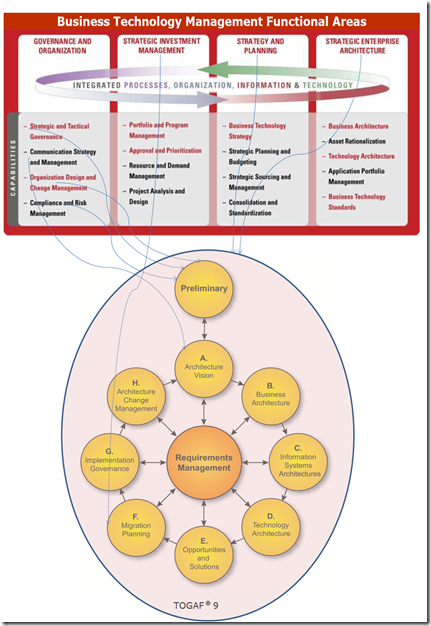
image
Business Technology Management addresses four critical dimensions of enterprise-wide strategy
1. Process
This first dimension refers to the institution of a set of robust, flexible and repeatable processes, broadly defined as:
General quality of Business Practice: Doing the right things
Efficiency: Doing things efficiently, quickly with little redundancy
Effectiveness: Doing things well
The TOGAF® 9 ADM is an example of such processes with its associated governance framework.
2. Organisation
Management processes are more likely to succeed when it refers to the establishment of appropriate organisational structures, establishing a structure in which every member understands the scope and responsibilities of his or her role, and decision rights. Something perfectly addressed during the Phases Preliminary and A of TOGAF®.
Organizational structures may include
· Participative bodies involving senior level business and technology participants on a part-time but routine basis (e.g. Business Technology Investment Board). TOGAF® suggests the creation of an architecture board who participate with the key business stakeholders.
· Centralized bodies requiring specialized dedicated technology staff (e.g. PMO).
· Need-based bodies involving rotational assignments dealing with particular efforts (e.g. PMO, Project Management teams).
Both last bodies would be identified during Phase F: Migration Planning and Phase G: Implementation Governance
3. Information
Valid, effective, timely provision of information is a prerequisite in effective decision making. Information must be delivered in a way that is comprehensible to non specialists as well. Data and metrics must be available. This would be addressed by the Communication Plan defined in the TOGAF® Architecture Vision’s phase taking into account the stakeholders needs, the communication mechanisms and timetable. Measurements and metrics may be included for strategic and operational objectives.
4. Technology
Effective technology can help connect the other three dimensions. The idea is that technology plays a vital role in all processes and can enable timely information sharing, improve co-ordination between members of an organisation and makes processes easier to execute. This covers automation of tasks, reporting, analytics and integration between management systems. In Enterprise Architecture, this would be covered by the interoperability requirements identified by the business and the identification of appropriate solutions in the TOGAF® Phases E and F, such as BPM suites and BI products.

Business Technology Management (BTM) Capabilities
A BTM capability is defined as a competency achieved by combining each of the above dimensions and creating repeatable management processes that are executed with the appropriate organizational structures, using an effective information architecture.
Business Technology Management defines 17 of these specific capabilities, each grouped into one of four functional areas.
Governance and Organisation:  These capabilities are focused on the enterprise’s CIO and business executives concerned with enterprise wide governance of business technology. It ensures that business technology decisions are effectively identified and executed, meet the needs of the business, manages the risk and give proper consideration to regulatory, legal and industry requirements. TOGAF® addresses all of this in the Preliminary Phase and the Architecture Vision, where an enterprise architecture governance framework is created.
Managing Technology Investments : This sits with PMO and business executives who are concerned with the selection and execution of the right business technologies initiatives and fulfil their objectives. The enterprise understands its current IT capabilities, what is currently available and what it is working on for the future. This is equally addressed during the Phase F: Migration Planning.
Strategy & Planning: These capabilities ensure that the CIO and business executives make the most appropriate moves to synchronise technology and business, both reducing complexity and planning for future developments. Enterprise Architecture and TOGAF 9 undoubtedly support these capabilities; you may refer to the previous article “How Strategic Planning relates to Enterprise Architecture”.
Strategic Enterprise Architecture: This capability must be developed to support this functional area, ensure that appropriate information and documentation exists that can describe current and future business technology environment within the enterprise. As we observed, TOGAF® as an Enterprise Architecture framework includes most of the capabilities mentioned above!
The BTM Maturity Model
A maturity model describes how well an enterprise performs a particular set of activities. These capabilities are useless without a method by which to measure their effectiveness. The BTM Maturity model is aligned with the de-facto standard from CMMi and use the five levels of maturity of all the four dimensions. Here again the Architecture Capability Maturity Model from TOGAF® 9 may be used to evaluate these capacities. We would identify the area most in need for improvement.
Level 1: enterprises execute some strategic business technology management processes in ad-hoc way. These enterprises typically manage processes in a simple task-based manner.
Level 2: enterprises attempt to assemble information for major decisions, and refer to IT on decisions for technology implications.

Level 3:
enterprises are ‘functional’ in BTM.

Level 4:
enterprises have achieved full BTM implementation. Their capabilities ensure that there is strong alignment between business and technology decision making.

Level 5:
enterprises have achieved the ‘Holy Grail’ of BTM. They are good enough to know when to change the rules to maintain strategic advantages over competitors.
To implement its business strategy, the enterprise requires particular operational capabilities as described above and clearly it appears that Business Technology Management can be supported by Enterprise Architecture. TOGAF® 9 is in reality addressing all of these 17 BTM capabilities grouped in functional areas, identified by the four dimensions and work as a management framework to clarify required enterprise business needs. Companies having implemented BTM should consider using TOGAF® 9 as the way of rightfully pursuing alignment of technology with the business and support a Business-Agile enterprise.