Have you noticed? Organizations have become initiative driven. Ten years ago enterprise architecture was topic de jour precisely because of initiative fatigue. But today there’s a huge focus again on narrow focus strategic projects and programs, because they are (perceived to be) the only way to deliver business change fast.
Architecture, especially enterprise architecture, has become yesterday’s issue – primarily, many would argue because it failed to deliver the promised business agility. Challenging for the same mindshare but at the other end of the spectrum are Agile software development methods that bring an almost religious zeal to rapid delivery by concentrating responsibility on self-managing, cross functional teams. Don’t get me wrong, narrow focus teams are highly effective in solving complex problems that are intrinsically narrow in scope. The problem is that many enterprises are inherently complex, and well executed architecture is the only way in which complex problems can be broken down and structured in order to establish appropriately independent units of work that can be addressed in an effective manner using Agile methods.
There have been several well intentioned attempts to evolve Agile methods to be effective in an enterprise context, to deal with the inevitable complexity that goes with very large scale operations that demand high levels of regulation, governance, scalability, standard services and business processes. But these efforts are unlikely to succeed because they approach the problem through the narrow lens of the Agile methods.
At the same time we should observe that use of UML based model driven methods and tooling has not become widespread, as was once anticipated. Agile methods provide no guidance on “how” to undertake tasks and Agile practitioners by my own observation commonly reject the rigor of formal methods and tools. This single action without question limits the scalability of Agile projects making continuous change and iteration an effort intensive and lower quality activity.
Many enterprises have voted with their feet and in their use of Agile methods have adopted a hybrid approach commonly referred to as Water-Scrum-Fall. In other words, architecture, planning and requirements are undertaken in the time honored fashion, and development is executed using Agile methods, typically Scrum. In truth, Water-Scrum-Fall should be designated an Anti-Pattern because it perpetuates the inefficiencies of early phases and renders the Agile development process sub-optimal because conventional levels of requirements errors and development and test driven rework persist.
What’s happened is that Agile methods have in the main been adopted in a relatively uncritical and immature manner. It’s very noticeable that proponents of Agile methods strongly advocate adherence to the core concepts and methods, citing the transformational nature of the approach and the inherent dangers of compromise. Yet there are examples of Agile being used effectively in large scale, but these are the exception, and have usually been achieved with either, exceptional levels of skilled resources, or more probably considerable customization of method, together with high levels of structure and tooling.
One must conclude that adoption of Agile methods remains at an early stage of maturity, and that like many new ideas in many domains, will be evolved by convergence with depending and dependent practices, which themselves must also evolve.
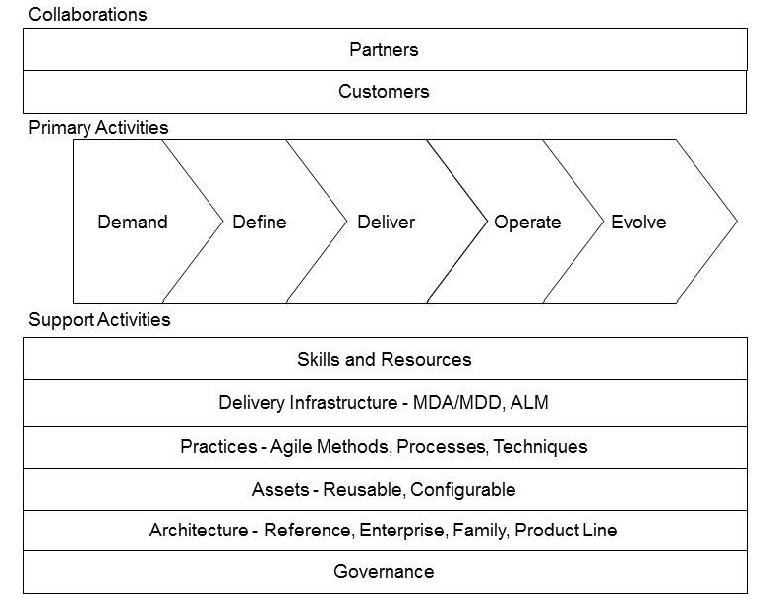
A practical way to manage this maturing process is with a value chain of the business change delivery cycle.
Whilst architecture and structured methods and tooling are important as discussed, it’s clear there’s a larger ecosystem that Agile methods must collaborate with. This collaboration cannot be approached in a casual manner, it needs to be specified in detailed processes, practices and deliverables with appropriate automation to bring high levels of discipline to the end to end delivery process. It’s time enterprises applied the same level of process change effort to the IT activity that it does to the broader business. In this business improvement process it’s also important to note that Agile concepts can be productively applied to a broader range of activity than purely software development. And as with any value chain, there’s great opportunity to organize the supporting activities and leverage common practices, methods, resources and assets.
The very pace of technology change means today’s enterprise is inevitably going to be initiative driven, but this doesn’t mean initiatives should be isolated in order to be successful – this is a path to delivering instant legacy. Rather Agile methods and concepts are effective Organizing and Management approaches, and they need to be integrated into the broader value chain, particularly architecture and life cycle automation, that delivers rapid business change.
Talk to Everware-CBDI about the Agile Enterprise Workshop. This is currently available as an in-house, intensive workshop. Public scheduled classes will hopefully follow next year.