Do You Feel Safe?

  I have been doing a lot of thinking lately about organizations, culture, leadership, and performance. Recently I spoke at the ISM conference in Las Vegas on The Elusive High Performance Organization. (And they are very elusive.) I had the good fortune to hear a number of other people speak about talent management and career […]

On value-governance

What do I mean, when I talk about ‘value-governance’ in an enterprise-architecture sense? In Enterprise Canvas, what does that ‘Value Governance’ cell represent? What do its services actually do, for the service, the organisation and the overall enterprise? This one’s for

Socially Developed Architecture

One of the most challenging aspects in our role as architects is that we often have to influence without direct authority.   We often wrestle with this fact as we may not have the managerial clout and there may be lack of clarity on what precisely we are accountable for.    Perhaps simply stated, we have to be THE accountable party for…

Are you an Architect or an Engineer?

If you share any of my professional background and work experiences, I am sure this question must have popped in your head a few times! 

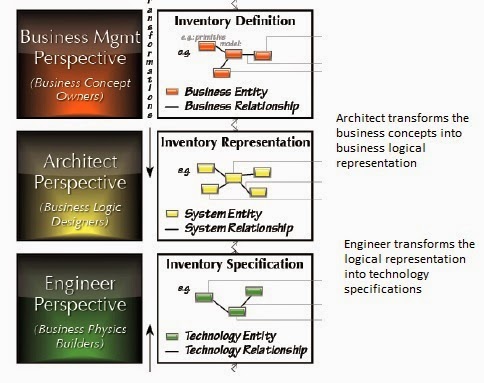
Zachman Framework clearly differentiates between the above two perspectives. As a matter of fact, Zachaman Framework clearly distinguishes between six perspectives, namely; Executive, Business Management, Architect, Engineer, Technician and the Enterprise. But I find the differentiation between Architect and Engineer perspective most interesting, probably because I started my professional life as a Software Engineer and then went onto play a range of Architect roles (Business, System, EA etc.) over the last fifteen years. 

I probably can recollect a dozen instances where these roles overlapped and can also recollect may be another dozen when there was a gap between the two. That probably is more a comment on the Operating Model issues! Referring back to Zachman Framework’s definitions, the two perspectives are defined as below;
Architect and Engineer Perspectives – in Zachman Framework
All Copyrights with Zachman International
The Architecture Perspective is about the Business Logic Designers. People who manage this perspective, namely Architect role profile works closely with Business Managers to understand the key business concepts and then turn them into representations. Zachman actually names them as System Entity and System Relationship representations. The Engineer Perspective is about as Zachman calls it, Business Physics Builders. In other words, Engineers work closely with Architects to turn System representations into Technology Specifications. Zachman actually uses an example of Technology Entity Relationship specifications.


TOGAF though defines Architect roles well; it probably does not clearly differentiate between an Architect and an Engineer at a role profile level. But it does offer a good methodical (as you can expect from TOGAF) and well defined classification of view; namely, Business Architecture View, Data Architecture View, Software Engineering View, System Engineering View and so on. In my opinion that works well too as with these views an organisation can then map roles, responsibilities of Architects and Engineers onto its operating model. 

While many readers of this blog may or may not agree with precise definitions, I think this is still a good enough framework for us to start building operating model constructs around how best do Architects work with Engineers? Or vice versa! In some organisation they may be played by single role profile, in large environments it may be spread across say two or three role profiles. In an outsourced environment, Architect role may still be part of the retained IT staff and Engineers (or Engineering Services) may be procured from suppliers. I suppose, individual organisational operating model will dictate the specifics on these.


What is your experience in your organisation? How do architects work with engineers in your organisation?

References and additional reading: 


Are you an Architect or an Engineer?

If you share any of my professional background and work experiences, I am sure this question must have popped in your head a few times! 

Zachman Framework clearly differentiates between the above two perspectives. As a matter of fact, Zachaman Framework clearly distinguishes between six perspectives, namely; Executive, Business Management, Architect, Engineer, Technician and the Enterprise. But I find the differentiation between Architect and Engineer perspective most interesting, probably because I started my professional life as a Software Engineer and then went onto play a range of Architect roles (Business, System, EA etc.) over the last fifteen years. 

I probably can recollect a dozen instances where these roles overlapped and can also recollect may be another dozen when there was a gap between the two. That probably is more a comment on the Operating Model issues! Referring back to Zachman Framework’s definitions, the two perspectives are defined as below;
Architect and Engineer Perspectives – in Zachman Framework
All Copyrights with Zachman International
The Architecture Perspective is about the Business Logic Designers. People who manage this perspective, namely Architect role profile works closely with Business Managers to understand the key business concepts and then turn them into representations. Zachman actually names them as System Entity and System Relationship representations. The Engineer Perspective is about as Zachman calls it, Business Physics Builders. In other words, Engineers work closely with Architects to turn System representations into Technology Specifications. Zachman actually uses an example of Technology Entity Relationship specifications.


TOGAF though defines Architect roles well; it probably does not clearly differentiate between an Architect and an Engineer at a role profile level. But it does offer a good methodical (as you can expect from TOGAF) and well defined classification of view; namely, Business Architecture View, Data Architecture View, Software Engineering View, System Engineering View and so on. In my opinion that works well too as with these views an organisation can then map roles, responsibilities of Architects and Engineers onto its operating model. 

While many readers of this blog may or may not agree with precise definitions, I think this is still a good enough framework for us to start building operating model constructs around how best do Architects work with Engineers? Or vice versa! In some organisation they may be played by single role profile, in large environments it may be spread across say two or three role profiles. In an outsourced environment, Architect role may still be part of the retained IT staff and Engineers (or Engineering Services) may be procured from suppliers. I suppose, individual organisational operating model will dictate the specifics on these.


What is your experience in your organisation? How do architects work with engineers in your organisation?

References and additional reading: 


Enterprise Architecture Approach in an HE Institution: 10 Practical Steps

What’s particular about doing EA in a research-intensive HE Institution like the University of Bristol? For one thing the HE sector has some interesting dichotomies to grapple with such as the dual activities of a University like Bristol of both research and education. In a sense we are two businesses: the business of conducting research […]

Enterprise Architecture Approach in an HE Institution: 10 Practical Steps

What’s particular about doing EA in a research-intensive HE Institution like the University of Bristol? For one thing the HE sector has some interesting dichotomies to grapple with such as the dual activities of a University like Bristol of both research and education. In a sense we are two businesses: the business of conducting research […]