A practical set of EA deliverables

A question on LinkedIn recently reminded me that, as the team leader for Segment Architecture in my former EA team, I was accountable for identifying a core set of deliverables for the team.  The idea was that we could focus on defining standard formats and contents for these deliverables and, in doing so, we could start to measure both our output and our quality.

We only created  pre-canned templates for a few of them.  This is partly because the team was not mature enough in its practices to get consistency, and partly because Enterprise Architecture itself is not mature, or accepted, enough to have stakeholders that would notice if our deliverables meet an objective standard.  Also this list is not intended to be comprehensive.  The goal was to describe deliverables where it may possibly make sense to go for some level of consistency.  Any EA could (and often did) create deliverables that were not on the list.

Perhaps it is time to share what we came up with. 

Note that this list is the result of a single team doing its work, and is not representative of any “standards” effort across other EA groups.  That said, I stand beside this list.  I think it is a useful start.  Note that many are technical in nature.  I did not, in making this list, differentiate between BA and EITA deliverables.  So if you are someone who believes that EA = BA + EITA, then you will see both sets of deliverables, intermixed, in the list below.  If you are someone offended by the inclusion of technical architecture deliverables in an EA list… tough.  I was working with reality.

Deliverable name

Why create it

Description

Architectural Point of View (or Technical Policy)

Provide clear input to Business or IT leadership on issues relevant to Enterprise Architecture

Short document describing a problem that requires attention and the opinion of EA for solving it.

Architectural Reference Model (or Architectural Pattern)

Provide clear input to IT project SMEs on optimal or preferable design options

Short document describing a set of concerns and a proven approach for addressing them

<Segment> Current State Model and Analysis

To demonstrate and communicate challenges inherent in current processes / systems / information

A collection of architectural models, including a context model, process models, and information models, as understood to currently exist , plus an analysis of issues and risks

<segment> Future State Vision and Model

To demonstrate the design of the future processes / systems / information needed by strategic intent.

A collection of architectural models that reflect a specific set of engineered changes

Governance Model and Analysis

Clarify roles and responsibilities and decision making processes for planning and oversight of initiatives

Process model, description of roles and responsibilities, and description of deliverables needed for planning, oversight and governance, along with implementation ROI and plans

M&A Business Case & Analysis

To provide a rationale for the acquisition of a company for the purpose of improving operational effectiveness. (M&A)

The document contains rationale including Competitive Analysis, SWOT / Twos analysis, and Strategic Alternatives Analysis

System Integration Recommendations  Document

To set a vision for how key processes and systems shall be integrated into enterprise infrastructure (primarily M&A)

End to End business scenarios, Process and System Integration points, Risks and Issues for each integration concern, and an analysis of alternatives and recommendations

Value chain and operating model analysis

To clearly address gaps and strategic requirements for integrating or divesting a set of processes and/or systems (primarily M&A)

Target value chain and operating model for post-M&A future state. Mappings of key processes to or from the enterprise core diagram, and analysis of changes with the intent of composing key initiatives.

Enterprise Core Diagram

To clearly declare the processes and systems that are NOT core to the operations of the enterprise

A list of systems and processes mapped grouped into “ecosystems” that are clearly indicated as “core” and “edge” with analysis of governance

EARB Engagement Package

To demonstrate project level architectural quality to the EA Review Board

A pre-defined collection of project architectural models and artifacts.

Capability Model and Assessment

Provide clear basis for data collection for a segment

List of capabilities for a segment with assessment of capability maturity, etc.

Capability Gap Analysis

Highlight underperforming capabilities to focus investment

Map of capabilities needed by strategies, highlighting those needed investment, and listing relative and absolute program spend against each

<segment> Roadmap (a.k.a. Transition Plan)

To clarify the scope, timing, and dependencies between initiatives needed to deliver on a strategy

List of proposed initiatives and dependencies between them to deliver on strategic intent

Strategy Map and/or Balanced Scorecard

To clarify the strategies, goals, and objectives of a segment and allow for measurement and alignment

Categorized strategies, measures, and metrics for a specific timeframe and business scope

<segment> Process Model and Analysis

To clarify and build consensus on the business processes (as-is or to-be), and as input to process improvement / measurement

Models of processes, activities, information assets and system interaction points , and an analysis of opportunities to improve.

Enterprise Scenario and Analysis

To get clarity on the experience of a key stakeholder (often a customer or partner)

Textual and diagrammatic description of an experience, often with analysis to indicate opportunities

<segment> Information Model and Analysis

To improve understanding of requirements and the rationalization of design

Well-constructed information model, at one or more well-defined levels of abstraction, covering all aspects of a segment, aligned with EDM, along with an analysis of risks and issues

Platform Assessment

Capture ability of an app or platform to meet strategic needs

Collection of measurements, attributes, and mappings to an app or platform

Proof of Concept (POC) delivery

To create a design that demonstrates, and proves, an approach for solving difficult issues

A software deliverable and an architectural reference model (see above)

Record of Architectural Tradeoffs

To clearly communicate the tradeoffs made by architects on the customer’s behalf

Textual description of architectural decisions and the implications for the owner of the process / tool

Categories Uncategorized

Towards Next Practice EA

A few weeks ago, @Cybersal and I met with @snowded to talk about enterprise architecture. He showed us a graph of the Complex Space, whose two dimensions were Evidence and Consensus. Dave has since posted a version of this graph on his blog.Source: D…

Data Management 2: Subject Areas and Objects

<p class=”p1″><span class=”s1″>This is the second blog post in the Data Management series and we will dive straight in with a discussion about subject areas and (information) objects, often called Entities. We start with a high-level overview of the theory and then dive into ArchiMate modeling.</span></p><p class=”p1″><img alt=”Subject Areas and Objects. Data Management blog series” src=”http://www.bizzdesign.com/assets/BlogDocuments-2/20130524_BasvanGils/Data-management-subject-areas-objects_424x283.png” style=”width: 424px; height: 283px;” title=”Data Management blog series. Part: Subject Areas and Objects”/></p><h2 class=”p1″>Theory</h2><p class=”p1″><span class=”s1″>A subject area model is used to differentiate between areas of interest from a data/ information perspective in the organization. These are called Subject Areas. Examples of subject areas are: customer, product, and supplier. This is not a new concept; it seems that it was introduced by James Martin in his books on Information Engineering in the late 1970s/ early 1980s. </span><br/>A Subject Area typically consists of 12-20 Business Subjects. These are the key areas of interest in the business domain. Simplifying slightly from the <a href=”http://www.amazon.com/Guide-Management-Knowledge-DAMA-DMBOK-Edition/dp/1935504029/” target=”_blank”><span class=”s2″>DMBOK</span></a> best practice, we use the concept of an Entity as a synonym for a Subject.<br/>Note that in fact we are talking about Entity Types rather than Entities (see the work of <a href=”http://www.amazon.com/Data-Reality-Perspective-Perceiving-Information/dp/1935504215/” target=”_blank”><span class=”s2″>Kent</span></a> for an extensive discussion of why this distinction is important). We focus on the type level, not the instance level. For purposes of readability, we will consistently use the term Entity rather than Entity Type. The following ORM diagram illustrates this point:</p><p class=”p1″><img alt=”Entity types related by means of a fact type” class=”left” src=”http://www.bizzdesign.com/assets/BlogDocuments-2/20130524_BasvanGils/data-management-entity-types.png” style=”width: 202px; height: 110px; float: left;” title=”Two Entity Types (Person and Company) related by means of a fact type (“works for” with the inverse reading “employs”).”/>Here we see two Entity Types (Person and Company), each identified by their na,e. These are related by means of a fact type (“works for” with the inverse reading “employs”). The purple dot signifies the constraint that “each Company employs at least one Person”</p><p class=”p1”>The population of this scheme in terms of Entities is visualized by the supporting table. Here we see for example that the label “Bas” identifies an Entity of the Entitiy Type “P<span style=”font-size: 11px; line-height: 19px;”>erson”.</span><br/> </p><p class=”p1″><span class=”s1″>Business Entities are the ‘things’ we talk about in a business context. For example, the Subject Area ‘Customer’ would be decomposed in Entities such as customer, address, and purchase history, etcetera. </span><br/>One would typically make an ERD to show the relations between entities as well as constraints on these entities (for each order the customer supplies a shipping address and a billing address). This may be a bit too much at the architecture / ArchiMate level, but we should at least be able to tie in to an ERD.</p><h2 class=”p1″>Modeling</h2><p class=”p1″><span class=”s1″>In summary: we introduced and defined two concepts for information modeling that we will be using throughout this blog post series: </span></p><ul><li class=”li2″><span class=”s1″>Subject Areas, which are used to structure areas of interest from an information perspective,  for example customer, or product; and,</span></li> <li class=”li2″><span class=”s1″>Business Entities (or just short: Entities), which are the key concepts or “things” that are part of a Subject Area, e.g. for the Subject Area customer: address or purchase history;</span></li></ul><p class=”li2″><span class=”s1″>​</span>In this part we describe how these concepts could be modeled in ArchiMate. This makes it possible to integrate model support for Data Management into the overall Enterprise Architecture expressed in the ArchiMate standard. Also, tool support such as BiZZdesign’s modeling and analysis tool for Enterprise Architecture, BiZZdesign Architect, can be leveraged for Data Management.<br/><span class=”s1″ style=”font-size: 11px; line-height: 19px;”>It seems to make sense to model the Subject Area concept with the </span><span class=”s2″ style=”font-size: 11px; line-height: 19px;”><b>BusinessObject</b></span><span class=”s1″ style=”font-size: 11px; line-height: 19px;”> concept. In BiZZdesign Architect, we could add a profile to this concept so that we can distinguish them from regular </span><span class=”s2″ style=”font-size: 11px; line-height: 19px;”><b>BusinessObjects</b></span><span class=”s1″ style=”font-size: 11px; line-height: 19px;”> in the sense that they could have a different graphical shape. </span><br/><span class=”s1″ style=”font-size: 11px; line-height: 19px;”>Along the same lines: Entities should be modeled using the </span><span class=”s2″ style=”font-size: 11px; line-height: 19px;”><b>BusinessObject</b></span><span class=”s1″ style=”font-size: 11px; line-height: 19px;”> concept. This does not require any further profiles, except for cases where the model also captures other types of business objects (i.e., non-informational objects) and we want to be able to distinguish between the two types. Two challenges remain:</span></p><ol class=”ol1″><li class=”li1″><span class=”s1″>Entities have Attributes. It may be very important to be able to represent the fact that we distinguish between “first name” and “last name” rather than simply using “name”. Since ArchiMate does not have a concept for Attribute, we propose to simply use a </span><span class=”s2″><b>CompositionRelation</b></span><span class=”s1″> to decompose </span><span class=”s2″><b>BusinessObjects</b></span><span class=”s1″> into its attributes.  Domains, cardinality and optionality are not modeled at the ArchiMate level.</span></li> <li class=”li1″><span class=”s1″>Many organizations choose to explicitly model meta-data about Entities. For example: definition of the concept, relevant business rules and legislation, stewardship (as we will describe in a later posting) and so on. It seems to make sense to use the ‘</span><span class=”s2″><b>Meaning’</b></span><span class=”s1″> concept for this. However, this quickly becomes tedious and will crowd the model. Also, some meta-data is represented by the fact that </span><span class=”s2″><b>BusinessObjects</b></span><span class=”s1″> are linked to other ArchiMate concepts in the model. We will get back to the meta-data discussion in a separate post! </span></li></ol><p class=”li1″><span class=”s1″>​</span>To provide a link with the design level, it makes sense to relate Subject Areas to more detailed ERD models. To do this, we have recreated the basic Chen ER diagramming notation as a separate meta model in Architect which allows us to do the following:</p><ul><li class=”li2″><span class=”s1″>A Subject Area as modeled in the ArchiMate world </span><span class=”s3″><b>is refined in</b></span><span class=”s1″> an ERD view</span></li> <li class=”li2″><span class=”s1″>An Entity as modeled in the ArchiMate world </span><span class=”s3″><b>is equal to</b></span><span class=”s1″> an entity in an ERD view</span></li></ul><p class=”li2″><img alt=”Subject area and entity modelled in ArchiMate ” src=”http://www.bizzdesign.com/assets/BlogDocuments-2/20130524_BasvanGils/Data-management-ArchiMate-model-package_599x274.png” style=”width: 599px; height: 274px;” title=”Subject Area as modeled is refined in an ERD view in ArchiMate. An Entity is equal to an entity in an ERD view in ArchiMate”/></p><p class=”li2″><span class=”s1″>​In the next posting in this series we will describe how entities are realized in applications. As always: if you have questions or suggestions, please drop us a note. Stay tuned!</span></p>

Categories Uncategorized

NOTES – putting it into practice

How do we use an narrative approach in enterprise-transformation? What’s different about it, in real-world practice? How does it work? In the first post in this series, I introduced the core ideas for NOTES – Narrative-Oriented Transformation of Enterprise (and)

NOTES – an alternative approach for EA

If – as we’re often told – business-design is about the relationships between people, process and technology, what is it that links all of themes together? Answer: a story. Okay, yes, this is a theme I’ve explored a lot here on

June 2013 Events

One seminar (free) and several workshops (pay).Perspectives on Enterprise Architecture and Systems Thinking (EAST)14 June 2013, Central LondonThe meeting is intended for experienced practitioners of Enterprise Architecture (EA) and/or Systems Thinkin…

June 2013 Events

One seminar (free) and several workshops (pay).Perspectives on Enterprise Architecture and Systems Thinking (EAST)14 June 2013, Central LondonThe meeting is intended for experienced practitioners of Enterprise Architecture (EA) and/or Systems Thinkin…

Back to the Future with The Theory of Constraints

In so many situations today I find business people are much more savvy with IT than they used to be only 10 years ago. And while this is a fantastic advance, the result is they are MUCH more likely to dictate the solution right from the outset. I marvel at how very senior business executives are now so conversant with the specifics of application architecture, particular packages they wish to use and Cloud deployment architecture. But of course this level of direction frequently facilitates rapid action, but without full and thorough understanding of the business issues.

We know that business people should be focused on the inherent business architecture, surfacing the opportunities for common concepts and business services, business platforms, product lines and channels; identifying where standardization and differentiation is appropriate, and where partitions are relevant, all in context with the business and market  model. Get this level of architecture right and you have the chance of delivering an agile business. Get it wrong and you are in instant legacy territory!

With this interesting problem in mind I browsed my bookshelves and came across Eli Goldratt and the Theory of Constraints (ToC). There was an AH HA moment! I first came across Goldratt nearly 30 years ago; I went to one of his lectures in London and have read many of his books, but I haven’t used the ideas for a good while.

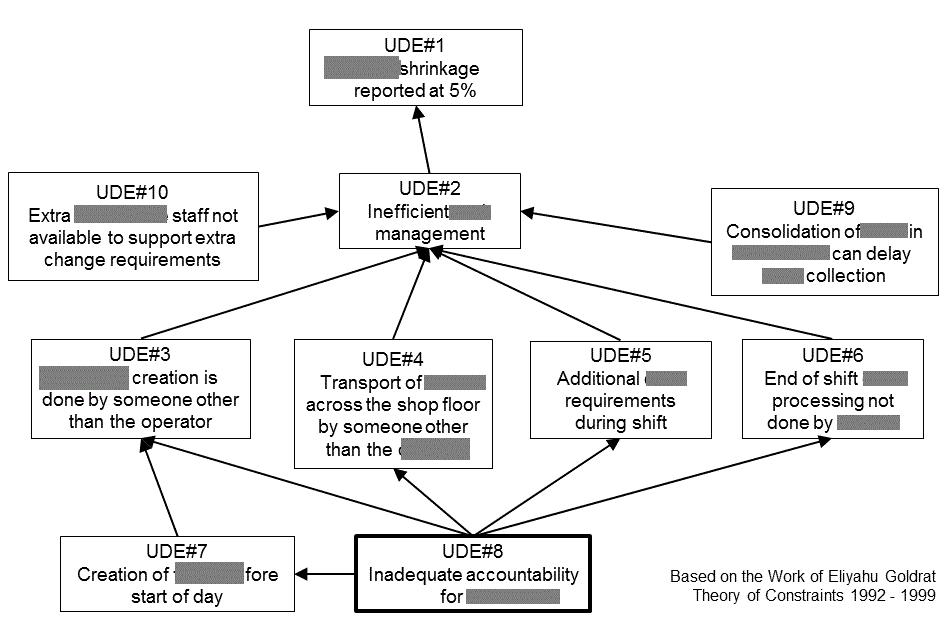
The starting point is to develop a Current Reality Tree, initially a list and then a dependency hierarchy of Undesirable Effects (UDEs) (see redacted example below). This is used to determine the root problem and then to develop a Future Reality Tree with Desired Effects (DEs). And the techniques naturally guide the user to focus on the HOW, and separate out the WHAT. In the process I insert an Ishikawa (Fishbone) diagram between the CRT and the FRT. It’s really useful in separating Domain based issues into (people, process, technology . . . ) clusters and also teasing out the root problem.

I would be interested to hear from others whether they are using ToC, or indeed if there are other techniques that do a similar job.

.