Enterprise Architecture – A Perfect Tool for Operating Model Management

On this blog I have covered the discipline of Enterprise Architecture from a number of perspectives. Enterprise Architecture (EA) can be effectively leveraged as a foundation for Industry Reference Architectures e.g. The Retail Reference Architecture. Equally effectively EA can also be leveraged as the mechanism for Business and Technology Governance as well as Technology Performance Monitoring. In this article I would like to propose that Enterprise Architecture is also an effective tool for the Operating Model management, both for the definition as well as the ongoing lifecycle management. 

It may be worthwhile visiting some industry definitions for Operating Model before we explore how Enterprise Architecture can be effective here. The definition of Operating Model varies based on the Organisational and Operational context in which it is applied and hence probably one definition may not fit all Operating Model scenarios. However if I had to choose one definition, I would like to refer to the IBM’s definition of the Operating Model (see the picture below)
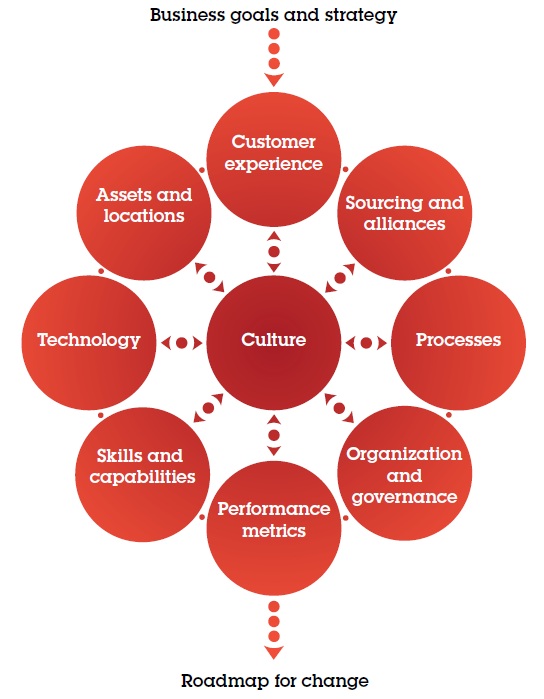
IBM Target Operating Model (TOM)

IBM proposes that a Target Operating Model (TOM) helps determine the best design and deployment of resources to achieve an organization’s business goals. It provides current operational maturity assessment and roadmap to defining and/or improving organisation’s Operations Strategy. Key deliverable include business review, current operating model assessment, desired future state and change management plan roadmap.
The TOM essentially is seen here as the mechanism to link the business goals and strategy of the organisation with the roadmap for change to achieve those goals. TOM then holds together various organisation concerns such as processes, technology, capabilities, customer view, governance and partners in a single cohesive fashion.
 
Now that we have briefly summarised an illustrative Operating Model definition, let us explore how Enterprise Architecture as a discipline or practice can be leveraged as a tool for its management. There are a number of good Enterprise Architecture Frameworks available for this purpose and recent revisions of certain frameworks have further established them as leading candidates for this purpose. I do not advocate or support a specific Enterprise Architecture Framework on this blog however for illustration purposes I am going to be using the TOGAF 9 as the tool for Operating Model Management. I would like to also mention the Zachman EA framework as the other leading framework which may be equally effective or in some application scenarios it may be a better fit. 


The purpose of this article is not to explain or define the TOGAF 9 and I would highly recommend visiting the OpenGroup website for relevant documentation. However for the ease of reference, I am going to share the TOGAF ADM which is the process for Enterprise Architecture Management in TOGAF. 
The process links the Vision and Strategy of the Organisation and its business / functions with a portfolio of change programs which realises this Strategy. TOGAF uses various architecture disciplines such as Business Architecture, Information Architecture (Data and Application) and Technology Architecture as mechanism for linking the Strategy with Implementation and Governance of Change programs to deliver on the Strategy. 
The central argument which I am now going to make is that such a process of Enterprise Architecture can be seamlessly deployed and leveraged to manage the Organisation Operating Model. A number of Enterprise Architecture Frameworks and especially Zachman categorically state that the application of Enterprise Architecture should not be restricted or limited to the Information Technology systems. It is a true framework for organisation and business management. For instance applying the TOGAF to manage the IBM TOM will result in following steps / mapping. The key here is to use tools, processes, approach, templates and constructs from each of the TOGAF ADM stage to define and develop the TOM stages as seen in figure – 1. 
  1. The business goals and strategy can be defined by the Preliminary phase while the vision underpinning this is defined in Phase A. Architecture Vision
  2. The Assets and the Locations of the TOM along with key processes can be captured and defined during the Phase B. Business Architecture
  3. Certain aspects of skills, capabilities, culture and processes too can be captured in Phase B
  4. The Technology, Processes, Performance Metrics can be captured through phases C and D while defining the Information and the Technology Architecture.
  5. The sourcing options and alliances can be identified and shortlisted in phase E. Opportunities and Solutions
  6. The phase F of migration planning can be used to identify the roadmap for change through what TOGAF calls as transition architectures
  7. Finally culture which is central to TOM needs to be constantly be a driving force as well as the recipient for the requirements for change
I would like to again highlight that this is simply an illustration of managing a view of Operating Model with a particular EA approach. However a number of other variations can be equally effectively managed by similar approach. It will probably make sense to present an illustration and mapping using other EA framework such as Zachman…may be a topic for next post on this blog!

References:

Strategy and transformation for a complex world, IBM Global Services, Mar 2011

The TOGAF Architecture Development Method (ADM)

The Zachman Framework

Discover the World’s First Technical Cloud Computing Standard… for the Second Time

Whether you are just beginning to deploy solutions in the cloud or if you already have existing cloud solutions deployed, SOCCI can be applied in terms of each organization’s different situation. Where ever you are on the spectrum of cloud adoption, the standard offers a well-defined set of architecture building blocks with specific roles outlined in detail. Continue reading

Data Protection Today and What’s Needed Tomorrow

Technology today allows thieves to copy sensitive data, leaving the original in place and thus avoiding detection. Published in October 2012, the Jericho Forum® Data Protection white paper reviews the state of data protection today and where it should be heading to meet tomorrow’s business needs. Continue reading

The Planning Paradox

One of my uncle’s favorite jokes goes like this:

Greg: “Hey Gabriel, say to me ‘what’s the most important thing about humor?’”

Gabriel: “Okay Greg, what’s the mo-“

Greg: “Timing.”

[At this point, you’re supposed to laugh]

“Timing” is the most important thing to business strategy planning

As it turns out, timing is also the most important thing to support business performance management in terms of managing scorecards and synchronizing them with their project portfolios across a company.

Organizational Hierarchy Strategy Alignment. Organizational Hierarchy Strategy Alignment is the linkage between organization’s scorecards and budgets based on an organization’s hierarchy. The head of an organization’s scorecard and budget links to its children’s organizational scorecards and budgets forming a pyramid-like structure of strategy alignment like the illustration below.

Organizational Hierarchy

Value Stream Strategy Alignment. From a business strategy perspective, there are two types of organizations in a company; Business Organizations and Support Organizations. A Business Organization is an organization that is responsible for a product with scorecard KPIs related to market share, revenue and customer satisfaction.. All other organizations in a company are Support Organizations with scorecard KPIs related to cost, productivity, quality and risk. Business Strategy is set by the Business Organizations and Support Organizations mobilize to enable them, ideally in a sequential flow based on the Product’s value stream (aka core value stream, value chain and operating model). That is, organizations that deliver a product define their scorecards to express what success look like normally using KPIs like “units delivered”, “revenue received”, “customer satisfaction”. Then, working back up the value stream, Support Organizations determine how to sell the product to hit the desired success targets set by the deliver organization. Then, Support Organizations that market the product define KPIs on their scorecards to express what success looks like to hit the sale’s organization’s KPI Targets. Of course, not all processes are directly involved in the core value stream. Support Organizations that support customers, invoice/bill customers, hire people, manage partners, etc all have an enabling/support role and should work back from the core value stream process to determine what their success looks like based on the organization’s processes that they support. Here’s an illustration of a business strategy cascaded via value streams.

Value Stream Cascade 


The Planning Paradox

More common than you think, organization’s use a planning schedule to arrive at organizational scorecards and budgets that starts at the top of an organizational hierarchy and flows down from there. The problem is that organizations are rarely organized by value streams. In situations where the Business Organization is a sibling organization to Support Organizations, they both have to produce their scorecards and budgets at the same time forcing Support Organizations to scramble to discover the Business Organization’s strategy to then set their own scorecard for success and the budget necessary to achieve it. Even further, there are times when Business Organization functions report to Support Organizations forcing the Support Organization scorecards and budgets to be set before the Business Organization can declare what they need to be successful. In my experience, this situation causes several intense activities in brief stints that ultimately result in a undocumented alignment of business strategy leaving open the possibility of gaps, overlaps and conflicts in plans to execute the business’ strategy.

To add to the problem, it’s also worth mentioning these challenges posed when business strategy is poorly aligned:

  • Lack of ability to perform impact analysis to make upstream groups aware of dependent projects slipping/failing to set expectations
  • 60% of Organizations don’t map Organizational Scorecard KPIs to funded projects *
  • 66% of HR and IT organizations have no link to the business strategy *
  • 70% of middle manager’s and 90% front-line employee’s compensation not linked to the business’ strategy *
  • 95% of employees in most organizations do not understand their business’ strategy *

* Harvard Business School, 2006, “The Office of Strategy Management”, http://hbswk.hbs.edu/item/5269.html

Categories Uncategorized

The Planning Paradox

One of my uncle’s favorite jokes goes like this: Greg: “Hey Gabriel, say to me ‘what’s the most important thing about humor?’” Gabriel: “Okay Greg, what’s the mo-“ Greg: “Timing.” [At this point, you’re supposed to laugh] “Timing” is the most important thing to business strategy planning As it turns out, timing is also the…

Metaframeworks in practice, Part 4: Context-space mapping and SCAN

What generic base-frameworks or base-metaframeworks do we need, to support sensemaking and decision-making across the full scope of enterprise-architectures? How do we create those frameworks in real-world practice? This is the fourth of five worked-examples of metaframeworks in practice – on how

The Cloud Infrastructure for Next-Generation – Big Data Computing

The device ecosystem is growing faster with the ready availability of gadgets for personal and professional use. The application landscape is on the climb with the addition of Cloud, social, mobile and sensor services. Amongst the most captivating technologies, the Cloud technology stands out. Continue reading

Link Collection — November 11, 2012

  • Dremel: Interactive Analysis of Web-Scale Datasets

    “Dremel is a scalable, interactive ad-hoc query system for analysis of read-only nested data. By combining multi-level execution trees and columnar data layout, it is capable of running aggregation queries over trillion-row tables in seconds. The system scales to thousands of CPUs and petabytes of data, and has thousands of users at Google. In this paper, we describe the architecture and implementation of Dremel, and explain how it complements MapReduce-based computing.”

    tags: dremel google hadoop realtime impala

  • Cloudera Impala: Real-Time Queries in Apache Hadoop, For Real | Apache Hadoop for the Enterprise | Cloudera

    “After a long period of intense engineering effort and user feedback, we are very pleased, and proud, to announce the Cloudera Impala project. This technology is a revolutionary one for Hadoop users, and we do not take that claim lightly.

    When Google published its Dremel paper in 2010, we were as inspired as the rest of the community by the technical vision to bring real-time, ad hoc query capability to Apache Hadoop, complementing traditional MapReduce batch processing. Today, we are announcing a fully functional, open-sourced codebase that delivers on that vision – and, we believe, a bit more – which we call Cloudera Impala.”

    tags: hadoop Cloudera impala

  • Obama Wins: How Chicago’s Data-Driven Campaign Triumphed | TIME.com

    “On Nov. 4, a group of senior campaign advisers agreed to describe their cutting-edge efforts with TIME on the condition that they not be named and that the information not be published until after the winner was declared. What they revealed as they pulled back the curtain was a massive data effort that helped Obama raise $1 billion, remade the process of targeting TV ads and created detailed models of swing-state voters that could be used to increase the effectiveness of everything from phone calls and door knocks to direct mailings and social media.”

    tags: obama datamining bigdata campaigns

  • Accelerating Insights in the New World of Data – The Official Microsoft Blog – Site Home – TechNet Blogs

    In-memory DB tech from Microsoft — Hekaton:

    “In-memory computing is a core element of Microsoft’s strategy to deliver a data platform that enables customers to analyze all types of data while also accelerating time to insight. Our approach to in-memory computing is to provide a complete portfolio for all application patterns, built into our existing products that enable rapid insights on any data, structured or unstructured. We’ve been delivering advanced in-memory technologies as part of SQL Server since 2010. Since then, we have shipped more than 1.5 million units to customers, making it the most pervasive data platform of its kind with in-memory technologies built in.

    Furthering Microsoft’s commitment to deliver in-memory solutions as part of our data platform, today we are introducing Project codenamed “Hekaton,” available in the next major release of SQL Server. Currently in private technology preview with a small set of customers, “Hekaton” will complete Microsoft’s portfolio of in-memory capabilities across analytics and transactional scenarios. It will provide breakthrough performance gains of up to 50 times, and because it will be built into SQL Server, customers won’t need to buy specialized hardware or software and will be able to easily migrate existing applications to benefit from the dramatic gains in performance.”

    tags: microsoft in-memory dbms

  • Answer three ‘why’ questions: Abstract thinking can make you more politically moderate

    “The researchers used techniques known to induce an abstract mindset in people, Preston said. Previous studies had shown that asking people to think broadly about a subject (with “why” rather than “how” questions, for example) makes it easier for them to look at an issue from different perspectives.
    ” ‘Why’ questions make people think more in terms of the big picture, more in terms of intentions and goals, whereas more concrete ‘how’ questions are focused on something very specific, something right in front of you, basically,” Preston said.
    Previous research showed that abstract thinking enhances creativity and open-mindedness, but this is the first study to test its power to moderate political beliefs, Preston said.”

    tags: thinking

  • Nate Silver-Led Statistics Men Crush Pundits in Election – Bloomberg

    “Silver, the computer expert who gave Obama a 90 percent chance of winning re-election, predicted on his blog, FiveThirtyEight (for the number of seats in the Electoral College), that the president would receive 51 percent of the popular vote as he called each of the 50 states, including all nine battlegrounds.”

    tags: natesilver statistics prediction elections

  • The Night A Computer Predicted The Next President : All Tech Considered : NPR

    “Some milestone moments in journalism converged 60 years ago on election night in the run between Republican Dwight D. Eisenhower and Democratic Illinois Gov. Adlai Stevenson. It was the first coast-to-coast television broadcast of a presidential election. Walter Cronkite anchored his first election night broadcast for CBS.

    And it was the first time computers were brought in to help predict the outcome. That event in 1952 helped usher in the computer age, but it wasn’t exactly love at first sight…”

    tags: elections prediction technology

  • Data is the new coal — abundant, dirty and diffic

Posted from Diigo. The rest of my favorite links are here.

How Adaptive Case Management Can Help in the Battle for Same Day Delivery

“In this article, I take a look at the latest moves by Walmart and Amazon to extend Santa’s supply chain with same-day delivery. Readers of my CMSWire article series will not be surprised that I see an important role here for case management.”

Related posts:

  1. Being Human: Why Knowledge Workers Need Adaptive Case Management How important is the human factor in driving meaningful process…
  2. Human vs. Machine: How Adaptive Case Management Helps Insurance Firms Serve Customers Have you seen the movie Real Steel? In the storyline…
  3. A Simple Plan: How Adaptive Case Management Helps Financial Institutions Overcome Challenges This is a cross-post of this month’s CMSWire article. Continuing…

Related posts brought to you by Yet Another Related Posts Plugin.

Build Upon SOA Governance to Realize Cloud Governance

When it comes to Cloud Governance, it is more than just getting the word out. We must make progress in the following areas for Cloud Governance to become real. Once these progressions are made, Cloud Governance will be positioned like SOA Governance—and it will then be just a “matter of getting the word out.” Continue reading

The Case Management Top Influencers Study: Who are the main influencers for Case Management?

This week, we are starting a series of articles, making public the results of The Case Management Top Influencers Study. Today’s article is an introduction to the study. Tomorrow we’ll describe the history of the study and why OpenText commissioned the study. A Little Background For those working with Case Management and having to make decisions about […]

Related posts:

  1. Case Study: BPM for Fuel Supply Management In a previous blog post, we cited that BPM technology…
  2. Forrester Business Process Conference: How Dynamic Case Management Helps Businesses Hit High Velocity Improvements I just returned from this year’s Forrester Business Process Conference…
  3. A Simple Plan: How Adaptive Case Management Helps Financial Institutions Overcome Challenges This is a cross-post of this month’s CMSWire article. Continuing…

Related posts brought to you by Yet Another Related Posts Plugin.