3 Ways Technology is Transforming Care Management

Guest blog by James Selden It’s no secret that the current healthcare system isn’t working. Though well-intentioned, the original model was not built for today’s complex healthcare environment where fragmentation and integration co-exist (see New Health Economy). Private practice physicians proliferated. As a result, the centralized communication needed to deliver a holistic perspective of the patient’s care that would have managed rising costs, improved patient utilization and provided optional health outcomes was never met. While […]

Don’t Let End of Life Sneak Up on You

bg outline

By: Bill Cason, CTO, Troux

Three Factors for Managing Business Critical Applications

old tech 090814According to Microsoft, “In today’s corporate environment, enterprise applications are complex, scalable, distributed, component-based, and mission-critical.”

Does this sound like something you should be managing with spreadsheets and guess work?

For most organizations in today’s digital business environment, big enterprise applications actually drive the business. Companies invest a lot of time, resources and money into business critical applications so it makes sense to take the appropriate steps to make sure these applications are providing your organization with the value and service intended and not opening you up to unnecessary risk.

I have walked into large global enterprises still using spreadsheets to track the life cycle of all of their technology, expecting to be able to stay on top of what’s current and still supported and what’s nearing the end of active support. Mismanaging this data can lead to security vulnerabilities, failure of critical processes, corporate compliance issues and much higher cost of support, yet large organizations continue to rely on a method that has proven time and time again to be dangerously error-prone.

It’s hard to argue that a manually updated spreadsheet stored on a shared drive somewhere is a smart way to protect an organization from unnecessary risk and costs. Especially when there are automated, efficient and accurate tools out there to eradicate the issue.

By understanding the current business context, security vulnerabilities and costs associated with each enterprise application (something not possible by spreadsheet alone), an organization can confidently manage the risks, expenses and resources required to ensure your end users are getting what they need and the business is seeing value.

It sounds like common sense, but the first step is simply understanding how your applications support the business – specifically how are they tied to your goals and strategies, your processes, your capabilities, your policies and your organizations? Are the intended users actually using the software? Is it providing a service or gathering virtual dust while you continue to pay money to support it?

Second we need to understand where our applications may have security vulnerabilities. Once a technology reaches end of life and goes out of manufacturer support, no more security patches will be produced, meaning defense from hackers and other outside intrusions is instantly non-existent.  

Last but not least, identify the costs of maintaining each application. We often find that the most expensive applications are those built on old unsupported technology.  They will have higher support costs, more trouble tickets, are more difficult and expensive to maintain, and often utilize older and more expensive legacy infrastructure.

Once we put all of this data in the enterprise context we can take the guess work out of managing our application end of life program, because we now know what to pay attention to and what to ignore.

Through an integration with BDNA Technopedia, the world’s largest repository of IT software and hardware information, Troux customers use our Enterprise Portfolio Management solutions to make informed decisions around planning, managing and retiring their End-of-Life application software efficiently.

Join our upcoming webinar Taking the Guesswork out of Managing the End-of-Life for Enterprise Applications Wednesday, September 10, to see a live demo with Troux and BDNA and learn how to automatically gain visibility into the entire technology asset lifecycle including End-of-Life dates for application software. 

troux and bdna

Categories Uncategorized

Our First IT Core Service Catalogue

I am very proud to announce that we have published the first version of our IT Core Service Catalogue for our university. We started this process in November 2012 and I described the approach in a post called : Introducing IT Service Management Using a Core Service Catalogue.  This post described our approach to building […]

The post Our First IT Core Service Catalogue appeared first on Enterprise Architecture in Higher Education.

Using The Open Group Standards – O-ISM3 with TOGAF®

By Jose Salamanca, UST Global, and Vicente Aceituno, Inovement In order to prevent duplication of work and maximize the value provided by the Enterprise Architecture and Information Security discipline, it is necessary to find ways to communicate and take advantage … Continue reading

Agile Governance

Last year the decision was finally made to mandate Agile across our enterprise. The decision was taken, even though there were many unanswered questions. The assumption was that forcing the migration, along with adoption of popular “enterprise Agile methods” would ensure resolution of the outstanding questions. In practice, Agile methods have been very effective in delivering specific digital business initiatives. But almost inevitably the distribution and delegation of architecture has resulted in duplication, inconsistency and increased complexity, across all project types including legacy and new projects. We are now concerned that we no longer have an effective governance capability. The question is how do we fix this without losing the undoubted benefits of Agile methods?“ Enterprise Architect, F2000 company.

Over the past few months I have heard this message over and over again. While Agile is being successful, it is increasingly in conflict with broader goals. And this is clearly becoming a major issue, manifest in increased complexity, horizon of change and coordination issues as well as inconsistent customer experience.  I am now regularly advising a practical approach to resolution by addressing from the governance perspective.

In many organizations governance is still practiced by phase or stage gate peer review, and Agile projects are forced to accommodate, which leads to WaterScrumFall or worse. But governance criteria and policies are often very weak anyway, out of date or non-existent. Consequently governance is frequently a matter of opinion and experience, highly dependent upon the experience of individual reviewers. As we all know, a basic principle of Agile methods is delegation of responsibility, and ideally we need to delegate governance to the Agile practitioners and teams. So the question is how to implement self-governance and ensure quality and consistency of governance?

I think it was an old John Cleese training film in which Cleese himself plays the part of a manager telling a subordinate that he is now empowered, and he scatters magic dust over him and shouts some magic words saying, “You are now empowered!” Clearly this isn’t any more useful than telling an Agile team that they are now self-governing! Rather we need to go back to basics and define and communicate what governance is required and provide Agile teams with guidance on what is expected.

That sounds good in theory, except that in practice no one is going to be able to accurately define all the governance requirements; certainly not in a fast changing, Agile business and technology environment; nor will Agile development teams be able to keep up with a bureaucratic regime that continually issues edicts that everyone is expected to adopt.

What’s required is a governance system that works in an Agile environment. The parameters of the Agile governance system comprise:
a) A defined Agile governance model
b) Defined principles and reference architecture that establish ways of working together with articulation of business value
c) Automation systems that progressively incorporate the principles and reference architecture into frameworks, tooling, design time platforms, deliverable profiles and knowledge management systems.
d) A Community of Interest (CoI) responsible for the governance system and communications
e) A communication system that ensures Agile projects are fully implementing the governance system, and providing at least retrospective feedback to the CoI that contributes to a common asset base as well as practice maturity.

Agile Governance Model


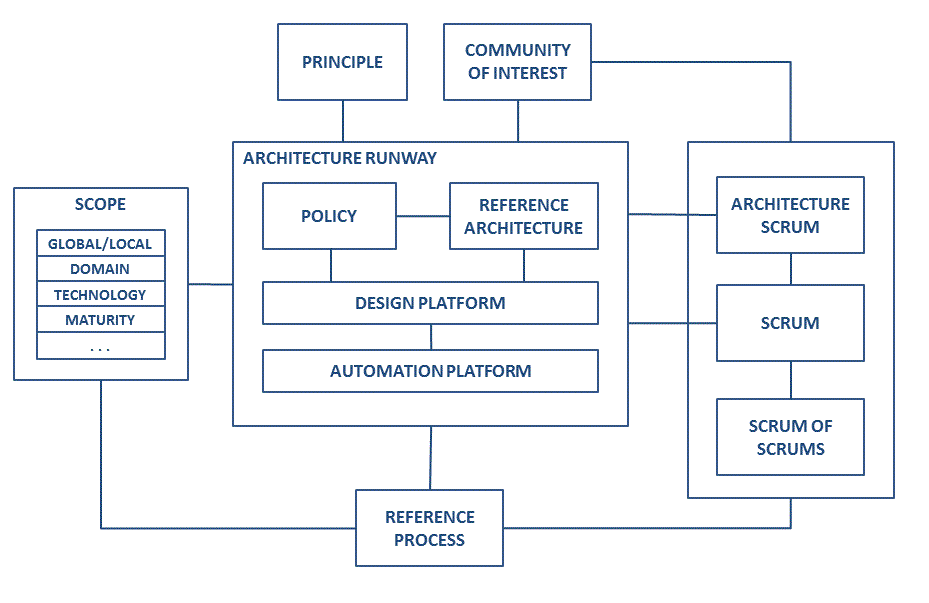
This is a much simplified Agile governance model. Key points to note are:
1. the centricity of the architecture runway, and the tight relationships between policy, reference architecture, reusable assets and the automation platform. 
2. variants guided by various dimensions of scope, which may include applicability, business or technology domain, or even the maturity of the business or technology domain to achieve compliance.
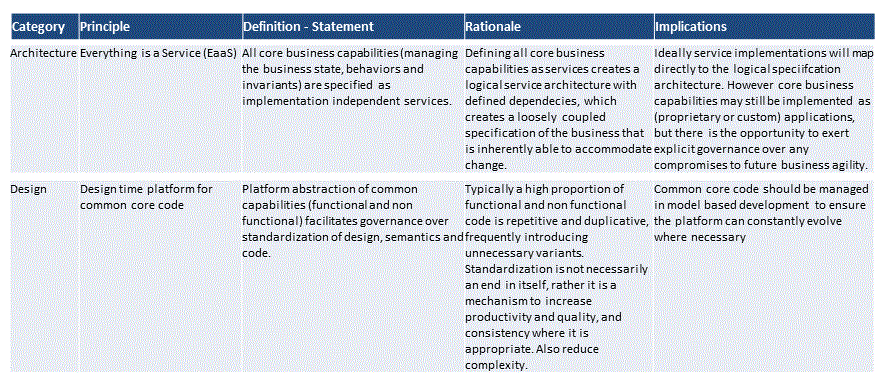
Principles  are a great place to start. Self-governance is going to be a key part of Agile governance, and if we can’t articulate and communicate what’s important then we are dead in the water. Some examples shown here:
Reference Architecture is a critical capability, defining the architecture styles and patterns and applicability. But reference architecture shouldn’t stop at models, it must be realized in code in the Design Platform – which progressively realizes the reference architecture as application level infrastructure reusable across multiple projects. The design platform is typically managed by the CoI, a collaboration of senior developers and architects that decide what should be in the platform and develop the models and code as exemplars that succeeding projects will be happy to use, customize and or extend. The design platform is therefore a critical governance tool that actively evolves, managed by the CoI and constantly challenged by project developers  to provide optimal solutions to delivering on the principles and reference architecture. As a by-product the mature design platform will also be a major productivity tool; for example in the Everware-CBDI Agile Service Factory, over 80% of the code for typical large projects will be automatically inherited from the platform.
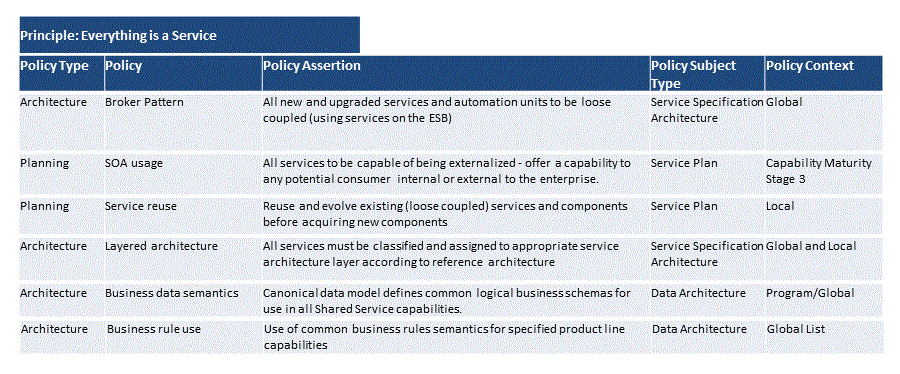
As shown Principles are generic patterns or techniques that guide strong solutions to business problems. The application of Principles is achieved by Policies. But not your father’s policies! In many (most?) organizations Policies are outdated lists of standards. In Agile governance, policies should be a context based record of how the principles and reference architecture have been realized. Like principles, policies are not mandates from senior management, they are transparent  communications of pragmatic decisions made by the CoI on the best way of delivering an optimal result in a particular context, reusing tried and tested methods supported by existing architecture and design assets. This is therefore a continuously evolving body of knowledge, specifically tailored for one enterprise’s needs. Examples below. Note in particular the Policy Context that highlights applicability and exemption.
Many Agile teams are now using the Scrum of Scrums approach to coordination of multiple projects. This is a highly effective mechanism to manage the pan-Scrum backlog. However this coordination must not be confused with architecture realization. The Community of Interest is not a Scrum of Scrums, it is a group of the most respected architects and developers who will be active practitioners in architecture and development projects, who coordinate the realization of the architecture, the models and implementing code, typically in direct response to project demand, but involving CoI members as appropriate to review, refine and contribute to improve the solution, to be optimal, generic, principle and policy compliant. The Architecture Scrum may therefore on occasions be a series of architecture specific sprints, perhaps at commencement of new programs, or in response to significant new areas of reference architecture or design platform requirement. But in momentum situations the Architecture Scrum is more likely to be integral to multiple development Scrums.  
In a generic sense, governance is concerned with ensuring the integrity of the delivered product. This requires a strong focus on the architecture and how it is realized. As many organizations are now realizing, delegation of architecture in an uncontrolled manner is high risk. The approach outlined actually encourages delegation of architecture but to a coordinating body, the CoI, which itself is charged with supporting project demands and broader organizational objectives. But the approach outlined also recognizes that there needs to be explicit documentation of architecture principles and policies and their application in order to allow communication and review, and justification of business value. This is a necessary level of documentation needed to communicate to the many stakeholders involved. 

Summary

Reliance on opinions expressed on a case by case basis, or architect resource involvement in projects without the backing of strong, defined reference architecture, gives programs or projects far too much discretion. Whilst we may laugh at John Cleese’s magic dust, in practice the embedding of key architectural code into the platform layer actually does make governance considerably more effective. But even if it’s incredibly effective, it’s not magic. An effective CoI comprising the very best architect and developer skills available means all projects have access to optimal solutions as well as automatic compliance. Agile governance as described in this post is therefore not an extension of Agile methods per se, rather it is a bridge between Agile methods and agile architecture that defines and ensures desired outcomes, without compromising the integrity of the Agile process. 

Agile Governance

Last year the decision was finally made to mandate Agile across our enterprise. The decision was taken, even though there were many unanswered questions. The assumption was that forcing the migration, along with adoption of popular “enterprise Agile methods” would ensure resolution of the outstanding questions. In practice, Agile methods have been very effective in delivering specific digital business initiatives. But almost inevitably the distribution and delegation of architecture has resulted in duplication, inconsistency and increased complexity, across all project types including legacy and new projects. We are now concerned that we no longer have an effective governance capability. The question is how do we fix this without losing the undoubted benefits of Agile methods?“ Enterprise Architect, F2000 company.

Over the past few months I have heard this message over and over again. While Agile is being successful, it is increasingly in conflict with broader goals. And this is clearly becoming a major issue, manifest in increased complexity, horizon of change and coordination issues as well as inconsistent customer experience.  I am now regularly advising a practical approach to resolution by addressing from the governance perspective.

In many organizations governance is still practiced by phase or stage gate peer review, and Agile projects are forced to accommodate, which leads to WaterScrumFall or worse. But governance criteria and policies are often very weak anyway, out of date or non-existent. Consequently governance is frequently a matter of opinion and experience, highly dependent upon the experience of individual reviewers. As we all know, a basic principle of Agile methods is delegation of responsibility, and ideally we need to delegate governance to the Agile practitioners and teams. So the question is how to implement self-governance and ensure quality and consistency of governance?

I think it was an old John Cleese training film in which Cleese himself plays the part of a manager telling a subordinate that he is now empowered, and he scatters magic dust over him and shouts some magic words saying, “You are now empowered!” Clearly this isn’t any more useful than telling an Agile team that they are now self-governing! Rather we need to go back to basics and define and communicate what governance is required and provide Agile teams with guidance on what is expected.

That sounds good in theory, except that in practice no one is going to be able to accurately define all the governance requirements; certainly not in a fast changing, Agile business and technology environment; nor will Agile development teams be able to keep up with a bureaucratic regime that continually issues edicts that everyone is expected to adopt.

What’s required is a governance system that works in an Agile environment. The parameters of the Agile governance system comprise:
a) A defined Agile governance model
b) Defined principles and reference architecture that establish ways of working together with articulation of business value
c) Automation systems that progressively incorporate the principles and reference architecture into frameworks, tooling, design time platforms, deliverable profiles and knowledge management systems.
d) A Community of Interest (CoI) responsible for the governance system and communications
e) A communication system that ensures Agile projects are fully implementing the governance system, and providing at least retrospective feedback to the CoI that contributes to a common asset base as well as practice maturity.

Agile Governance Model


This is a much simplified Agile governance model. Key points to note are:
1. the centricity of the architecture runway, and the tight relationships between policy, reference architecture, reusable assets and the automation platform. 
2. variants guided by various dimensions of scope, which may include applicability, business or technology domain, or even the maturity of the business or technology domain to achieve compliance.
Principles  are a great place to start. Self-governance is going to be a key part of Agile governance, and if we can’t articulate and communicate what’s important then we are dead in the water. Some examples shown here:
Reference Architecture is a critical capability, defining the architecture styles and patterns and applicability. But reference architecture shouldn’t stop at models, it must be realized in code in the Design Platform – which progressively realizes the reference architecture as application level infrastructure reusable across multiple projects. The design platform is typically managed by the CoI, a collaboration of senior developers and architects that decide what should be in the platform and develop the models and code as exemplars that succeeding projects will be happy to use, customize and or extend. The design platform is therefore a critical governance tool that actively evolves, managed by the CoI and constantly challenged by project developers  to provide optimal solutions to delivering on the principles and reference architecture. As a by-product the mature design platform will also be a major productivity tool; for example in the Everware-CBDI Agile Service Factory, over 80% of the code for typical large projects will be automatically inherited from the platform.
As shown Principles are generic patterns or techniques that guide strong solutions to business problems. The application of Principles is achieved by Policies. But not your father’s policies! In many (most?) organizations Policies are outdated lists of standards. In Agile governance, policies should be a context based record of how the principles and reference architecture have been realized. Like principles, policies are not mandates from senior management, they are transparent  communications of pragmatic decisions made by the CoI on the best way of delivering an optimal result in a particular context, reusing tried and tested methods supported by existing architecture and design assets. This is therefore a continuously evolving body of knowledge, specifically tailored for one enterprise’s needs. Examples below. Note in particular the Policy Context that highlights applicability and exemption.
Many Agile teams are now using the Scrum of Scrums approach to coordination of multiple projects. This is a highly effective mechanism to manage the pan-Scrum backlog. However this coordination must not be confused with architecture realization. The Community of Interest is not a Scrum of Scrums, it is a group of the most respected architects and developers who will be active practitioners in architecture and development projects, who coordinate the realization of the architecture, the models and implementing code, typically in direct response to project demand, but involving CoI members as appropriate to review, refine and contribute to improve the solution, to be optimal, generic, principle and policy compliant. The Architecture Scrum may therefore on occasions be a series of architecture specific sprints, perhaps at commencement of new programs, or in response to significant new areas of reference architecture or design platform requirement. But in momentum situations the Architecture Scrum is more likely to be integral to multiple development Scrums.  
In a generic sense, governance is concerned with ensuring the integrity of the delivered product. This requires a strong focus on the architecture and how it is realized. As many organizations are now realizing, delegation of architecture in an uncontrolled manner is high risk. The approach outlined actually encourages delegation of architecture but to a coordinating body, the CoI, which itself is charged with supporting project demands and broader organizational objectives. But the approach outlined also recognizes that there needs to be explicit documentation of architecture principles and policies and their application in order to allow communication and review, and justification of business value. This is a necessary level of documentation needed to communicate to the many stakeholders involved. 

Summary

Reliance on opinions expressed on a case by case basis, or architect resource involvement in projects without the backing of strong, defined reference architecture, gives programs or projects far too much discretion. Whilst we may laugh at John Cleese’s magic dust, in practice the embedding of key architectural code into the platform layer actually does make governance considerably more effective. But even if it’s incredibly effective, it’s not magic. An effective CoI comprising the very best architect and developer skills available means all projects have access to optimal solutions as well as automatic compliance. Agile governance as described in this post is therefore not an extension of Agile methods per se, rather it is a bridge between Agile methods and agile architecture that defines and ensures desired outcomes, without compromising the integrity of the Agile process. 

Does the EA’s Wardrobe Matter?

A slightly humorous post on fashion and enterprise architecture. On two separate occasions I’ve been privy to conversations among enterprise architects discussing fashion. That’s right; grizzled veterans (guys) of the business world musing over what to wear. It was like an episode of “Say Yes to the Dress” gone bad. It started with Mike Walker mentioning this […]

Personal Learning Plans Support Employee Retention

I have been a strong advocate of implementing Personal Learning Plans (PLP) for employees for years.  This concept was introduced to me during my years working at the British Columbia Institute of Technology.  I used the Personal Learning Plan process to help my teams improve their abilities in the jobs they have and to advance their […]

The post Personal Learning Plans Support Employee Retention appeared first on Enterprise Architecture in Higher Education.

How Are You Managing Total Digitization?

Since the 2008 economic recession, companies have looked to innovation to fuel growth. You see this in the wide range of digital investments for everything from mobile apps to business processes to financial products. This has led to a significant increase in spending on digitization, but it’s often not managed as a whole. In an […]

US Regional, Metropolitan Area Public Sector “Open Data” Synergies, Opportunities, Challenges

Current dialogue among the leadership and constituents of the Federal, Washington
DC, Maryland and Virginia (DMV) regional “Open Data” government
community have shed new light on the challenges and opportunities that
individual jurisdictions face (not just around DC), in establishing Open
Data capabilities and services – both public-facing, and as part of the
inward-facing “information sharing” context within their own agencies. 
Open Data is also a very different conversation, when held at a purely
local level, vs. statewide or across an entire metropolitan region.